Mississippi Jury Instruction - Tortious Inference of Business Relations
About this form
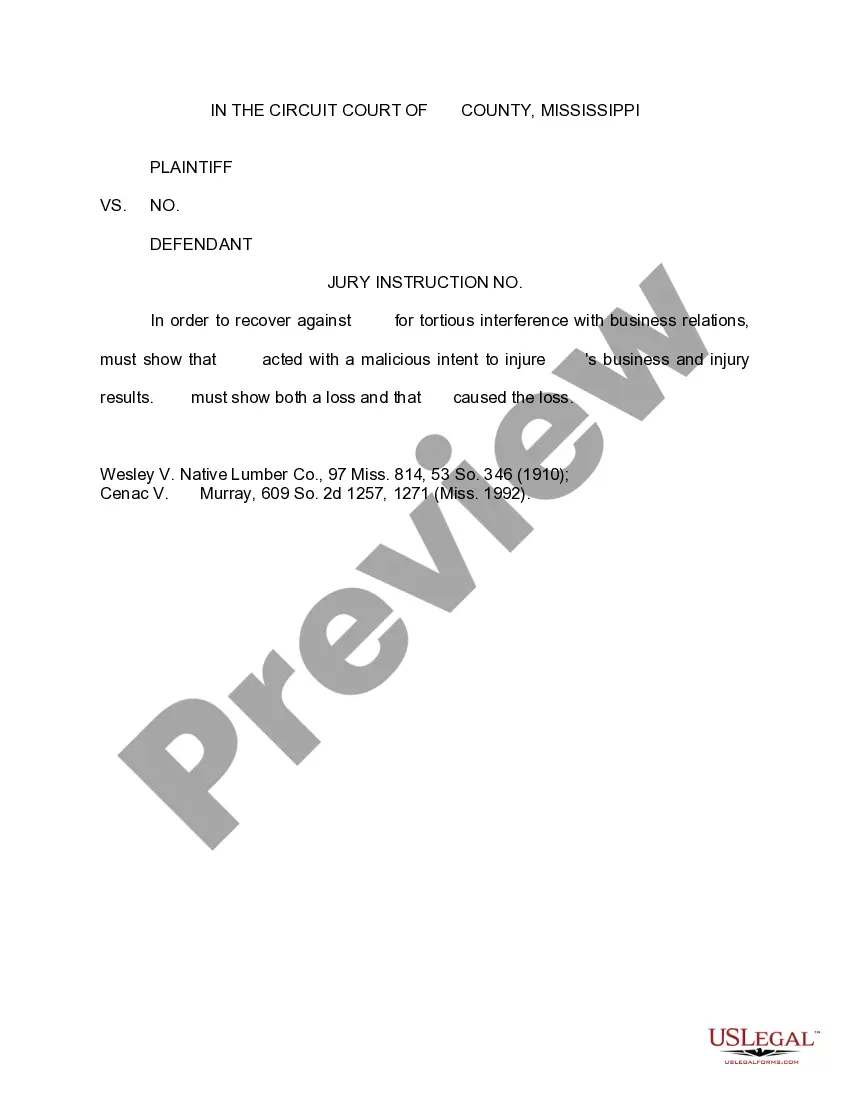
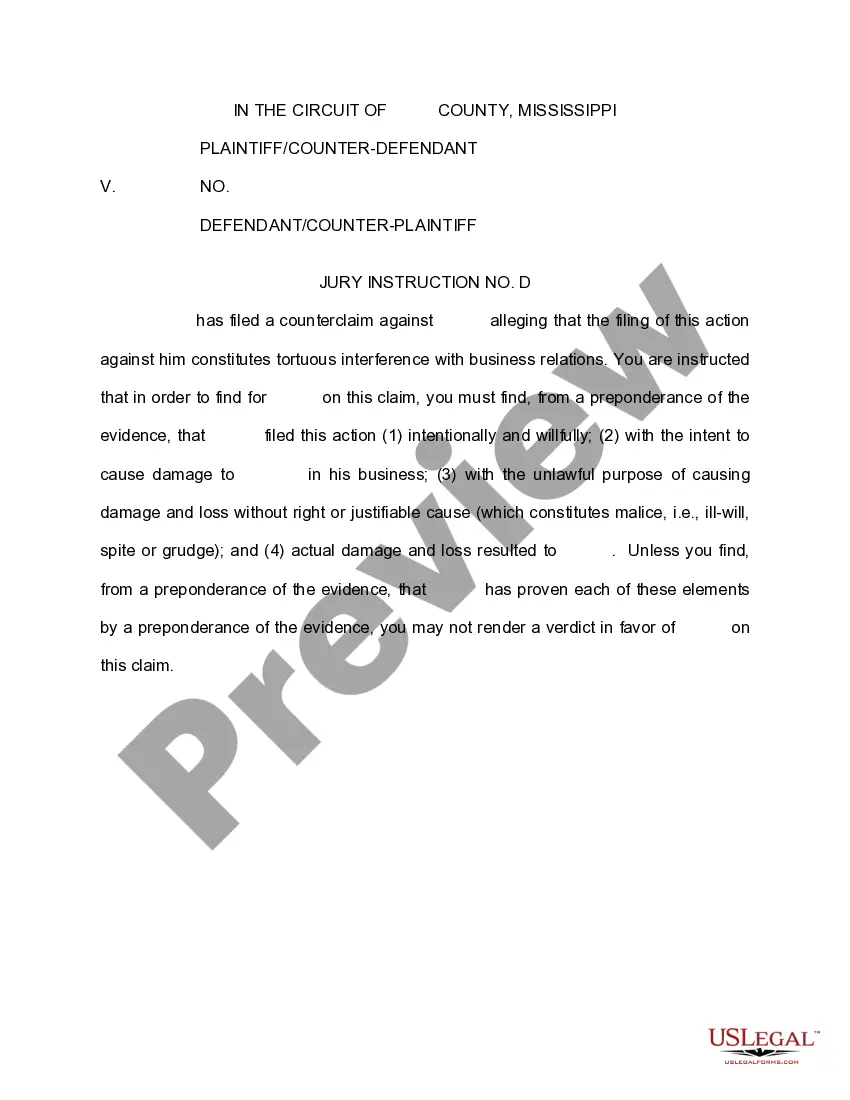
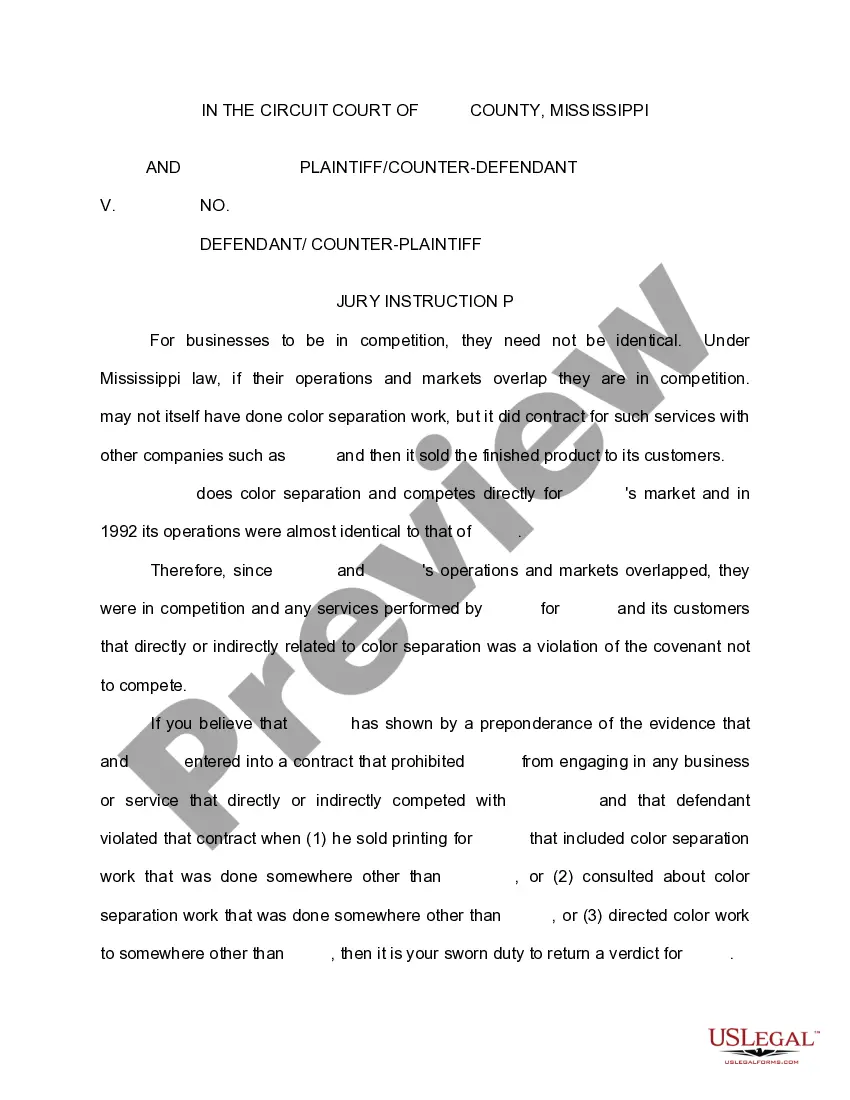
This Jury Instruction - Tortious Interference of Business Relations is a legal document used in Mississippi courtrooms. It provides clear guidance to jurors on how to evaluate claims regarding wrongful interference with business relationships. This form differs from other jury instructions by specifically addressing the requirements for proving tortious interference in commercial contexts, emphasizing the need to demonstrate malicious intent and actual loss caused by the defendant's actions.
What’s included in this form
- Identification of the plaintiff and defendant in the case.
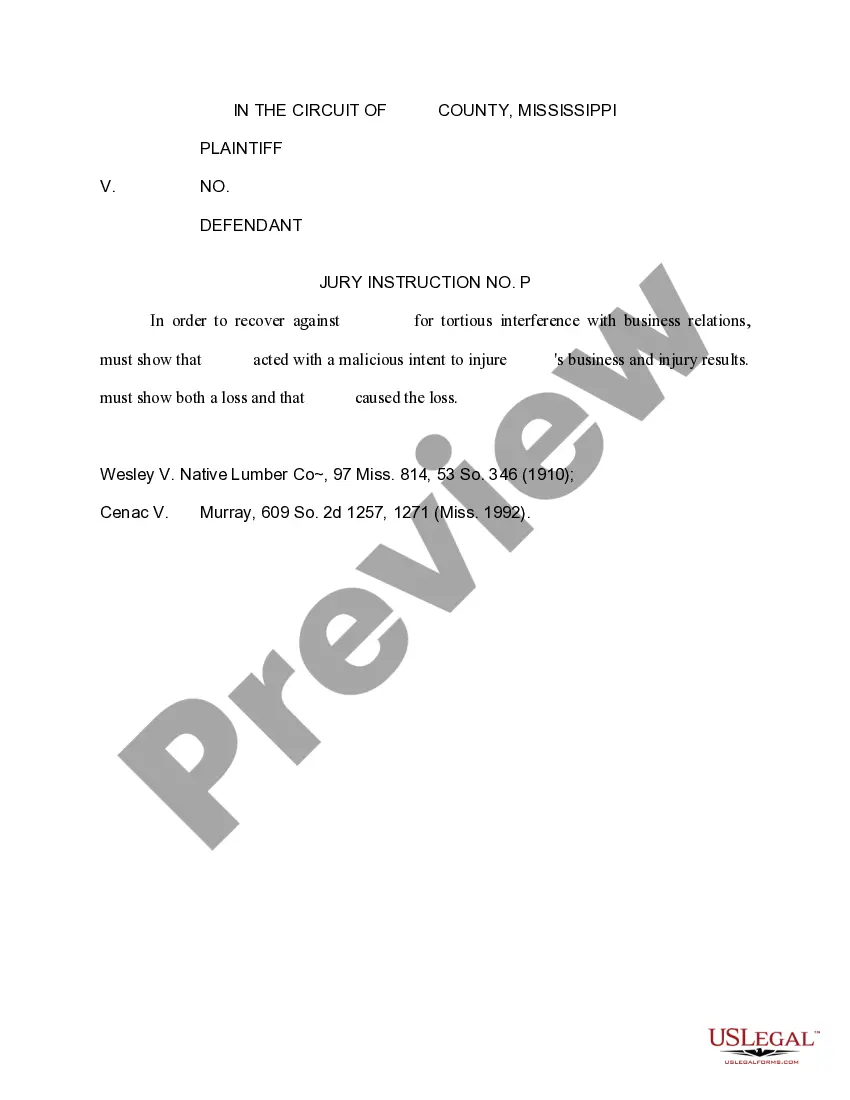
- Definition of tortious interference with business relations.
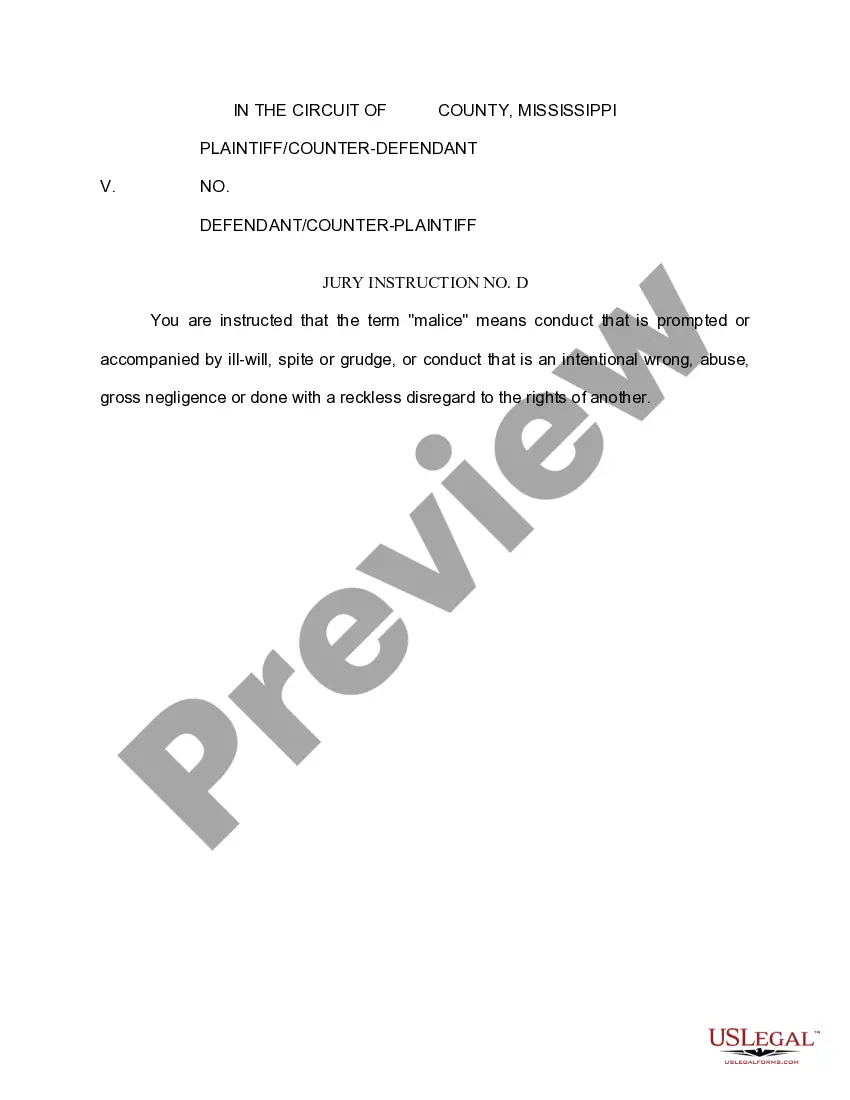
- Requirement for the plaintiff to prove malicious intent by the defendant.
- Necessity for the plaintiff to show that actual injury resulted.
- Citations of relevant case law to support the instruction.
When this form is needed
This form is used in situations where a business alleges that another party has unlawfully interfered with its economic relationships. Typical scenarios include disputes over contract breaches, competitive business practices, or scenarios where a party's actions have led to a tangible loss for a business. It is essential for attorneys to utilize this instruction when preparing for trial in Mississippi, ensuring jurors understand the legal standards they must apply.
Intended users of this form
- Attorneys representing plaintiffs in tortious interference cases.
- Legal professionals involved in business litigation.
- Court personnel responsible for jury instruction during trials.
- Individuals or businesses seeking to understand their rights regarding interference with business relations.
How to complete this form
- Identify and write down the names of the plaintiff and defendant at the beginning of the form.
- Specify the malicious actions or statements made by the defendant that are alleged to have caused harm.
- Outline the measurable losses suffered by the plaintiff due to the defendantâs interference.
- Cite relevant Mississippi case law, such as Wesley V. Native Lumber Co. and Cenac V. Murray, to support the instruction.
- Review the completed form for clarity and compliance with legal standards before submission.
Notarization requirements for this form
This form does not typically require notarization unless specified by local law. Users should review Mississippi regulations to confirm any necessity for notarization in their specific context.
Get your form ready online
Our built-in tools help you complete, sign, share, and store your documents in one place.
Make edits, fill in missing information, and update formatting in US Legal Forms—just like you would in MS Word.
Download a copy, print it, send it by email, or mail it via USPS—whatever works best for your next step.
Sign and collect signatures with our SignNow integration. Send to multiple recipients, set reminders, and more. Go Premium to unlock E-Sign.
If this form requires notarization, complete it online through a secure video call—no need to meet a notary in person or wait for an appointment.
We protect your documents and personal data by following strict security and privacy standards.
Make edits, fill in missing information, and update formatting in US Legal Forms—just like you would in MS Word.
Download a copy, print it, send it by email, or mail it via USPS—whatever works best for your next step.
Sign and collect signatures with our SignNow integration. Send to multiple recipients, set reminders, and more. Go Premium to unlock E-Sign.

If this form requires notarization, complete it online through a secure video call—no need to meet a notary in person or wait for an appointment.

We protect your documents and personal data by following strict security and privacy standards.
Mistakes to watch out for
- Failing to clearly define the actions that constitute tortious interference.
- Not providing sufficient evidence or examples of actual losses incurred.
- Using outdated or incorrect case law references.
- Neglecting to specify the intent behind the defendant's actions.
Advantages of online completion
- Immediate access to a professionally drafted form, saving time and effort.
- Ability to download and customize the form according to specific case needs.
- Easy updates to ensure compliance with the latest legal standards.
- Convenient access from any device, allowing for quick revisions when necessary.
Looking for another form?
Form popularity
FAQ
The requisite elements of tortious interference with contract claim are: (1) the existence of a valid and enforceable contract between plaintiff and another; (2) defendant's awareness of the contractual relationship; (3) defendant's intentional and unjustified inducement of a breach of the contract; (4) a subsequent
The requisite elements of tortious interference with contract claim are: (1) the existence of a valid and enforceable contract between plaintiff and another; (2) defendant's awareness of the contractual relationship; (3) defendant's intentional and unjustified inducement of a breach of the contract; (4) a subsequent
The Litigation Privilege Does Not Protect Intentional Interference with Contract. A law firm represented an employee in an action against her former employer and its principal.
To prevail on the claim, plaintiff must prove four elements: (1) that a valid contract existed, (2) that defendant had knowledge of the contract, (3) that defendant acted intentionally and improperly, and (4) that plaintiff was injured by the defendant's actions.
Tortious interference is a common law tort allowing a claim for damages against a defendant who wrongfully interferes with the plaintiff's contractual or business relationships. See also intentional interference with contractual relations.
To prevail on the claim, plaintiff must prove four elements: (1) that a valid contract existed, (2) that defendant had knowledge of the contract, (3) that defendant acted intentionally and improperly, and (4) that plaintiff was injured by the defendant's actions.
Tortious interference, also known as intentional interference with contractual relations, in the common law of torts, occurs when one person intentionally damages someone else's contractual or business relationships with a third party, causing economic harm.
A contract existed between the plaintiff and a third party; The defendant knew about the contract; The defendant engaged in conduct that prevented or hindered performance of the contract; The defendant intended this result, or knew it was likely;
Tortious interference, a common law economic tort, occurs when one party interferes with the contracts or relationships of another party with the intent of causing economic harm.