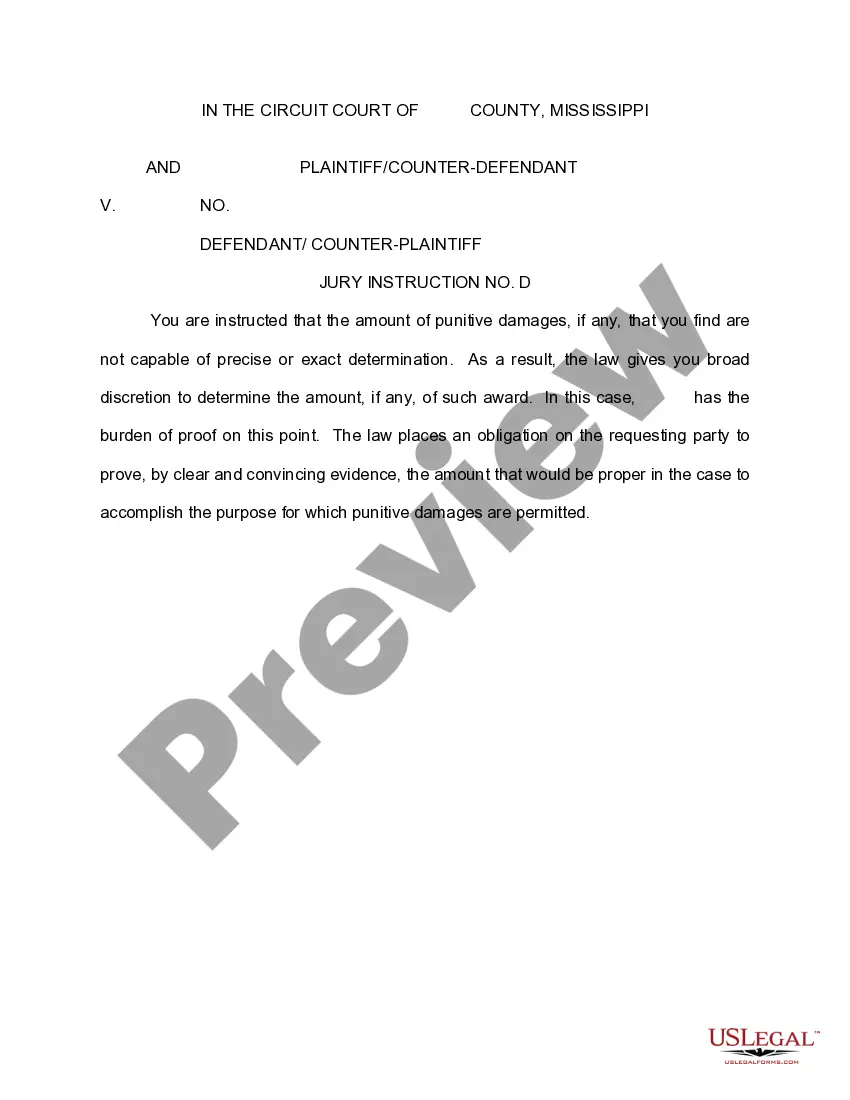
Mississippi Jury Instruction - Punitive Damages - Determination of Amount
Overview of this form
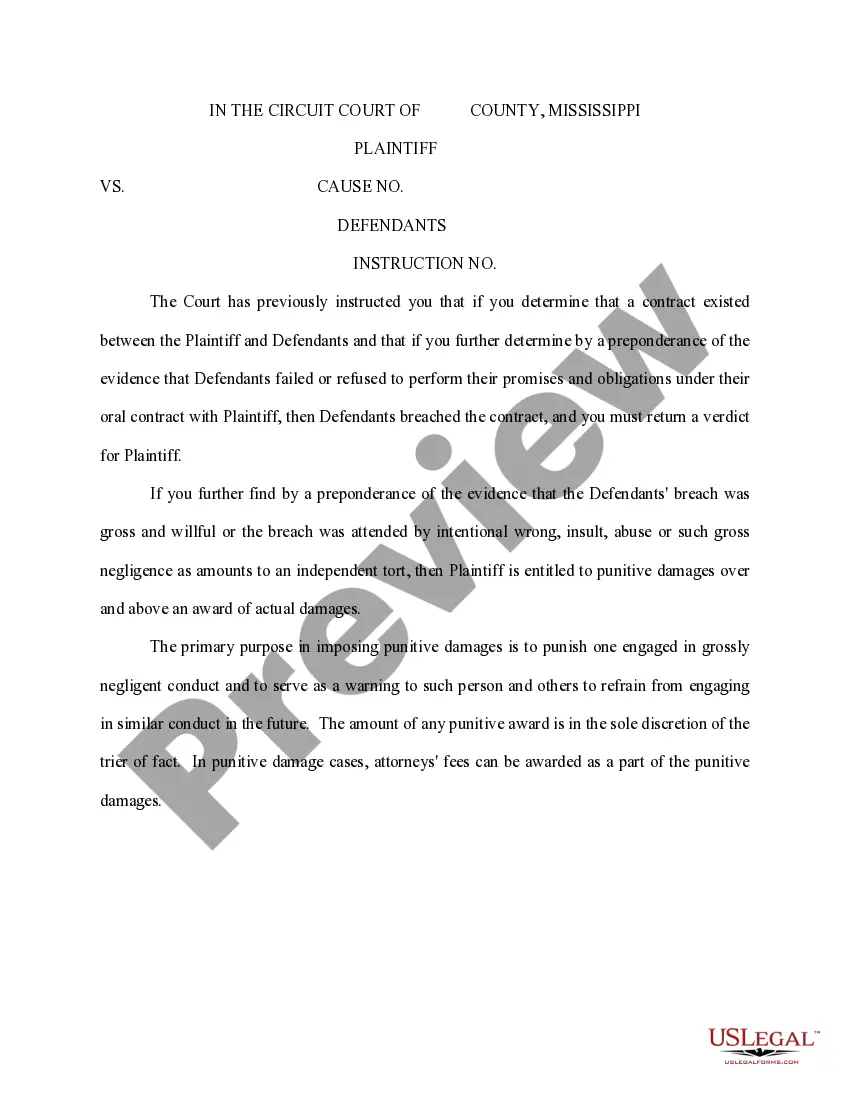
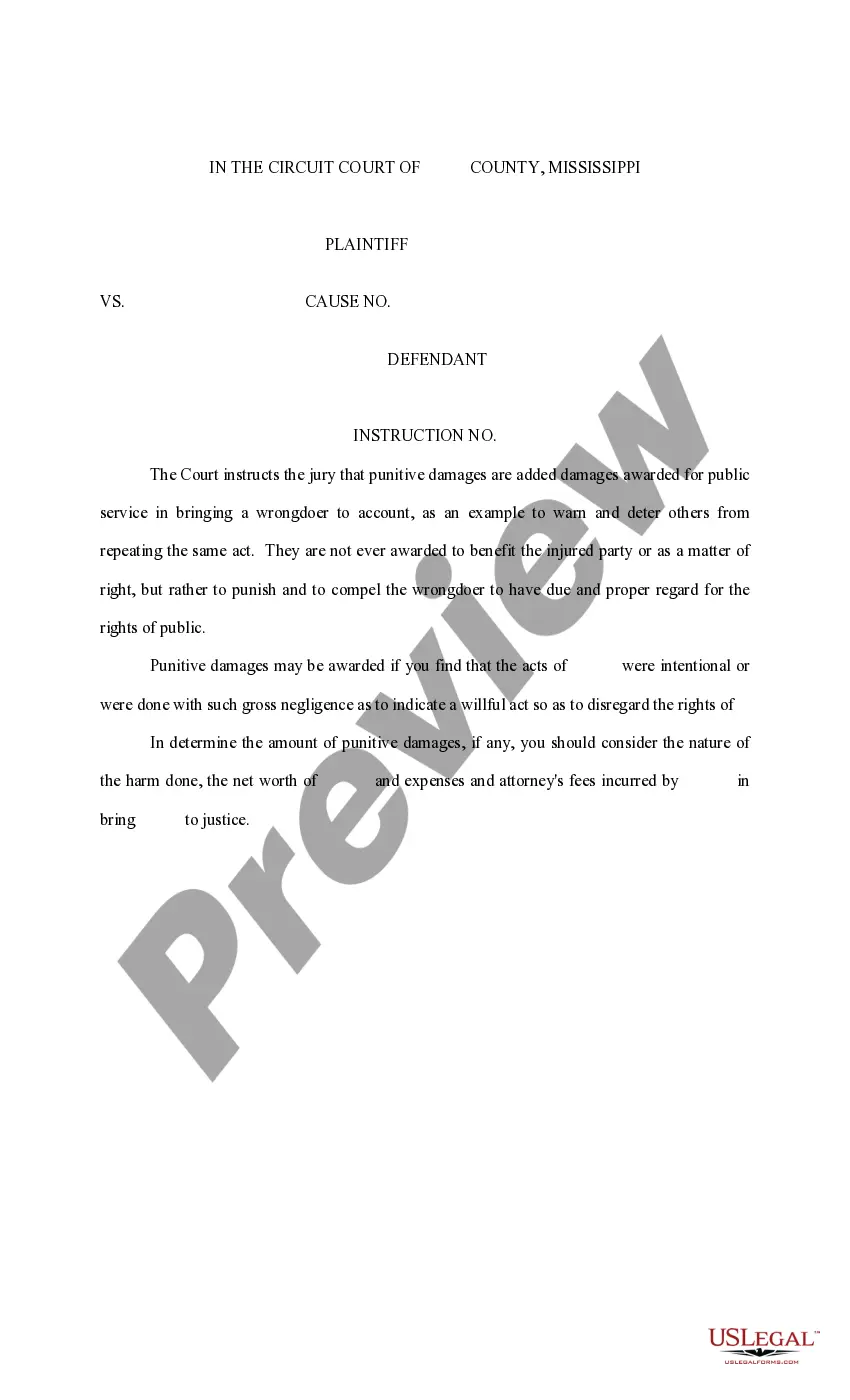
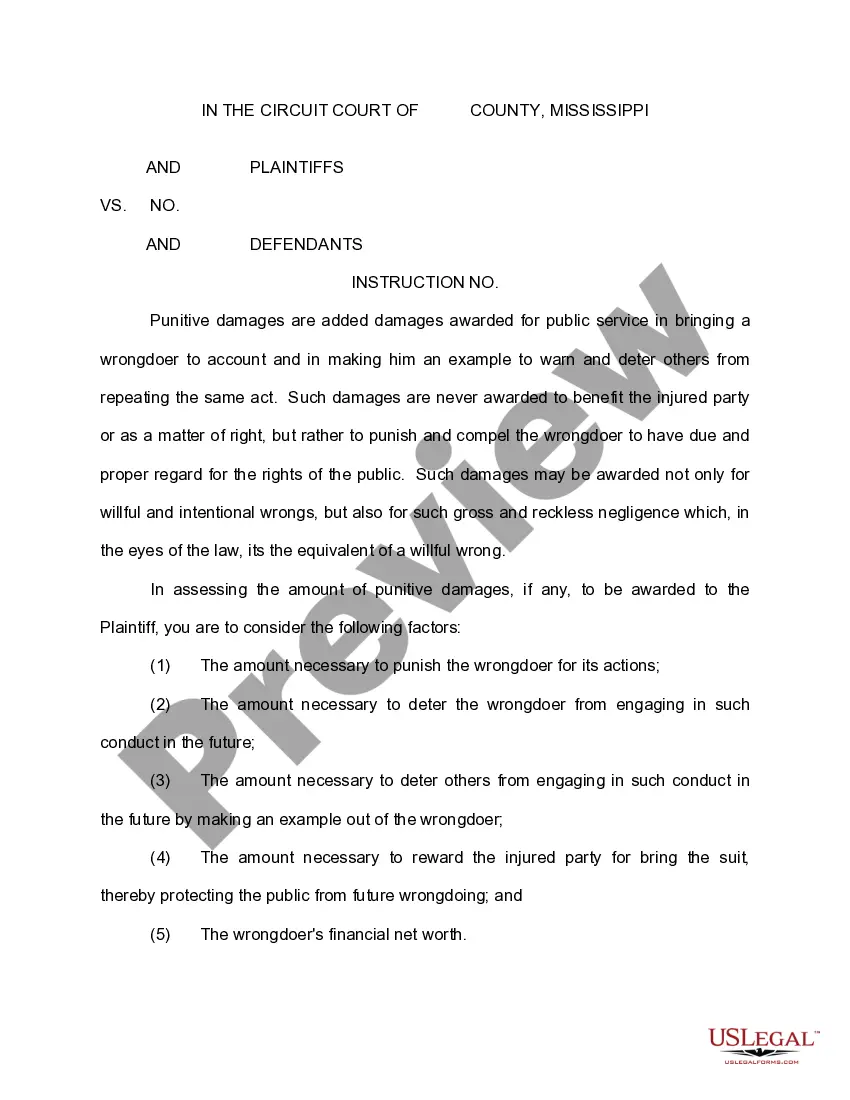
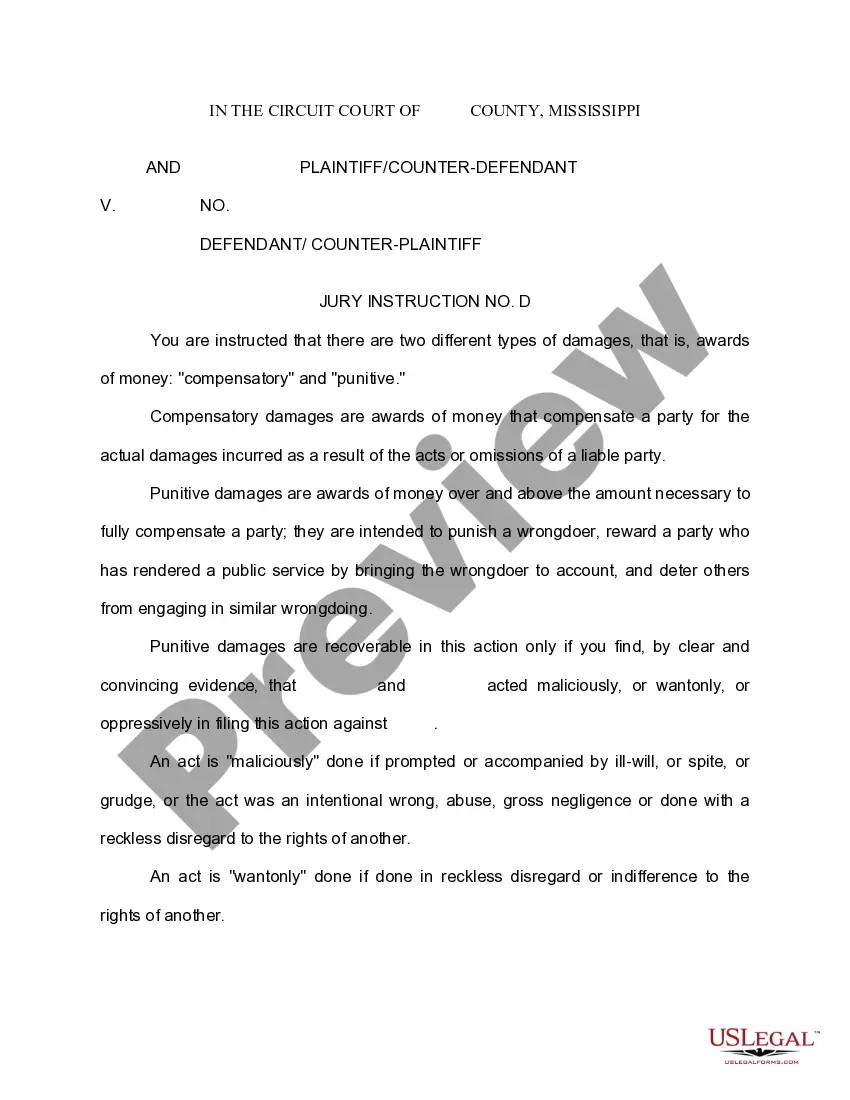
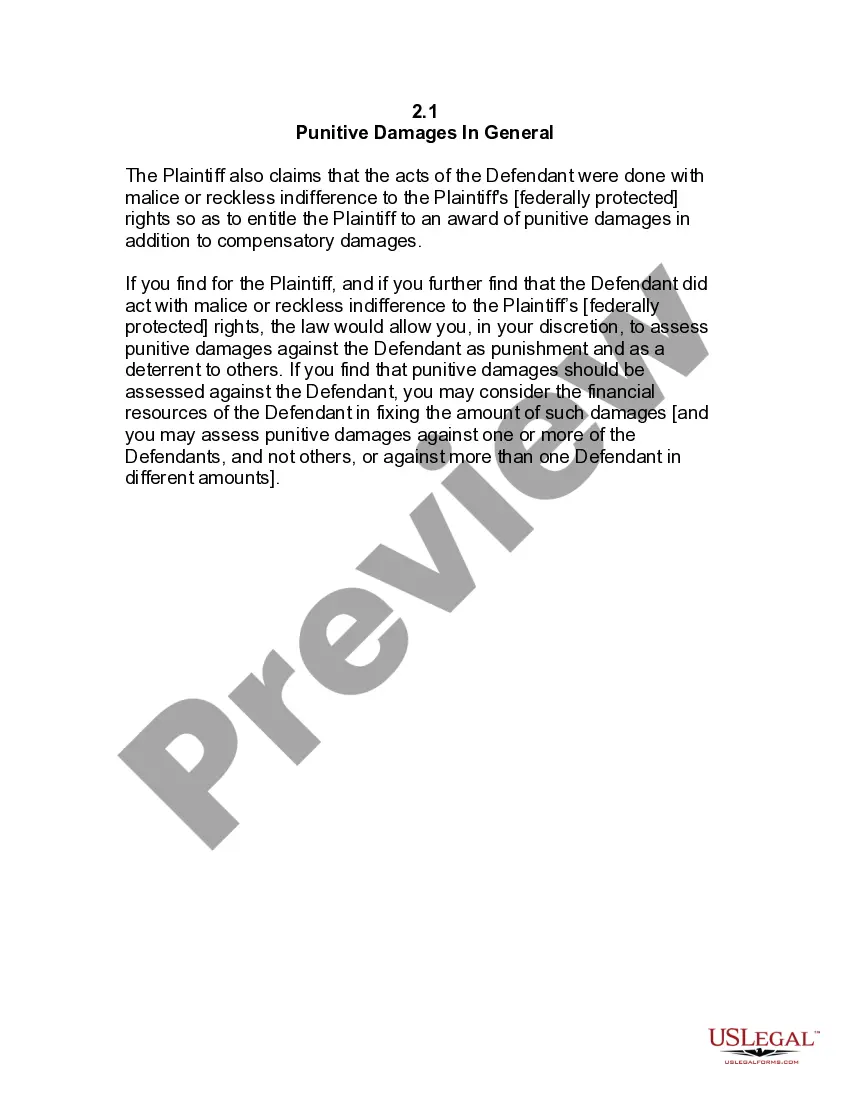
This form provides a sample jury instruction regarding punitive damages and the determination of their amount under Mississippi law. It is designed to guide jurors in evaluating the appropriate level of punitive damages that may be awarded in a case, distinguishing it from other legal forms related to damages. Users must ensure that the language complies with current case law and may adapt it for specific circumstances in their case.
Key components of this form
- Introduction to punitive damages and their purpose.
- Criteria jurors should consider when determining the amount of punitive damages.
- Factors affecting the severity and appropriateness of the damages awarded.
- Clarification of standards that must be met for punitive damages to apply.
When to use this form
This form is typically used in civil litigation cases where a plaintiff seeks punitive damages. It can be employed during jury trials to instruct jurors on how to evaluate and decide the amount of damages in cases of wrongful conduct that require deterrence and punishment beyond compensatory damages.
Intended users of this form
- Attorneys representing plaintiffs seeking punitive damages in trial cases.
- Attorneys representing defendants who need to understand jury instructions related to punitive damages.
- Legal professionals preparing for jury instructions in Mississippi civil litigation.
Completing this form step by step
- Review the specific case details to ensure the instruction applies.
- Adapt the language to fit the circumstances of the case, ensuring clarity.
- Specify the criteria the jury should use when determining the amount of punitive damages.
- Include pertinent legal standards relevant to punitive damages in Mississippi.
- Present the instruction to the judge for approval before trial.
Is notarization required?
This form usually doesn’t need to be notarized. However, local laws or specific transactions may require it. Our online notarization service, powered by Notarize, lets you complete it remotely through a secure video session, available 24/7.
Get your form ready online
Our built-in tools help you complete, sign, share, and store your documents in one place.
Make edits, fill in missing information, and update formatting in US Legal Forms—just like you would in MS Word.
Download a copy, print it, send it by email, or mail it via USPS—whatever works best for your next step.
Sign and collect signatures with our SignNow integration. Send to multiple recipients, set reminders, and more. Go Premium to unlock E-Sign.
If this form requires notarization, complete it online through a secure video call—no need to meet a notary in person or wait for an appointment.
We protect your documents and personal data by following strict security and privacy standards.

Make edits, fill in missing information, and update formatting in US Legal Forms—just like you would in MS Word.

Download a copy, print it, send it by email, or mail it via USPS—whatever works best for your next step.

Sign and collect signatures with our SignNow integration. Send to multiple recipients, set reminders, and more. Go Premium to unlock E-Sign.

If this form requires notarization, complete it online through a secure video call—no need to meet a notary in person or wait for an appointment.

We protect your documents and personal data by following strict security and privacy standards.
Typical mistakes to avoid
- Failing to update the form according to recent case law.
- Using vague language that could confuse jurors.
- Ignoring jurisdiction-specific requirements and legal standards.
Why complete this form online
- Immediate access to professionally drafted legal language.
- Ability to download and customize the form to meet case-specific needs.
- Convenience of obtaining legal guidance without needing to consult in person.
Legal use & context
- Must be used in accordance with Mississippi laws regarding punitive damages.
- Understanding the legal implications of punitive damages can play a significant role in trial outcomes.
Looking for another form?
Form popularity
FAQ
Compensatory And Punitive Damages The compensatory damages awarded to plaintiffs are designed to give justice to them after being wronged. Punitive damages are designed to prevent others from being hurt by the same or similar actions.
On the other hand, vicariously-assessed punitive damages are assessed against a defendant who was not directly negligent but instead had liability imputed under agency principal law. For example, a corporation may be vicariously liable for the acts of its employees.
Under California law, before a plaintiff can recover punitive damages, he must prove, by clear and convincing evidence, fraud, malice or oppression by the defendant as laid out in Civ. Code section 3294(c).
In many jurisdictions, punitive damages are inappropriate if there was no award of compensatory damages. Many appellate courts have ruled that a simple liability finding without an award of compensatory damages is not enough to support a punitive damages award.
Specifically, in a breach of case, the plaintiff is normally only awarded compensatory damages (i.e., money damages for the actual loss suffered based on the value of the contract), and punitive damages are generally not awarded at all.
While mandated percentage "limits" on a punitive damage award have drawn criticism, awards in excess of these limits have also drawn objection. Again, using California as an example, courts have generally found punitive damages greater than 15 percent of a defendant's net worth to be excessive.
Judges may reduce punitive damage awards when it looks like juries have not followed instructions.
Jurisdictions employ one of three standards of proof in decisions concerning punitive damages: (1) beyond a reasonable doubt, (2) by clear and convincing evidence, and (3) by a preponderance of evidence.
Punitive damages are legal recompense that a defendant found guilty of committing a wrong or offense is ordered to pay on top of compensatory damages. They are awarded by a court of law not to compensate injured plaintiffs but to punish defendants whose conduct is considered grossly negligent or intentional.