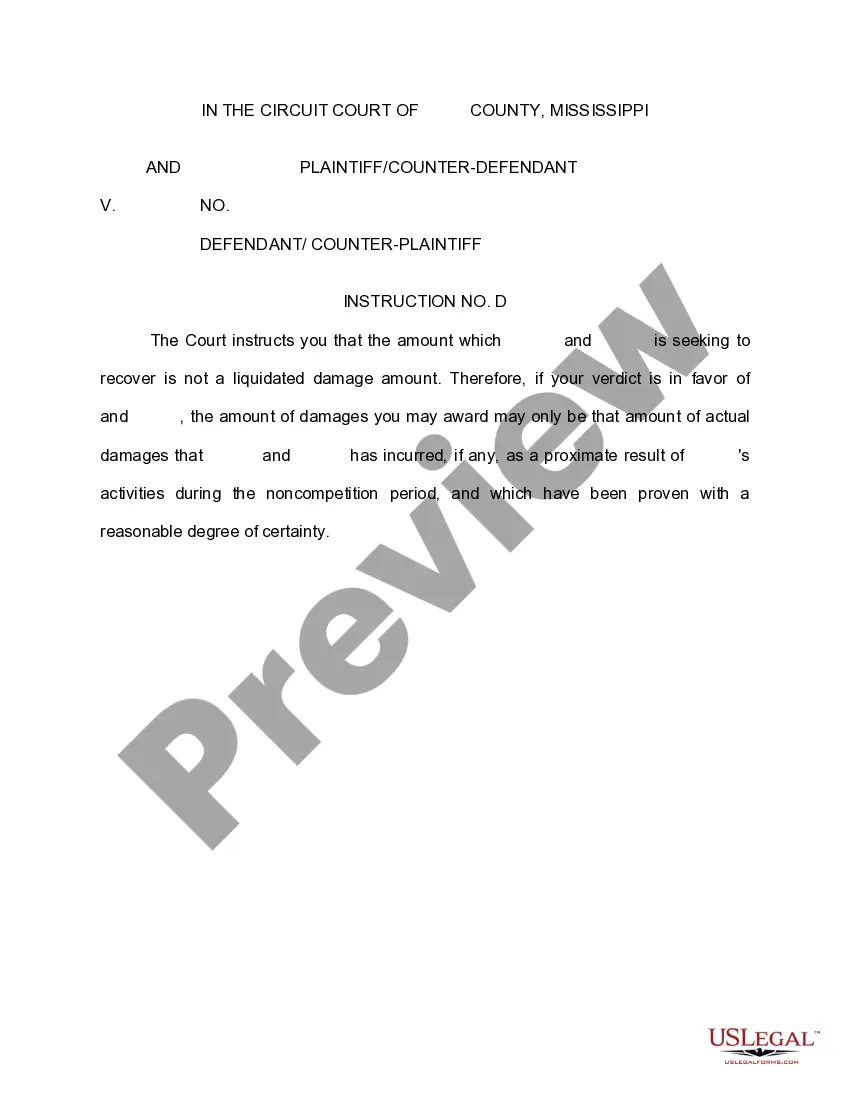
Mississippi Jury Instruction - Liquidated Damages - Covenant Not to Compete
Understanding this form
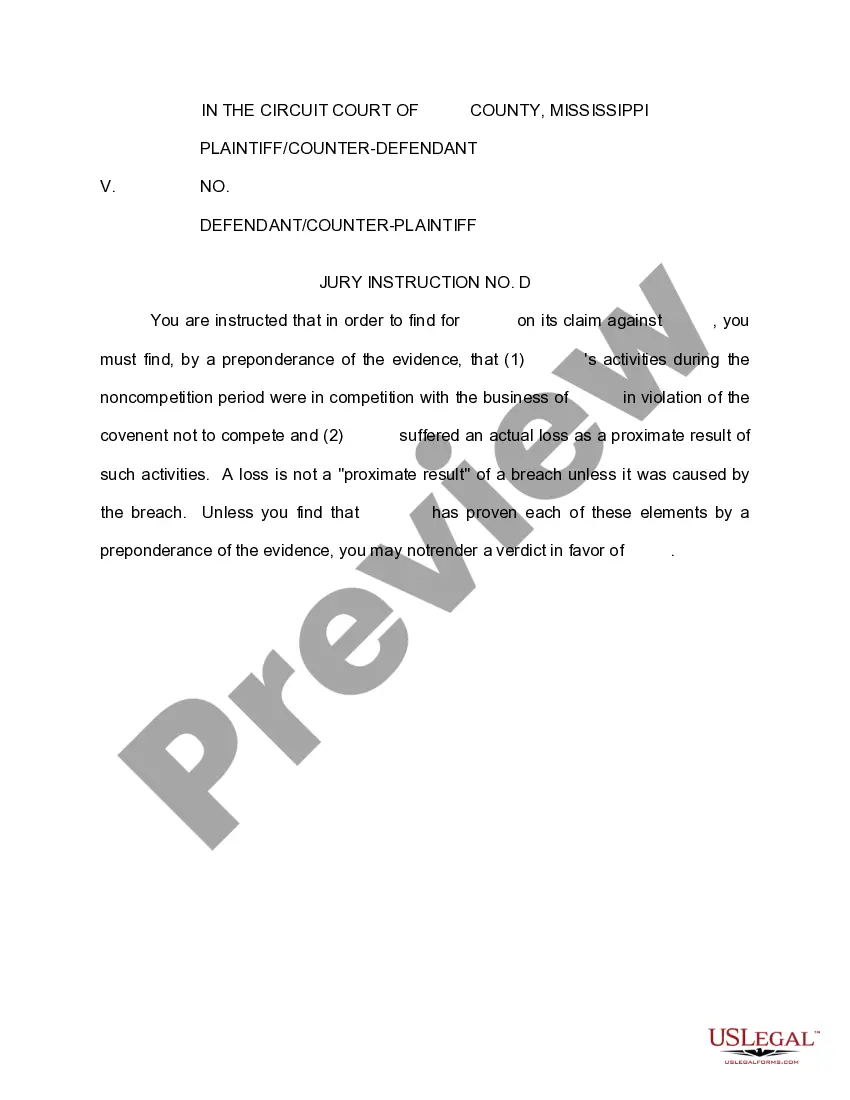
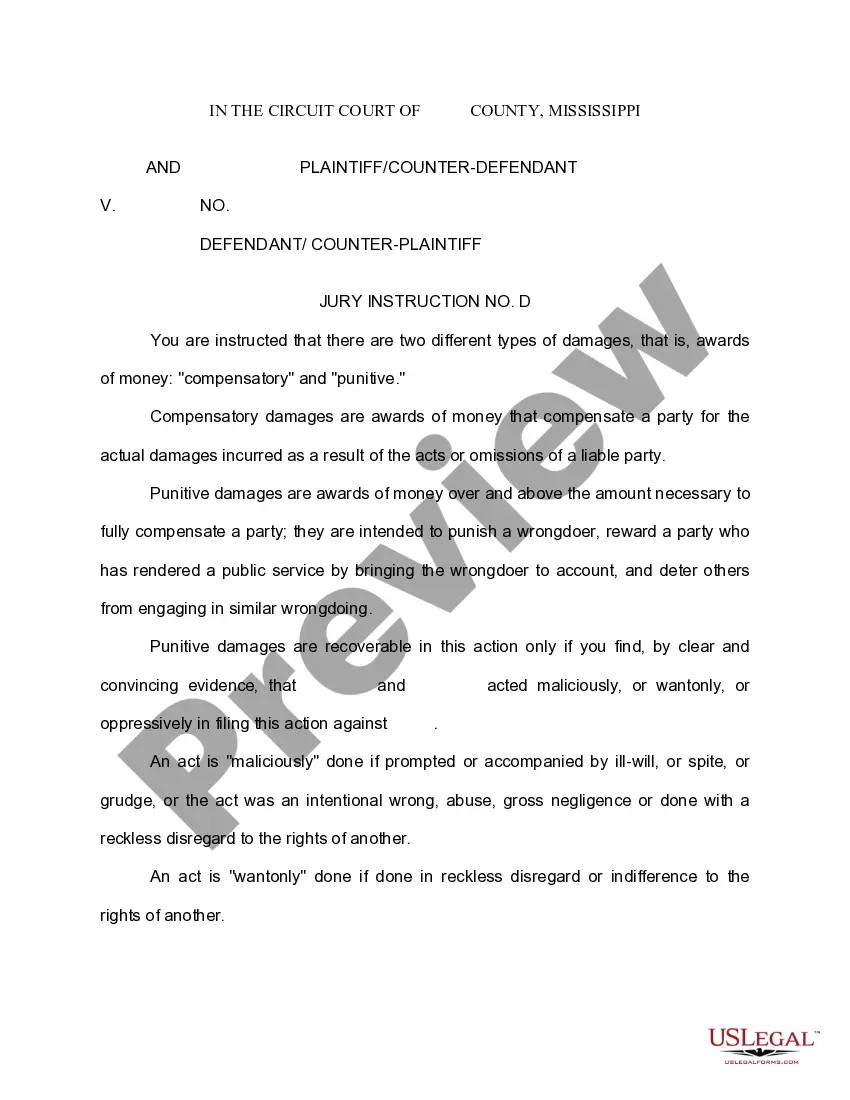
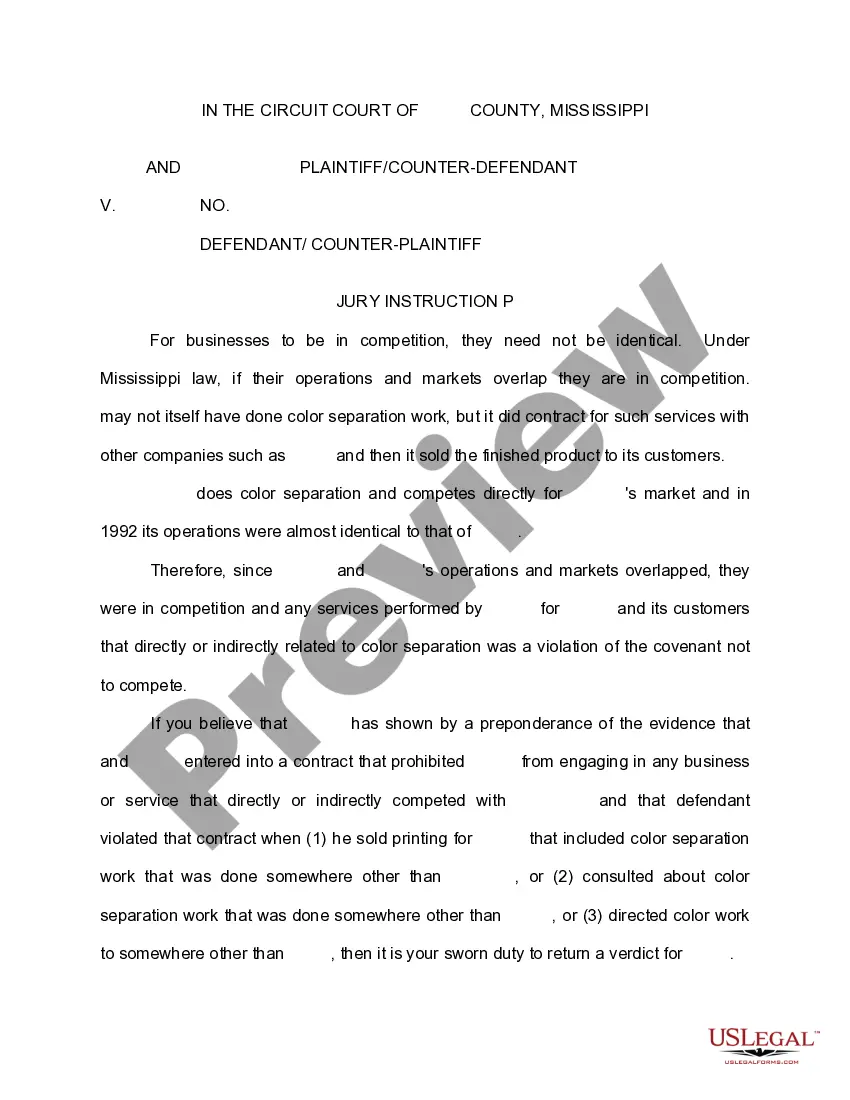
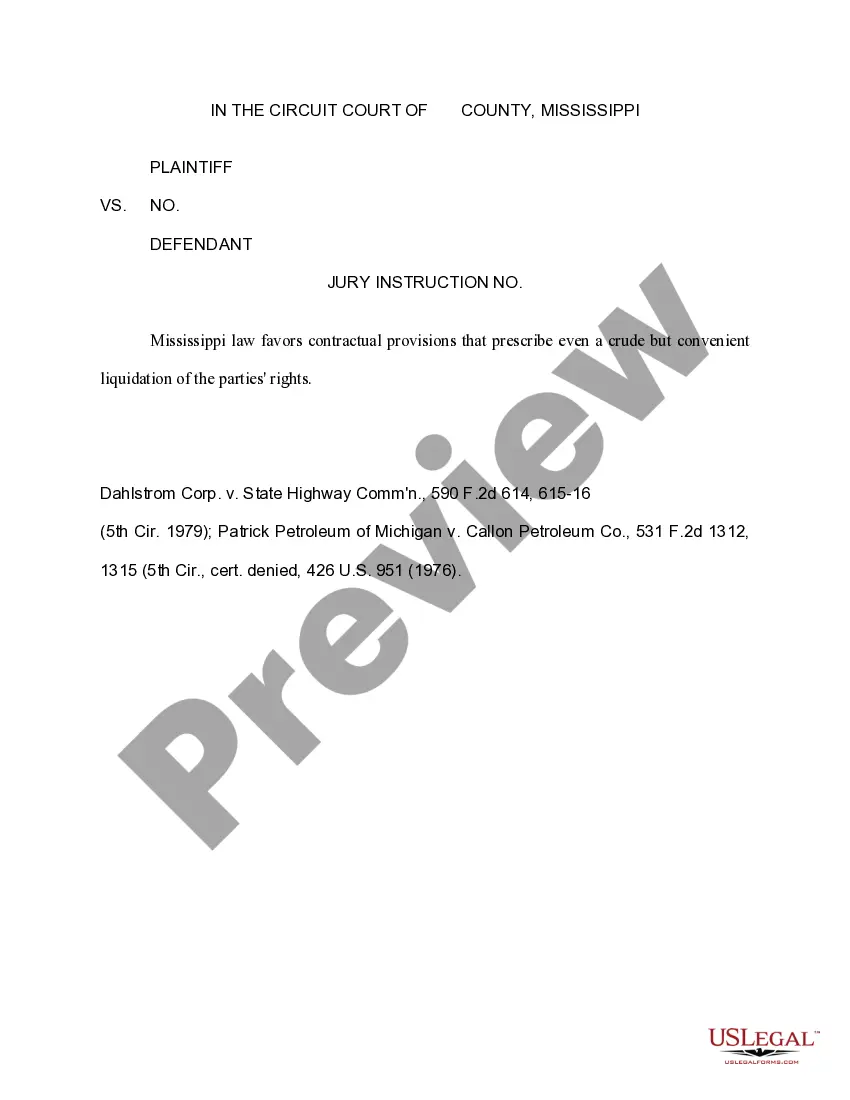
The Jury Instruction for Liquidated Damages - Covenant Not to Compete is a legal document designed for use in Mississippi courtrooms to guide juries on the topic of liquidated damages in the context of non-compete agreements. This form highlights the legal principles surrounding the enforcement of such covenants, distinguishing it from other jury instructions that may cover different aspects of contract law.
Form components explained
- Definition of liquidated damages as it relates to non-compete clauses
- Standards for assessing the reasonableness of the liquidated damages provision
- Guidance on the enforceability of covenants not to compete in Mississippi law
- Instructions for jurors on how to apply the law to the facts of the case
Common use cases
This jury instruction form should be used in cases involving disputes over non-compete agreements, particularly when there is contention regarding the reasonableness of liquidated damages specified in the contract. It is essential when parties seek to present their legal arguments clearly to the jury, ensuring that they understand how to apply the law appropriately in their deliberations.
Who should use this form
- Attorneys representing clients in cases involving non-compete agreements
- Judges who need standardized instructions for jury deliberations
- Legal educators or students studying contract law and jury instructions
Completing this form step by step
- Review the definition of liquidated damages relevant to the case at hand.
- Determine the appropriateness and reasonableness of the damages specified in the non-compete clause.
- Summarize the legal standards applicable to covenants not to compete in Mississippi.
- Draft clear, concise instructions for jurors to facilitate their understanding of the legal issues.
Does this document require notarization?
Notarization is generally not required for this form. However, certain states or situations might demand it. You can complete notarization online through US Legal Forms, powered by Notarize, using a verified video call available anytime.
Get your form ready online
Our built-in tools help you complete, sign, share, and store your documents in one place.
Make edits, fill in missing information, and update formatting in US Legal Forms—just like you would in MS Word.
Download a copy, print it, send it by email, or mail it via USPS—whatever works best for your next step.
Sign and collect signatures with our SignNow integration. Send to multiple recipients, set reminders, and more. Go Premium to unlock E-Sign.
If this form requires notarization, complete it online through a secure video call—no need to meet a notary in person or wait for an appointment.
We protect your documents and personal data by following strict security and privacy standards.

Make edits, fill in missing information, and update formatting in US Legal Forms—just like you would in MS Word.

Download a copy, print it, send it by email, or mail it via USPS—whatever works best for your next step.

Sign and collect signatures with our SignNow integration. Send to multiple recipients, set reminders, and more. Go Premium to unlock E-Sign.

If this form requires notarization, complete it online through a secure video call—no need to meet a notary in person or wait for an appointment.

We protect your documents and personal data by following strict security and privacy standards.
Mistakes to watch out for
- Failing to update the form in accordance with recent case law changes.
- Using vague language that may confuse jurors about their responsibilities.
- Neglecting to explain fully what constitutes reasonable liquidated damages.
Legal use & context
- This form serves as a guideline and should be adapted to fit specific case details.
- It is intended to clarify the complexities surrounding liquidated damages and non-compete agreements.
- The enforceability of these agreements varies significantly based on the jurisdiction.
Looking for another form?
Form popularity
FAQ
Courts consider several elements when determining the reasonableness of a covenant not to compete, including (1) the time and territory encompassed by the covenant, (2) the territory in which the employee worked, (3) the area in which the employer operated, (4) the nature of the business and (5) the nature of the
In California, however, covenants not to compete are almost always not enforceable. California state law says that a covenant that restrains someone from engaging in a lawful profession, trade, or business is void.
United States. The majority of U.S. states recognize and enforce various forms of non-compete agreements. A few states, such as California, North Dakota, and Oklahoma, totally ban noncompete agreements for employees, or prohibit all noncompete agreements except in limited circumstances.
Voiding a non-compete contract is possible in certain circumstances. For instance, if you can prove that you never signed the contract, or if you can demonstrate that the contract is against the public interest, you may be able to void the agreement.
Not necessarily. Fortunately for you, courts have recently limited the power of non-compete agreements to protect employees' rights, making it possible (though not guaranteed) for you to get out of your non-compete. For a non-compete agreement to be enforceable, it must first be reasonable.
Under Mississippi law, a non-compete covenant must not unduly restrict trade and must generally serve a legitimate, protectable business interest.However, a non-compete agreement that is either too broad or too narrow will not be enforceable under the law.
California - Non-compete clauses are not enforceable under California law. However, LegalNature's non-compete agreement may still be used to prohibit the employee from soliciting customers and other employees away from the employer.Non-compete clauses are generally not enforceable.
A covenant not to compete, also called a "nompete agreement" or "non compete clause," is an agreement where one party promises not to compete with the other party in a specified area for a certain period of time. A covenant not to compete can be found in an employment contract or a sale of business contract.
Voiding a non-compete contract is possible in certain circumstances. For instance, if you can prove that you never signed the contract, or if you can demonstrate that the contract is against the public interest, you may be able to void the agreement.