Mississippi Jury Instruction - Burden of Proof - Cross Claims
Overview of this form
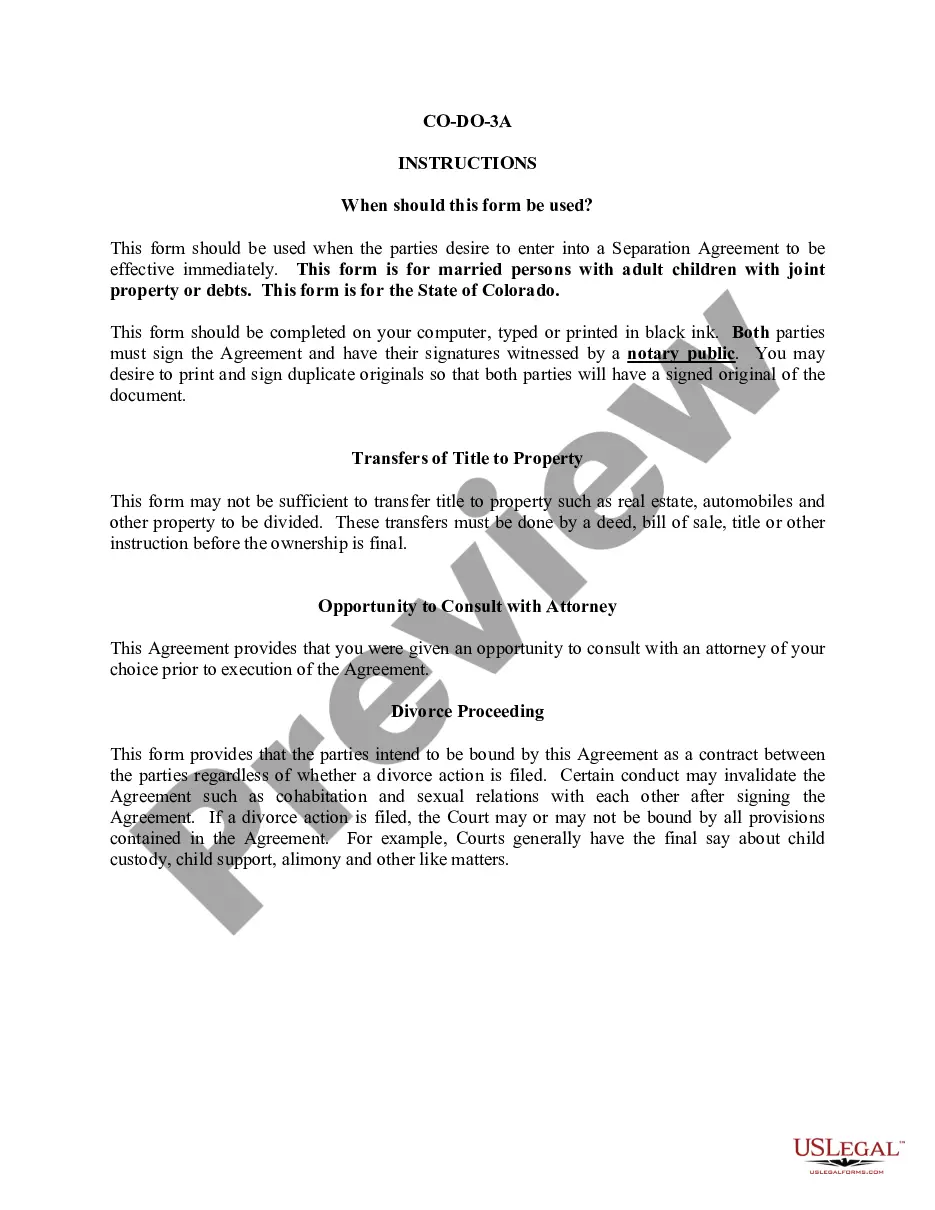
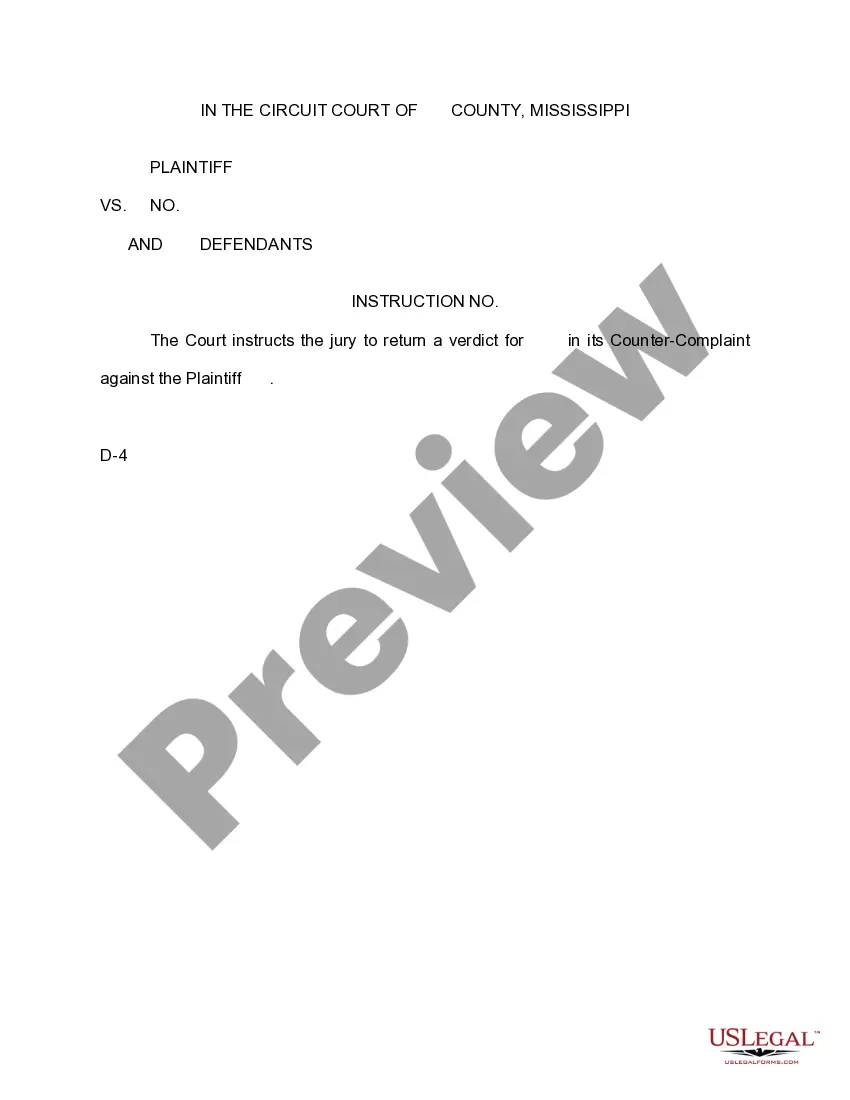
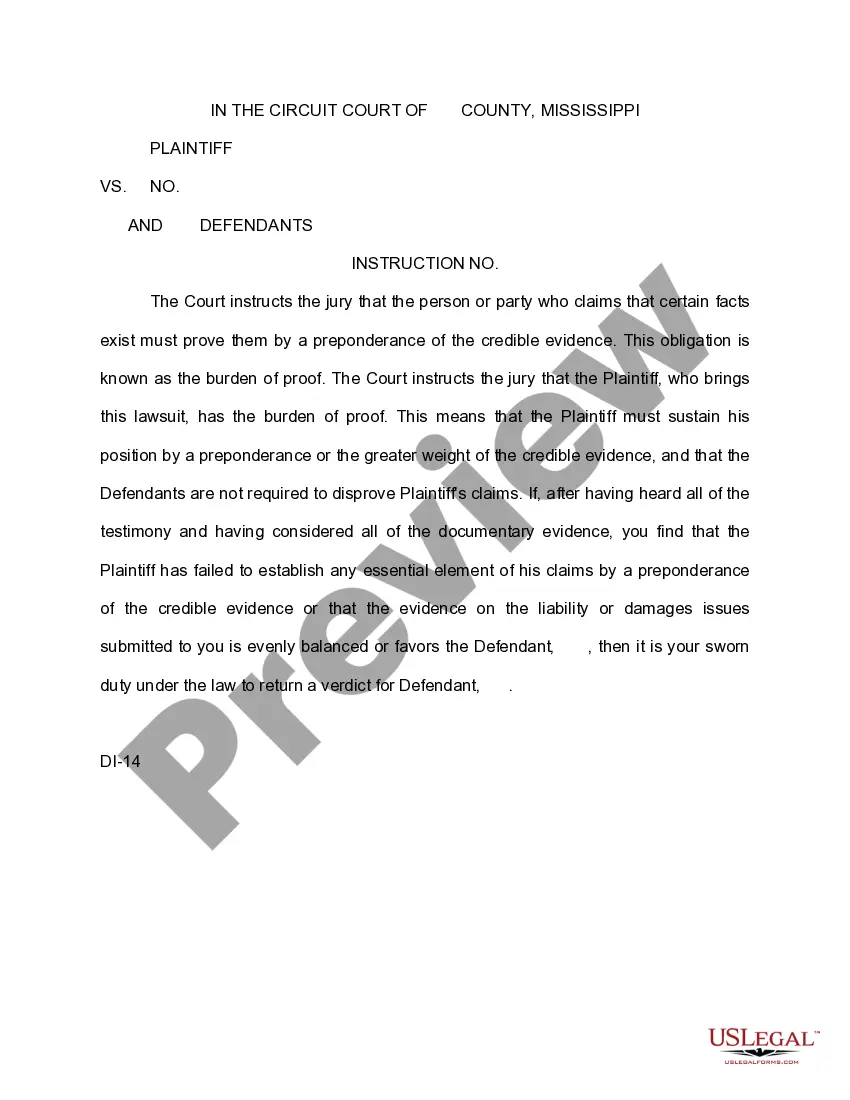
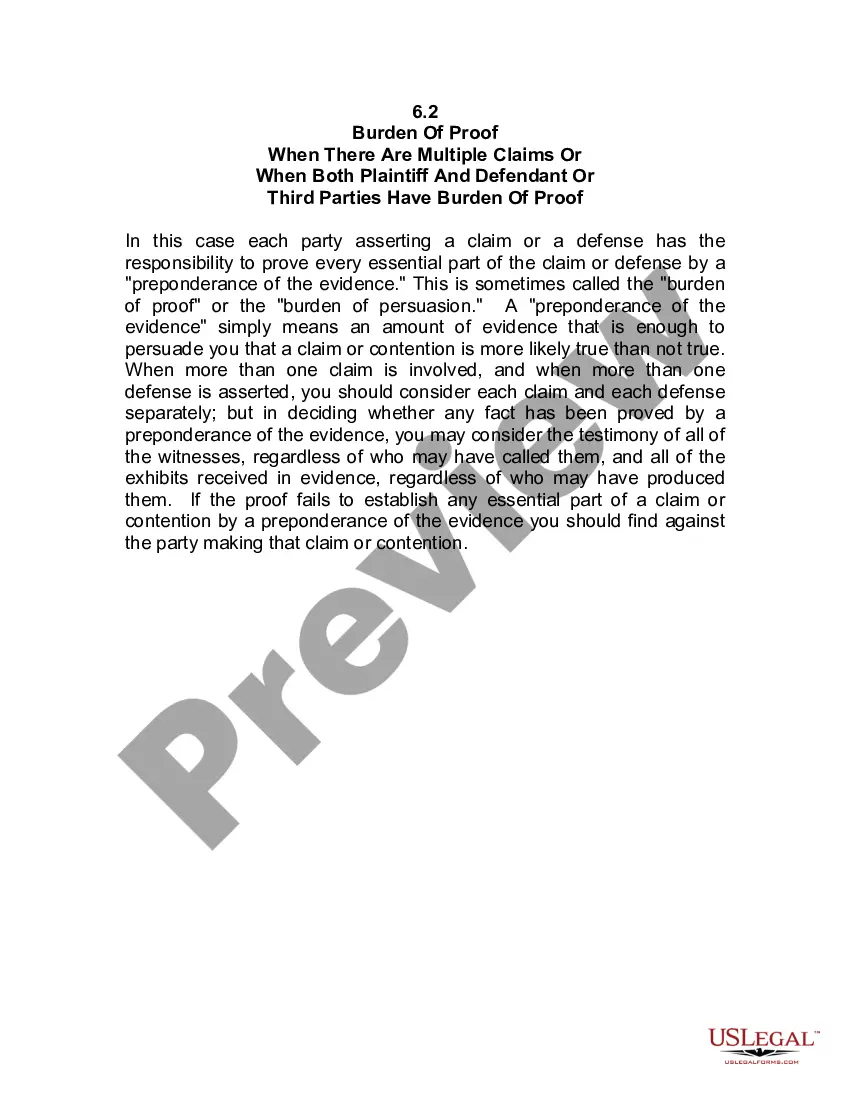
This form is a jury instruction regarding the burden of proof for cross claims in Mississippi. It helps guide jurors in understanding the responsibilities of each party in presenting evidence and making a case. Unlike other jury instructions that may cover different topics, this specific form focuses on how cross claims affect the burden of proof, ensuring clarity and compliance with legal standards.
What’s included in this form
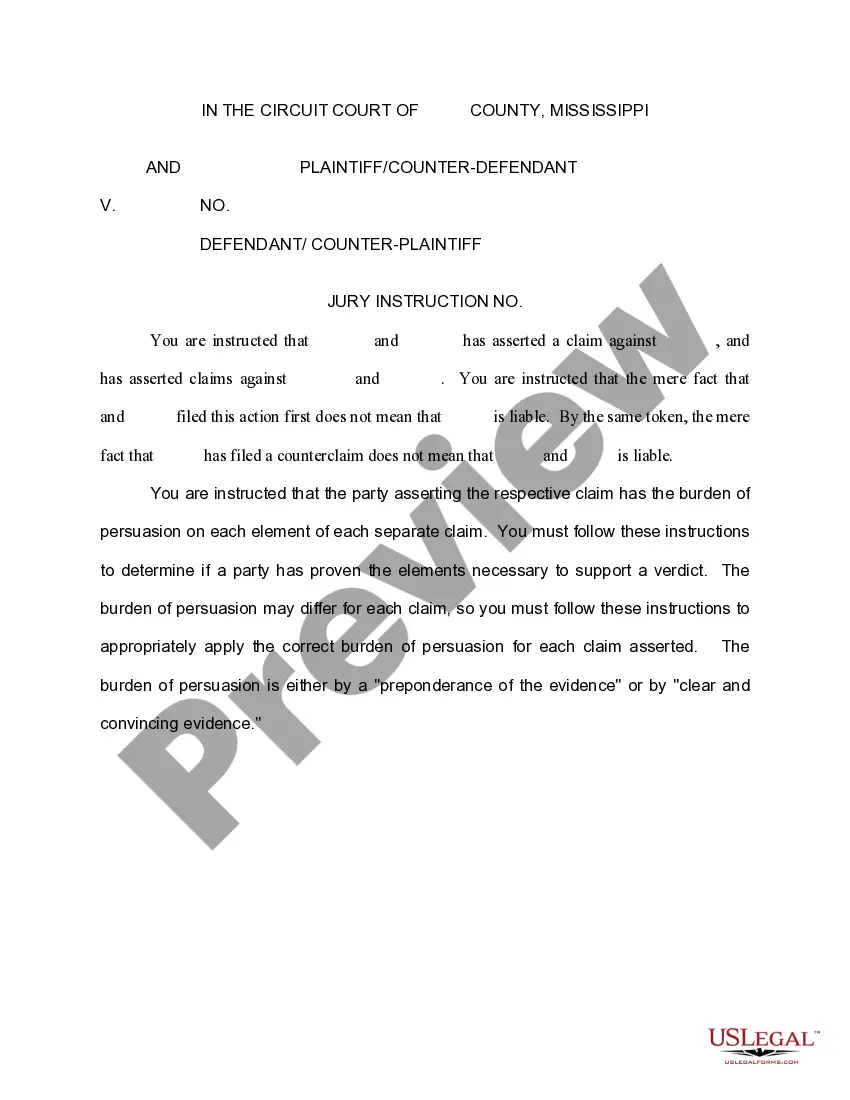
- Definition of the burden of proof for cross claims.
- Instructions on how the jury should assess evidence presented.
- Clarifications on the responsibilities of the parties involved.
- Guidelines on how to deliberate based on the given evidence.
Common use cases
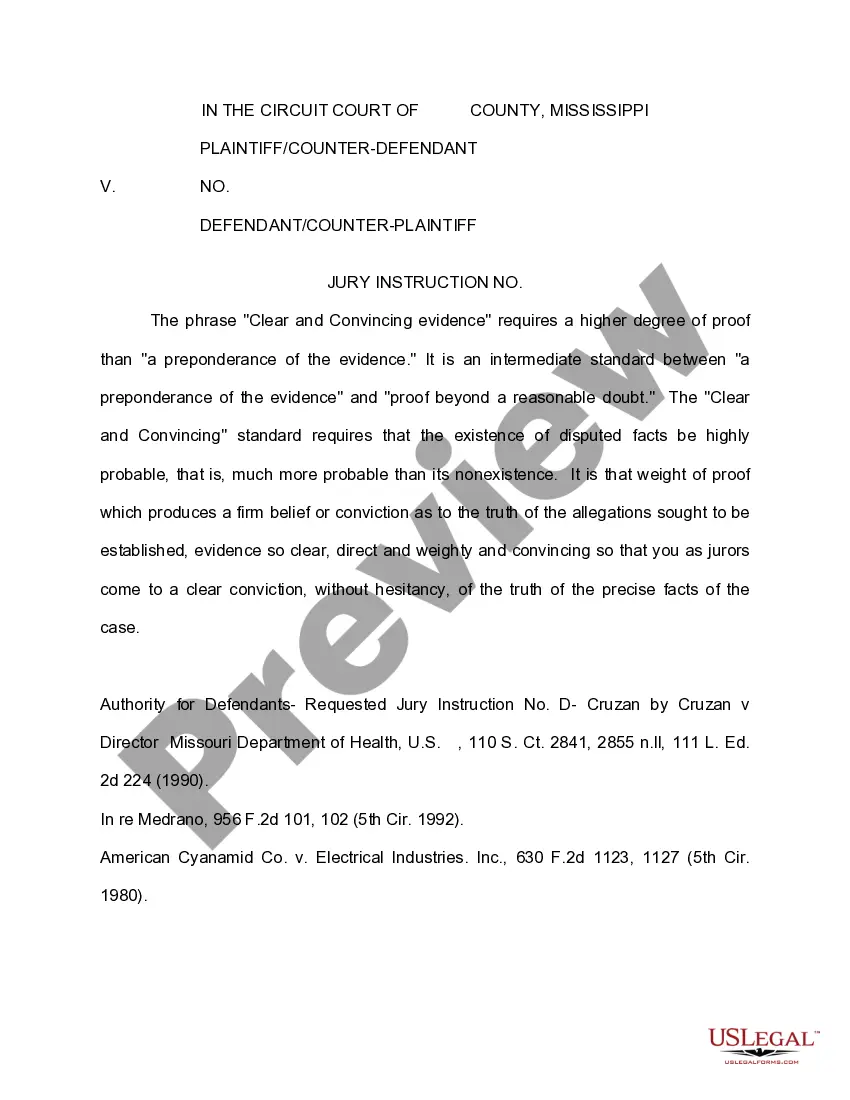
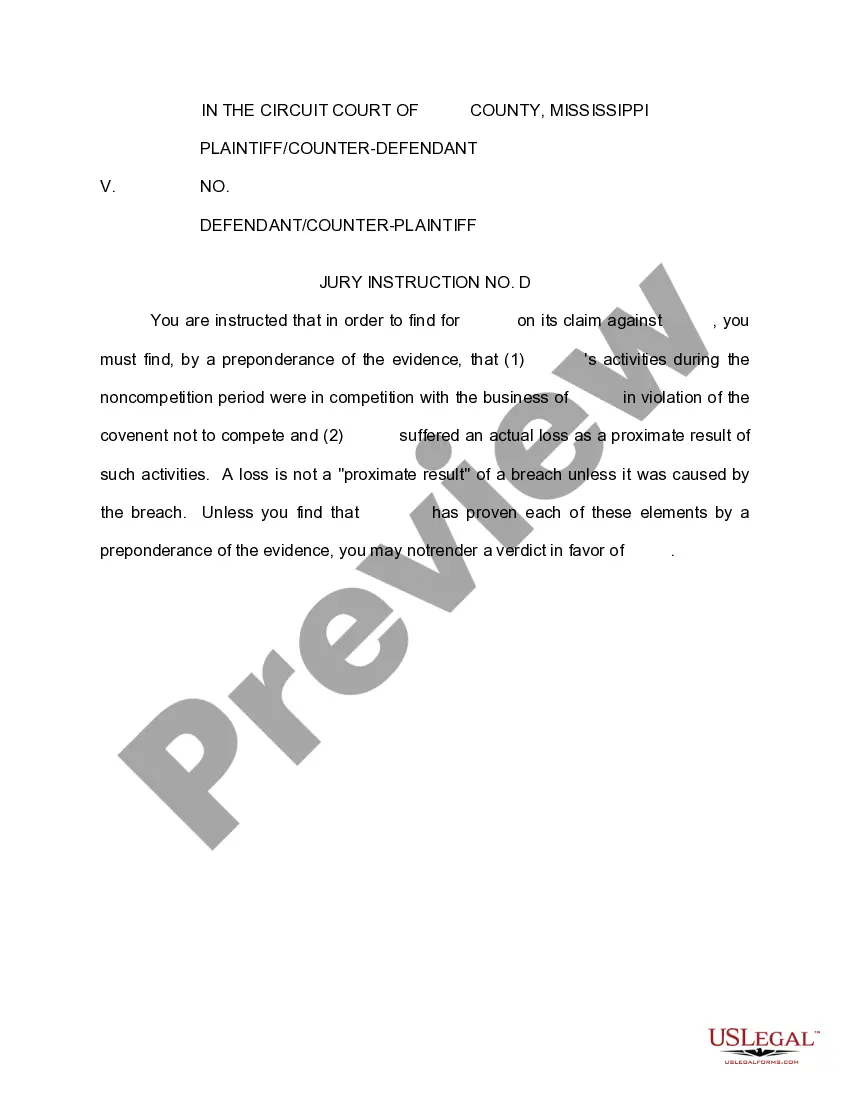
This form should be used in cases involving cross claims where the jury needs clear instructions on the burden of proof. It is particularly applicable in civil litigation scenarios, where multiple parties are making claims against one another. The jury will rely on this instruction to understand who must prove their case and the level of evidence required.
Who this form is for
The following individuals or entities may find this form useful:
- Attorneys representing clients involved in civil litigation with cross claims.
- Judges issuing jury instructions during trials.
- Legal professionals preparing documents for jury trials in Mississippi.
How to prepare this document
- Review the current Mississippi case law related to burden of proof.
- Identify the parties involved in the cross claims.
- Draft the instruction to clearly state the burden of proof and its implications.
- Ensure all terminology is compliant with Mississippi legal standards.
- Present this instruction to the jury during the trial.
Is notarization required?
This form does not typically require notarization to be legally valid. However, some jurisdictions or document types may still require it. US Legal Forms provides secure online notarization powered by Notarize, available 24/7 for added convenience.
Get your form ready online
Our built-in tools help you complete, sign, share, and store your documents in one place.
Make edits, fill in missing information, and update formatting in US Legal Forms—just like you would in MS Word.
Download a copy, print it, send it by email, or mail it via USPS—whatever works best for your next step.
Sign and collect signatures with our SignNow integration. Send to multiple recipients, set reminders, and more. Go Premium to unlock E-Sign.
If this form requires notarization, complete it online through a secure video call—no need to meet a notary in person or wait for an appointment.
We protect your documents and personal data by following strict security and privacy standards.

Make edits, fill in missing information, and update formatting in US Legal Forms—just like you would in MS Word.

Download a copy, print it, send it by email, or mail it via USPS—whatever works best for your next step.

Sign and collect signatures with our SignNow integration. Send to multiple recipients, set reminders, and more. Go Premium to unlock E-Sign.

If this form requires notarization, complete it online through a secure video call—no need to meet a notary in person or wait for an appointment.

We protect your documents and personal data by following strict security and privacy standards.
Common mistakes
- Failing to update the instruction to reflect recent case law changes.
- Using vague language that can confuse jurors.
- Not specifying the distinct roles of each party in relation to the burden of proof.
Benefits of completing this form online
- Convenient access to legal templates from anywhere.
- Editable forms that can be customized to fit specific case needs.
- Reliable language drafted by licensed attorneys.
Looking for another form?

Form popularity
FAQ
The simplest (from a logic perspective) style of proof is a direct proof . Often all that is required to prove something is a systematic explanation of what everything means. Direct proofs are especially useful when proving implications.
Make a game plan. Make up numbers for segments and angles. Look for congruent triangles (and keep CPCTC in mind). Try to find isosceles triangles. Look for parallel lines. Look for radii and draw more radii. Use all the givens.
The beyond a reasonable doubt standard is the highest standard of proof that may be imposed upon a party at trial, and it is usually the standard used in criminal cases.
The three primary standards of proof are proof beyond a reasonable doubt, preponderance of the evidence and clear and convincing evidence.
A party's duty to produce sufficient evidence to support an allegation or argument. Plaintiffs in civil cases typically have the burden of proving their allegations by a preponderance of the evidence. In criminal cases, the prosecution typically has the burden of proving its allegations beyond a reasonable doubt.
Phrase. The burden of proof is the task of proving that you are correct, for example when you have accused someone of a crime. The burden of proof is on the prosecution.
Draw the figure that illustrates what is to be proved. List the given statements, and then list the conclusion to be proved. Mark the figure according to what you can deduce about it from the information given. Write the steps down carefully, without skipping even the simplest one.
For example, in criminal cases, the burden of proving the defendant's guilt is on the prosecution, and they must establish that fact beyond a reasonable doubt. In civil cases, the plaintiff has the burden of proving his case by a preponderance of the evidence.
However, proofs aren't just ways to show that statements are true or valid. They help to confirm a student's true understanding of axioms, rules, theorems, givens and hypotheses. And they confirm how and why geometry helps explain our world and how it works.