Mississippi Qualified Medical Child Support Order
About this form
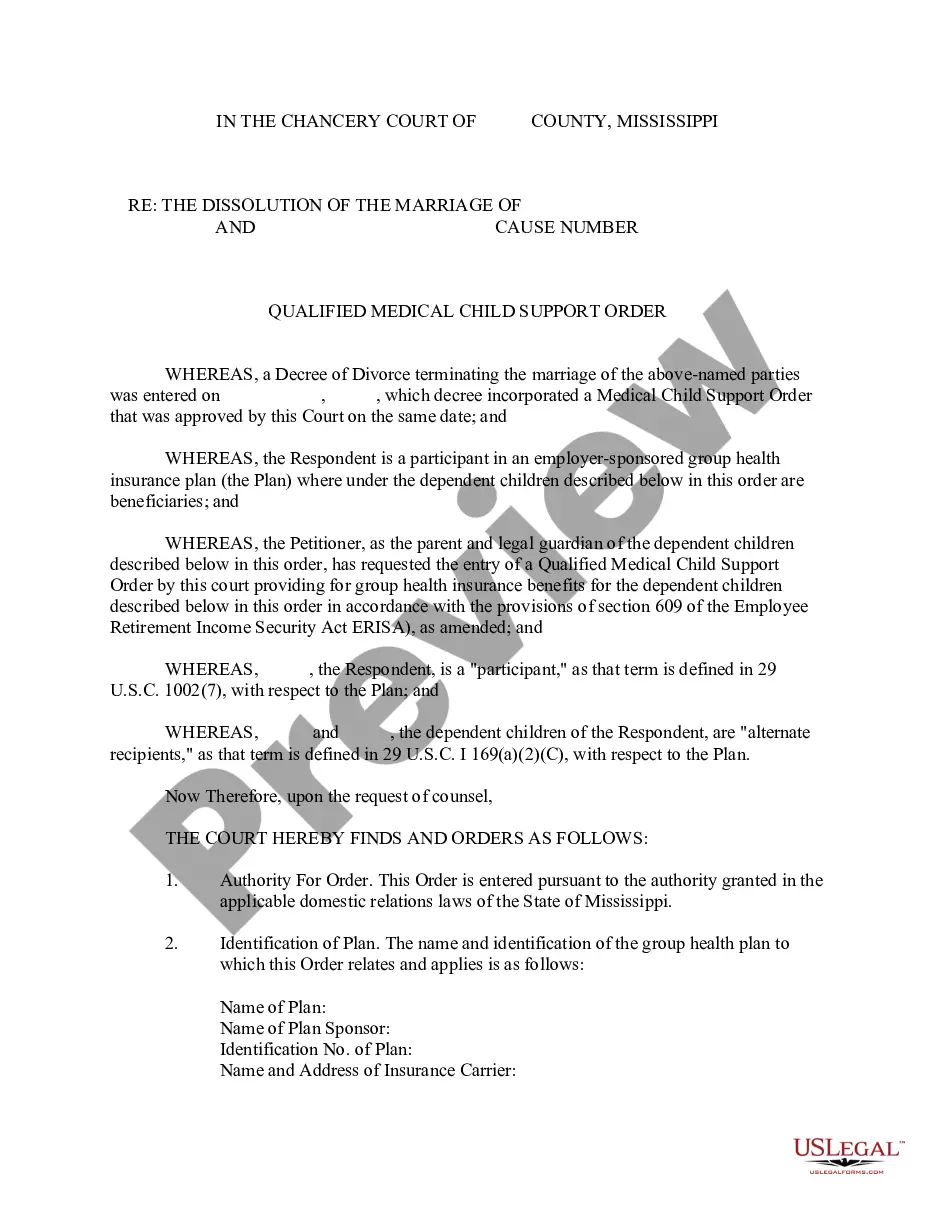
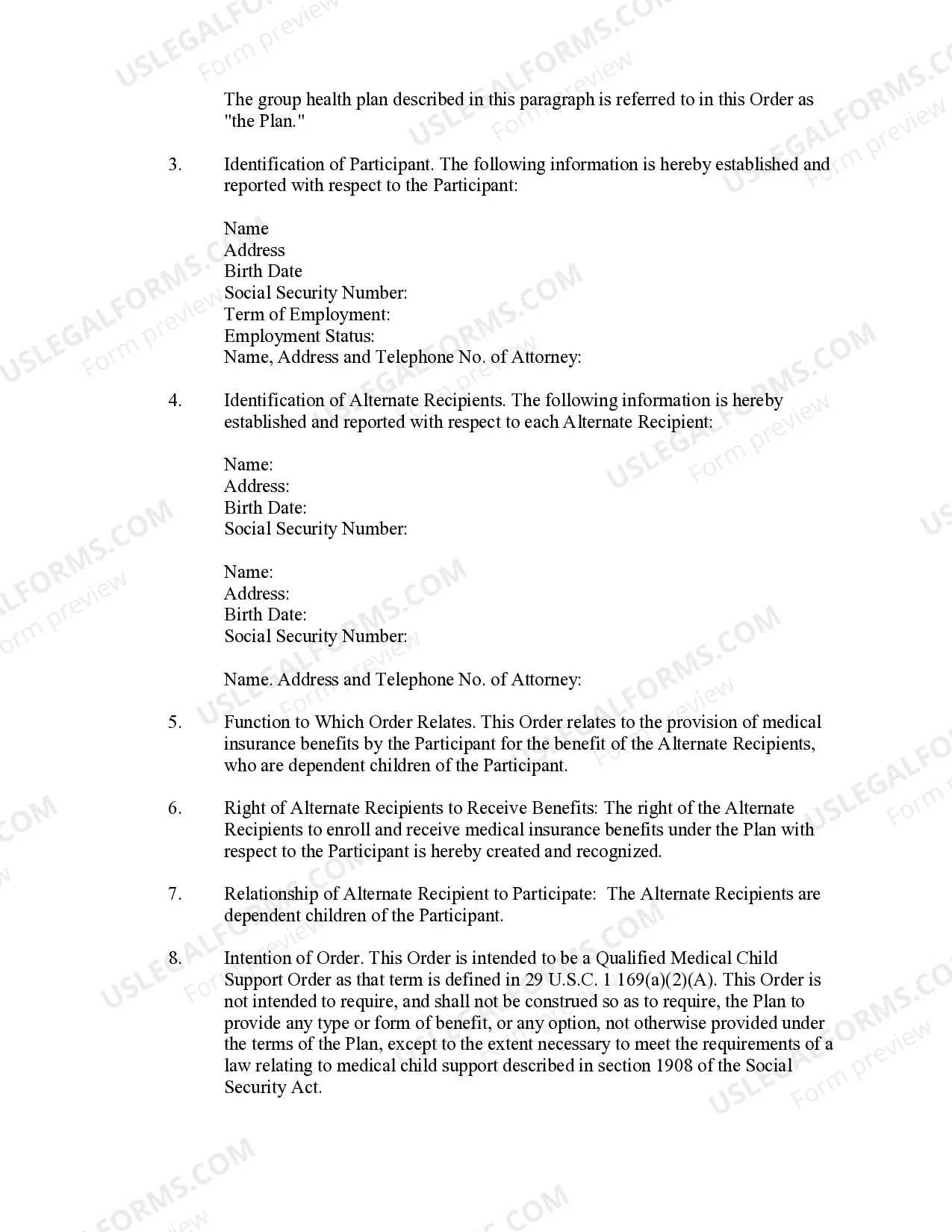
The Qualified Medical Child Support Order is a legal document that specifies which parent will provide medical insurance coverage for their child or children. This order is essential for ensuring that dependents have consistent access to medical benefits and helps clarify responsibilities in compliance with domestic relations laws. Unlike general custody or support agreements, this form focuses specifically on health insurance obligations.
Key components of this form
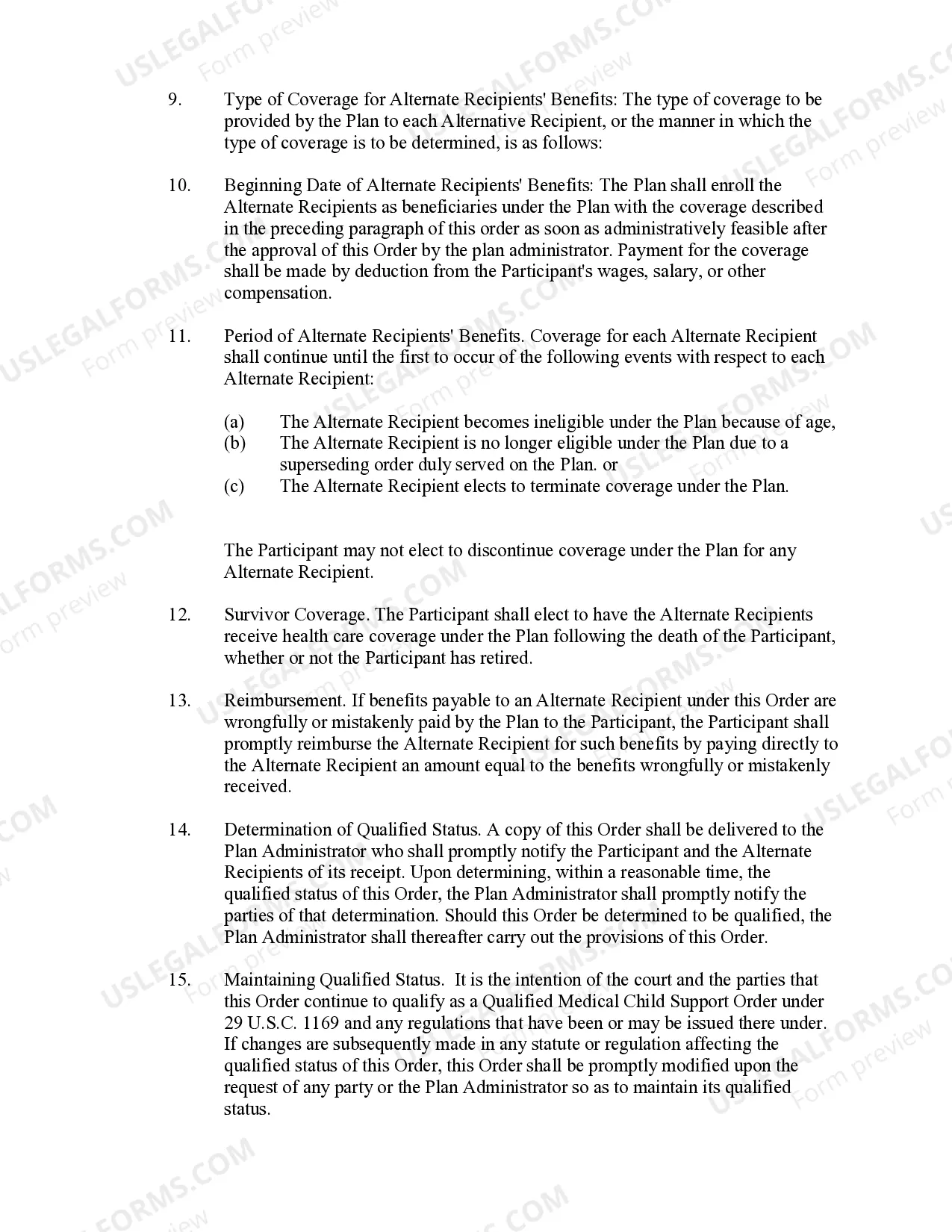
- Authority for Order: Identifies the legal basis for the order under state laws.
- Identification of Plan: States the group health plan related to the order.
- Right of Alternate Recipients: Establishes the rights of children to receive benefits.
- Type of Coverage: Describes the type of medical coverage to be provided.
- Enrollment: Sets procedures for enrolling children in the health plan.
- Continuity of Coverage: Addresses when coverage ends for each child.


Common use cases
You would use the Qualified Medical Child Support Order when you need to establish legal obligations for a parent to provide health insurance coverage for their children. This form is particularly important during divorce or separation, where clear medical support arrangements must be defined. It is also useful in situations where one parent is required to provide proof of insurance for benefit qualification purposes.
Who this form is for
- Parents undergoing divorce or separation who need to establish medical insurance responsibilities.
- Custodial and non-custodial parents aiming to clarify healthcare coverage for their children.
- Legal representatives assisting clients with family law matters.
- Insurance plan administrators needing a formal order for compliance with medical support laws.
Instructions for completing this form
- Identify the parties involved: Clearly name the custodial parent, non-custodial parent, and children covered under the order.
- Specify the health plan: Include the name and details of the health insurance plan that will cover the children.
- Determine the type of coverage: Outline what type of medical insurance benefits will be provided.
- Set the coverage duration: Indicate how long the medical insurance will remain effective for each child.
- Obtain necessary signatures: Ensure that all parties involved sign the document for legal validity.
Is notarization required?
This form does not typically require notarization unless specified by local law. Always check with local regulations to determine if notarization is necessary for your specific situation.
Get your form ready online
Our built-in tools help you complete, sign, share, and store your documents in one place.
Make edits, fill in missing information, and update formatting in US Legal Forms—just like you would in MS Word.
Download a copy, print it, send it by email, or mail it via USPS—whatever works best for your next step.
Sign and collect signatures with our SignNow integration. Send to multiple recipients, set reminders, and more. Go Premium to unlock E-Sign.
If this form requires notarization, complete it online through a secure video call—no need to meet a notary in person or wait for an appointment.
We protect your documents and personal data by following strict security and privacy standards.

Make edits, fill in missing information, and update formatting in US Legal Forms—just like you would in MS Word.

Download a copy, print it, send it by email, or mail it via USPS—whatever works best for your next step.

Sign and collect signatures with our SignNow integration. Send to multiple recipients, set reminders, and more. Go Premium to unlock E-Sign.

If this form requires notarization, complete it online through a secure video call—no need to meet a notary in person or wait for an appointment.

We protect your documents and personal data by following strict security and privacy standards.
Mistakes to watch out for
- Failing to include all children in the order.
- Not specifying the exact health plan details.
- Omitting signatures from one or more parties involved.
- Neglecting to specify the duration of coverage for dependent children.
Benefits of completing this form online
- Convenience: Downloadable format allows immediate access to needed forms.
- Editability: Easily customize fields to fit your specific circumstances.
- Reliability: Drafted by licensed attorneys to ensure compliance with legal standards.
Legal use & context
- Helps enforce the health insurance obligations of the non-custodial parent.
- Ensures that children receive necessary medical benefits as part of child support obligations.
- Aligns with federal requirements under the Social Security Act for medical child support.
Summary of main points
- A Qualified Medical Child Support Order is crucial for defining medical insurance responsibilities in child custody arrangements.
- Proper completion and submission of this order help ensure that children have necessary health coverage.
- Understanding state-specific requirements, such as those in Mississippi, is essential for the order's effectiveness.
Looking for another form?



Form popularity
FAQ
A QMCSO is a medical child support order that: Creates or recognizes the right of an alternate recipient to receive. benefits for which a participant or beneficiary is eligible under a group. health plan or assigns to an alternate recipient the right of a participant.
In Alberta, the basic amount of child support that someone with an income of $150,000 would have to pay for one child is $1318.00 per month.
Child support responsibilities usually end when the child turns 21 years of age, enters the military, gets married, becomes self-supporting or is adopted by a third party. A parent can seek a reduction in his/her child support payments if his/her salary decreases.
In Mississippi for one child the non-custodial parent pays 14% of their adjusted gross income. For two children the non-custodial parent pays 20% of their adjusted gross income. For three children the non-custodial parent pays 22% of their adjusted gross income.
Minimum basic child support obligation is $100 per month.
The guideline formula for determining the amount of child support is 14% of noncustodial parent's income for one child, 20% for two children, 22% for three children, 24% for four children and 26% for five or more children.
A NMSN is a medical child support order used by a state child support enforcement agency to obtain employer-provided group health coverage for a child. If appropriately completed, a NMSN is deemed to be a qualified medical child support order (QMCSO), and benefits must be provided in accordance with its terms.
Medical support means providing health care coverage for a joint child by carrying health care coverage for the joint child or by contributing to the cost of health care coverage, public coverage, unreimbursed medical expenses, and uninsured medical expenses of the joint child.