Mississippi Order of Partial Distribution
Understanding this form
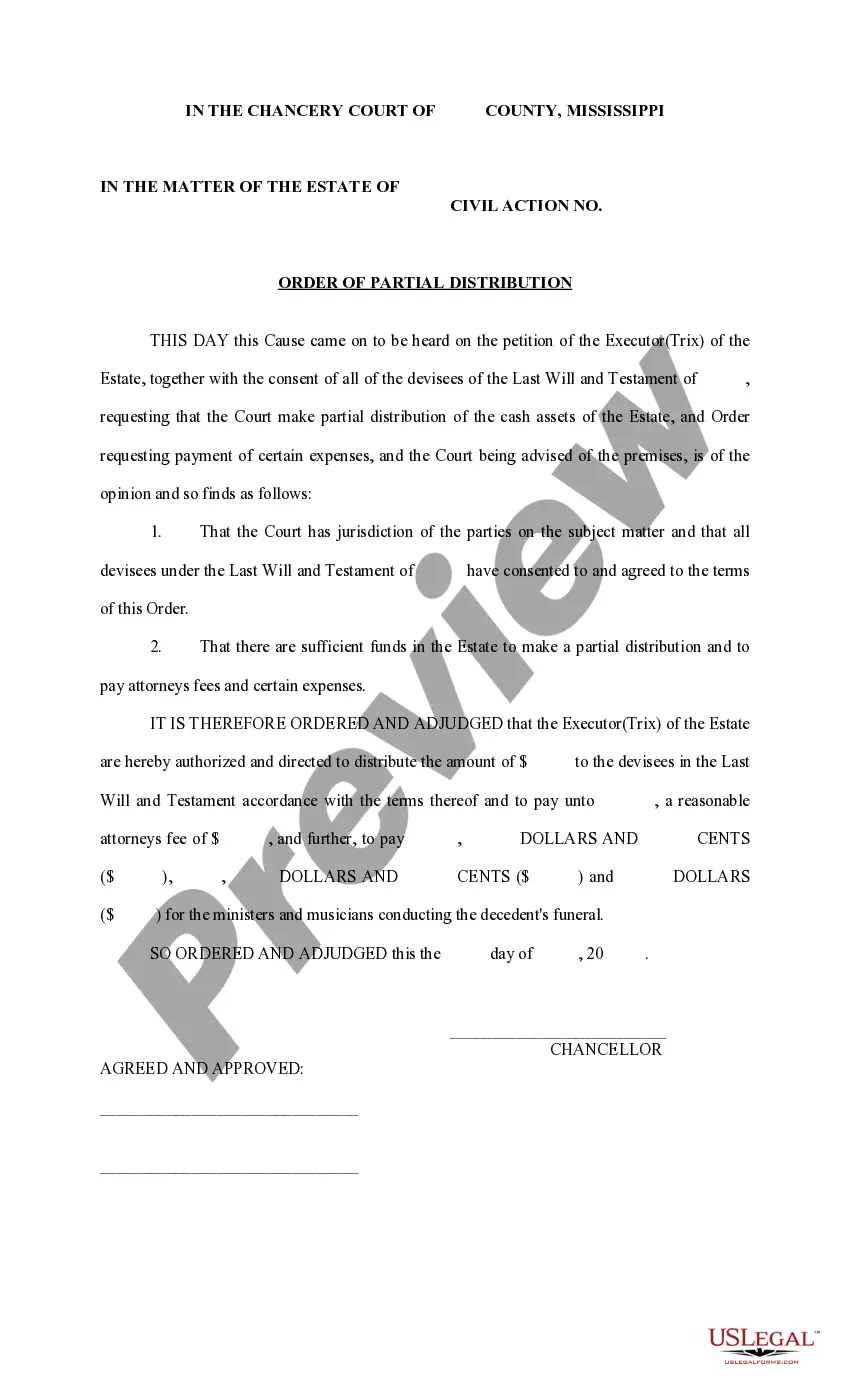
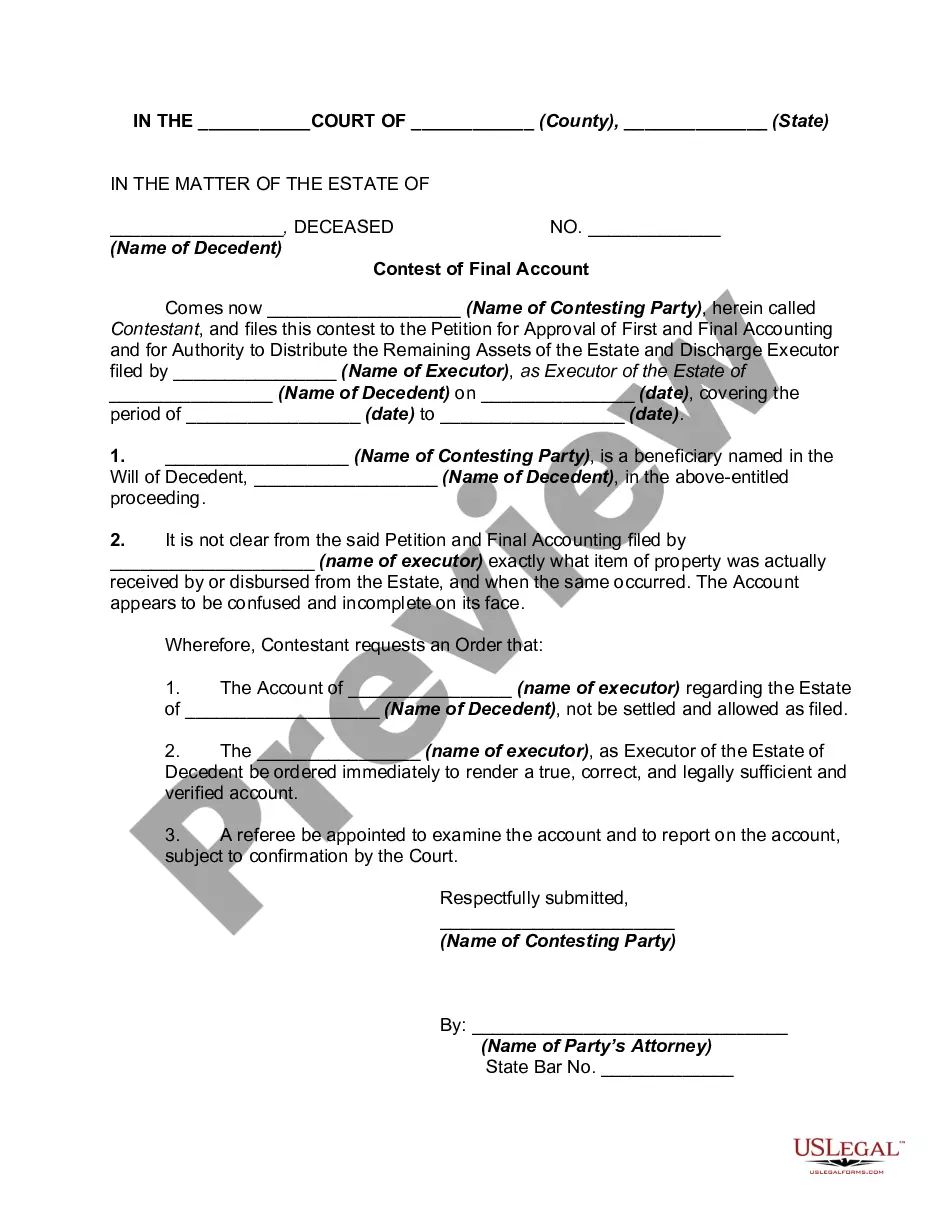
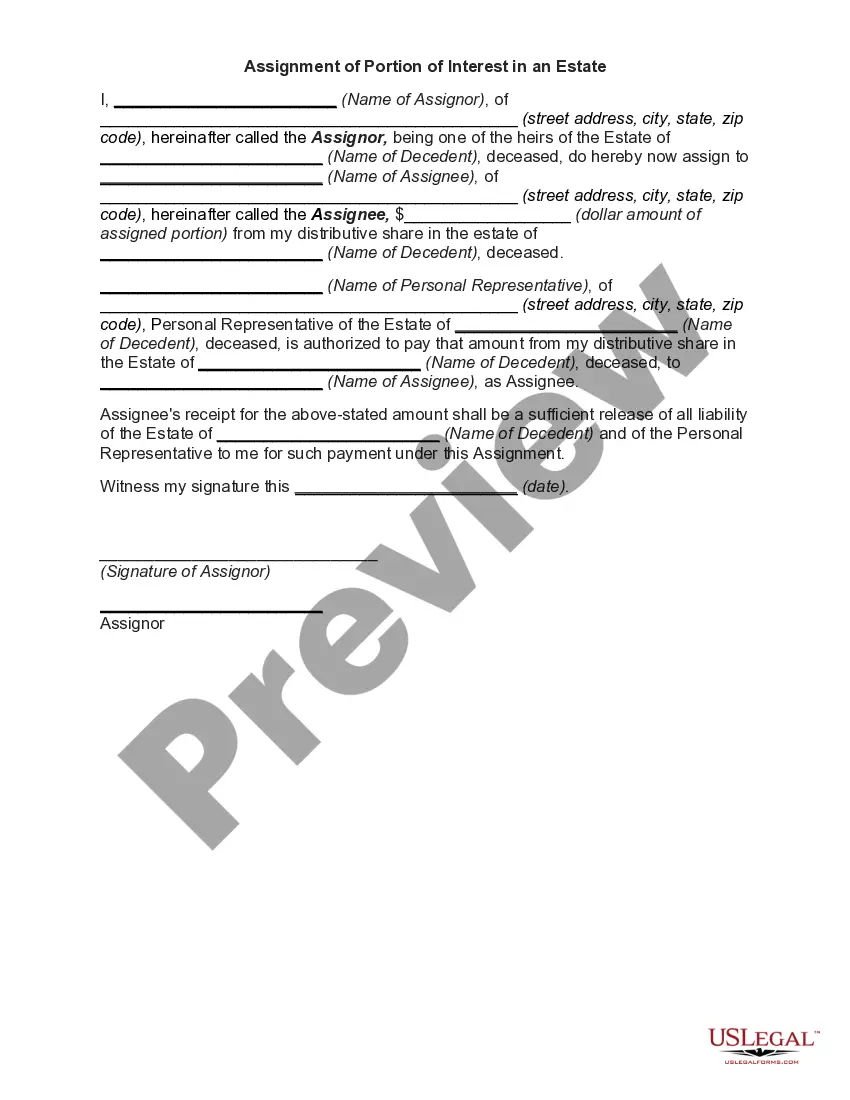
An Order of Partial Distribution is an official document issued by the court that allows for the distribution of certain assets from an estate before the final settlement of the estate. This form is distinct from other orders because it specifically addresses the immediate distribution of a portion of the estateâs assets, rather than all assets or the estateâs final accounting. It is essential for executing the distribution legally and can serve as a model for creating customized orders tailored to specific cases.
Main sections of this form
- Court information: Includes the name of the court where the order is filed.
- Case number: The unique identifier for the legal case associated with the partial distribution.
- Parties involved: Identification of the individuals or entities involved in the distribution.
- Description of assets: Details about the specific assets being distributed.
- Signature of the judge: The official endorsement that makes the order legally binding.
When this form is needed
This form should be used when a party involved in an estate needs to petition the court for permission to distribute a portion of the estateâs assets before the entire estate is settled. Common situations include needing funds for immediate expenses, paying debts, or supporting beneficiaries who require financial assistance during the probate process.
Who can use this document
- Executors or administrators of an estate who are managing estate distributions.
- Heirs or beneficiaries seeking access to estate assets for urgent needs.
- Attorneys representing parties involved in the probate process.
How to complete this form
- Identify the court: Write the name of the court handling the estate.
- Fill in the case number: Enter the unique case identifier assigned to the estate.
- List the parties: Clearly state the names and roles of all parties involved in the distribution.
- Describe the assets: Provide detailed information about the assets being requested for partial distribution.
- Obtain the judge's signature: Submit the document for the judge's review and signature.
Notarization requirements for this form
This form does not typically require notarization unless specified by local law. Be sure to verify requirements in your jurisdiction to ensure compliance.
Get your form ready online
Our built-in tools help you complete, sign, share, and store your documents in one place.
Make edits, fill in missing information, and update formatting in US Legal Forms—just like you would in MS Word.
Download a copy, print it, send it by email, or mail it via USPS—whatever works best for your next step.
Sign and collect signatures with our SignNow integration. Send to multiple recipients, set reminders, and more. Go Premium to unlock E-Sign.
If this form requires notarization, complete it online through a secure video call—no need to meet a notary in person or wait for an appointment.
We protect your documents and personal data by following strict security and privacy standards.

Make edits, fill in missing information, and update formatting in US Legal Forms—just like you would in MS Word.

Download a copy, print it, send it by email, or mail it via USPS—whatever works best for your next step.

Sign and collect signatures with our SignNow integration. Send to multiple recipients, set reminders, and more. Go Premium to unlock E-Sign.

If this form requires notarization, complete it online through a secure video call—no need to meet a notary in person or wait for an appointment.

We protect your documents and personal data by following strict security and privacy standards.
Common mistakes
- Failing to include the case number, which can delay processing.
- Not providing a clear description of the assets, leading to potential legal challenges.
- Neglecting to obtain necessary signatures from all parties involved.
- Submitting the form without checking local court rules and requirements.
Advantages of online completion
- Convenience of downloading and accessing the form anytime.
- Editability allows you to customize the document to fit your specific case.
- Reliability in using professionally drafted templates created by licensed attorneys.
Legal use & context
- This order must be issued by a competent court to ensure its enforceability.
- Partial distributions can significantly impact the final probate process.
- Failure to comply with the order could result in legal consequences or contempt of court charges.
Quick recap
- The Order of Partial Distribution facilitates timely access to estate assets.
- It's critical to follow legal protocols and conditions when filling out this form.
- Ensure that you adapt the order to fit the specifics of your case for greater clarity and impact.
Looking for another form?
Form popularity
FAQ
After someone dies, it can be a number of months before the assets are distributed to the beneficiaries. If a Grant of Probate is necessary, the Supreme Court needs to be informed of the current assets and liabilities of the deceased before probate can occur.
A term used when a grant to legatees is made of a portion of an estate before the final settlement is made.
Generally, beneficiaries have to wait a certain amount of time, say at least six months. That time is used to allow creditors to come forward and to pay them off with the estate assets. (In some cases, an executor may make partial distributions to the heirs after he or she estimates the debts.
The Mississippi small estate affidavit may be used by an heir or successor when the decedent's estate (the person who died) left $75,000 or less in probate-able personal property.
A personal representative has the discretion to make a partial distribution of assets during the administration of the estate.Once final expenses have been made and the estate is ready to close, the personal representative can distribute the remaining assets to the beneficiaries.
Those requirements are: That the estate assets are distributed at least 6 months after the deceased's date of death; That the executor has published a 30 day notice of his/her intent to distribute the estate; and. That the time specified in the notice has expired.
In the best of circumstances, the Mississippi probate process usually takes 4 to 6 months. This would only be possible if the estate was fairly simple, all interested parties are agreeable, and documents are signed and returned to the probate attorney in a timely manner.
Divide up assets based on their value. Instruct your executor to divide assets equally. Instruct your executor to sell everything and then distribute the proceeds to your beneficiaries equally.
The executor will need to wait until the 2 month time limit is up, before distributing the estate. Six month limit to bring a claim in other cases, it can be sensible for the executors not to pay any beneficiaries until at least 6 months after receiving the grant of probate.