Mississippi Temporary Letters Testamentary
What this document covers
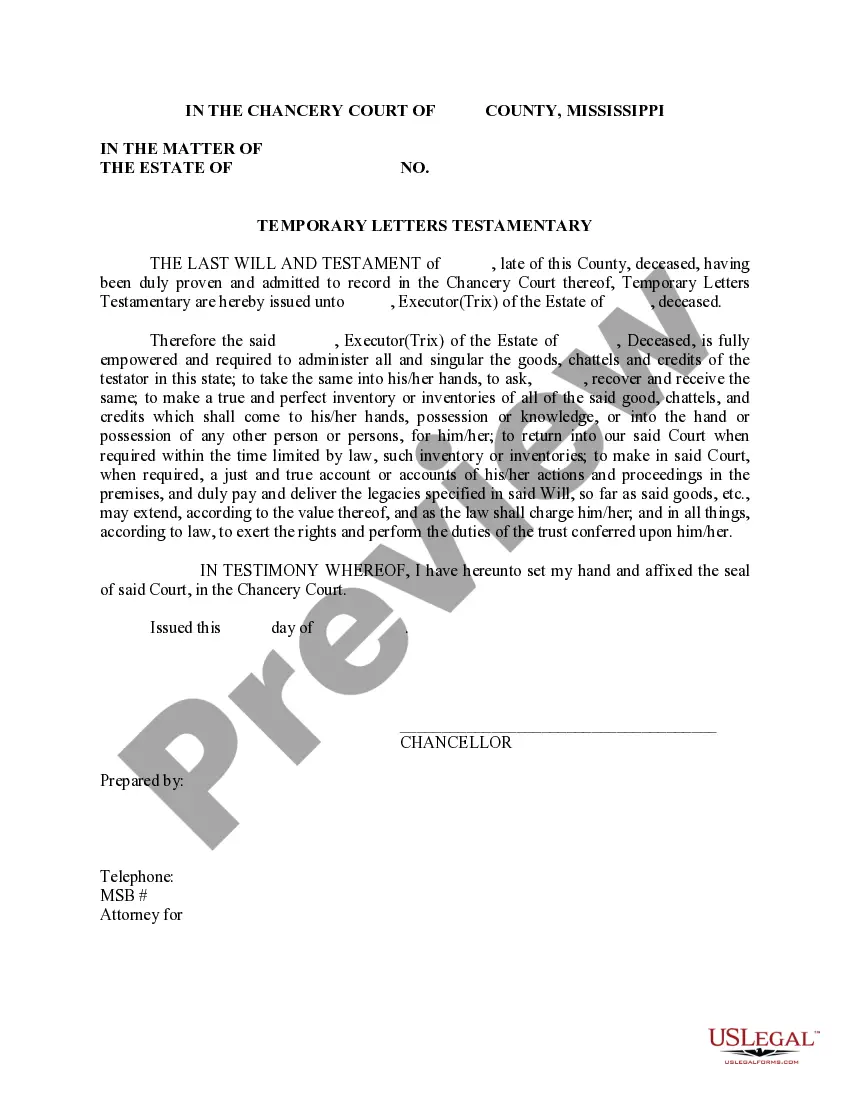
Temporary Letters Testamentary is a legal document specific to Mississippi that authorizes a person to act as the temporary administrator of a deceased person's estate. This form is crucial for managing the estate's affairs prior to the appointment of a permanent administrator. Unlike other estate-related forms, it is specifically designed for situations requiring immediate authority to handle the deceased's affairs during the transition period.
What’s included in this form
- Appointment of the Temporary Administrator: Names the individual assigned to manage the estate.
- Court Seal: Affirms the legitimacy of the letters granted by the Chancery Court.
- Authority Duration: Specifies the temporary nature of the administrator's powers until a permanent appointment.

When to use this document
This form is necessary when a person passes away, and there is an immediate need to manage their estate before a permanent administrator can be appointed. Common scenarios include settling urgent debts, managing assets, and ensuring the estate remains secure during the transition process.
Intended users of this form
- Individuals who have been designated as the temporary administrator of an estate.
- Executor or heirs of an estate awaiting the appointment of a permanent administrator.
- Legal representatives assisting in the estate management during the transition period.
How to complete this form
- Provide the full name of the deceased individual.
- Identify the temporary administrator, including their contact information.
- Include the date of death and any relevant details about the estate.
- Have the form signed before the appropriate court authority.
- Affix the court seal to validate the document.
Notarization guidance
This form does not typically require notarization unless specified by local law. However, it's essential to check local requirements to ensure compliance.
Get your form ready online
Our built-in tools help you complete, sign, share, and store your documents in one place.
Make edits, fill in missing information, and update formatting in US Legal Forms—just like you would in MS Word.
Download a copy, print it, send it by email, or mail it via USPS—whatever works best for your next step.
Sign and collect signatures with our SignNow integration. Send to multiple recipients, set reminders, and more. Go Premium to unlock E-Sign.
If this form requires notarization, complete it online through a secure video call—no need to meet a notary in person or wait for an appointment.
We protect your documents and personal data by following strict security and privacy standards.

Make edits, fill in missing information, and update formatting in US Legal Forms—just like you would in MS Word.

Download a copy, print it, send it by email, or mail it via USPS—whatever works best for your next step.

Sign and collect signatures with our SignNow integration. Send to multiple recipients, set reminders, and more. Go Premium to unlock E-Sign.

If this form requires notarization, complete it online through a secure video call—no need to meet a notary in person or wait for an appointment.

We protect your documents and personal data by following strict security and privacy standards.
Mistakes to watch out for
- Failing to include complete information about the deceased.
- Not having the necessary signatures before a court official.
- Omitting the court seal, which is essential for the validity of the letters.
Advantages of online completion
- Convenience of accessing and downloading the form instantly.
- Editability allows for easy customization to fit specific needs.
- Reliability, with forms drafted by licensed attorneys ensuring legal compliance.
Legal use & context
- Temporary Letters Testamentary grant the authority needed to manage an estate in a timely manner.
- Utilizing this form ensures that estate matters can be handled legally during the transitional period.
- This document is enforceable within Mississippi and follows state-specific legal guidelines.
What to keep in mind
- Temporary Letters Testamentary are essential for managing an estate temporarily in Mississippi.
- Proper completion and court validation are crucial for the form's legality.
- Using this form online provides convenience and access to reliable, attorney-drafted templates.
Looking for another form?

Form popularity
FAQ
A testamentary will is a traditional will, aka last will and testament. It is a legal document that is used to transfer an estate to beneficiaries after the death of the person who makes the will, or the testator.
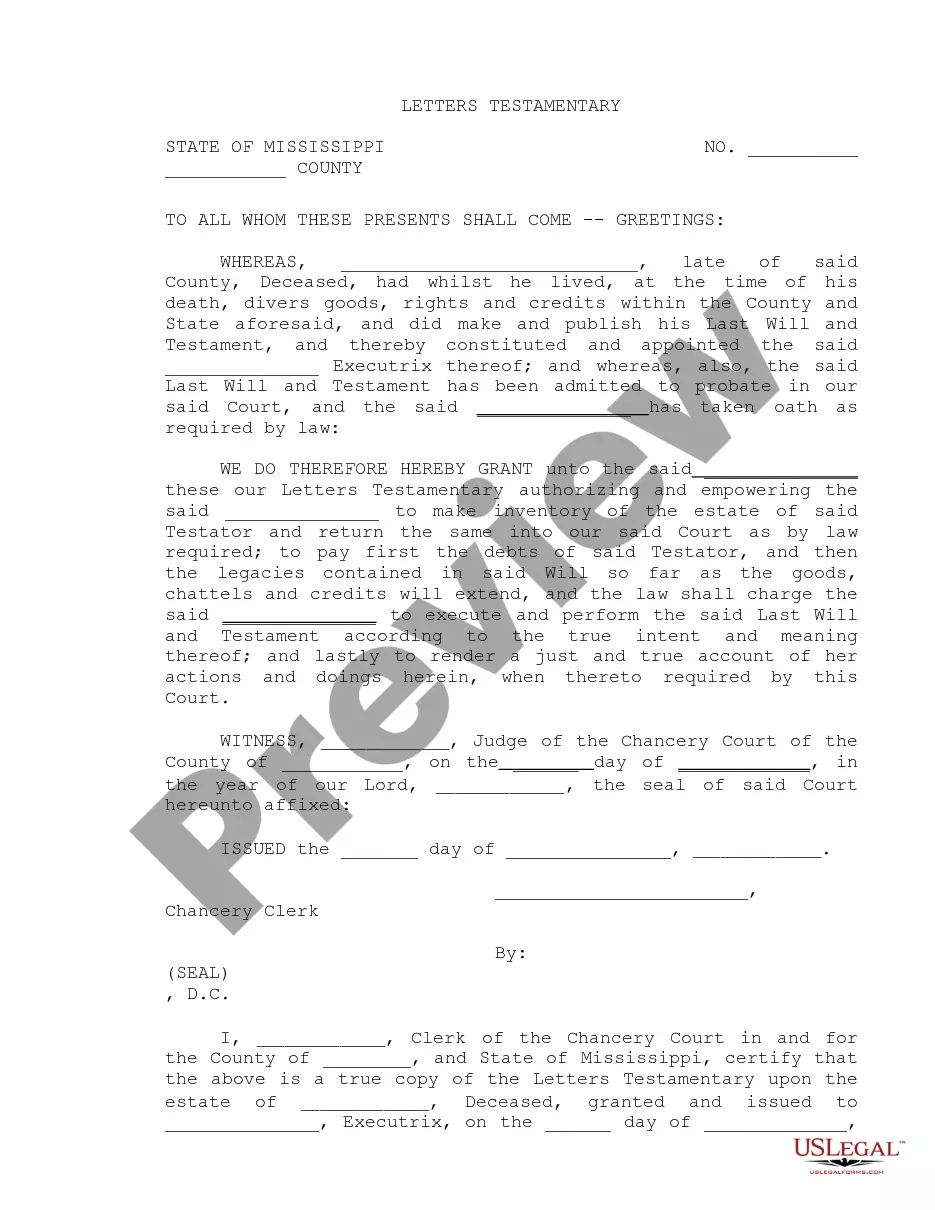
The purpose of a letter of testamentary is to show you have the legal right to act as an executor of a particular person's estate. This letter gives you permission to pay an estate's debts, take inventory of the estate's assets and distribute those assets on behalf of the decedent.
As part of the probate process, letters testamentary are issued by your state's probate court. To obtain the document, you need a copy of the will and the death certificate, which are then filed with the probate court along with whatever letters testamentary forms the court requires as part of your application.
To obtain your letter of testamentary, you will need to file the will and death certificate in the probate court, along with forms asking for the letter of testamentary. You'll need to provide your information, as well as some basic information about the value of the estate and the date of death.
Letter of Testamentary basics The purpose of a letter of testamentary is to show you have the legal right to act as an executor of a particular person's estate. This letter gives you permission to pay an estate's debts, take inventory of the estate's assets and distribute those assets on behalf of the decedent.
Adjective. of, relating to, or of the nature of a testament or will. given, bequeathed, done, or appointed by will. set forth or contained in a will.
Find the local probate court or surrogate's court, as it's sometimes called. File the will and a certified copy of the testator's death certificate . Fill out the necessary paperwork , like a petition form, and provide any additional documents.
Costs incurred by a deceased's personal representatives in administering his estate.