Mississippi Response to Plaintiff's Motion to Quash
About this form
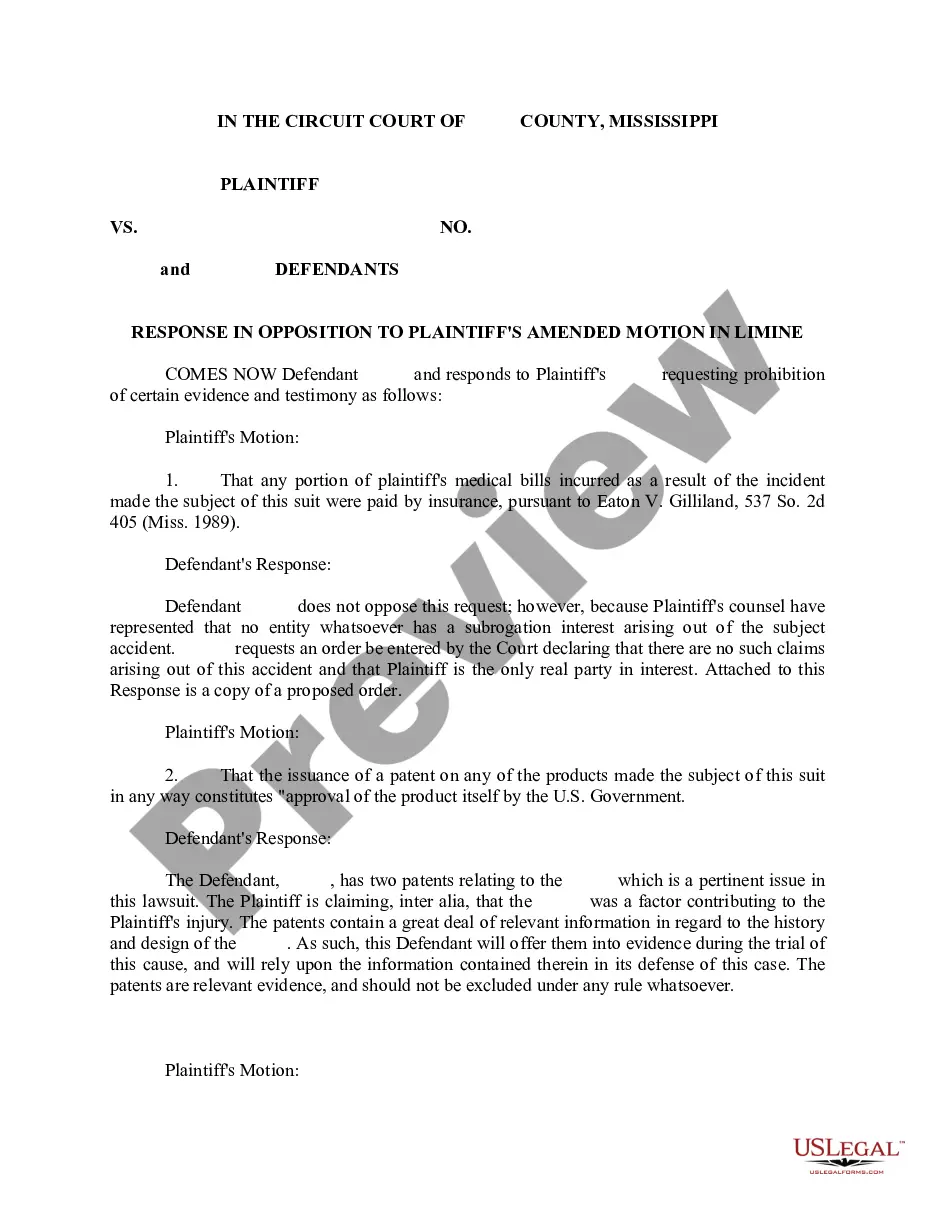
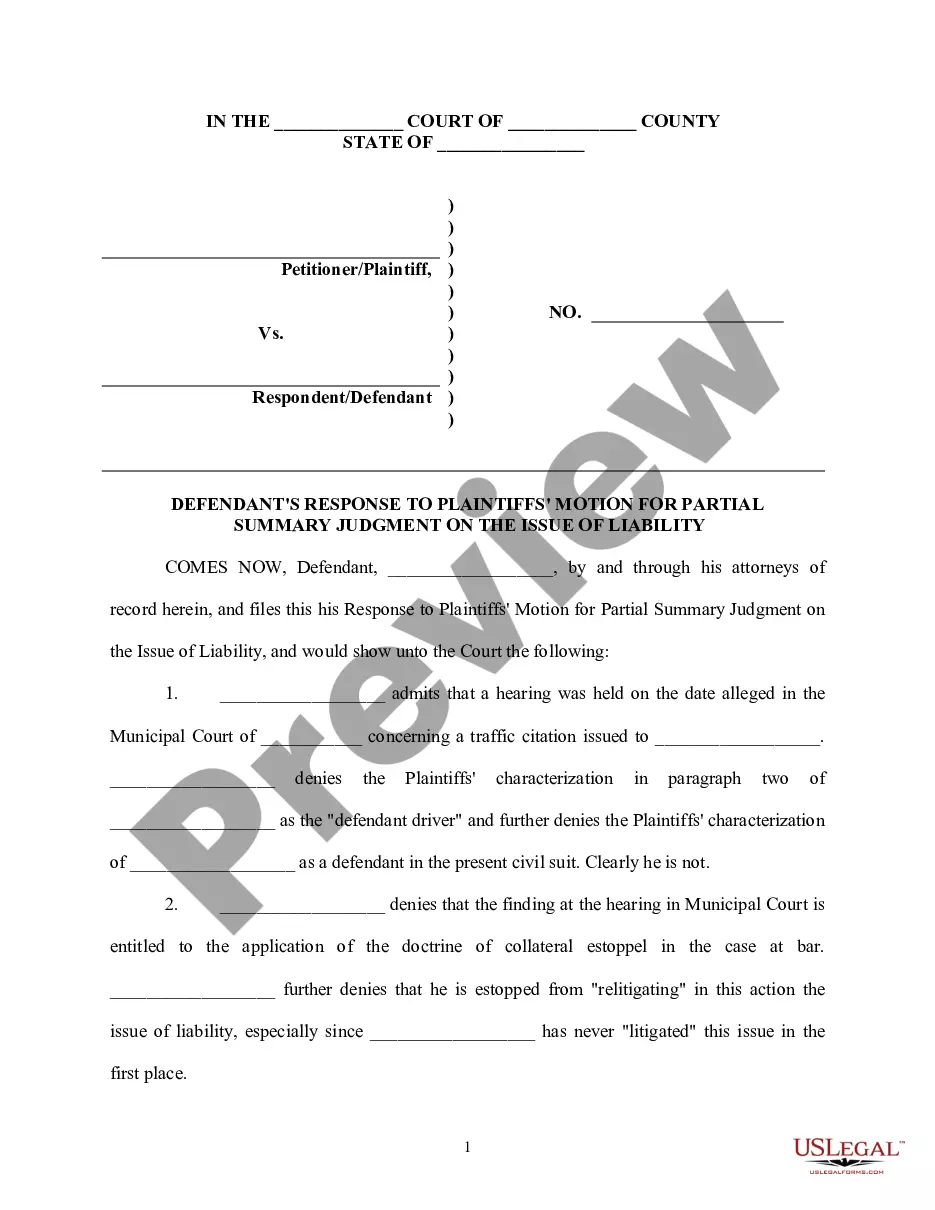
The Response to Plaintiff's Motion to Quash is a legal document used to respond to a plaintiff's request to nullify or invalidate a legal action or evidence in court. This form allows defendants to formally express their objections or arguments against the motion, ensuring their position is recorded in the legal proceedings. It differs from similar forms by specifically addressing motions seeking to quash, providing a targeted response format.
Key parts of this document
- Caption: Includes the case title and court information.
- Introduction: States the purpose of the response and identifies the plaintiff's motion.
- Factual Background: Outlines the relevant facts related to the motion.
- Arguments: Sections where the respondent can present their legal arguments against the motion to quash.
- Conclusion: Sign-off that summarizes the request for the court to deny the plaintiff's motion.
- Signature block: Area for the defendant or their attorney to sign and date the response.
Situations where this form applies
This form should be used when a defendant receives a motion from the plaintiff requesting to quash evidence, testimony, or legal action. Common scenarios include cases involving subpoenas, motions to suppress evidence, or challenges to discovery requests. It is essential in these situations to respond formally to protect your legal rights and interests in the case.
Who should use this form
This form is intended for:
- Defendants in civil cases who have been served with a motion to quash.
- Attorneys representing clients in legal proceedings responding to a motion.
- Self-represented individuals seeking to defend against a plaintiff's request in court.
How to complete this form
Follow these steps to complete your response:
- Identify the parties involved by filling in the caption section.
- Summarize the motion to quash in the introduction.
- Provide relevant facts to support your response in the factual background section.
- Clearly outline your legal arguments against the motion to quash.
- Conclude with a request for the court to deny the plaintiff's motion.
- Sign and date the form at the signature block.
Does this document require notarization?
This form usually doesn’t need to be notarized. However, local laws or specific transactions may require it. Our online notarization service, powered by Notarize, lets you complete it remotely through a secure video session, available 24/7.
Get your form ready online
Our built-in tools help you complete, sign, share, and store your documents in one place.
Make edits, fill in missing information, and update formatting in US Legal Forms—just like you would in MS Word.
Download a copy, print it, send it by email, or mail it via USPS—whatever works best for your next step.
Sign and collect signatures with our SignNow integration. Send to multiple recipients, set reminders, and more. Go Premium to unlock E-Sign.
If this form requires notarization, complete it online through a secure video call—no need to meet a notary in person or wait for an appointment.
We protect your documents and personal data by following strict security and privacy standards.

Make edits, fill in missing information, and update formatting in US Legal Forms—just like you would in MS Word.

Download a copy, print it, send it by email, or mail it via USPS—whatever works best for your next step.

Sign and collect signatures with our SignNow integration. Send to multiple recipients, set reminders, and more. Go Premium to unlock E-Sign.

If this form requires notarization, complete it online through a secure video call—no need to meet a notary in person or wait for an appointment.

We protect your documents and personal data by following strict security and privacy standards.
Common mistakes to avoid
- Failing to respond within the designated time frame.
- Omitting critical facts or legal arguments.
- Inaccurate case captions or party names.
- Not signing or dating the response.
- Neglecting to review local court rules for specific requirements.
Benefits of using this form online
- Convenience: Downloadable form allows for completion at your convenience.
- Editability: Easily adapt the form to fit your specific circumstances.
- Reliability: Templates are drafted by licensed attorneys to ensure legal compliance.
Legal use & context
- Responses to motions to quash can significantly impact ongoing litigation.
- The effectiveness of your arguments may affect the court's decision.
- Compliance with procedural rules is critical to avoid dismissal or negative rulings.
Main things to remember
- The Response to Plaintiff's Motion to Quash allows defendants to formally contest a plaintiff's motion.
- Completing the form correctly is essential for effective legal representation.
- Be mindful of state-specific requirements and deadlines for submission.
Looking for another form?
Form popularity
FAQ
A pleading demands that the other party do something, while a motion requests that the judge in the case do something. These documents can be filed with the court before, during, or after the trial, though pleadings are typically filed at or near a case's outset.
Effect of a Rule 12 Motion - Absent a court order setting a different time, a Rule 12 motion extends the time to file a responsive pleading until 14 days after the court's denial of the motion or deferral to trial or, if more definite statement ordered, 14 days after service of the more definite statement. FED.
A party may move for a more definite statement of a pleading to which a responsive pleading is allowed but which is so vague or ambiguous that the party cannot reasonably prepare a response. The motion must be made before filing a responsive pleading and must point out the defects complained of and the details desired.
Judgment on the pleadings is a motion made after pleading and before discovery; summary judgment happens after discovery and before trial; JMOL occurs during trial.Timing is very important in making a motion for JMOL; the motion can be made only after the opposing party has presented its case.
Complaint. A lawsuit begins when a plaintiff (the party suing) files a complaint against a defendant (the party being sued.) Answer. The answer is the defendant's written response to the plaintiff's complaint. Counterclaim. Cross-claim. Amended Pleadings.
When it comes to summary judgment, plaintiff lawyers are often guilty of forgetting the fact that either party can file one. If you have solid evidence that can't be disputed, you may very well be able to prove your claim without going to trial.
The Complaint. The Answer. The Counterclaim. The Cross Claim. The Pre-Trial Motions. Post-Trial Motions.
21 provides that misjoinder of parties is not ground for dismissal of an action, and that parties may be dropped or added by court order on motion of any party or of the court's own initiative at any stage in the action and on such terms as are just.
Pleadings are certain formal documents filed with the court that state the parties' basic positions.Probably the most important pleading in a civil case, since by setting out the plaintiff's version of the facts and specifying the damages, it frames the issues of the case.