Mississippi Sample Motion JNOV
What is this form?
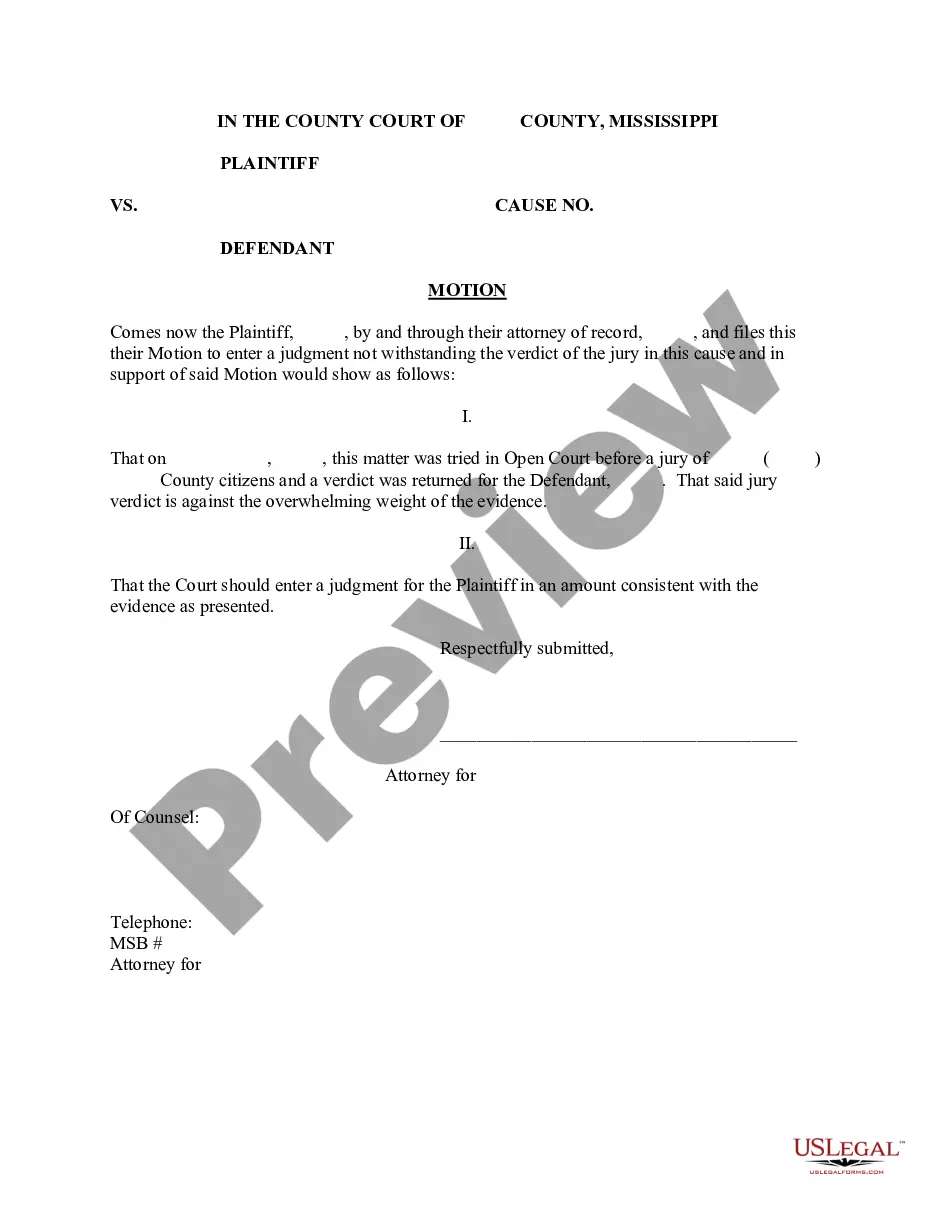
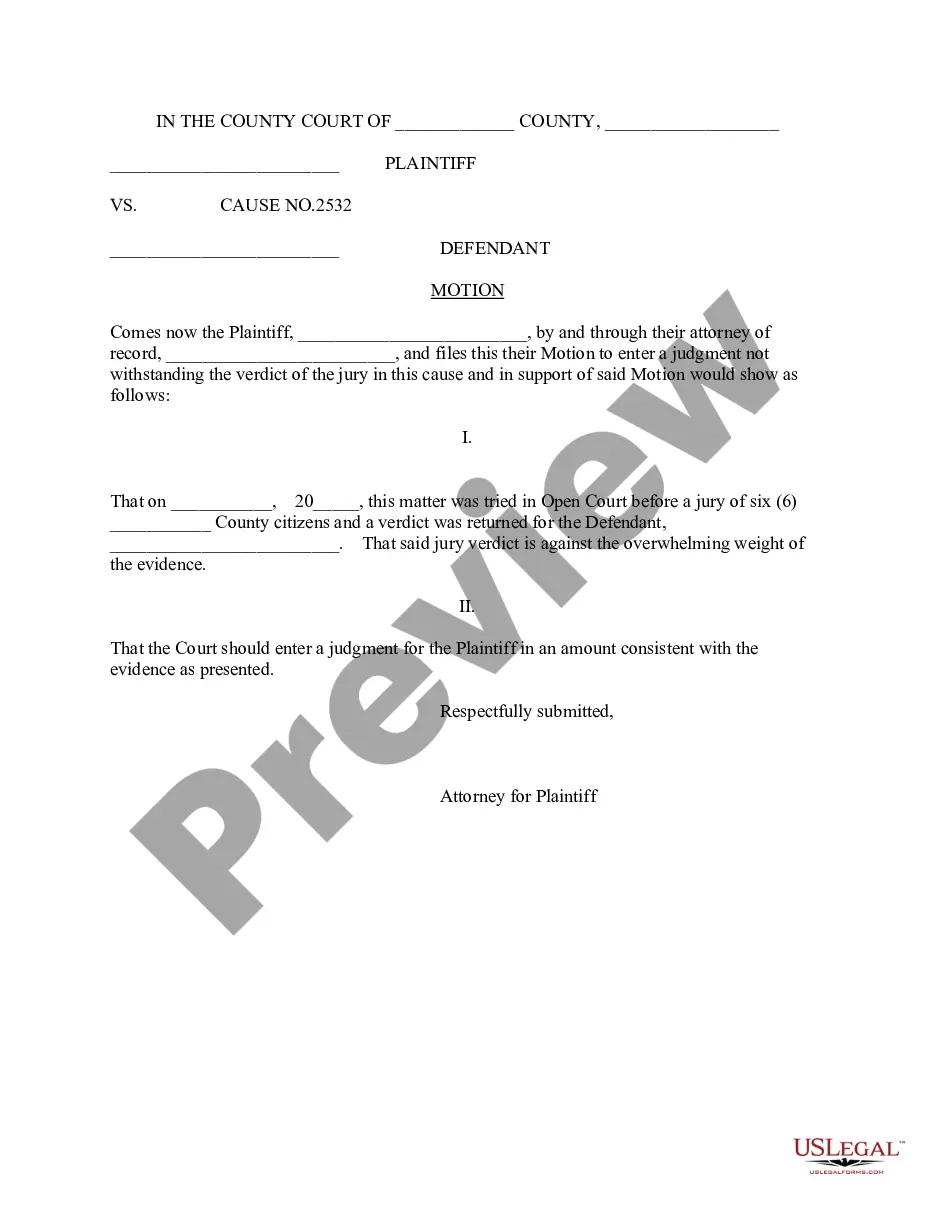
The Sample Motion JNOV (Judgment Notwithstanding the Verdict) is a legal document that requests the court to override a jury's verdict and enter a different judgment. This motion is distinct from other motions, as it specifically addresses cases where the verdict may be deemed contrary to the law or evidence presented. It is designed for use in civil cases where a judgment needs to be reconsidered, ensuring legal rights are upheld even after the jury's decision.
Key components of this form
- Title: Clearly states the motion type and case information.
- Introduction: Provides a basis for the motion and relevant facts of the case.
- Statement of Jurisdiction: Establishes why the court has authority over the case.
- Legal Standards: Outlines the legal criteria for granting a JNOV.
- Prayer for Relief: Specifies the action requested from the court.
When to use this form
This form should be used when a party believes that the jury's verdict is incorrect based on the law or evidence presented. Common scenarios include cases where the verdict is not supported by substantial evidence or when legal errors occurred during the trial that affected the outcome. Utilizing a Motion JNOV is essential for seeking justice after an unfavorable verdict.
Intended users of this form
- Litigants who have lost a case but believe the verdict was legally incorrect.
- Attorneys representing clients in civil litigation who need to challenge a jury's verdict.
- Parties involved in cases where significant legal errors occurred during the trial.
Steps to complete this form
- Identify the parties involved, including the plaintiff and defendant names.
- Provide case details, including the court name, case number, and the date of the jury verdict.
- State the grounds for the motion clearly, citing legal standards and applicable precedents.
- Specify the requested relief, indicating the judgment or ruling you wish the court to make.
- Enter the signatures of the relevant parties and their attorneys as required.
Notarization requirements for this form
Notarization is generally not required for this form. However, certain states or situations might demand it. You can complete notarization online through US Legal Forms, powered by Notarize, using a verified video call available anytime.
Get your form ready online
Our built-in tools help you complete, sign, share, and store your documents in one place.
Make edits, fill in missing information, and update formatting in US Legal Forms—just like you would in MS Word.
Download a copy, print it, send it by email, or mail it via USPS—whatever works best for your next step.
Sign and collect signatures with our SignNow integration. Send to multiple recipients, set reminders, and more. Go Premium to unlock E-Sign.
If this form requires notarization, complete it online through a secure video call—no need to meet a notary in person or wait for an appointment.
We protect your documents and personal data by following strict security and privacy standards.

Make edits, fill in missing information, and update formatting in US Legal Forms—just like you would in MS Word.

Download a copy, print it, send it by email, or mail it via USPS—whatever works best for your next step.

Sign and collect signatures with our SignNow integration. Send to multiple recipients, set reminders, and more. Go Premium to unlock E-Sign.

If this form requires notarization, complete it online through a secure video call—no need to meet a notary in person or wait for an appointment.

We protect your documents and personal data by following strict security and privacy standards.
Typical mistakes to avoid
- Failing to adhere to state-specific filing deadlines for the motion.
- Not providing sufficient legal basis for overriding the jury's verdict.
- Neglecting to include all necessary signatures on the motion.
Benefits of completing this form online
- Instant access to a professionally drafted legal document tailored for your needs.
- Editable formats allow you to customize the content easily.
- Reliable and accurate forms ensure compliance with legal requirements.
Looking for another form?

Form popularity
FAQ
A JNOV is proper when the court finds that the party bearing the BURDEN OF PROOF fails to make out a PRIMA FACIE case (a case that on first appearance will prevail unless contradicted by evidence). To be granted relief by a JNOV, a party must make a motion seeking that relief.
Rule 50(a) provides for a motion for judgment as a matter of law (JMOL) which may be made at any time before submission of the case to the jury. This was previously known as a motion for a directed verdict.
A motion for judgment as a matter of law may be made at any time before the case is submitted to the jury. The motion must specify the judgment sought and the law and facts that entitle the movant to the judgment.
A motion for a judgment notwithstanding the verdict is often filed together with a motion for a new trial by the losing party in response to the jury's verdict. A judge's decision to grant or deny a motion for JNOV is often reviewable on appeal.
To overturn a guilty verdict, the judge must look at all evidence presented most favorable to the prosecution. The judge can only grant judgment to overturn the verdict if the evidence clearly fails to establish guilt.A judge will never interfere with a jury's decision and process unless there is a legitimate reason.
A judgment notwithstanding the verdict (or JNOV) is an order by a judge after a jury has returned its verdict. The judge can overturn the jury's verdict if he or she feels it cannot reasonably be supported by the evidence or if it contradicts itself. This rarely happens.
To overturn a guilty verdict, the judge must look at all evidence presented most favorable to the prosecution. The judge can only grant judgment to overturn the verdict if the evidence clearly fails to establish guilt.A judge will never interfere with a jury's decision and process unless there is a legitimate reason.
Directed Verdict a) After Plaintiff201fs evidence or after the close of all the evidence, a party may move for a directed verdict in its favor. Standard: If the non-moving party201fs evidence is insufficient as a matter of law to go to a jury, the Court should grant a directed verdict for the moving party.
The High Court found that a trial judge is able to direct a jury to return a verdict of not guilty where a verdict of guilty would be 'unsafe or unsatisfactory. 'So, all in all, courts can intervene to either direct the outcome of a case or overturn a verdict of guilty but these situations are rare.