Mississippi Deed of Release
Overview of this form
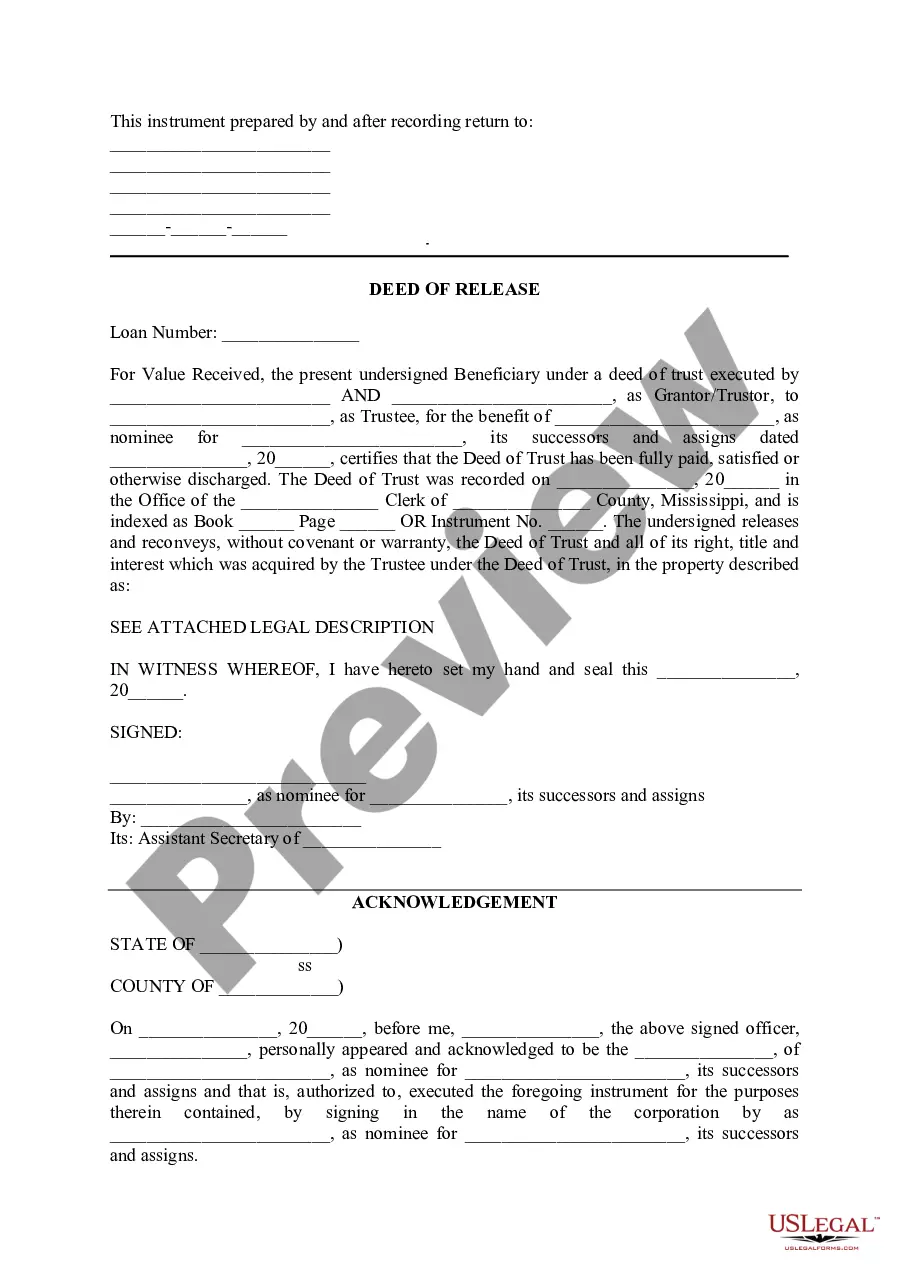
The Deed of Release is a legal document used when the beneficiary under a deed of trust certifies that the loan secured by that deed has been fully paid or otherwise discharged. This form facilitates the release of the lien on the property, ensuring that the borrower is no longer encumbered by the trust. Unlike other property-related forms, the Deed of Release specifically addresses the satisfaction of a deed of trust, rather than other types of property liens or mortgages.
What’s included in this form
- Loan number field to identify the specific loan associated with the deed of trust.
- Beneficiary declaration stating the release of the deed of trust.
- Dates for agreement execution and the original deed recording.
- Property description section that details the location and specifications of the property.
- Signature block for the beneficiary, including title and name of the firm or individual.
- Acknowledgment section requiring notarization for legal validity.

When this form is needed
This form should be used when a borrower has fully satisfied a deed of trust obligation. You will need to complete and file this document when you want to officially release the lien on a property after completing loan payments or in instances where the deed was discharged for any reason. It serves to provide clarity and legal proof that the borrower is no longer responsible for the debt linked to the property.
Who this form is for
The Deed of Release is intended for the following parties:
- The beneficiary of a deed of trust seeking to release their claim on a property.
- Borrowers or trustors who have fully paid their obligations and need to clear the title of their property.
- Attorneys or legal professionals assisting clients in property matters.
How to complete this form
- Identify the loan number related to the deed of trust to ensure proper record-keeping.
- Fill in the names of the grantors and the beneficiaries, including their roles.
- Specify the date when the deed of trust was executed and when it was recorded.
- Provide a clear legal description of the property being released from the deed of trust.
- Sign the document in the presence of a notary to validate the release.
Notarization requirements for this form
Yes, this form must be notarized to be legally valid. Notarization helps confirm the identities of the signing parties and provides an additional layer of authenticity. US Legal Forms offers integrated online notarization services, available 24/7, ensuring a secure and efficient process without the need for physical travel.
Get your form ready online
Our built-in tools help you complete, sign, share, and store your documents in one place.
Make edits, fill in missing information, and update formatting in US Legal Forms—just like you would in MS Word.
Download a copy, print it, send it by email, or mail it via USPS—whatever works best for your next step.
Sign and collect signatures with our SignNow integration. Send to multiple recipients, set reminders, and more. Go Premium to unlock E-Sign.
If this form requires notarization, complete it online through a secure video call—no need to meet a notary in person or wait for an appointment.
We protect your documents and personal data by following strict security and privacy standards.

Make edits, fill in missing information, and update formatting in US Legal Forms—just like you would in MS Word.

Download a copy, print it, send it by email, or mail it via USPS—whatever works best for your next step.

Sign and collect signatures with our SignNow integration. Send to multiple recipients, set reminders, and more. Go Premium to unlock E-Sign.

If this form requires notarization, complete it online through a secure video call—no need to meet a notary in person or wait for an appointment.

We protect your documents and personal data by following strict security and privacy standards.
Typical mistakes to avoid
- Failing to accurately fill in the property description can delay the release process.
- Not including the correct recording details for the original deed may result in invalidation of release.
- Omitting the signature of the notary can render the form unenforceable.
Benefits of completing this form online
- Easy accessibility to the form allows for immediate completion and printing.
- Editable templates ensure accurate completion without legal jargon.
- Secure storage of completed forms for future reference.
Looking for another form?


Form popularity
FAQ
A deed of release or release deed is a legal document that removes the claim of a person from an immovable property and transfers his/her share to the co-owner. The release deed procedure is executed in the sub-registrars office and both the parties are required to be present for signing it.
Once signed and notarized, a Mississippi deed must be recorded. The deed must be presented to the Recorder of Deeds in the county where the property is located. The transfer takes effect when signed and accepted by the grantee. However, recording provides notice to the public that the property was transferred.
A Mortgage Release is where you, the homeowner, voluntarily transfer the ownership of your property to the owner of your mortgage in exchange for a release from your mortgage loan and payments.Depending on your situation, you may be required to make a financial contribution to receive a mortgage release.
A deed of release is a legal document that removes a previous claim on an asset.A deed of release might be included when a lender transfers the title of real estate to the homeowner upon satisfaction of the mortgage. A deed of release literally releases the parties from previous obligations.
Retrieve your original deed. Get the appropriate deed form. Draft the deed. Sign the deed before a notary. Record the deed with the county recorder. Obtain the new original deed.
When discharging your mortgage, you are paying your current loan in full. The mortgage we have registered on the title of your property is removed, and we will no longer hold it as security.
Once signed and notarized, a Mississippi deed must be recorded. The deed must be presented to the Recorder of Deeds in the county where the property is located. The transfer takes effect when signed and accepted by the grantee. However, recording provides notice to the public that the property was transferred.
When you pay off your loan and you have a mortgage, the lender will send you or the local recorder of deeds or office that handles the filing of real estate documents a release of mortgage.On the other hand, when you have a trust deed or deed of trust, the lender files a release deed.
Deed: This is the document that proves ownership of a property. It transfers ownership of the property to the grantee, also known as the buyer.Mortgage: This is the document that gives the lender a security interest in the property until the Note is paid in full.