Mississippi Order Setting Case for Trial
Overview of this form
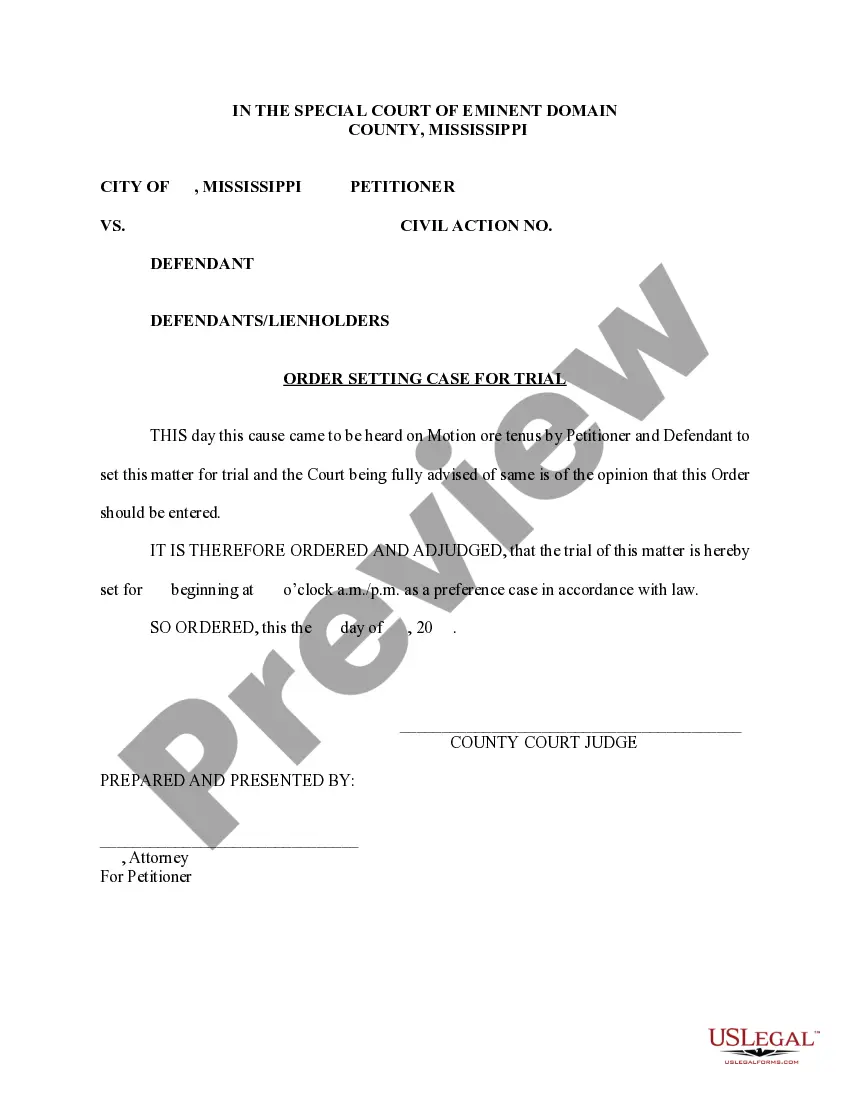
The Order Setting Case for Trial is an official court document that schedules a trial date for a legal proceeding. This form differs from others as it specifically instructs the court to set a date for a case to be heard and is typically signed by a judge. It serves as a framework for legal professionals drafting such orders, ensuring that all necessary components are included.
Form components explained
- County and city information
- Petitioner and defendant details
- Civil action number
- Date and time set for trial
- Signature of the county court judge
- Prepared by information for the attorney

When to use this document
This form is used when the petitioner or defendant needs to formally set a trial date for their civil case. It is appropriate to use this document after a motion has been heard and granted by the court, indicating readiness to proceed to trial. This ensures that all parties are informed of the trial schedule and can make the necessary preparations.
Who needs this form
- Petitioners filing for a trial date in civil cases
- Defendants responding to previous motions for trial
- Attorneys representing clients in civil litigation
- Court clerks managing case schedules
How to prepare this document
- Identify and enter the county and city where the case is filed.
- Provide the names of the petitioner and defendant as well as the civil action number.
- Specify the date and time of the trial as ordered by the court.
- Include the judge's signature line for formal approval.
- Fill in the section prepared by the attorney representing the petitioner.
Does this document require notarization?
In most cases, this form does not require notarization. However, some jurisdictions or signing circumstances might. US Legal Forms offers online notarization powered by Notarize, accessible 24/7 for a quick, remote process.
Get your form ready online
Our built-in tools help you complete, sign, share, and store your documents in one place.
Make edits, fill in missing information, and update formatting in US Legal Forms—just like you would in MS Word.
Download a copy, print it, send it by email, or mail it via USPS—whatever works best for your next step.
Sign and collect signatures with our SignNow integration. Send to multiple recipients, set reminders, and more. Go Premium to unlock E-Sign.
If this form requires notarization, complete it online through a secure video call—no need to meet a notary in person or wait for an appointment.
We protect your documents and personal data by following strict security and privacy standards.

Make edits, fill in missing information, and update formatting in US Legal Forms—just like you would in MS Word.

Download a copy, print it, send it by email, or mail it via USPS—whatever works best for your next step.

Sign and collect signatures with our SignNow integration. Send to multiple recipients, set reminders, and more. Go Premium to unlock E-Sign.

If this form requires notarization, complete it online through a secure video call—no need to meet a notary in person or wait for an appointment.

We protect your documents and personal data by following strict security and privacy standards.
Avoid these common issues
- Failing to include the correct trial date and time.
- Omitting the civil action number, which can lead to confusion.
- Incorrectly spelling names of the parties involved.
- Not obtaining the judge's signature before filing.
Benefits of using this form online
- Convenience of downloading and filling out the form from anywhere.
- Editability allows for easy updates and changes as needed.
- Access to templates drafted by licensed attorneys ensures quality and accuracy.
Legal use & context
This form is frequently used in civil litigation to ensure that cases proceed efficiently through the court system. Proper use of the Order Setting Case for Trial is essential for enforceability and to avoid delays in legal proceedings.
Summary of main points
- The Order Setting Case for Trial is essential for scheduling legal proceedings.
- Correct completion is critical to avoid delays and ensure legal compliance.
- This form is specific to Mississippi and must reflect local legal standards.
Looking for another form?


Form popularity
FAQ
If you are selected to serve on this Grand jury panel, you will serve approximately one to three days every month for an eighteen (18) month period.
A motion is an application to the court made by the prosecutor or defense attorney, requesting that the court make a decision on a certain issue before the trial begins. The motion can affect the trial, courtroom, defendants, evidence, or testimony.
The criminal statute of limitations requires prosecutors to file criminal charges against a suspect within two years for misdemeanors and within five years for certain felonies, but there is no time limit in Mississippi for charges of murder, kidnapping, rape, burglary, robbery, larceny, and several other serious
There are basically 3 stages to a civil appeal in Mississippi. First, you file your notice of appeal and other preliminary documents. Critically, you MUST file your notice of appeal within 30 days of the trial court's final judgment. In some cases, you should file a post-trial motion within 10 days of the judgment.
Unlike a criminal complaint which can only be filed 2 times without cause there is no limit on going to the grand jury. At some point there may come a time when the prosecutor decides there in not enough evidence to proceed.
Remanded means that whatever was before the court was sent usually to a lower court but here it might be to a file.
A charge is brought against someone by a prosecutor. But in an indictment, a grand jury brings the charges against the defendant. All indictments are charges, but not all charges are indictments.
Filing the Notice of Appeal. Abandonment or Settlement. Waiver of Fees. Designating the Record. Civil Case Information Sheet. Briefs. Oral Argument. The Court's Decision.
Sixteen-year-old William Haymon has spent more than 500 days in an adult jail in rural Lexington, Mississippi. There are no state rules governing how long a person can be incarcerated without being formally charged with a crime.