Mississippi Order Overruling Motion for Judgment for a New Trial
Overview of this form
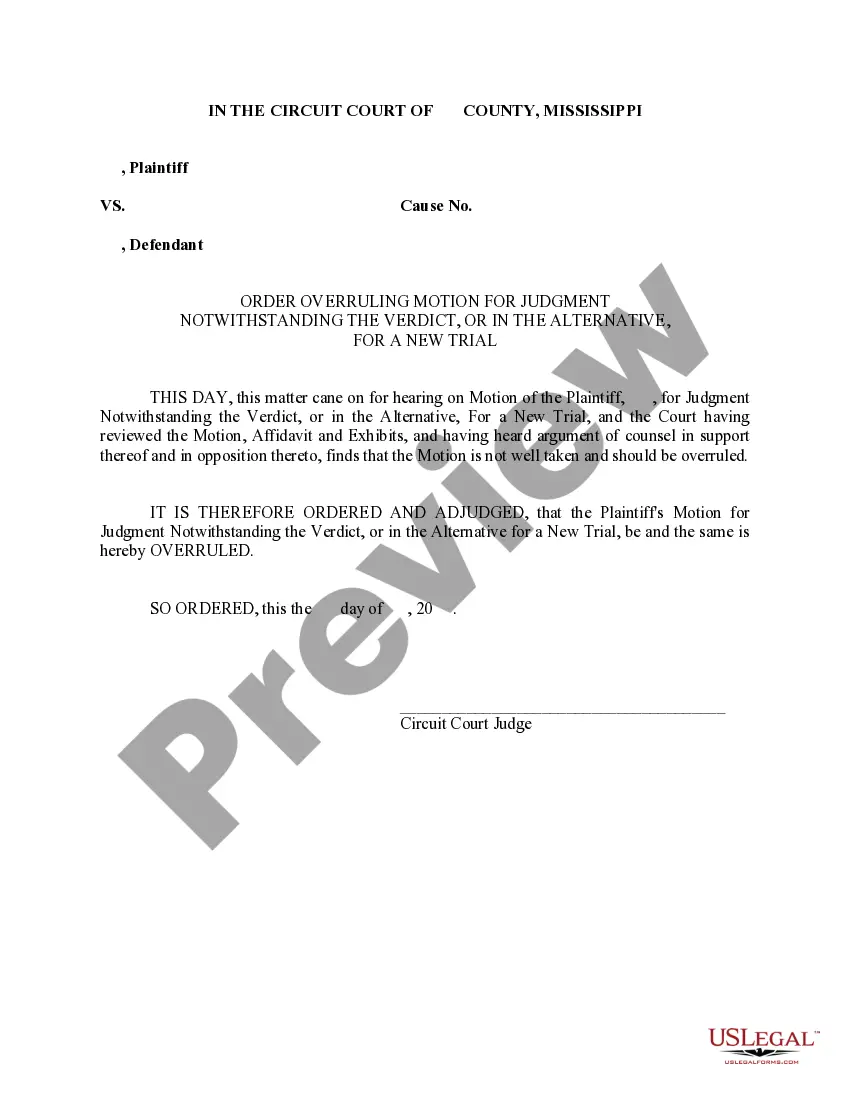
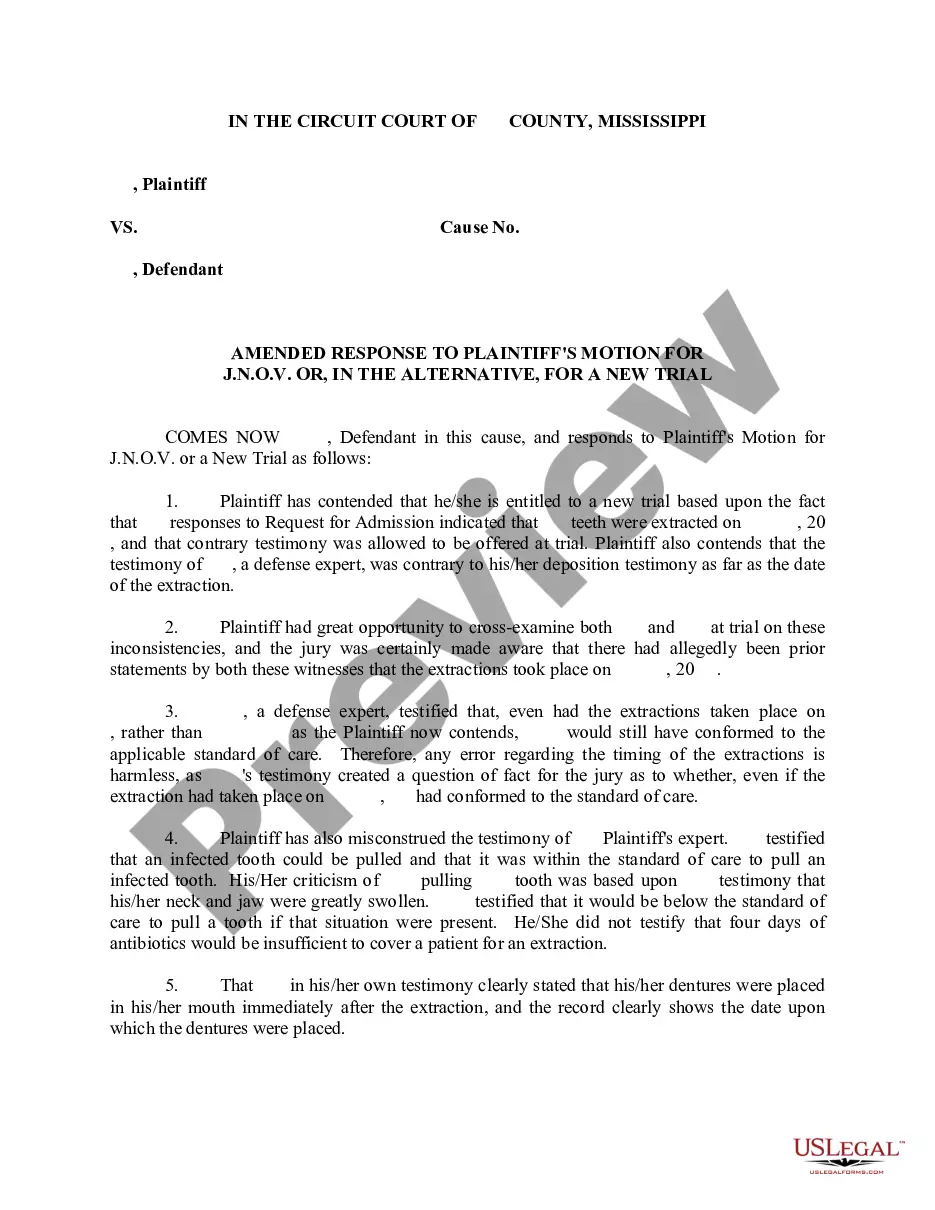
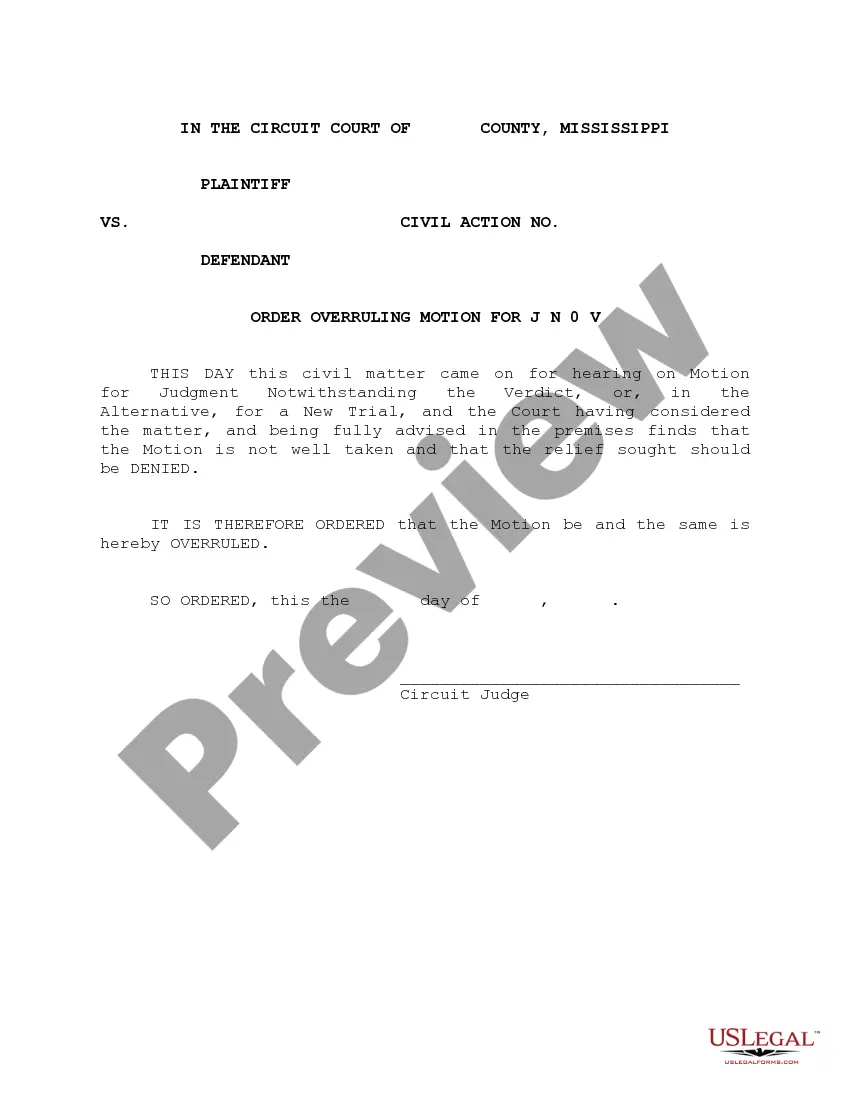
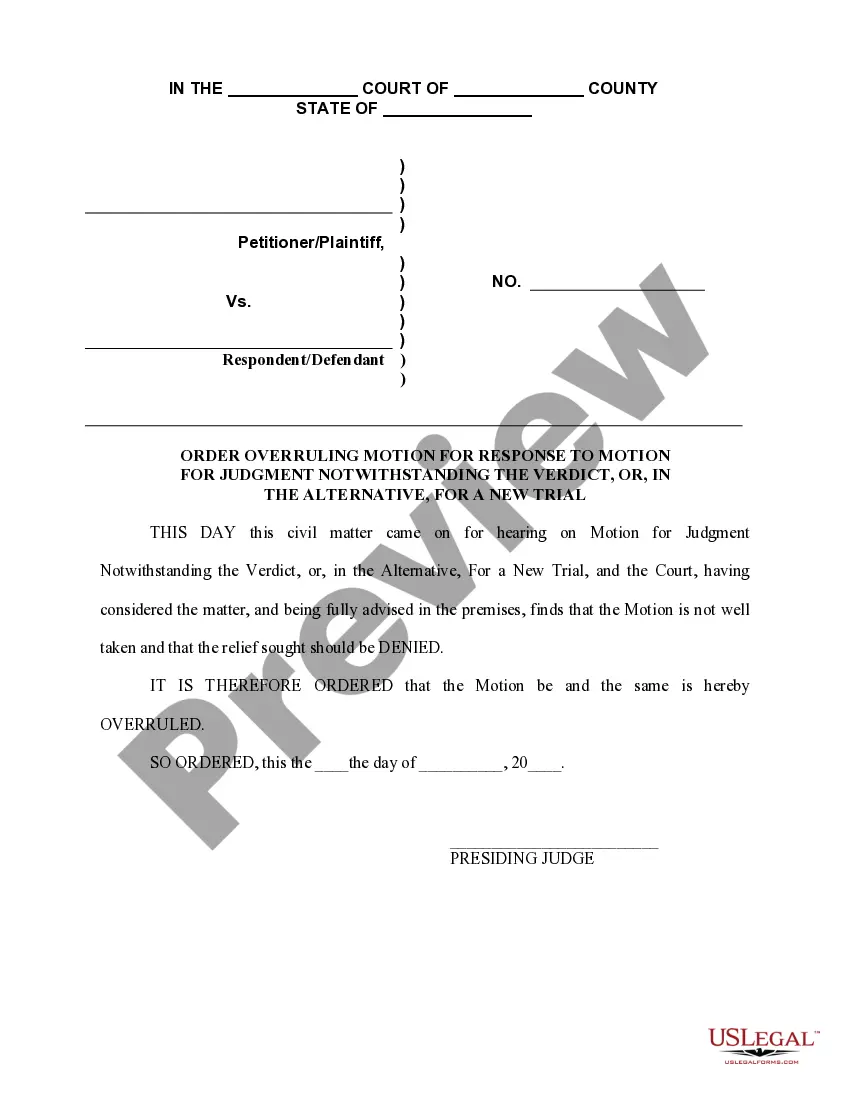
The Order Overruling Motion for Judgment for a New Trial is a legal document used to formally reject a motion filed by a party seeking a new trial or judgment notwithstanding the verdict in a court case. This form is essential when a court has determined that a previously submitted motion does not warrant further action. Unlike other motion forms, this specific order signals the court's decision and provides clarity on the outcome of the request for reconsideration or retrial.
Main sections of this form
- Case caption featuring the names of the plaintiff and defendant.
- Cause number for reference in court records.
- Statement of the court's findings after reviewing the motion and supporting documents.
- Clear declaration that the motion for judgment or new trial is overruled.
- Date of the court's order and signature line for the Circuit Court Judge.
When to use this document
This form is used when a party has filed a motion for judgment notwithstanding a verdict, or alternatively for a new trial, and the court has determined that the motion is without merit. It is required in scenarios where the court has held a hearing and reviewed the relevant materials before making a ruling. This document is crucial for formally documenting the court's decision regarding such motions in a legal proceeding.
Who should use this form
- Parties involved in a legal case where a motion for a new trial or judgment notwithstanding the verdict has been filed.
- Legal professionals seeking to document a court's decision on a motion.
- Individuals or entities aiming to formally communicate the court's ruling on a request for a new trial.
How to prepare this document
- Identify the parties involved by entering the plaintiff's and defendant's names in the case caption.
- Insert the relevant cause number to associate the order with the correct case.
- Fill in the appropriate date when the order is issued by the court.
- Provide a succinct statement outlining the court's reasoning for overruling the motion.
- Ensure the Circuit Court Judge signs and dates the order to finalize it.
Notarization requirements for this form
Notarization is not commonly needed for this form. However, certain documents or local rules may make it necessary. Our notarization service, powered by Notarize, allows you to finalize it securely online anytime, day or night.
Get your form ready online
Our built-in tools help you complete, sign, share, and store your documents in one place.
Make edits, fill in missing information, and update formatting in US Legal Forms—just like you would in MS Word.
Download a copy, print it, send it by email, or mail it via USPS—whatever works best for your next step.
Sign and collect signatures with our SignNow integration. Send to multiple recipients, set reminders, and more. Go Premium to unlock E-Sign.
If this form requires notarization, complete it online through a secure video call—no need to meet a notary in person or wait for an appointment.
We protect your documents and personal data by following strict security and privacy standards.

Make edits, fill in missing information, and update formatting in US Legal Forms—just like you would in MS Word.

Download a copy, print it, send it by email, or mail it via USPS—whatever works best for your next step.

Sign and collect signatures with our SignNow integration. Send to multiple recipients, set reminders, and more. Go Premium to unlock E-Sign.

If this form requires notarization, complete it online through a secure video call—no need to meet a notary in person or wait for an appointment.

We protect your documents and personal data by following strict security and privacy standards.
Mistakes to watch out for
- Failing to properly format the case caption or include the cause number.
- Inaccurately summarizing the court's findings or omitting key statements.
- Not including the date of the court's decision, leading to confusion about the order's validity.
- Forgetting to obtain the judge's signature, rendering the order ineffective.
Advantages of online completion
- Convenient access to a professionally drafted template tailored for legal use.
- Easily editable to accommodate specific case details and circumstances.
- Structured format ensures compliance with legal standards and requirements.
- Immediate download capability allows for quick filing with the court.
Legal use & context
- The order provides a clear and formal record of the court's ruling on the rejected motion.
- Essential for maintaining accurate court records and legal documentation.
- Enforceable in the legal proceedings as it signifies the court's final decision regarding the motion.
What to keep in mind
- The Order Overruling Motion for Judgment for a New Trial is crucial for documenting court decisions on specific motions.
- It should be completed accurately to avoid common pitfalls in legal documentation.
- This form is applicable across various legal settings and essential for parties seeking clarity on their case outcomes.
Looking for another form?


Form popularity
FAQ
A "motion" is simply a formal request to a court that it do something or decide an issue in favor of the party that asks for it. "Granted" means the court agreed with the request, and did or decided in favor of the requester.
A hearing for the purpose of asking a judge to issue a ruling or order. The motion is typically filed by one side and a notice is sent to the opposing attorney who responds in writing.
What Happens at a Trial Setting Conference? The judge will ask questions about the case to ascertain whether it is ready for trial and how long the trial is likely to take. If the case is indeed ready to proceed to trial, the court will set a Mandatory Settlement Conference (or MSC) as well as a trial date.
After you complete your motion, you must file it with the court.You must then serve (mail) a copy of your filed motion (including all exhibits and the date, time, and place of hearing) to all other parties in the case. If a party is represented by an attorney, mail the motion directly to the attorney's office.
Filing the Notice of Appeal. Abandonment or Settlement. Waiver of Fees. Designating the Record. Civil Case Information Sheet. Briefs. Oral Argument. The Court's Decision.
Fraud, accident, mistake or excusable negligence.Newly discovered evidence.Damages awarded were excessive.Insufficient evidence to support.
There are basically 3 stages to a civil appeal in Mississippi. First, you file your notice of appeal and other preliminary documents. Critically, you MUST file your notice of appeal within 30 days of the trial court's final judgment. In some cases, you should file a post-trial motion within 10 days of the judgment.
A motion is an application to the court made by the prosecutor or defense attorney, requesting that the court make a decision on a certain issue before the trial begins. The motion can affect the trial, courtroom, defendants, evidence, or testimony.
Rule 59(a) of the Federal Rules of Civil Procedure 28 U.S.C., Appendix. The amendments to the first two sentences make it clear that a judge has no power to order a new trial on his own motion, that he can act only in response to a motion timely made by a defendant.