Mississippi Final Judgment
Understanding this form
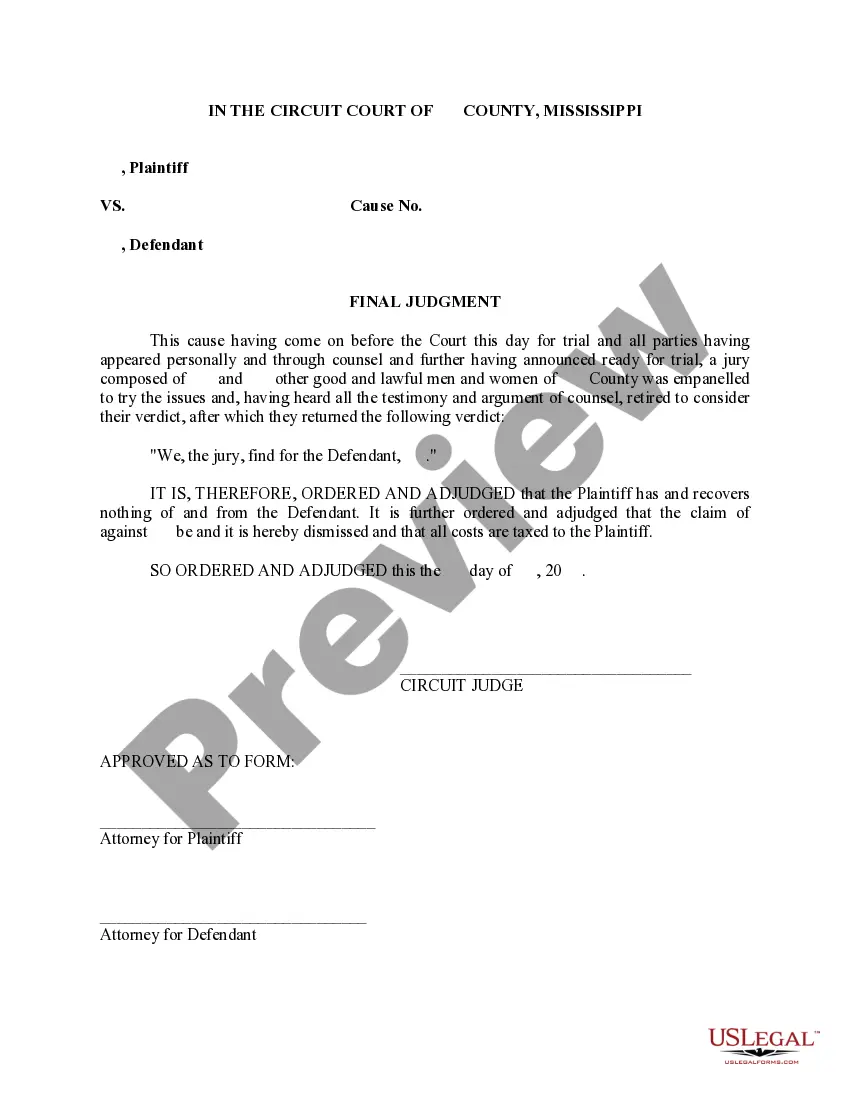
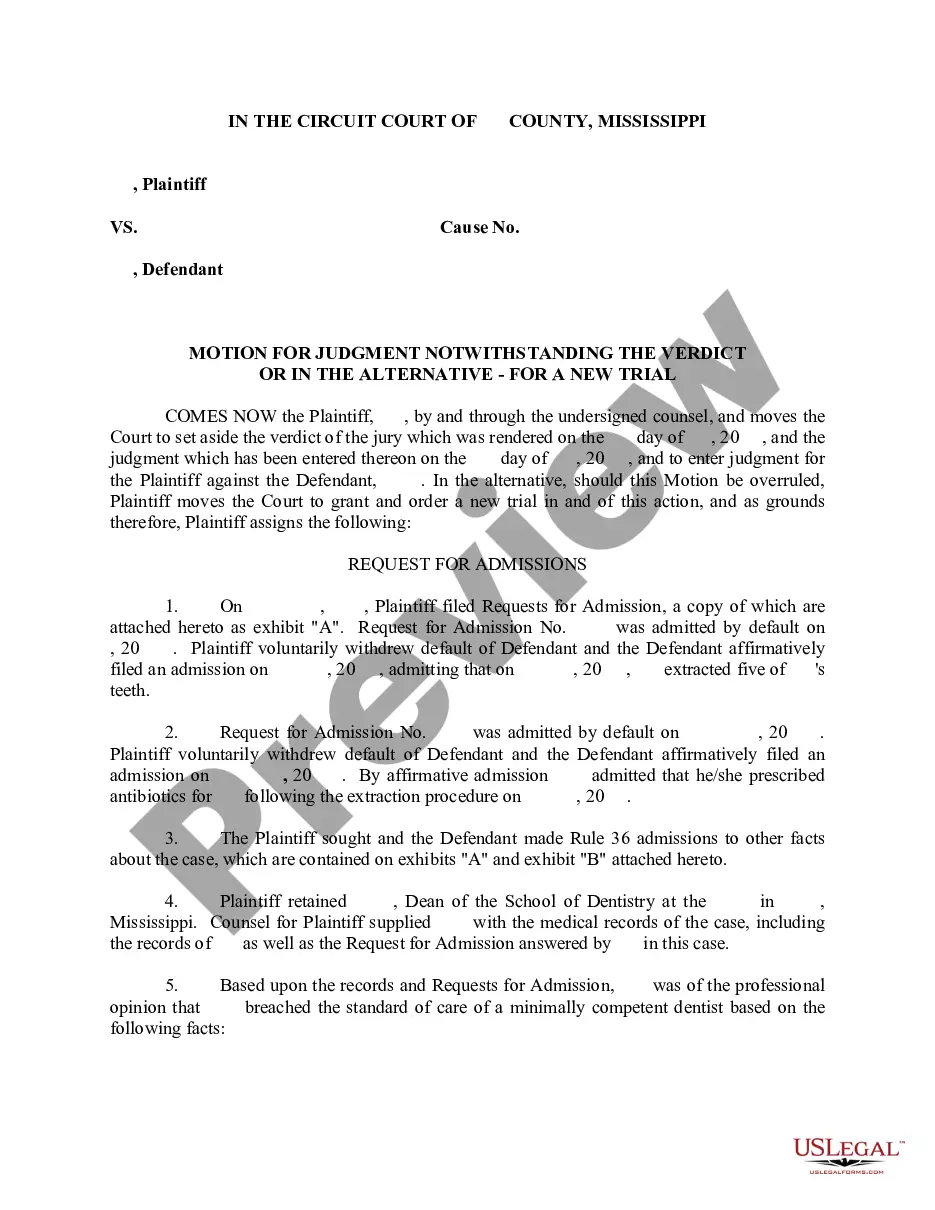
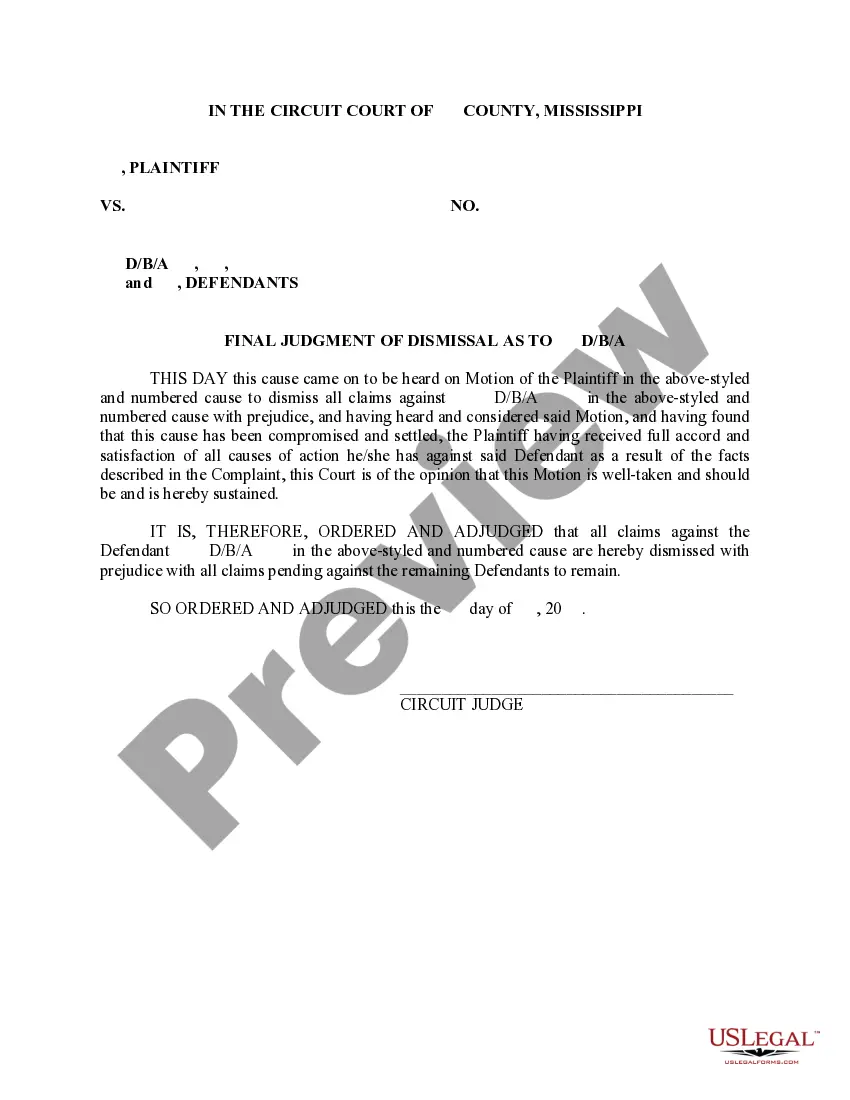
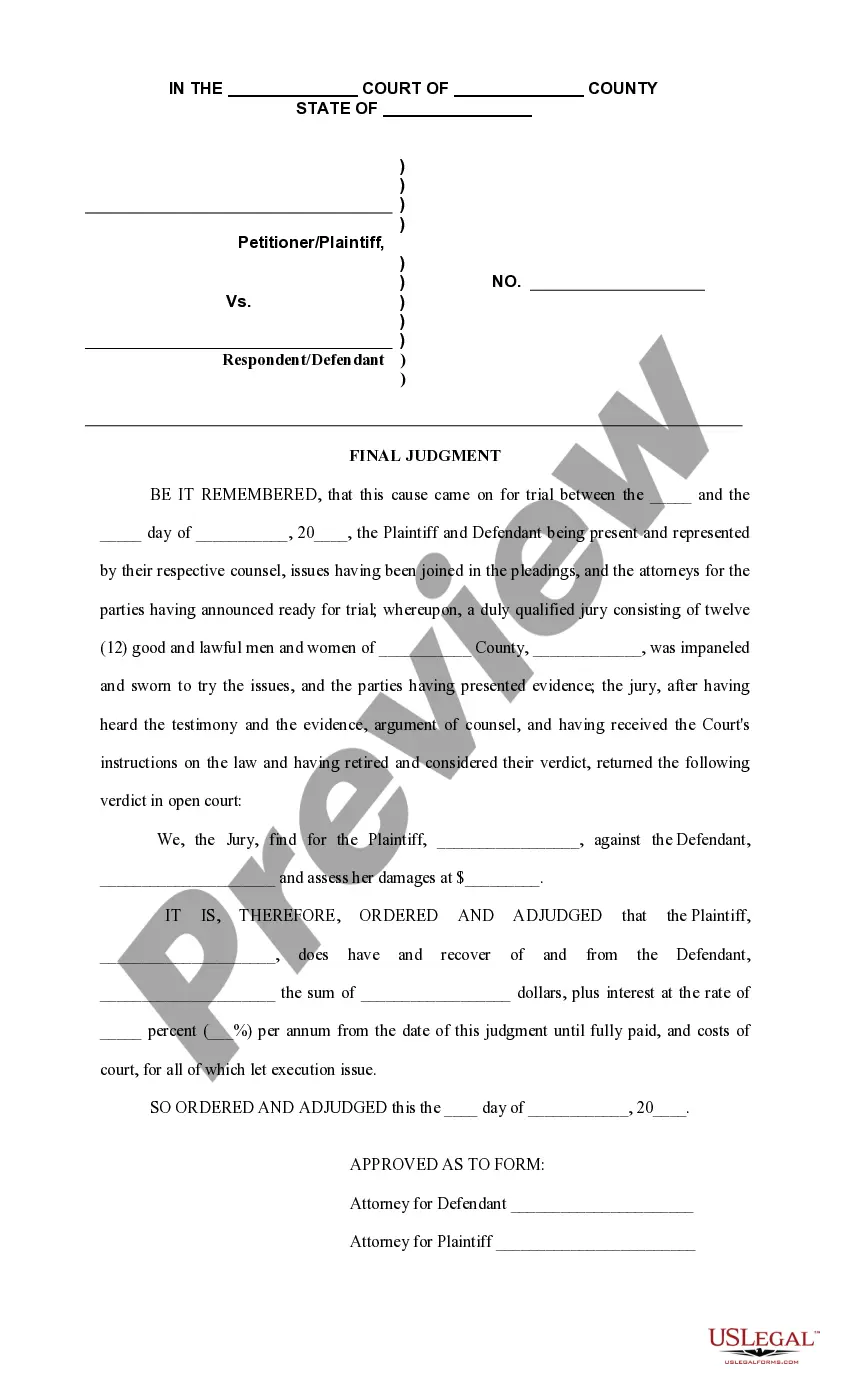
The Final Judgment is a legal document that officially concludes a lawsuit. It is signed by a judge and outlines the jury's verdict regarding the case. Unlike other forms related to lawsuits, the Final Judgment serves as the definitive decision, detailing the results and any awards or dismissals of claims. A copy of this form is sent to all parties involved in the case and is available for download in both Word and Rich Text formats.
Key components of this form
- Parties involved: Identifies the plaintiff and defendant in the case.
- Cause number: Unique identifier for the court case.
- Verdict statement: Details the jury's decision regarding the claims made.
- Judgment details: Specifies the outcome, including any recovery or dismissal of claims.
- Order by the judge: Officially concludes the case with the judge's signature.
- Attorney approval: Includes signatures from the attorneys representing each party.
When to use this document
This form should be used when a lawsuit has been resolved, and the court has rendered a final decision. It is necessary in situations where a jury trial has taken place, and a judgment is required to formally document the verdict. This is applicable in civil cases where disputes over money, property, or rights have been adjudicated.
Who can use this document
- Individuals or businesses who have been involved in a legal dispute and have reached the trial stage.
- Plaintiffs seeking to confirm the outcome of their claims.
- Defendants wishing to understand the implications of the verdict against them.
- Attorneys representing clients in a lawsuit.
How to prepare this document
- Identify the parties: Fill in the names of the plaintiff and defendant at the beginning of the form.
- Enter the cause number: Specify the unique case number assigned to this lawsuit.
- Insert the jury's verdict: Indicate the decision reached by the jury regarding the claims.
- Detail the judgment outcome: State whether the plaintiff recovers anything and mention any dismissals.
- Complete the order date: Write in the date when the judgment is being issued.
- Sign and date: Ensure the judge and attorneys sign the form to validate it.
Is notarization required?
This form does not typically require notarization unless specified by local law. Ensure to check any state-specific guidelines regarding notarization requirements.
Get your form ready online
Our built-in tools help you complete, sign, share, and store your documents in one place.
Make edits, fill in missing information, and update formatting in US Legal Forms—just like you would in MS Word.
Download a copy, print it, send it by email, or mail it via USPS—whatever works best for your next step.
Sign and collect signatures with our SignNow integration. Send to multiple recipients, set reminders, and more. Go Premium to unlock E-Sign.
If this form requires notarization, complete it online through a secure video call—no need to meet a notary in person or wait for an appointment.
We protect your documents and personal data by following strict security and privacy standards.

Make edits, fill in missing information, and update formatting in US Legal Forms—just like you would in MS Word.

Download a copy, print it, send it by email, or mail it via USPS—whatever works best for your next step.

Sign and collect signatures with our SignNow integration. Send to multiple recipients, set reminders, and more. Go Premium to unlock E-Sign.

If this form requires notarization, complete it online through a secure video call—no need to meet a notary in person or wait for an appointment.

We protect your documents and personal data by following strict security and privacy standards.
Typical mistakes to avoid
- Failing to include the correct cause number.
- Leaving out the jury's verdict or inaccurately reporting it.
- Not obtaining the necessary signatures from the judge and attorneys.
- Using an outdated version of the form that does not comply with current local laws.
Benefits of using this form online
- Convenience: Download the form anytime, from anywhere.
- Editability: Customize the form to fit the specific details of your case.
- Reliability: Forms are crafted by licensed attorneys to ensure legal compliance.
Legal use & context
- This form serves as the official document confirming the court's decision.
- It can be used in further proceedings, including appeals if applicable.
- Understanding the Final Judgment is crucial for all involved parties regarding their rights and obligations following the verdict.
Summary of main points
- The Final Judgment marks the conclusion of a lawsuit with the definitive court decision.
- Ensure all components, including signatures and verdicts, are correctly completed.
- This document is essential for informing all parties of the trial outcome and any subsequent actions needed.
Looking for another form?

Form popularity
FAQ
The court may, upon any terms as may be just, relieve a party or his or her legal representative from a judgment, dismissal, order, or other proceeding taken against him or her through his or her mistake, inadvertence, surprise, or excusable neglect. (Code Civ.
United States, a final judgment is a decision by the. district court that ends the litigation on the merits and leaves nothing for the court to do but. execute the judgment.
The grant of summary judgment usually results in a final judgment only if the grant resolves all issues as to all parties. An order for summary judgment is interlocutory if it does not entirely end the proceedings before the trial court.
There are basically 3 stages to a civil appeal in Mississippi. First, you file your notice of appeal and other preliminary documents. Critically, you MUST file your notice of appeal within 30 days of the trial court's final judgment. In some cases, you should file a post-trial motion within 10 days of the judgment.