Mississippi Warranty Deed - From Widow or Widower
Overview of this form
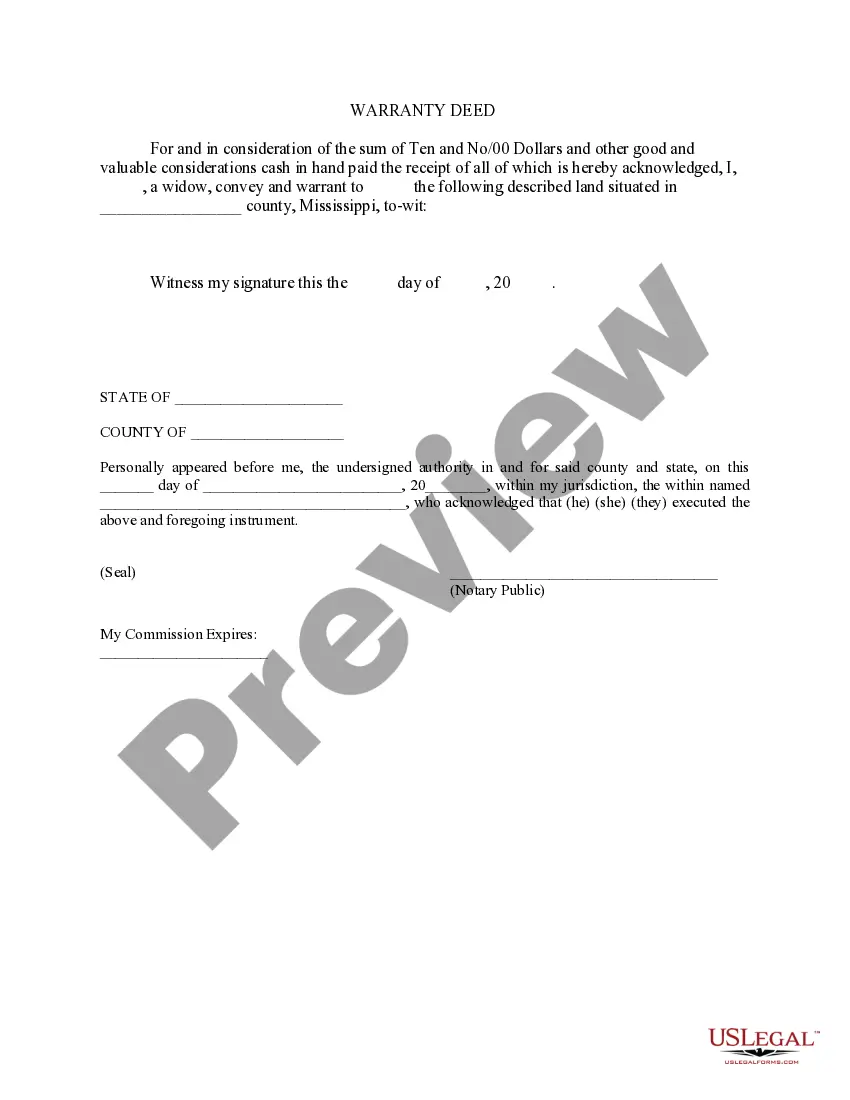
The Warranty Deed - From Widow or Widower is a legal document used to transfer real property ownership from a surviving spouse to another party. This form is essential for ensuring that the property title is conveyed securely and without any liens or claims. Unlike other types of deeds, this warranty deed provides a guarantee that the transferor holds clear title to the property and has the right to sell it. It helps protect the interests of the new owner by affirming the validity of the property title.
Key components of this form
- The names and contact information of the grantor (widow or widower) and grantee.
- A thorough legal description of the property being transferred.
- Statements assuring the grantee that the title is free from claims or liens.
- The date of the transfer to establish when the deed becomes effective.
- The signatures of the grantor and a notary public, if required.



When to use this document
This form is typically used in situations where a widow or widower wishes to transfer property to an heir, family member, or third party after the death of their spouse. It is particularly relevant in estate planning and when liquidating assets in probate proceedings. Using a warranty deed provides the assurance that the new owner is receiving ownership without any hidden issues regarding the title.
Who can use this document
- Widows or widowers looking to transfer property following the death of their spouse.
- Real estate professionals assisting clients in property transactions involving estates.
- Heirs who wish to formalize property ownership during the estate settlement process.
- Individuals needing a reliable way to ensure the clear title of the property being transferred.
How to complete this form
- Identify the parties involved by filling in the names and addresses of both the grantor (widow or widower) and the grantee.
- Specify the property by providing a detailed legal description, including parcel number and location.
- Indicate the date of the transfer to establish a clear timeline.
- Ensure that the grantor signs the deed in the presence of a notary public if notarization is required.
- Keep a copy of the completed deed for personal records after the deed is filed with the appropriate local authority.
Notarization requirements for this form
Notarization is required for this form to take effect. Our online notarization service, powered by Notarize, lets you verify and sign documents remotely through an encrypted video session, available 24/7.
Get your form ready online
Our built-in tools help you complete, sign, share, and store your documents in one place.
Make edits, fill in missing information, and update formatting in US Legal Forms—just like you would in MS Word.
Download a copy, print it, send it by email, or mail it via USPS—whatever works best for your next step.
Sign and collect signatures with our SignNow integration. Send to multiple recipients, set reminders, and more. Go Premium to unlock E-Sign.
If this form requires notarization, complete it online through a secure video call—no need to meet a notary in person or wait for an appointment.
We protect your documents and personal data by following strict security and privacy standards.

Make edits, fill in missing information, and update formatting in US Legal Forms—just like you would in MS Word.

Download a copy, print it, send it by email, or mail it via USPS—whatever works best for your next step.

Sign and collect signatures with our SignNow integration. Send to multiple recipients, set reminders, and more. Go Premium to unlock E-Sign.

If this form requires notarization, complete it online through a secure video call—no need to meet a notary in person or wait for an appointment.

We protect your documents and personal data by following strict security and privacy standards.
Mistakes to watch out for
- Forgetting to include a complete legal description of the property.
- Not obtaining a notarization when required.
- Leaving out the date of the transfer.
- Failing to verify the identity of the grantee before signing.
Why complete this form online
- Convenient access to legal documents designed by licensed attorneys.
- Editability allows users to customize the form to fit their specific situation.
- Reliable resource for ensuring compliance with state-specific legal requirements.
- Quick downloads save time compared to traditional legal services.
Key takeaways
- A Warranty Deed - From Widow or Widower conveys real property ownership from a surviving spouse.
- This form protects both the grantor and grantee by providing assurances about the title.
- Ensure the deed complies with Mississippi state law for proper execution.
- Online forms simplify the process, making legal documentation more accessible.
Looking for another form?
Form popularity
FAQ
To transfer it, you will have to get a succession certificate (for moveable property) and a letter of administration (for Immoveable property). While doing so, get the son and daughter to give no objections in court that they have no objection if all the property is transferred to the widow.
How long will home warranty coverage last? Most home warranty terms are one year. This is a 12-month contract which in many cases is renewable from year to year. Make sure to renew your home warranty promptly each year so that you're not caught without coverage.
Purchasing a home warranty, though, can help alleviate some of the financial burden new homeowners face when a major appliance or home system goes out. Yes, you'll pay for a warranty upfront but the savings could be worth the added expense.
If you don't want to worry about paying out of pocket when a key household item breaks down, spending $25 to $50 per month for protection is often worth it. The average home warranty costs between $300 and $600 per year, typically covering more than $20,000 worth of appliances and systems in your home.
What does a $500 home warranty cover? An annual service contract for $500 will typically cover basic systems like air conditioning, electrical, and plumbing, and important appliances like your refrigerator, dishwasher, washer, and dryer.