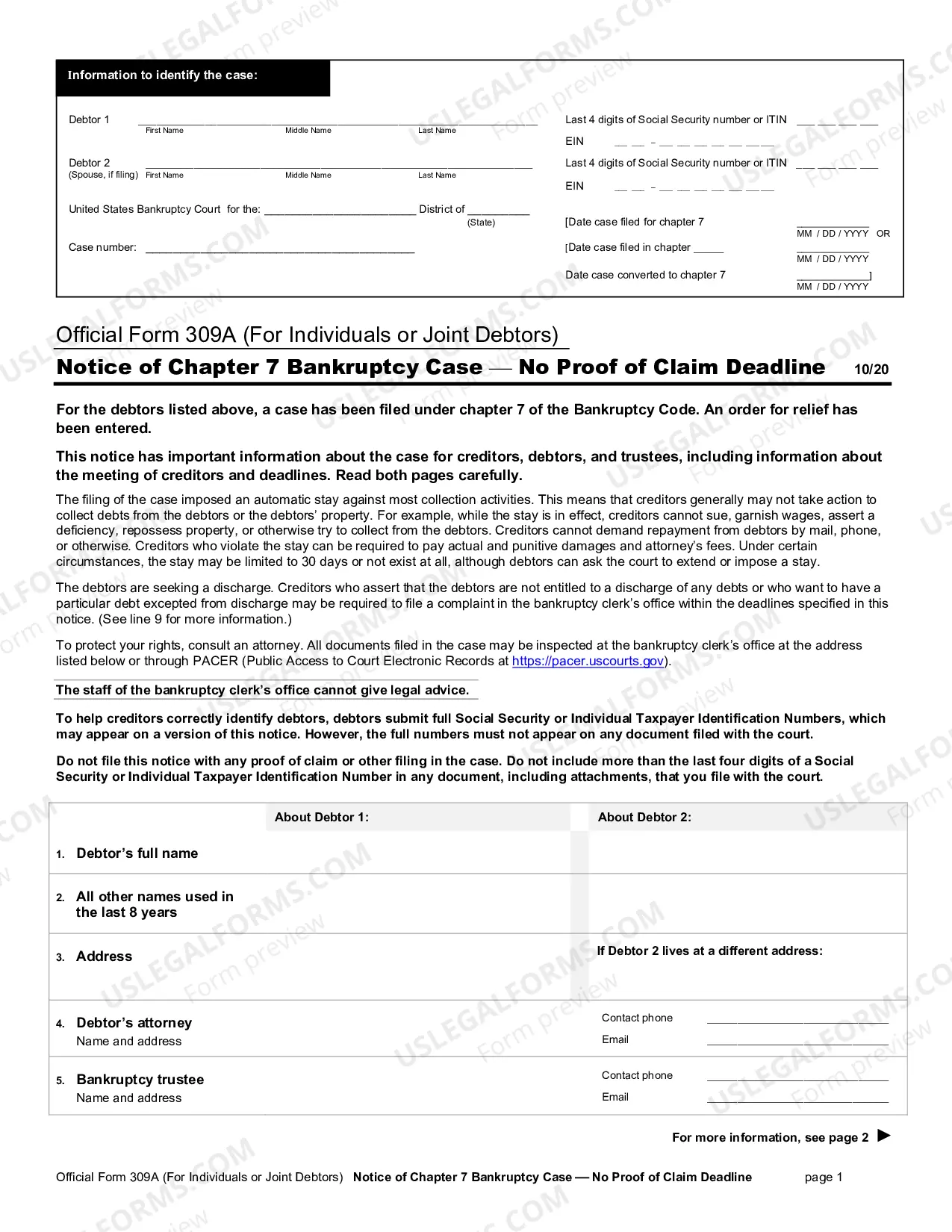
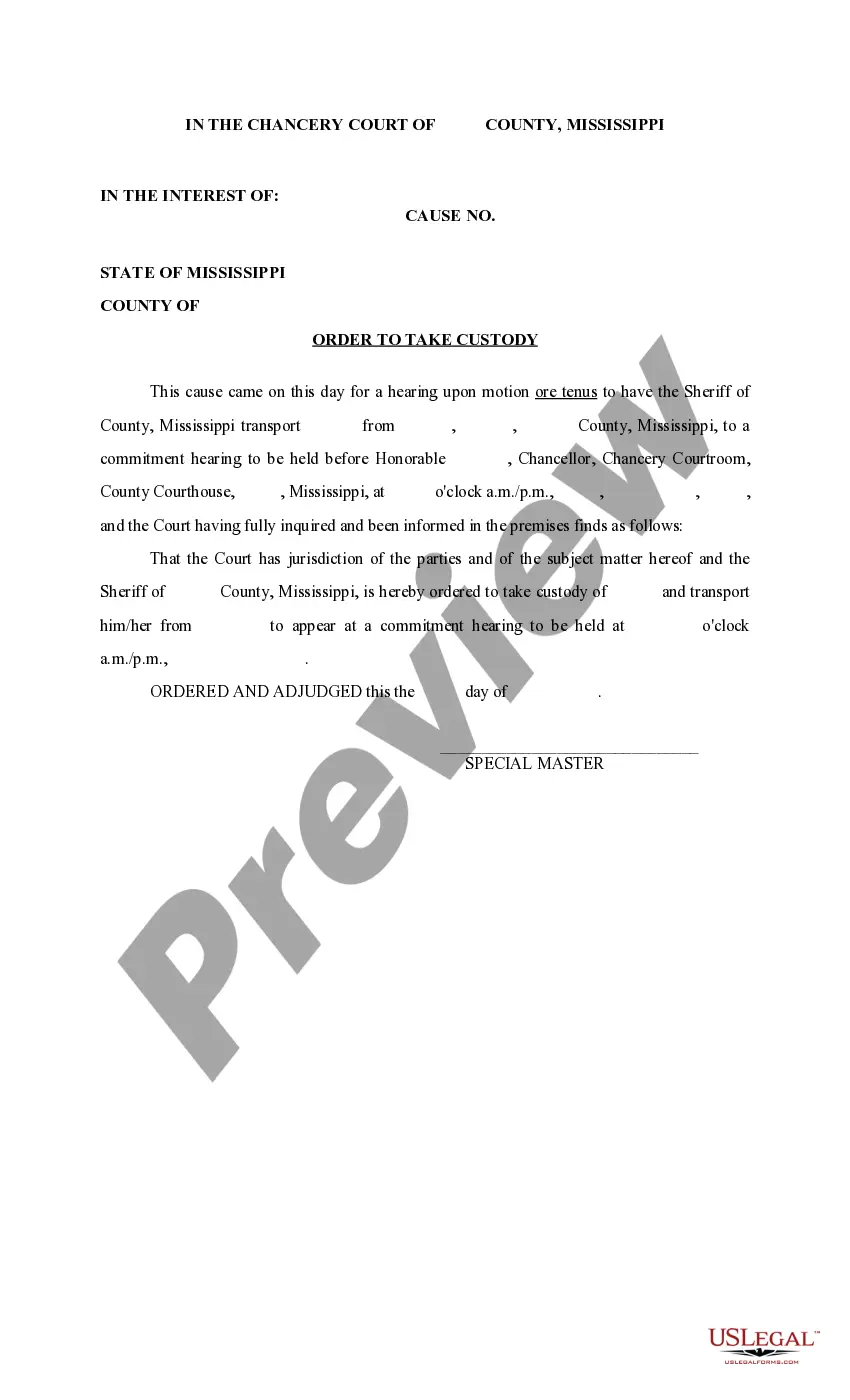
Mississippi Order to Take Custody
What is this form?
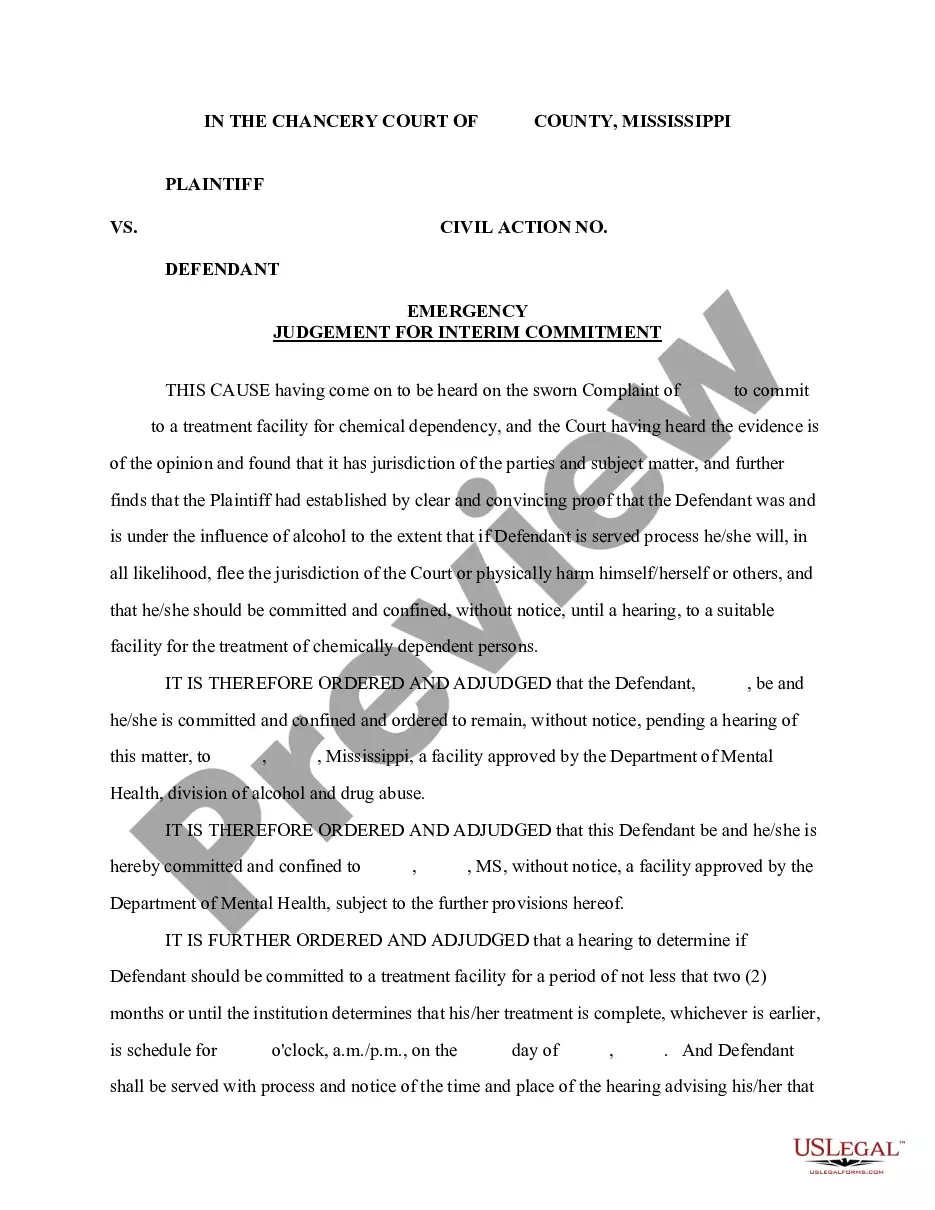
The Order to Take Custody is a legal document used in Mississippi Chancery Court to formally request the taking of custody of a person, usually in matters related to juvenile or family law. This document serves as a crucial tool for individuals seeking to establish or enforce custody arrangements, distinguishing it from other custody-related forms that may not carry the same legal weight or specificity.
Key components of this form
- Case Caption: Includes the name of the court and parties involved.
- Order Date: The date on which the custody order is issued.
- Custodian Information: Details about the individual taking custody.
- Terms of Custody: Specific conditions under which custody is granted.
- Signature block: Areas for required signatures from relevant parties.
When to use this form
This form is necessary when there is a legal need to take custody of an individual, typically following a court request in family or juvenile court. It should be used when circumstances require formal recognition of custody arrangements, such as during legal disputes or in cases where the safety and welfare of a minor are in question.
Who should use this form
- Parents or guardians seeking custody of a child.
- Attorneys representing clients in custody disputes.
- Individuals involved in family law proceedings related to custody matters.
Completing this form step by step
- Identify the parties involved, including the petitioner and custodian.
- Enter the date on which the order is being issued.
- Provide detailed information about the custodian, including their relationship to the individual being taken into custody.
- Specify the terms and conditions of custody within the designated section.
- Complete the signature block with the relevant signatures and dates from all parties involved.
Does this document require notarization?
This form must be notarized to be legally valid. US Legal Forms provides secure online notarization powered by Notarize, allowing you to complete the process through a verified video call.
Get your form ready online
Our built-in tools help you complete, sign, share, and store your documents in one place.
Make edits, fill in missing information, and update formatting in US Legal Forms—just like you would in MS Word.
Download a copy, print it, send it by email, or mail it via USPS—whatever works best for your next step.
Sign and collect signatures with our SignNow integration. Send to multiple recipients, set reminders, and more. Go Premium to unlock E-Sign.
If this form requires notarization, complete it online through a secure video call—no need to meet a notary in person or wait for an appointment.
We protect your documents and personal data by following strict security and privacy standards.

Make edits, fill in missing information, and update formatting in US Legal Forms—just like you would in MS Word.

Download a copy, print it, send it by email, or mail it via USPS—whatever works best for your next step.

Sign and collect signatures with our SignNow integration. Send to multiple recipients, set reminders, and more. Go Premium to unlock E-Sign.

If this form requires notarization, complete it online through a secure video call—no need to meet a notary in person or wait for an appointment.

We protect your documents and personal data by following strict security and privacy standards.
Avoid these common issues
- Failing to include all required parties' names and addresses.
- Not signing the document or missing signatures from necessary parties.
- Leaving sections blank or providing incomplete information.
Advantages of online completion
- Convenience of downloading the form from anywhere at any time.
- Editability allows personalization to match specific case requirements.
- Reliability of forms prepared by licensed attorneys, ensuring compliance with legal standards.
Looking for another form?




Form popularity
FAQ
I would not make plans until the Judge signs the order dictating when visitation can occur. Also, depending on the judge's case load, they can take several weeks/months depending on the complexity of the proceedings.
When can my child decide which parent to live with? A child never has an automatic right to choose which parent to live with; however, a child that is age 12 or older will have the right to state a preference that will be considered as part of the Albright best interest of the child test.
The legal definition of an unfit parent is when the parent through their conduct fails to provide proper guidance, care, or support. Also, if there is abuse, neglect, or substance abuse issues, that parent will be deemed unfit.
There is no set time. I have seen it as quick as 3 days and as long as 3 months. It depends mostly on how busy the Judge is. I genrally calendar a reminder to follow up in 30 days, and usually it gets done before then...
When the other parent wants to take your children out of the state.
Each parent can receive joint legal and physical custody. Both parents might receive joint legal custody, but one parent will have physical custody. Both parents might receive joint physical custody, but one parent will have legal custody. One parent could be given both legal and physical custody.
There is no legal age for a child to refuse to go to the court-ordered visitation while the child remains a minor. In the state of Mississippi, a child remains a minor until the child turns 21. Games with visitation should be AVOIDED because as the...
California courts must consider and give weight to a child's preference when the child is of sufficient age and ability to voice an intelligent opinion on custody or visitation. (Cal. Fam.Children can't choose where to live until they are 18 years old.
Judges must decide custody based on the best interests of the child." The best interests of the child law requires courts to focus on the child's needs and not the parent's needs. The law requires courts to give custody to the parent who can meet the child's needs best .