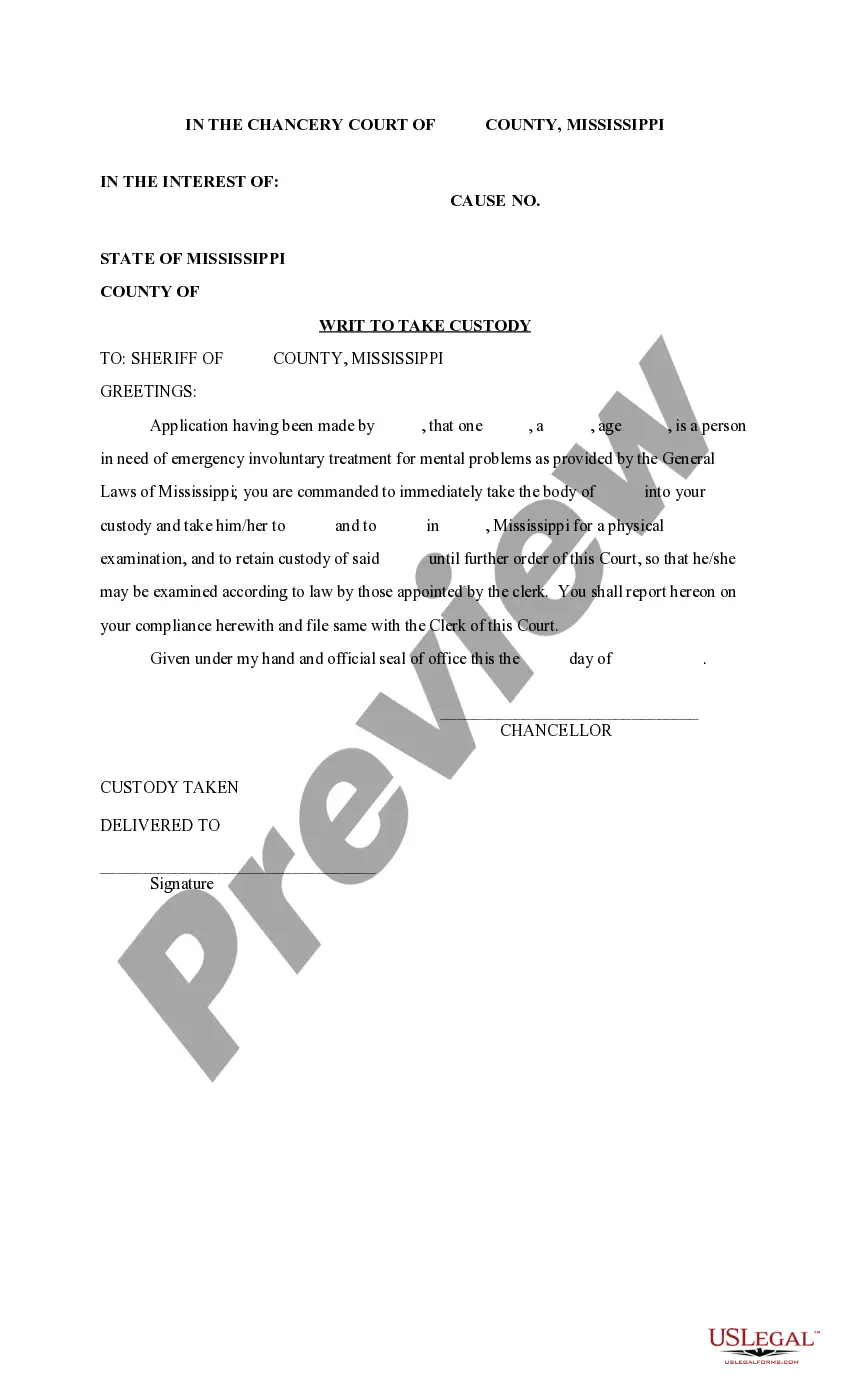
Mississippi Writ to Take Custody
Understanding this form
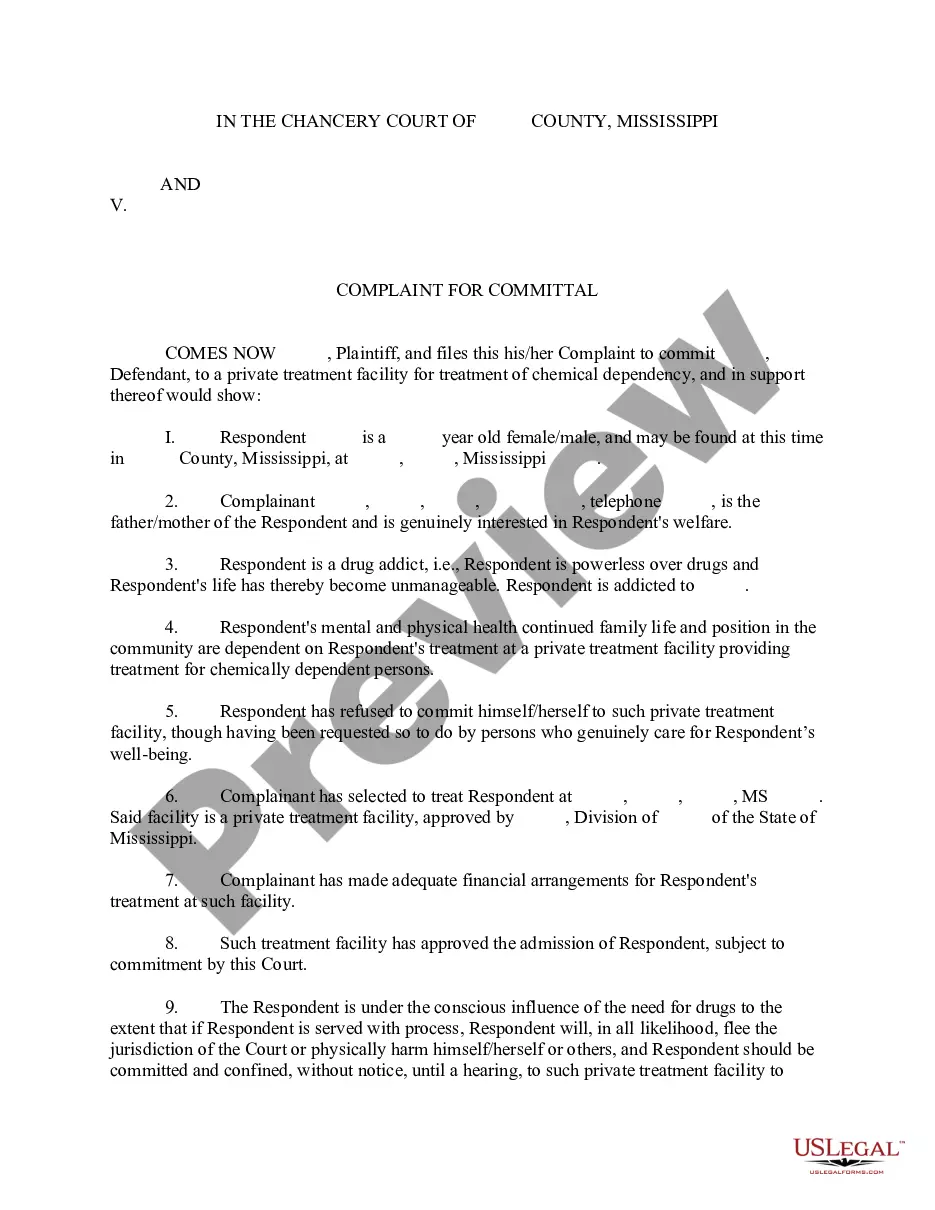
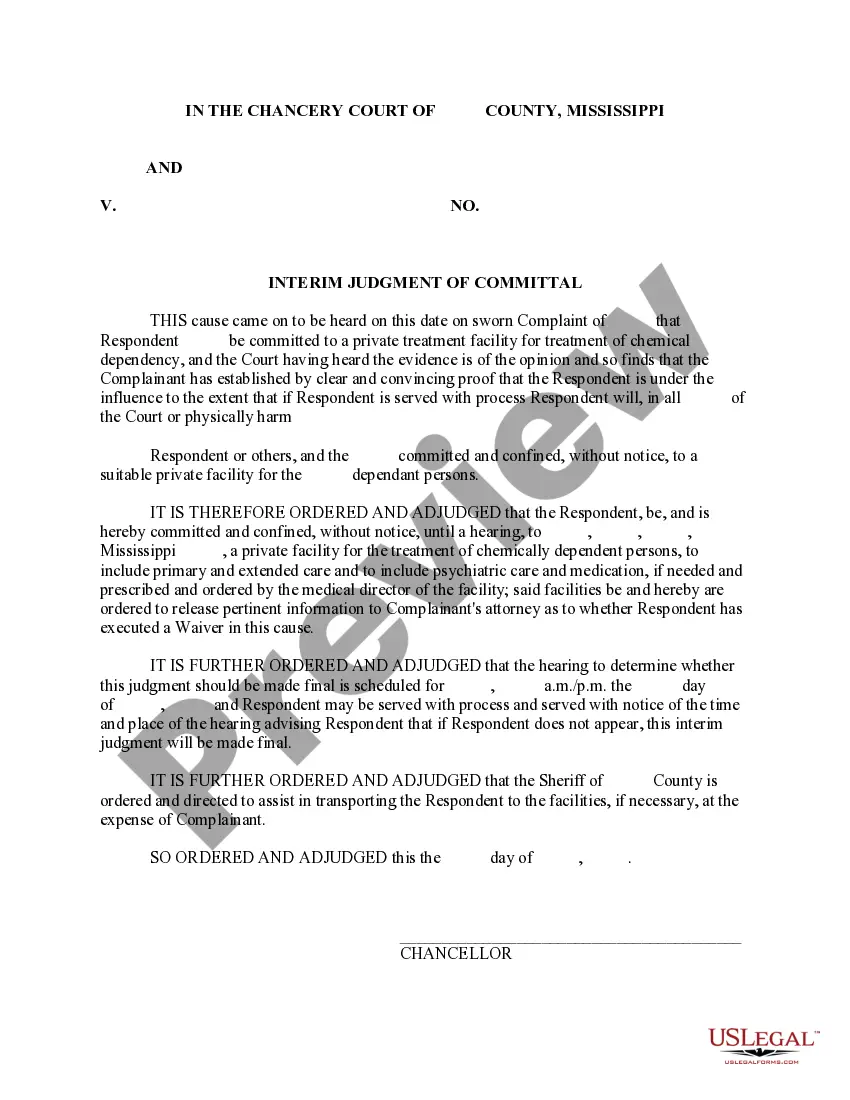
A Writ to Take Custody is a legal document issued by the court that allows for the custody of an individual, particularly in cases where hospitalization in a mental institution is required. This form is essential for ensuring that the individual's rights are respected during the custody process and differs from other custody forms by specifically addressing situations involving mental health concerns.
Key parts of this document
- Identification of the person being taken into custody.
- Details about the mental institution where the individual will be hospitalized.
- Legal justification for the need to take custody.
- Signature of the authorized individual or entity requesting custody.
- Court name and jurisdiction details.
Common use cases
This form should be used when a person requires custody for hospitalization in a mental health facility. Situations can include ensuring the safety of the individual or others, instances of severe mental illness, or when a person is unable to make decisions regarding their treatment due to their mental state.
Who needs this form
This form is intended for:
- Family members or legal guardians seeking custody for a loved one.
- Mental health professionals or advocates acting on behalf of the individual.
- Legal representatives appointed to oversee the individual's wellbeing.
How to complete this form
- Enter the name and details of the individual being taken into custody.
- Specify the mental health institution where they will be admitted.
- Provide the legal reasons supporting the need for custody.
- Include the necessary signatures of the requester and any witnesses, if required.
- Submit the completed form to the appropriate court for validation.
Notarization guidance
This form usually doesn’t need to be notarized. However, local laws or specific transactions may require it. Our online notarization service, powered by Notarize, lets you complete it remotely through a secure video session, available 24/7.
Get your form ready online
Our built-in tools help you complete, sign, share, and store your documents in one place.
Make edits, fill in missing information, and update formatting in US Legal Forms—just like you would in MS Word.
Download a copy, print it, send it by email, or mail it via USPS—whatever works best for your next step.
Sign and collect signatures with our SignNow integration. Send to multiple recipients, set reminders, and more. Go Premium to unlock E-Sign.
If this form requires notarization, complete it online through a secure video call—no need to meet a notary in person or wait for an appointment.
We protect your documents and personal data by following strict security and privacy standards.

Make edits, fill in missing information, and update formatting in US Legal Forms—just like you would in MS Word.

Download a copy, print it, send it by email, or mail it via USPS—whatever works best for your next step.

Sign and collect signatures with our SignNow integration. Send to multiple recipients, set reminders, and more. Go Premium to unlock E-Sign.

If this form requires notarization, complete it online through a secure video call—no need to meet a notary in person or wait for an appointment.

We protect your documents and personal data by following strict security and privacy standards.
Common mistakes
- Failing to provide accurate information about the individual being taken into custody.
- Omitting necessary signatures or details required for court submission.
- Not understanding local jurisdiction requirements regarding custody cases.
Why complete this form online
- Convenient access and immediate download of the required form.
- Editability allows you to customize the form to fit your specific needs.
- Reliable templates drafted by licensed attorneys ensure legal compliance.
Legal use & context
- The Writ to Take Custody must be executed following the local legal standards for it to be enforceable.
- Understanding your rights and obligations can help avoid legal complications.
- Consulting a legal expert can provide clarity on your specific situation.
Main things to remember
- A Writ to Take Custody is crucial in mental health-related hospitalizations.
- Ensure all information is accurate and complete to avoid delays.
- Consult local laws for specific requirements regarding custody procedures.
Looking for another form?
Form popularity
FAQ
A writ of body attachment is a process issued by the court directing the U.S. Marshal to bring a person who has been found in civil contempt before the court. The process may also be called an order of commitment for civil contempt or a warrant for civil arrest.
TYPES OF WRITS (i) Writ of Habeas Corpus, (ii) Writ of Mandamus, (iii) Writ of Certiorari, (iv) Writ of Prohibition, (v) Writ of Quo-Warranto, Writ of Habeas Corpus: It is the most valuable writ for personal liberty.
The laws for Treatment Orders vary by state, but generally speaking, a mental health professional can apply for an order, which must then be approved by a legal authority such as a magistrate or tribunal.
The term writ refers to a formal, legal document that orders a person or entity to perform or to cease performing a specific action or deed. Writs are drafted by judges, courts, or other entities that have administrative or judicial jurisdiction.
Commitment Process Any citizen of Mississippi can initiate the process by submitting a sworn statement requesting psychiatric treatment for that person. The statement must include strong evidence that the person is dangerous to him or herself or to others by reason of mental illness.
A writ is defined as a formal written order issued by a higher court which requests a lower court or a government entity to take action. Warrants, orders, directions, and subpoenas are all considered writs. When it comes to criminal cases, a defendant may file one or more writs in one trial.
A writ is an order issued by a legal authority with administrative or juridicial powers, typically a court.
There are five types of Writs which are Habeas Corpus, Mandamus, Certiorari, Quo Warranto and Prohibition and all these writs are an effective method of enforcing the rights of the people and to compel the authorities to fulfil the duties which are bound to perform under the law.
Any citizen of Mississippi can initiate the process by submitting a sworn statement requesting psychiatric treatment for that person. The statement must include strong evidence that the person is dangerous to him or herself or to others by reason of mental illness.