Mississippi Order Granting Hearing and Temporary Letters Testamentary
Overview of this form
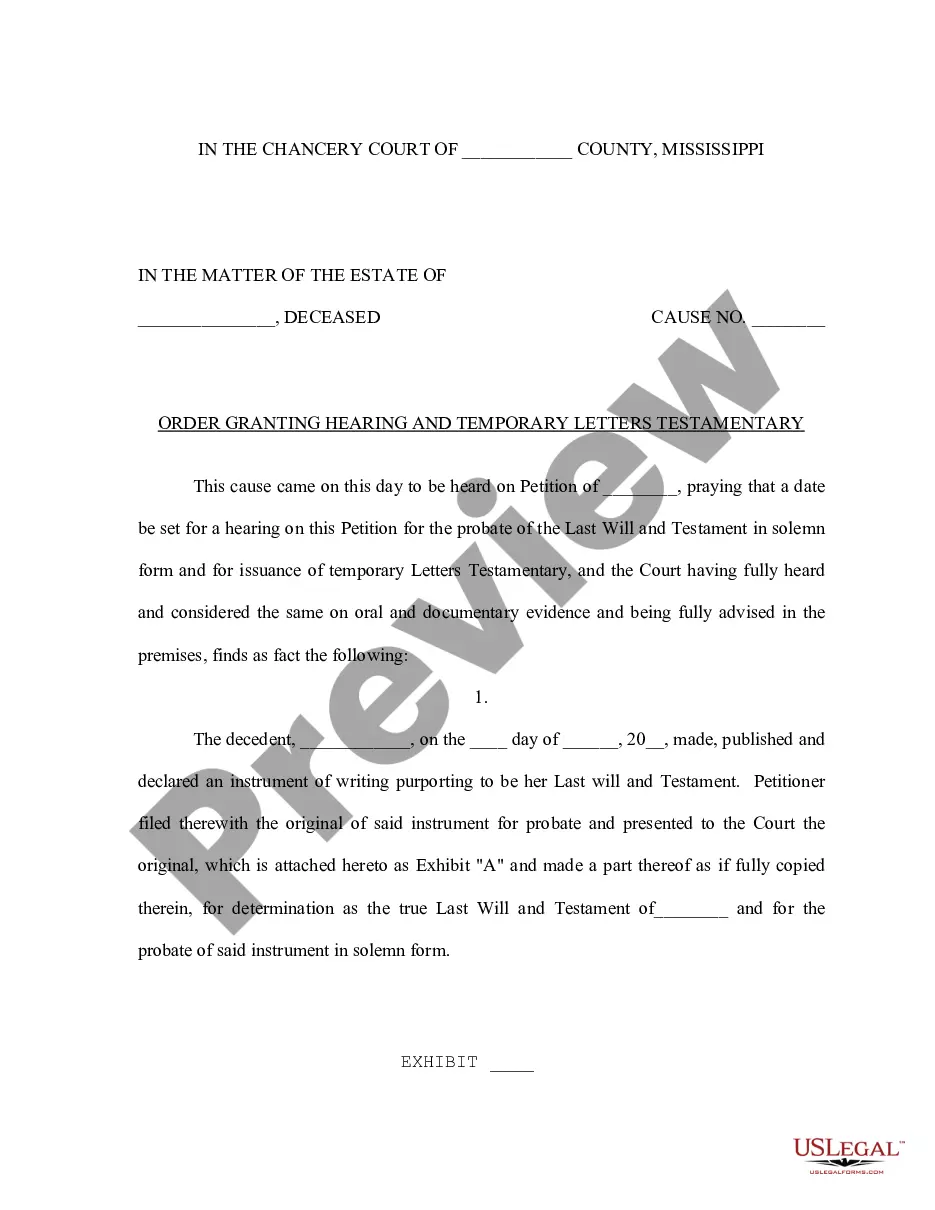
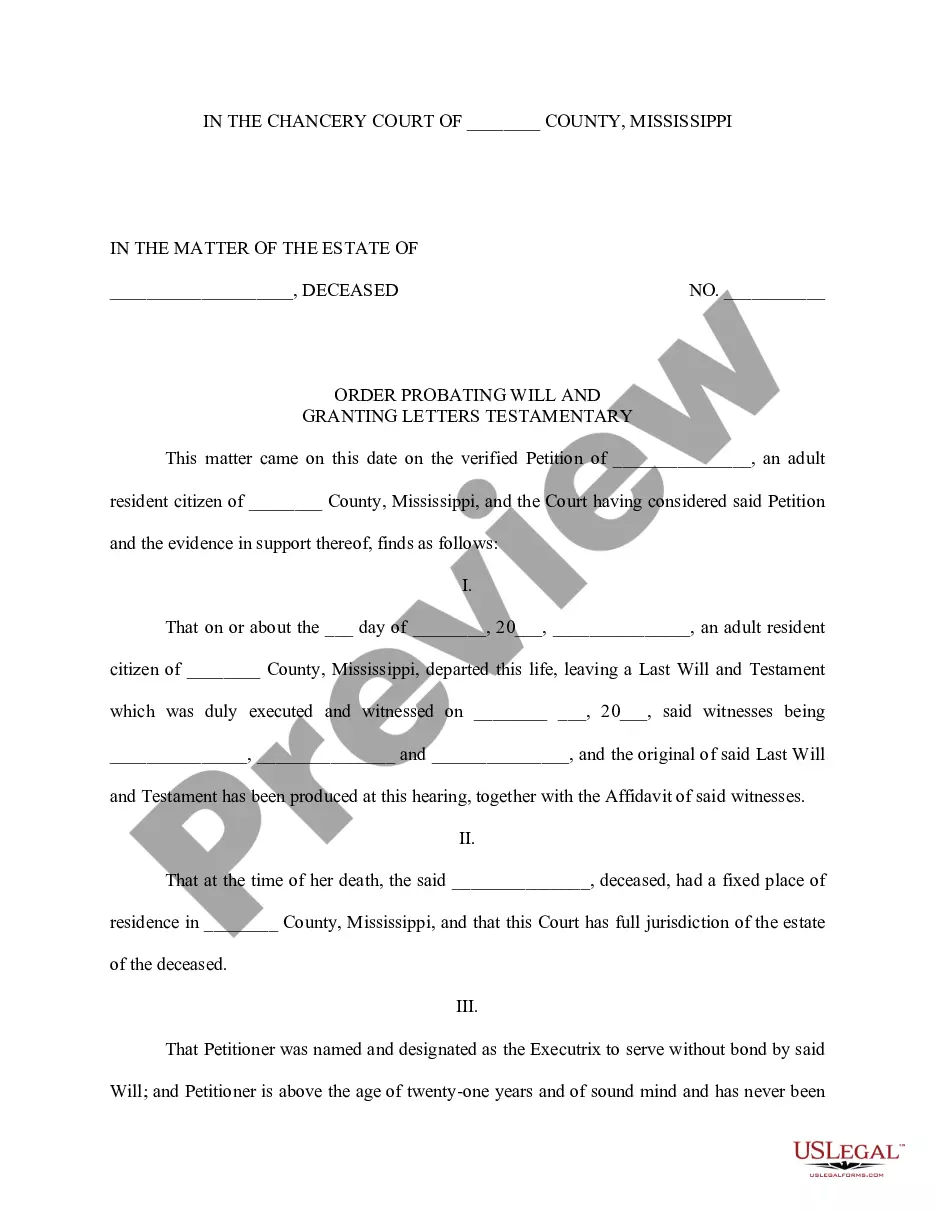
The Order Granting Hearing and Temporary Letters Testamentary is a legal document used in probate proceedings. It is issued by the Probate Court to schedule a hearing for the probate of a will and to grant Temporary Letters Testamentary to the petitioner. These temporary letters allow the petitioner to manage the deceased's estate until the court issues permanent documents, distinguishing it from other probate forms that may not initiate hearings or grant temporary authority.
Key parts of this document
- Title and case number identifying the estate in question.
- Details about the deceased, including their name and date of will execution.
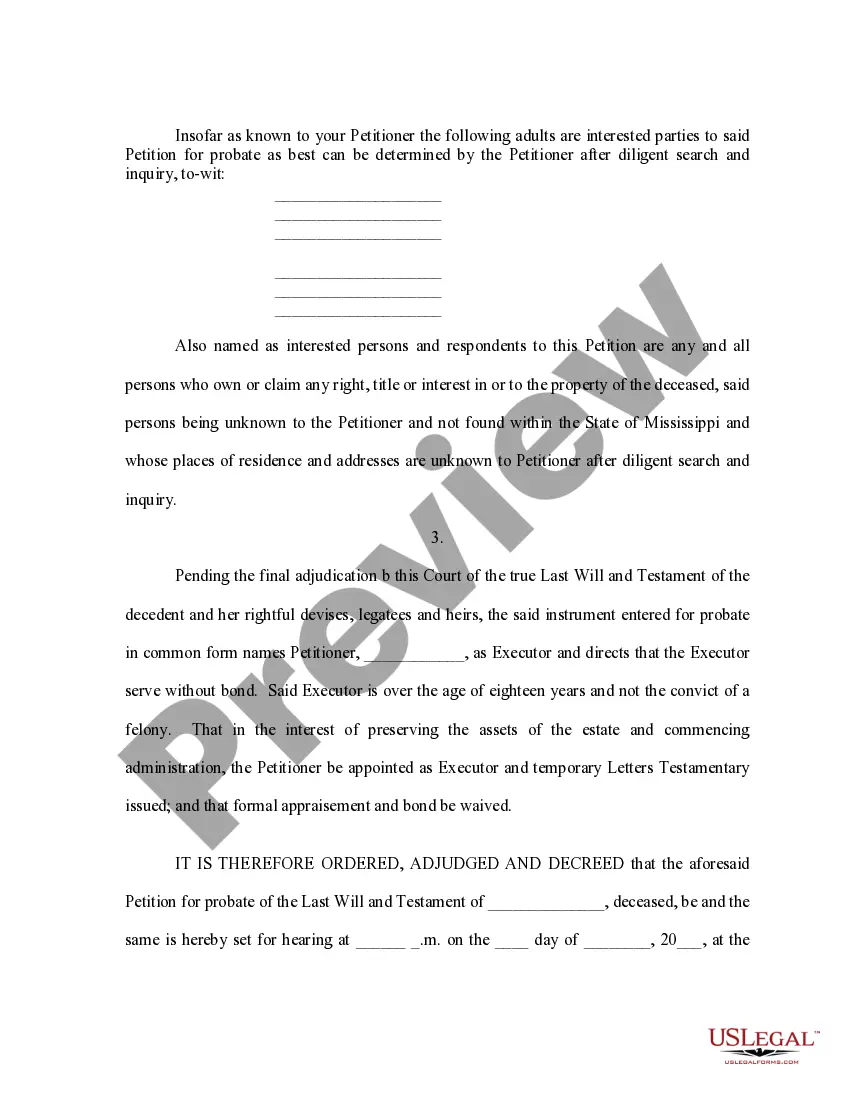
- Identification of interested parties who may contest the will.
- Appointment of the petitioner as the temporary Executor of the estate.
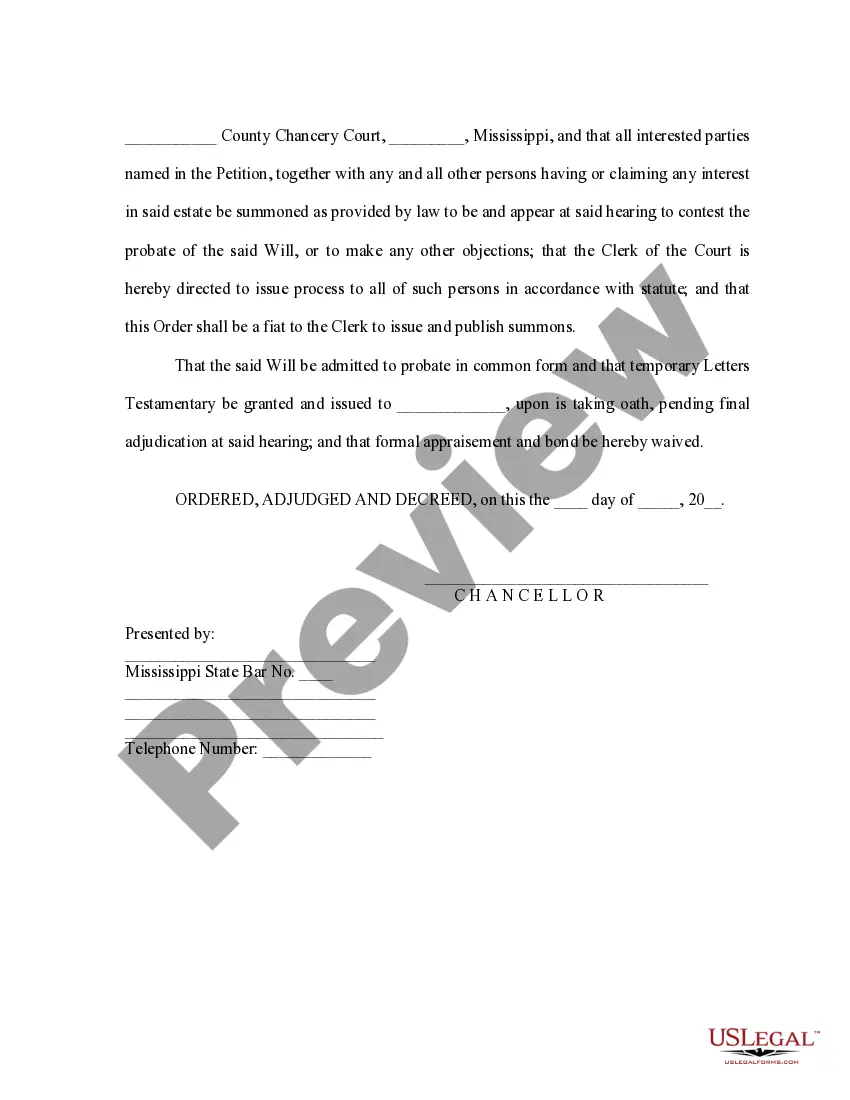
- Set date and time for the hearing regarding the will's probate.
- Confirmation that formal appraisement and bond requirements are waived.
Common use cases
This form is necessary when a person wishes to initiate probate proceedings after the death of an individual who left a will. It is used to set a hearing date for the probate of the will and to obtain temporary authority to manage the estate in the interim. This can help preserve the estate's assets and facilitate a smooth transition while awaiting the court's final decision on the will.
Intended users of this form
This form is intended for:
- Executors or administrators seeking to probate a will.
- Individuals nominated in the will to manage the deceased's estate.
- Interested parties who need to establish their role in probate proceedings.
- Legal representatives of the deceased's estate.
How to prepare this document
- Fill in the decedent's name and estate information at the top of the form.
- Provide the date the Last Will and Testament was executed.
- List all individuals who may have an interest in the estate, including those not located within the state.
- Indicate the name of the petitioner seeking the appointment as temporary Executor.
- Set and write the date and time for the court hearing related to the probate of the will.
- Sign the document and provide the necessary attorney details, if applicable.
Is notarization required?
To make this form legally binding, it must be notarized. Our online notarization service, powered by Notarize, lets you verify and sign documents remotely through an encrypted video session.
Get your form ready online
Our built-in tools help you complete, sign, share, and store your documents in one place.
Make edits, fill in missing information, and update formatting in US Legal Forms—just like you would in MS Word.
Download a copy, print it, send it by email, or mail it via USPS—whatever works best for your next step.
Sign and collect signatures with our SignNow integration. Send to multiple recipients, set reminders, and more. Go Premium to unlock E-Sign.
If this form requires notarization, complete it online through a secure video call—no need to meet a notary in person or wait for an appointment.
We protect your documents and personal data by following strict security and privacy standards.

Make edits, fill in missing information, and update formatting in US Legal Forms—just like you would in MS Word.

Download a copy, print it, send it by email, or mail it via USPS—whatever works best for your next step.

Sign and collect signatures with our SignNow integration. Send to multiple recipients, set reminders, and more. Go Premium to unlock E-Sign.

If this form requires notarization, complete it online through a secure video call—no need to meet a notary in person or wait for an appointment.

We protect your documents and personal data by following strict security and privacy standards.
Common mistakes
- Failing to list all interested parties, which can delay proceedings.
- Omitting the hearing date or time, leading to scheduling issues.
- Not properly signing the form or getting necessary signatures from witnesses.
- Using incorrect names or dates that do not match the will.
Why complete this form online
- Convenient access to legal forms and templates from anywhere, at any time.
- Editable digital formats that allow for easy customization according to specific needs.
- Reliability of professionally drafted forms that comply with legal standards.
Legal use & context
- The form is used in probate court to initiate the probate process.
- It serves as a legal request for the court to establish and validate the will.
- Temporary Letters Testamentary are issued to allow the petitioner to manage the estate during the probate process.
Key takeaways
- The Order Granting Hearing and Temporary Letters Testamentary initiates probate proceedings for a will.
- It temporarily grants authority to manage the estate before a final decision is made.
- Proper completion of all sections is critical for a smooth probate process.
- This form is specific to Mississippi laws and procedures.
Looking for another form?
Form popularity
FAQ
There are two components of letter of testamentary cost: the court fee and the attorney's fees. The court fee ranges from $45 to $1,250, depending on the gross value of the estate. The attorney's fees start at about $2,500 and can go up depending on the complexity of the case.
Find the local probate court or surrogate's court, as it's sometimes called. File the will and a certified copy of the testator's death certificate . Fill out the necessary paperwork , like a petition form, and provide any additional documents.
There are two components of letter of testamentary cost: the court fee and the attorney's fees. The court fee ranges from $45 to $1,250, depending on the gross value of the estate. The attorney's fees start at about $2,500 and can go up depending on the complexity of the case.
Net value of probate estate is $50,000 or less, or. Probate asset is bank account or accounts totaling no more than $12,500, or. Probate estate is $500 or less.
In the best of circumstances, the Mississippi probate process usually takes 4 to 6 months. This would only be possible if the estate was fairly simple, all interested parties are agreeable, and documents are signed and returned to the probate attorney in a timely manner.
To obtain your letter of testamentary, you will need to file the will and death certificate in the probate court, along with forms asking for the letter of testamentary. You'll need to provide your information, as well as some basic information about the value of the estate and the date of death.
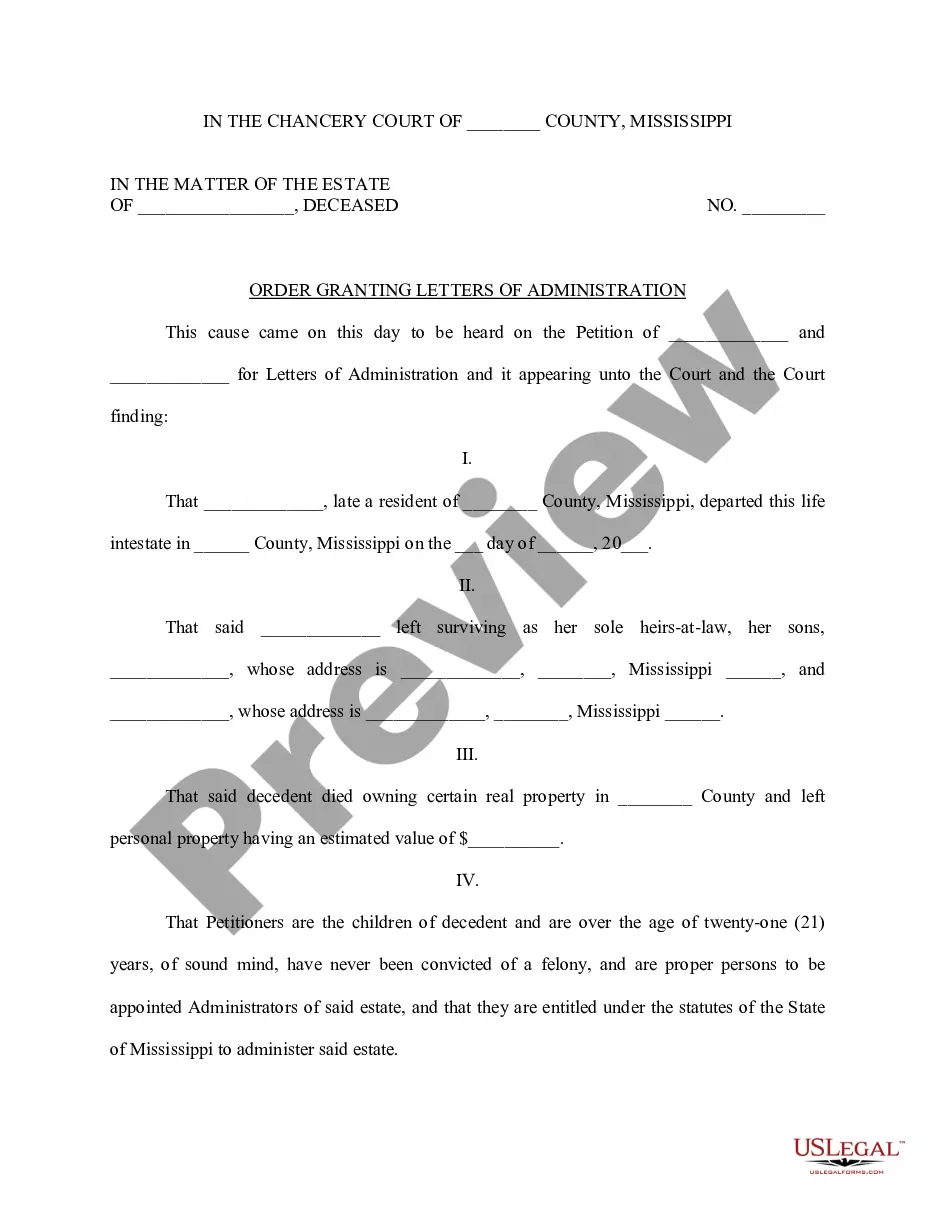
Letters testamentary are not issued when there is no will. When a person dies intestate, or without a will, the court issues letters of administration and appoints someone to distribute the decedent's property.
The executor will need to wait until the 2 month time limit is up, before distributing the estate. Six month limit to bring a claim in other cases, it can be sensible for the executors not to pay any beneficiaries until at least 6 months after receiving the grant of probate.
A simple estate with just a few, easy-to-find assets may be all wrapped up in six to eight months. A more complicated affair may take three years or more to fully settle.