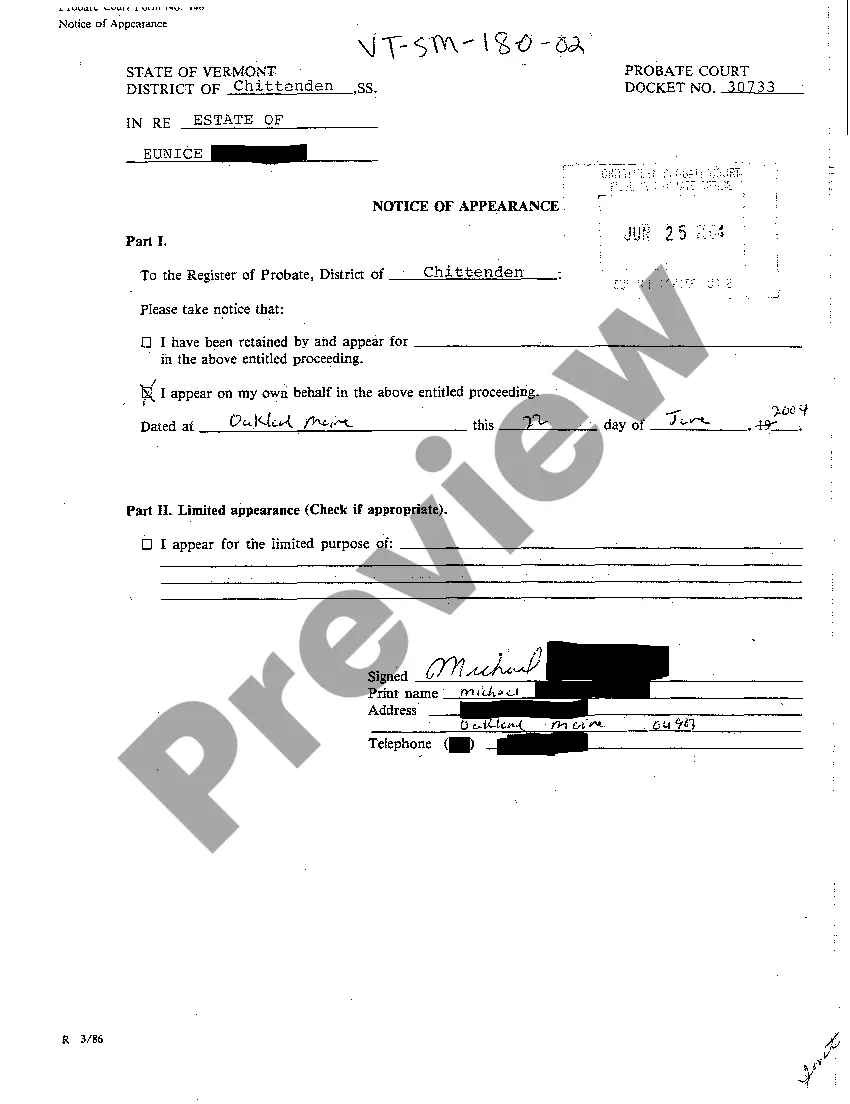
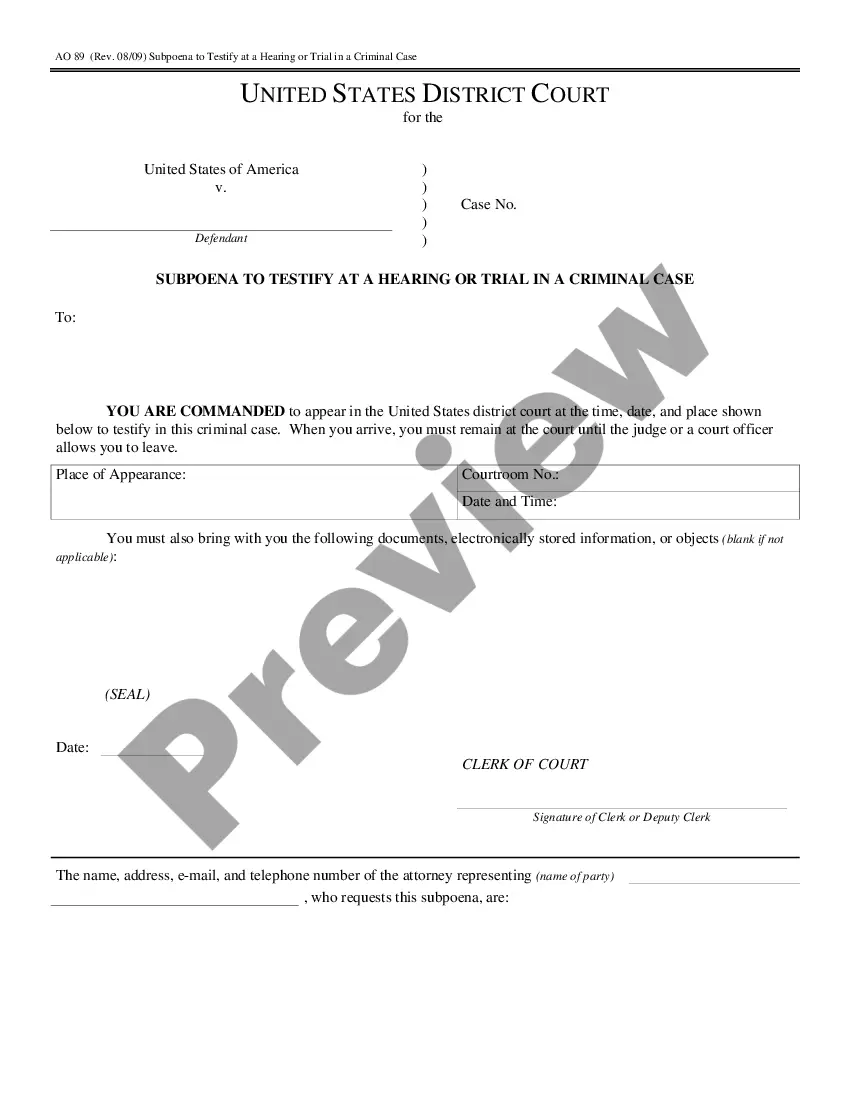
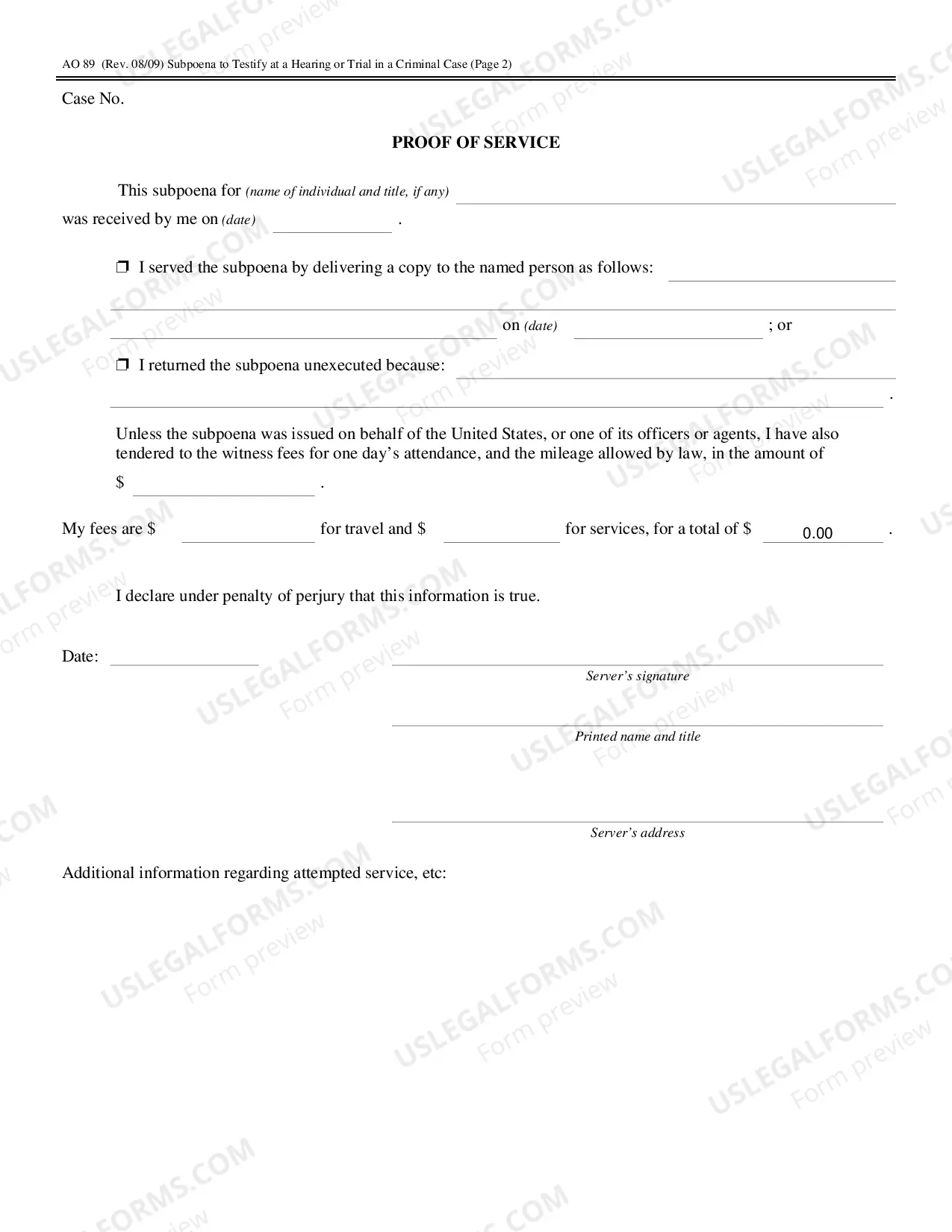
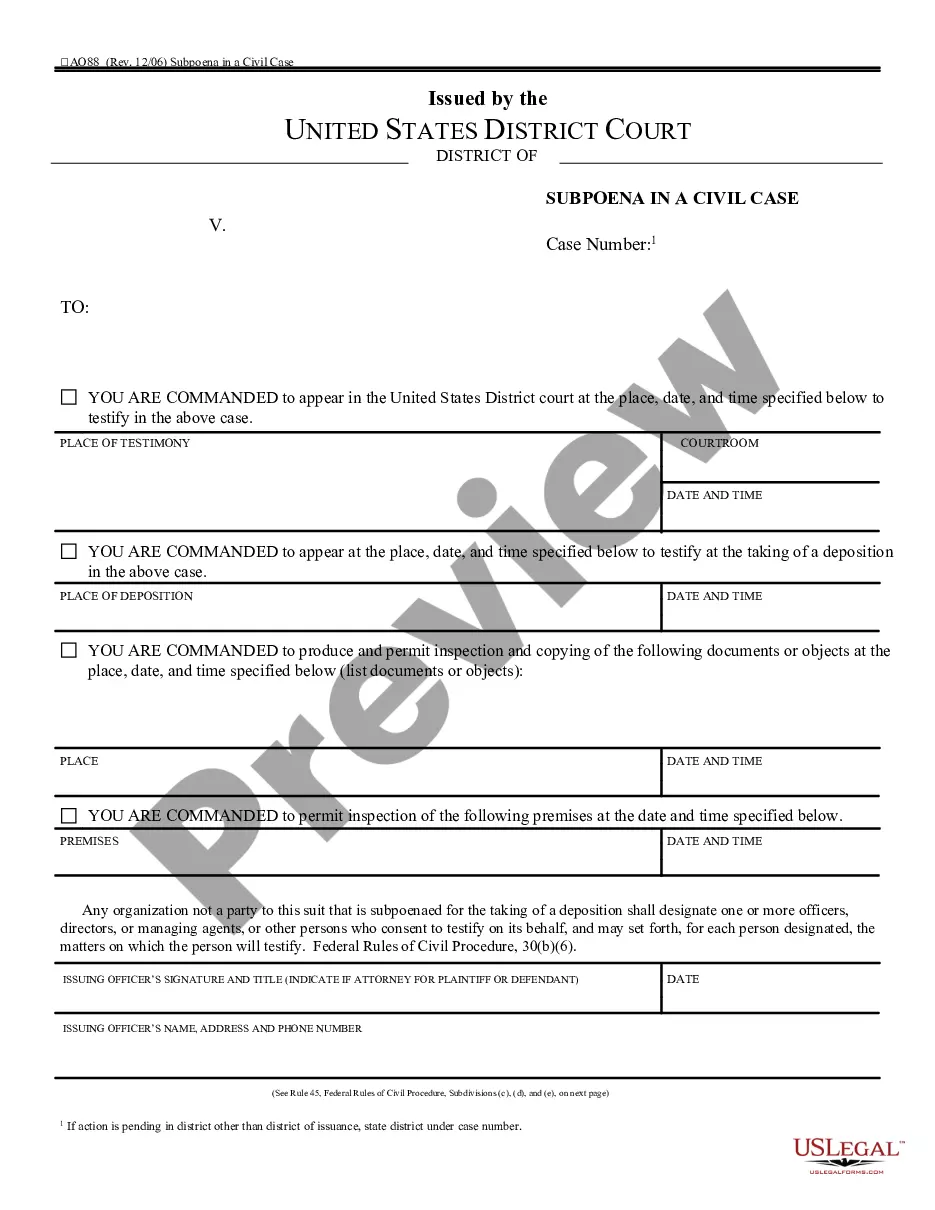
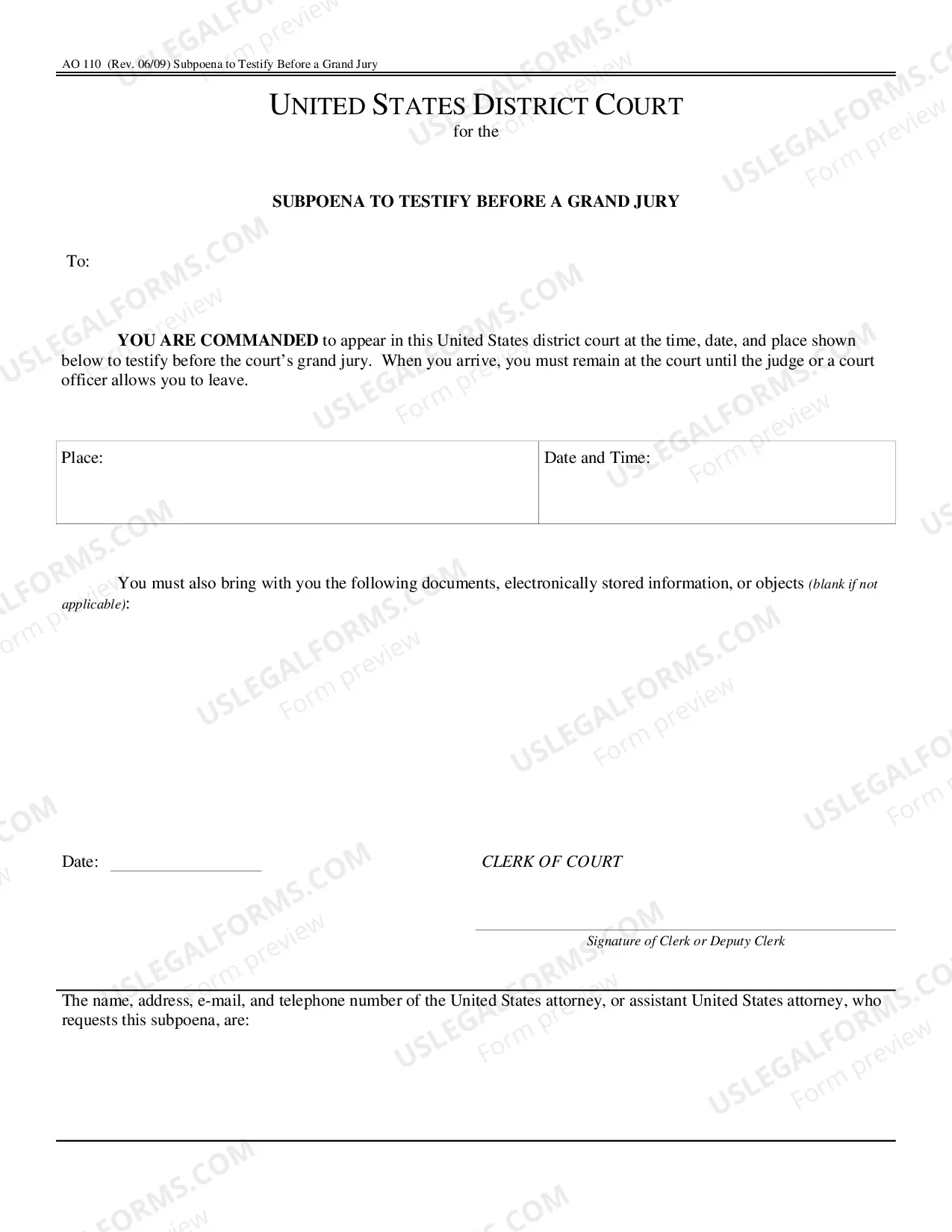
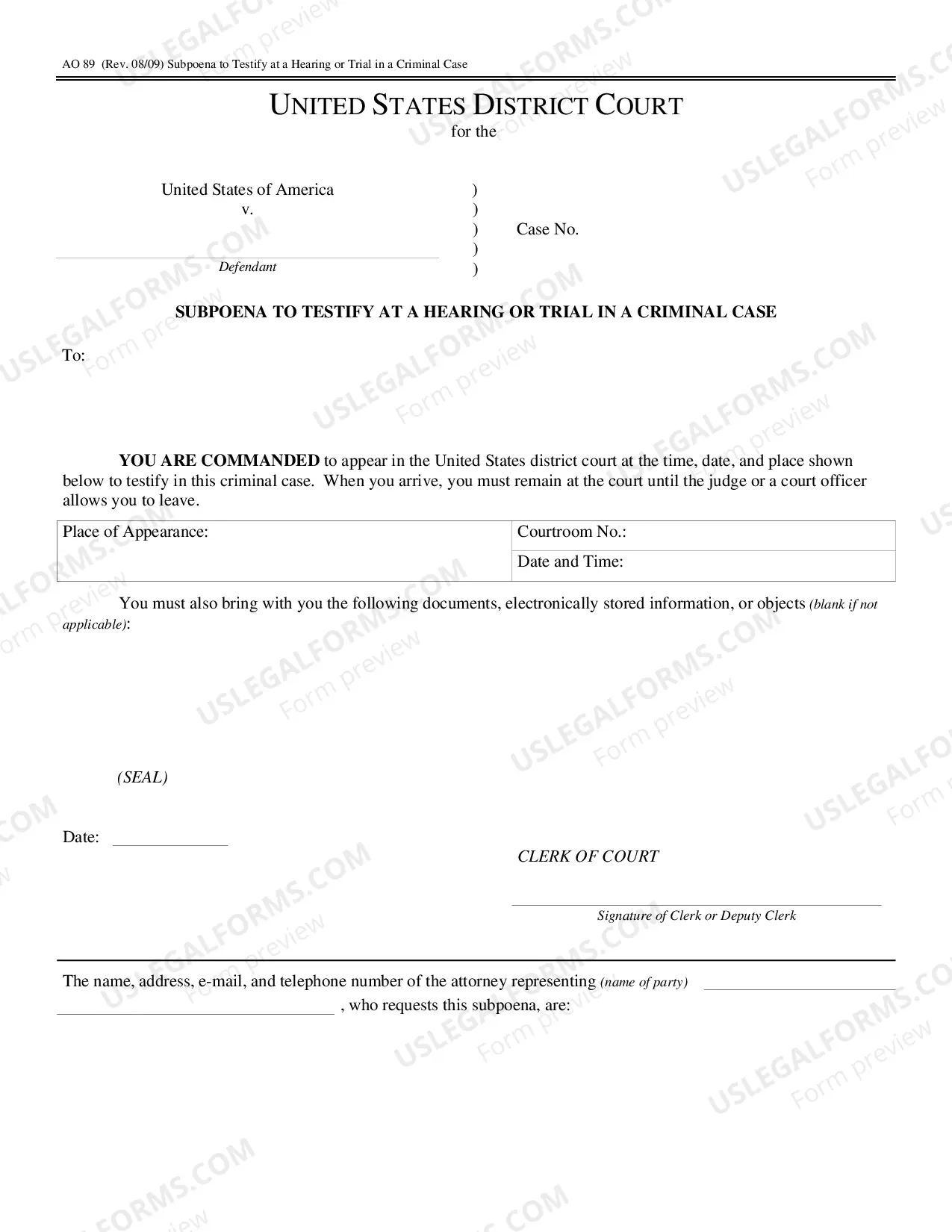
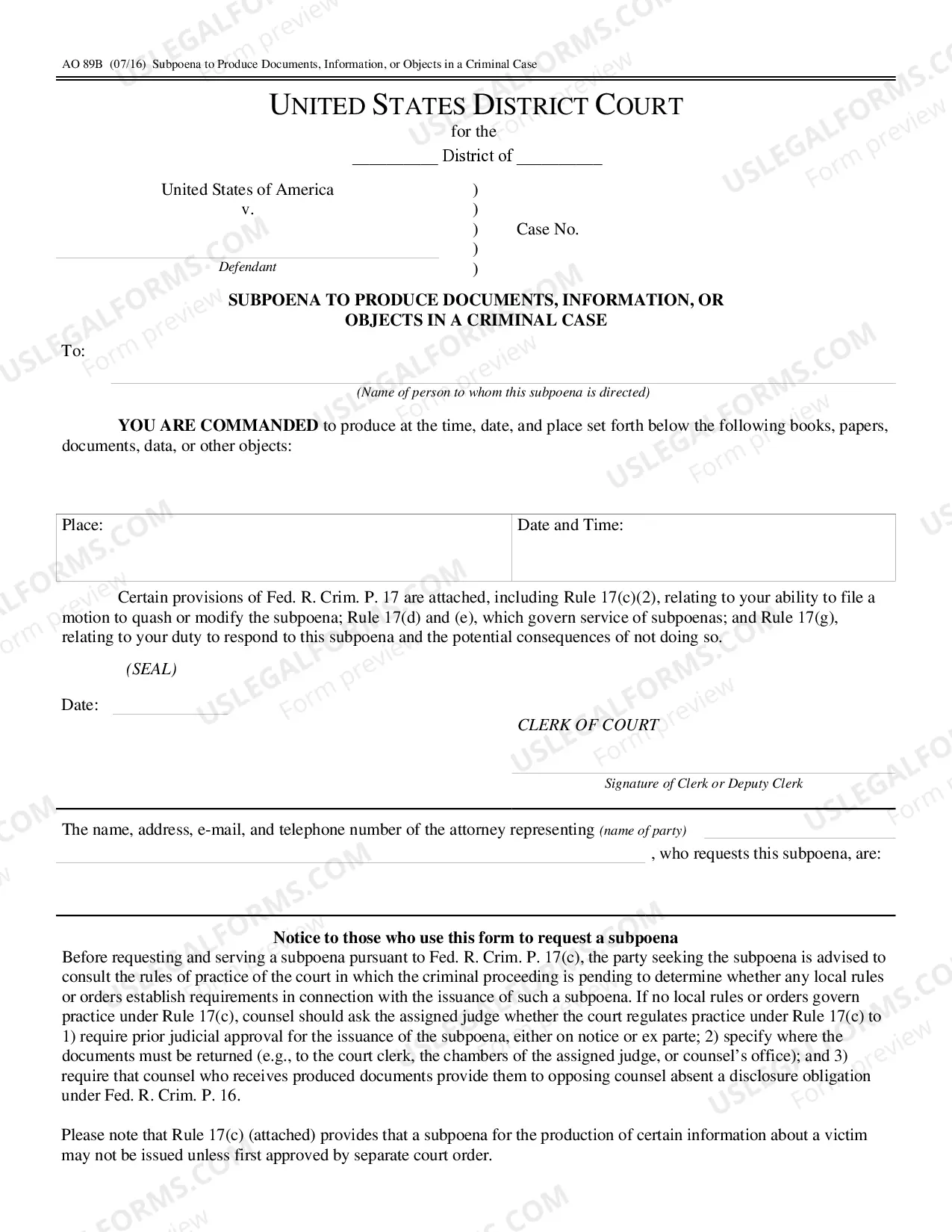
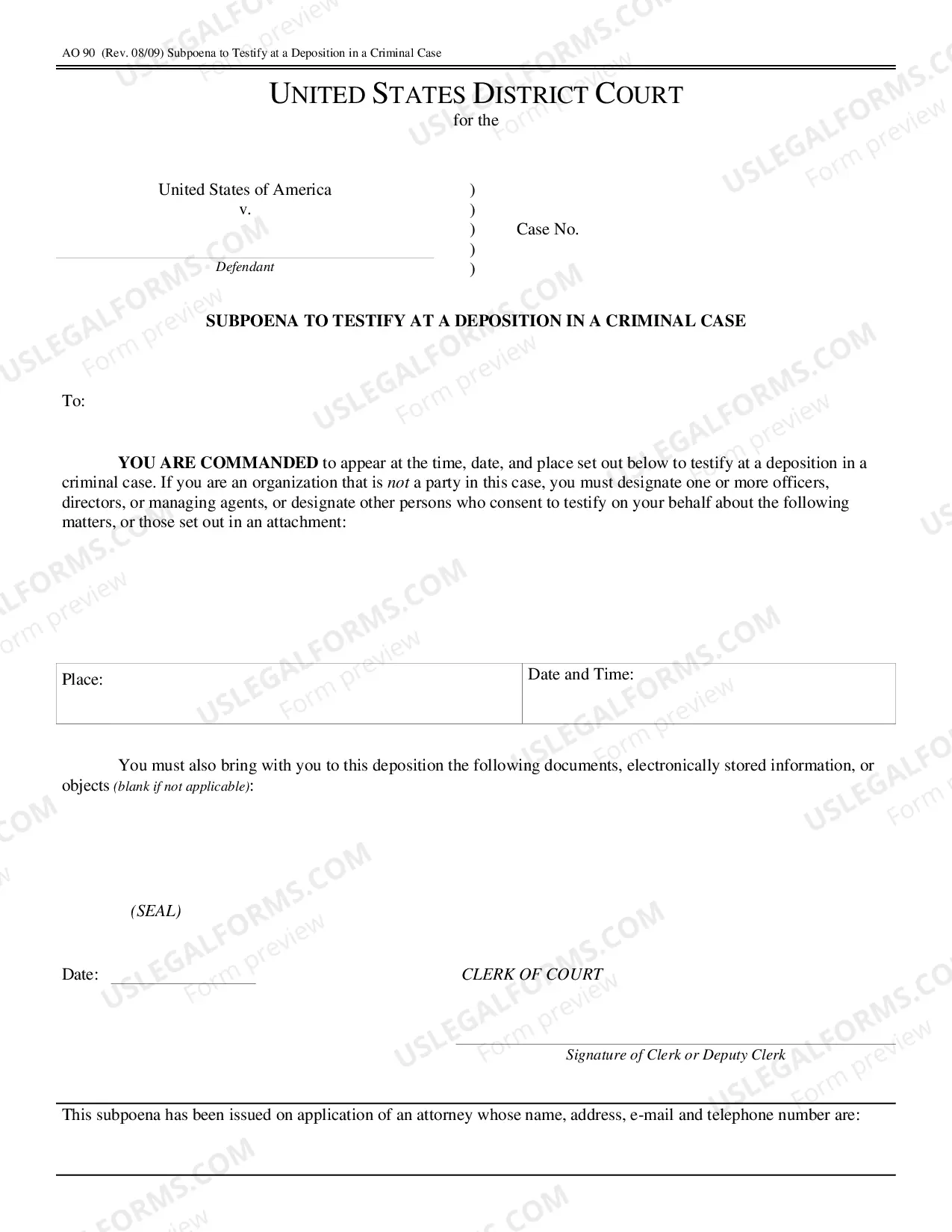
This is a form addressing a procedural aspect of a federal court case. Note the district in which this form is for use.
Missouri Subpoena in a Criminal Case
State:
Missouri
Control #:
MO-AO-89
Format:
PDF
Instant download
This website is not affiliated with any governmental entity
Public form
Description
Free preview
Get your form ready online
Our built-in tools help you complete, sign, share, and store your documents in one place.
Built-in online Word editor
Make edits, fill in missing information, and update formatting in US Legal Forms—just like you would in MS Word.
Export easily
Download a copy, print it, send it by email, or mail it via USPS—whatever works best for your next step.
E-sign your document
Sign and collect signatures with our SignNow integration. Send to multiple recipients, set reminders, and more. Go Premium to unlock E-Sign.
Notarize online 24/7
If this form requires notarization, complete it online through a secure video call—no need to meet a notary in person or wait for an appointment.
Store your document securely
We protect your documents and personal data by following strict security and privacy standards.

Make edits, fill in missing information, and update formatting in US Legal Forms—just like you would in MS Word.

Download a copy, print it, send it by email, or mail it via USPS—whatever works best for your next step.

Sign and collect signatures with our SignNow integration. Send to multiple recipients, set reminders, and more. Go Premium to unlock E-Sign.

If this form requires notarization, complete it online through a secure video call—no need to meet a notary in person or wait for an appointment.

We protect your documents and personal data by following strict security and privacy standards.
Looking for another form?





How to fill out Missouri Subpoena In A Criminal Case?
Obtain any template from 85,000 legal documents like the Missouri Subpoena in a Criminal Case online through US Legal Forms. Each template is crafted and refreshed by state-licensed attorneys.
If you possess a subscription, Log In. Once you are on the form’s page, click on the Download button and navigate to My documents to gain access to it.
In case you haven’t subscribed yet, follow the guidelines listed below.
With US Legal Forms, you will consistently have immediate access to the correct downloadable sample. The service will provide you with access to documents and categorizes them to streamline your search. Utilize US Legal Forms to acquire your Missouri Subpoena in a Criminal Case quickly and efficiently.
- Verify the state-specific criteria for the Missouri Subpoena in a Criminal Case you wish to utilize.
- Examine the description and preview the sample.
- When you are certain the sample is what you require, click Buy Now.
- Select a subscription plan that suits your budget.
- Establish a personal account.
- Make a payment in one of two suitable methods: by credit card or through PayPal.
- Choose a format to download the document in; two choices are available (PDF or Word).
- Download the document to the My documents tab.
- After your reusable template is prepared, print it out or save it to your device.
Form popularity
FAQ
Rule 33.5 in Missouri pertains to the issuance and service of subpoenas in criminal cases. This rule outlines the procedures for how a subpoena should be issued and the proper ways to serve it to witnesses. Understanding Rule 33.5 is essential for anyone involved in a Missouri subpoena in a criminal case, as it affects the rights of both the prosecution and defense. For detailed information and legal forms, consider using US Legal Forms to navigate these legal requirements effectively.
To get out of a criminal subpoena, you should first consult with an attorney who specializes in Missouri subpoena law. They can assess your situation and help you understand your rights and obligations. If you have a valid reason, such as the potential for self-incrimination, your attorney may file a motion to quash the Missouri subpoena in a criminal case. Utilizing resources like US Legal Forms can provide you with the necessary forms and guidance throughout this process.
The rule for subpoenas in Missouri mandates that they must be issued by a court or authorized official. A Missouri Subpoena in a Criminal Case must clearly specify the time and place for production or testimony, ensuring the recipient understands their obligations. Additionally, the rule allows for certain protections to safeguard against unreasonable demands. Utilizing resources like US Legal Forms can help you navigate these rules efficiently and ensure compliance with the legal requirements.
The subpoena rule in Missouri outlines how subpoenas can be issued and enforced in legal cases. Specifically, a Missouri Subpoena in a Criminal Case requires clear identification of the person being subpoenaed and the information or documents sought. This rule ensures that the legal process remains fair and transparent. Familiarizing yourself with these rules can help you avoid potential pitfalls when dealing with subpoenas.
In Missouri, a subpoena must be served in a timely manner to ensure compliance. Typically, the law requires that you serve a Missouri Subpoena in a Criminal Case at least 48 hours before the scheduled appearance or document production. This time frame allows the recipient to prepare adequately for their testimony or to gather the necessary documents. To simplify the process, consider using platforms like US Legal Forms that provide templates and guidance for serving subpoenas correctly.
Subpoenas are not limited to criminal cases; they also apply to civil cases. In a Missouri Subpoena in a Criminal Case, the court orders individuals to provide testimony or documents relevant to a criminal investigation. However, subpoenas can serve similar purposes in civil litigation, demanding evidence from parties involved in a dispute. Understanding the broader context of subpoenas can help you navigate both criminal and civil legal matters effectively.
Although receiving a court summons may be jarring, it does not automatically mean you are in trouble. You may just have important information or access to information necessary for a particular case to proceed.
In a civil case, you may be subpoenaed for out-of-court testimony as well. In either kind of case, a subpoena may order you to provide documents. A subpoena must be delivered in person. In most cases this can be done by one of the parties in the case or by anyone who is at least 18 years old.
If you refuse after being ordered by the court to give a deposition, you would likely be found in contempt of court, leading to dire consequences. On top of that, you would still be forced into the deposition.
In most instances, a subpoena can be issued and signed by an attorney on behalf of a court in which the attorney is authorized to practice law.In some cases, a non-lawyer may issue a subpoena if acting on his or her own behalf (known as pro se representation).