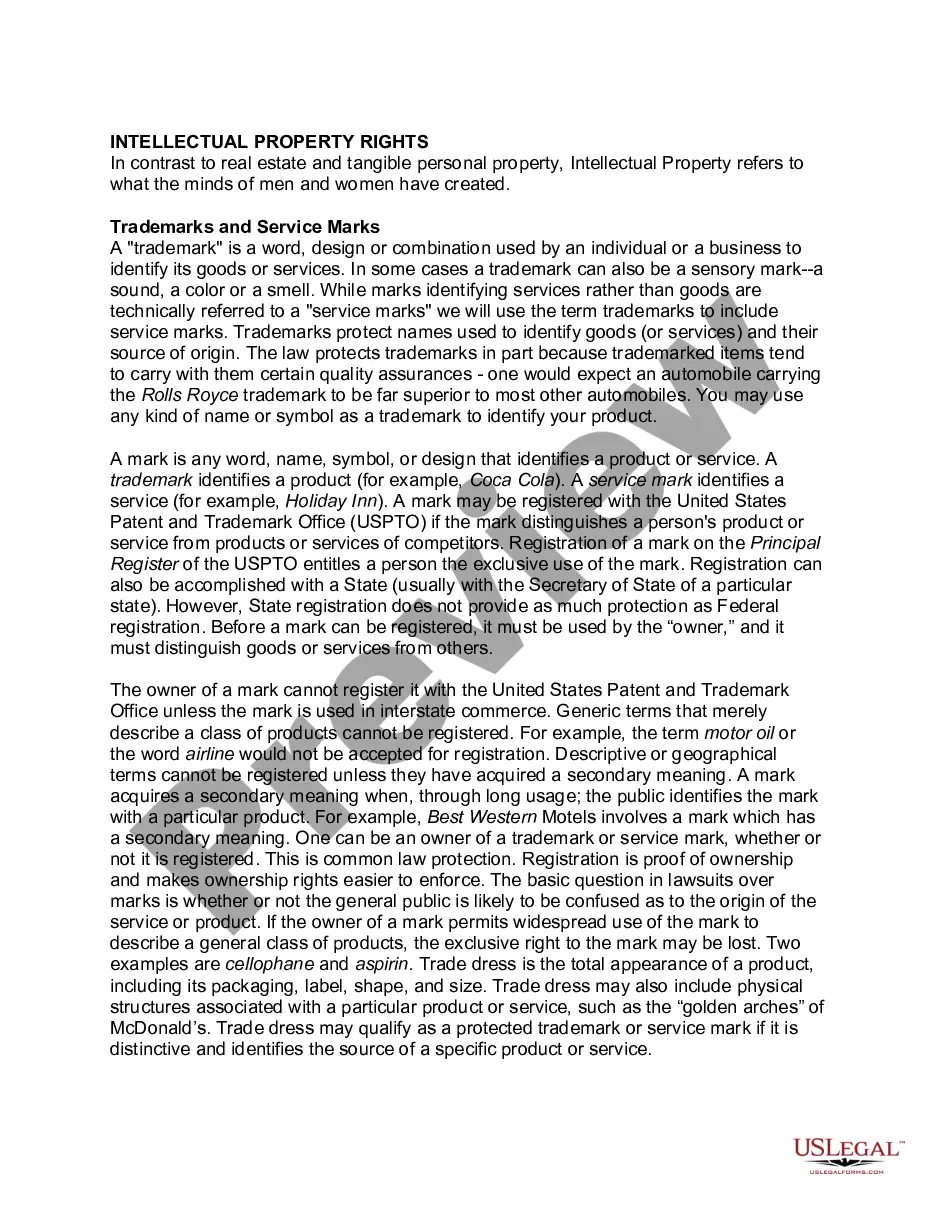
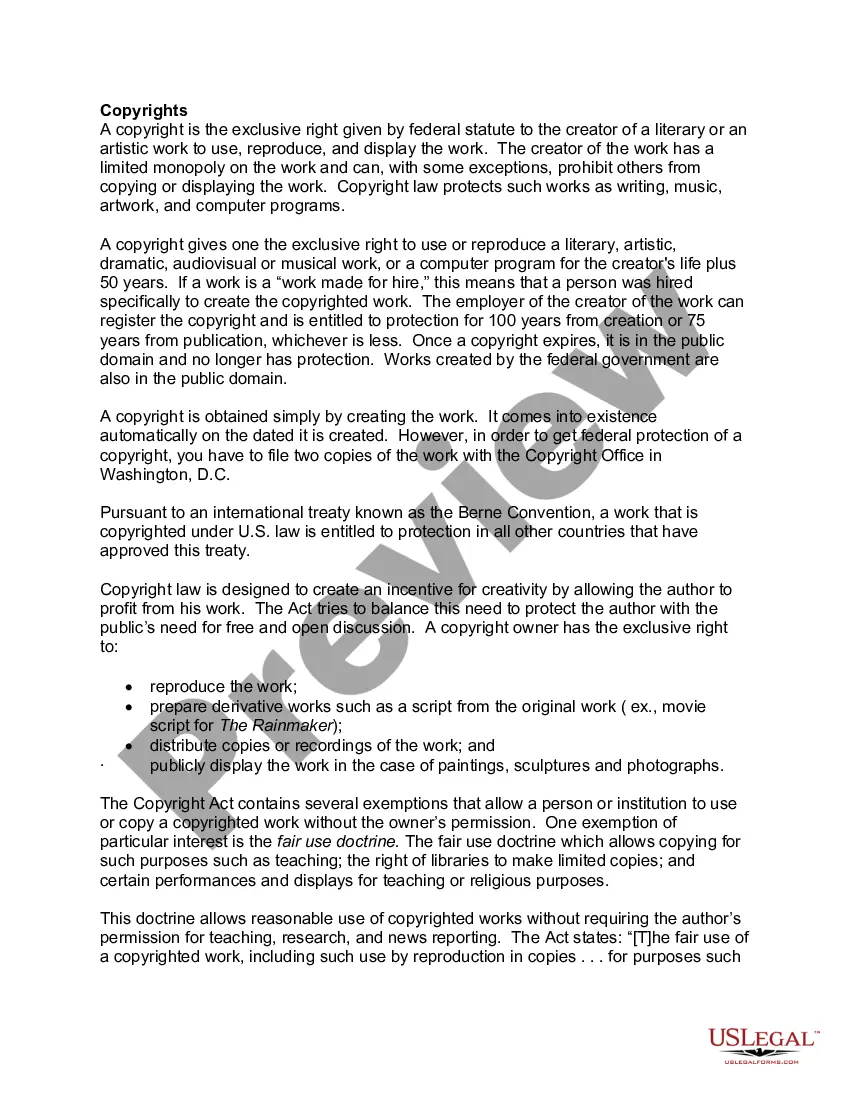
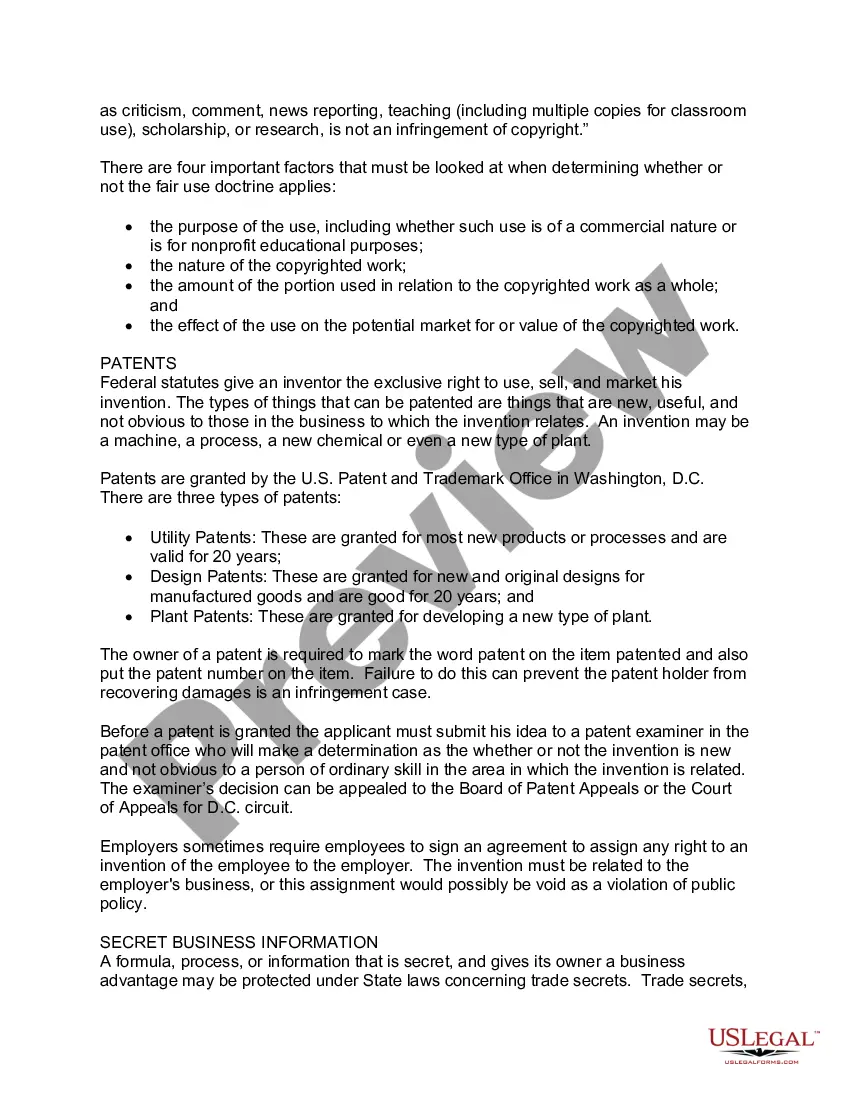
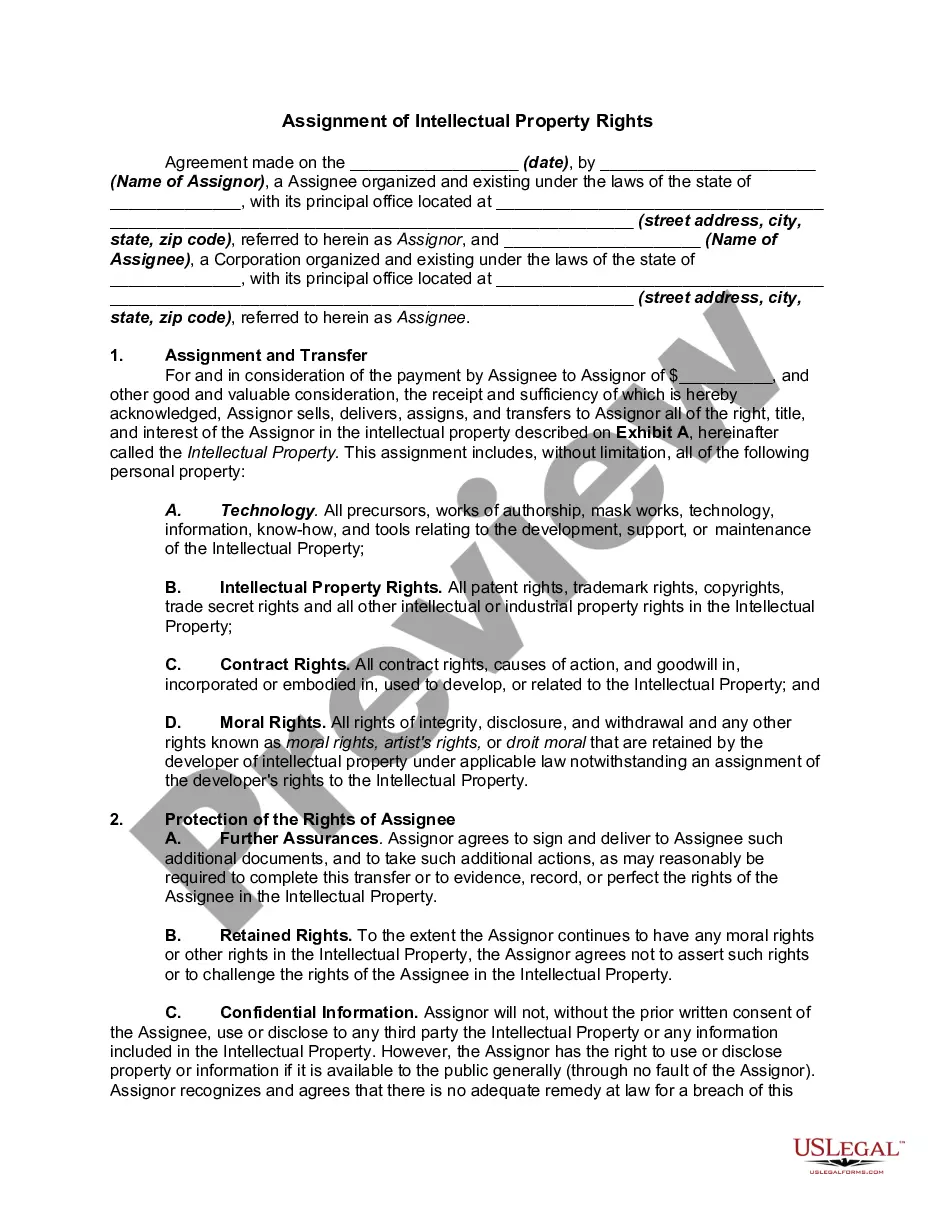
This guide provides an overview of intellectual property rights. Topics included cover trademarks, service marks, copyrights, patents, and trade secrets. Information on remedies for infringement is also provided.
Minnesota USLegal Guide to Intellectual Property Rights
State:
Multi-State
Control #:
US-GDE-22
Format:
Word;
Rich Text
Instant download
Description
Free preview


How to fill out USLegal Guide To Intellectual Property Rights?
If you require thorough, download, or print legal document templates, utilize US Legal Forms, the largest assortment of legal forms available online.
Utilize the site’s straightforward and user-friendly search to find the documents you need.
Various templates for business and personal purposes are organized by categories and states, or keywords.
- Employ US Legal Forms to quickly access the Minnesota USLegal Guide to Intellectual Property Rights.
- If you are already a user of US Legal Forms, sign in to your account and click the Download button to retrieve the Minnesota USLegal Guide to Intellectual Property Rights.
- You may also access forms you previously saved in the My documents section of your account.
- If you are utilizing US Legal Forms for the first time, follow the instructions below.
- Step 1. Ensure you have selected the form for the correct city/state.
- Step 2. Use the Preview option to review the content of the form. Always remember to read the description.
- Step 3. If you are dissatisfied with the form, use the Search field at the top of the screen to find other versions of the legal form template.
- Step 4. Once you have located the form you require, click the Get now button. Select the pricing plan you desire and input your details to register for an account.
- Step 5. Complete the payment. You may use your credit card or PayPal account to finalize the transaction.
- Step 6. Choose the format of the legal document and download it to your device.
- Step 7. Complete, edit, and print or sign the Minnesota USLegal Guide to Intellectual Property Rights.
- Every legal document template you acquire is yours permanently. You will have access to every form you saved in your account. Click on the My documents section and select a form to print or download again.
- Stay competitive and download, and print the Minnesota USLegal Guide to Intellectual Property Rights with US Legal Forms.
- There are many professional and state-specific forms you can utilize for your business or personal needs.
Form popularity
FAQ
Numerous resources can help you understand intellectual property rights better, including the Minnesota USLegal Guide to Intellectual Property Rights. This guide offers insights into various types of IP protections, registration processes, and legal considerations. Additionally, online platforms like USLegalForms provide valuable templates and documents to assist you in safeguarding your intellectual property.
To get permission to use someone else's intellectual property, you need to reach out to the owner directly and request a license or rights agreement. The Minnesota USLegal Guide to Intellectual Property Rights outlines the best practices for this process to ensure that you follow legal protocols. Clear communication about how you intend to use the property will often facilitate a smoother agreement.
Claiming ownership of intellectual property involves proving that you created the work and took necessary steps to protect it, such as registration. Familiarizing yourself with the Minnesota USLegal Guide to Intellectual Property Rights can help you navigate this process effectively. Documenting your development stages and timelines also strengthens your ownership claim.
To become an intellectual property (IP) lawyer, you typically need a law degree, followed by a focus on intellectual property law during your studies. Engaging in internships or externships specializing in IP can provide essential experience. Additionally, obtaining a license to practice law in Minnesota is crucial, and the Minnesota USLegal Guide to Intellectual Property Rights can offer necessary resources for this journey.
To obtain intellectual property rights, you must understand the type of protection you need, such as patents, trademarks, copyrights, or trade secrets. The Minnesota USLegal Guide to Intellectual Property Rights provides comprehensive steps for registration and application processes, ensuring that your creations are legally protected. It's vital to perform thorough research and possibly seek legal advice to confirm your submission's accuracy.
A good sentence for intellectual property might be, "This software is an original creation and is protected under intellectual property laws." Using this type of statement emphasizes the significance of the creation and the legal protections in place. For further insights, refer to the Minnesota USLegal Guide to Intellectual Property Rights to enrich your understanding.
To write an intellectual property disclaimer, start by clearly stating the aspects of your work that are not covered under intellectual property rights. This keeps your audience informed about your claims and any limitations related to use. The Minnesota USLegal Guide to Intellectual Property Rights includes helpful examples and formats to consider, ensuring your disclaimer meets legal standards.
A good example of intellectual property includes a unique logo created for a brand, which can be protected under trademark laws. Another example is a novel or a song that is protected by copyright. The Minnesota USLegal Guide to Intellectual Property Rights provides numerous examples and clarifies how these assets can be safeguarded effectively.
You write an intellectual property statement by focusing on the essence of your creation, detailing your claims and rights. Make sure to describe how the work was created, who holds the rights, and any relevant circumstances. For further assistance, refer to the Minnesota USLegal Guide to Intellectual Property Rights, which offers comprehensive templates and advice for crafting this statement.
Filing for intellectual property rights requires submitting specific forms to the appropriate state or federal office. Begin by preparing the required documentation, ensuring you meet all legal requirements outlined in the Minnesota USLegal Guide to Intellectual Property Rights. Additionally, consult an attorney or use resources like USLegalForms for a streamlined process.