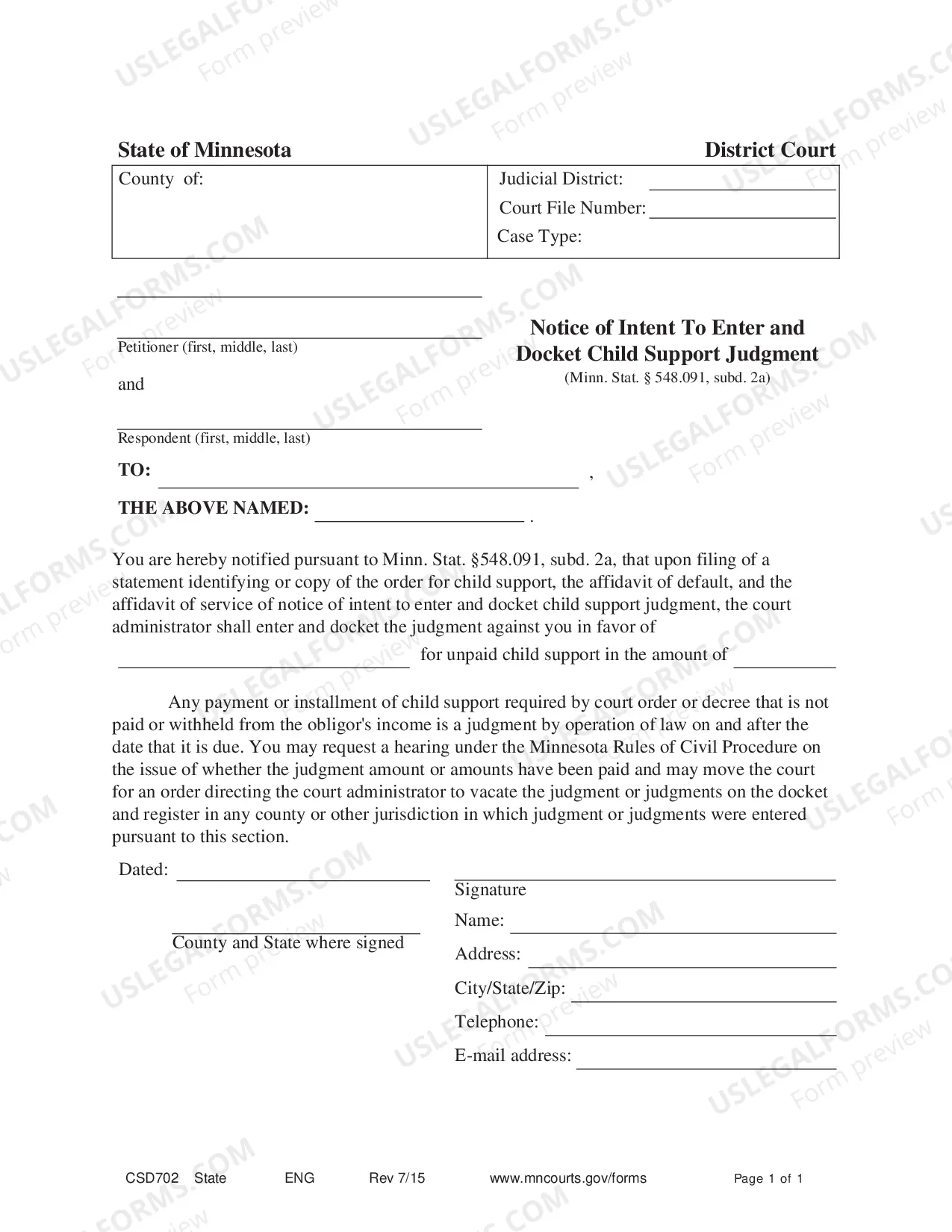
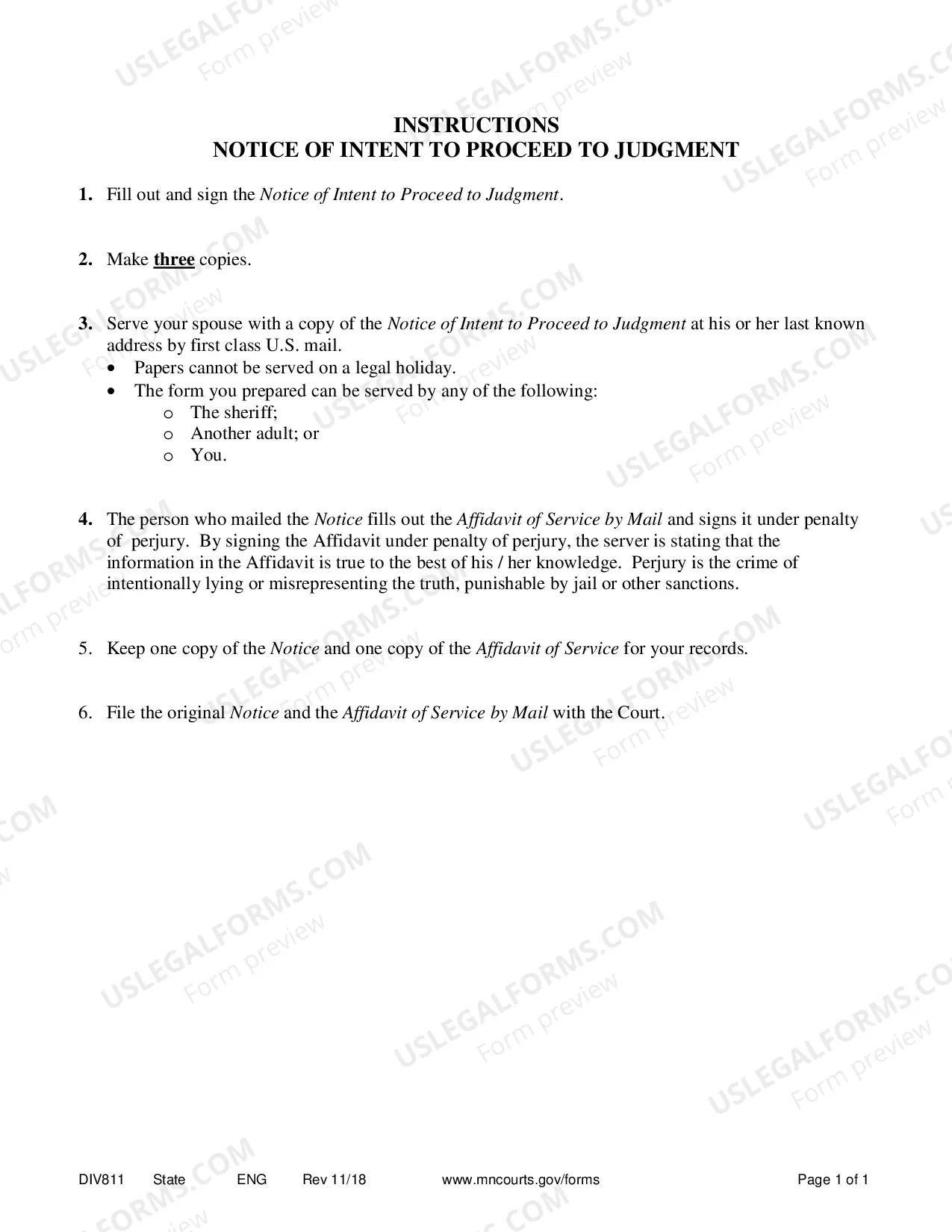
The Minnesota Notice of Intent To Enter and Docket Support Judgment is a document that must be filed by an individual, company, or organization when they intend to enter a judgment against another party in the state of Minnesota. This document serves to notify the court and opposing party that a judgment is being sought and must be filed with the court prior to the entry of the judgment. This document must include the names of the parties involved, the amount of the judgment to be entered, and the relief requested. There are two types of Minnesota Notice of Intent To Enter and Docket Support Judgment: (1) bench judgments, which require a judge to sign a judgment; and (2) default judgments, which are entered without a formal hearing or trial. The Notice of Intent To Enter and Docket Support Judgment must be accompanied by an affidavit of service, which certifies that the opposing party was properly notified of the intent to enter a judgment.
Minnesota Notice of Intent To Enter and Docket Support Judgment
Description
Get your form ready online
Our built-in tools help you complete, sign, share, and store your documents in one place.
Make edits, fill in missing information, and update formatting in US Legal Forms—just like you would in MS Word.
Download a copy, print it, send it by email, or mail it via USPS—whatever works best for your next step.
Sign and collect signatures with our SignNow integration. Send to multiple recipients, set reminders, and more. Go Premium to unlock E-Sign.
If this form requires notarization, complete it online through a secure video call—no need to meet a notary in person or wait for an appointment.
We protect your documents and personal data by following strict security and privacy standards.

Make edits, fill in missing information, and update formatting in US Legal Forms—just like you would in MS Word.

Download a copy, print it, send it by email, or mail it via USPS—whatever works best for your next step.

Sign and collect signatures with our SignNow integration. Send to multiple recipients, set reminders, and more. Go Premium to unlock E-Sign.

If this form requires notarization, complete it online through a secure video call—no need to meet a notary in person or wait for an appointment.

We protect your documents and personal data by following strict security and privacy standards.
Looking for another form?
How to fill out Minnesota Notice Of Intent To Enter And Docket Support Judgment?
Managing legal documents necessitates focus, accuracy, and utilizing well-prepared templates. US Legal Forms has been assisting individuals across the country to do exactly that for 25 years, so when you select your Minnesota Notice of Intent To Enter and Docket Support Judgment template from our collection, you can be assured it complies with federal and state regulations.
Interacting with our service is simple and fast. To obtain the required documents, all you need is an account with an active subscription. Here’s a concise guide for you to acquire your Minnesota Notice of Intent To Enter and Docket Support Judgment in just minutes.
All documents are crafted for multiple uses, such as the Minnesota Notice of Intent To Enter and Docket Support Judgment you see on this page. If you require them again, you can complete them without additional payment - just access the My documents tab in your profile and finalize your document whenever you need it. Experience US Legal Forms and organize your business and personal paperwork swiftly and in complete legal compliance!
- Ensure to thoroughly review the form content and its alignment with general and legal standards by previewing it or reading its description.
- Look for another official blank if the previously accessed one does not suit your circumstances or state regulations (the tab for that is located on the top page corner).
- Log in to your account and download the Minnesota Notice of Intent To Enter and Docket Support Judgment in your preferred format. If this is your first experience with our service, click Buy now to proceed.
- Create an account, choose your subscription option, and pay with your credit card or PayPal account.
- Select the format in which you wish to save your form and click Download. Print the blank or upload it to a professional PDF editor to prepare it without paper.
Form popularity
FAQ
To docket a judgment in Minnesota, you must first file the judgment with the court clerk. This process involves completing the necessary paperwork and paying any required fees. After filing, you will need to submit a Minnesota Notice of Intent to Enter and Docket Support Judgment to ensure the judgment is officially recorded. For assistance in navigating this process, consider using the US Legal Forms platform, which provides resources and templates to help you through each step.
Rule 55.01 in Minnesota pertains to the entry of default judgments. This rule allows a party to seek a judgment when another party fails to respond to a legal action. Understanding this rule is crucial for anyone looking to efficiently docket a judgment. By leveraging the Minnesota Notice of Intent to Enter and Docket Support Judgment, you can streamline the process and ensure that the default judgment is recognized by the court.
Rule 77.04 in Minnesota outlines the procedures for filing a Notice of Intent to Enter and Docket Support Judgment. This rule helps parties understand the process of entering a judgment after a court decision. By following this rule, you can ensure that your legal rights are protected and that the judgment is recorded properly. It is essential to comply with these rules to avoid delays in enforcing your judgment.
Step 1: Docket the judgment.Step 2: Request an Order for Disclosure.Step 3: Request an Order to Show Cause.Step 4: Send the judgment debtor notice that you plan to start collecting.Step 5: Request a Writ of Execution from court administration.Step 6: Take the paperwork to the sheriff's office.
A motion for default judgment is a request asking the court to provide a default judgment when the defendant has not responded to a complaint within the court-allotted time-frame. The following are examples of forms used for a default judgment motion in Minnesota court.
The statute of limitations for most debts in Minnesota is six years, including open accounts and written contracts. Creditors and debt collectors can file a lawsuit for breach of contract under Minnesota law within this period to hold you legally responsible for an unpaid debt.
The statute of limitations for bringing a lawsuit for breach of contract under Minnesota law is six (6) years. This means that a creditor or debt collector can sue you anytime within six (6) years from the date of your last purchase or last payment, whichever was later.
Satisfaction of Judgment is when the judgment has been paid in full. The parties need to let the court know that the judgment has been paid. The creditor (party being paid) or the debtor (person who owes the money) can do this by filing a form with the court.
Sometimes, a judgment sits there for many years. The creditor can take action to keep it active. A judgment can be renewed for another 10 years by starting a new action within a ten-year period.
How long does a judgment last? Judgments last for ten years and then can be renewed for another ten years. There is no limit to how many times a judgment can be renewed as long as the creditor takes the appropriate steps every ten years. So a judgment against you will potentially last forever.