Minnesota Request for Trial De Novo
About this form
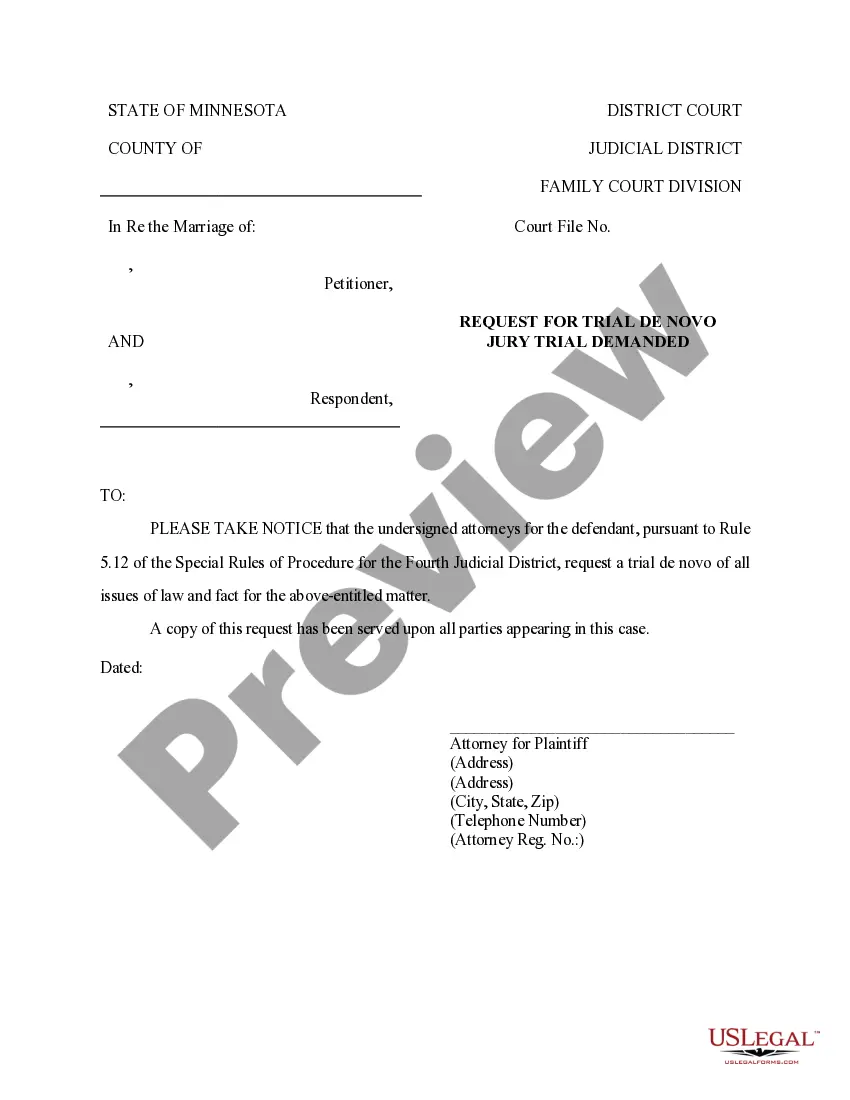
The Request for Trial De Novo is a legal document presented to seek a new trial on the basis of all issues of law and fact in a case. This form is typically filed after a case has been decided, allowing the requesting party to challenge the decision. It differs from standard motions by specifically asking for a full reevaluation of the case rather than addressing individual issues or revisiting limited aspects of the previous trial.
Form components explained
- Notice of intent to pursue a trial de novo.
- Details about the parties involved in the case.
- Signature and contact information of the attorney representing the plaintiff.
- Indication of compliance with local procedural rules.
- Date of filing.
When to use this form
This form should be used after a court has made a ruling in a case and one party wishes to contest that decision. It is appropriate in situations where a party believes that the original trial did not address all the pertinent issues or where legal errors may have impacted the outcome. This form emerges when there is a strong basis to argue for a reevaluation of the entire case.
Who should use this form
This form is intended for:
- Defendants who seek to contest a trial verdict.
- Attorneys representing clients in post-trial motions.
- Any party involved in a case who wishes to secure a comprehensive review of the trial's findings.
Steps to complete this form
- Identify the parties involved in the original case.
- Fill in the date you are making the request for a trial de novo.
- Provide the attorney's name, office address, and contact information.
- Sign the document, certifying it has been served to all parties involved.
- Review the form to ensure all required sections are completed before submission.
Is notarization required?
This form does not typically require notarization to be legally valid. However, some jurisdictions or document types may still require it. US Legal Forms provides secure online notarization powered by Notarize, available 24/7 for added convenience.
Get your form ready online
Our built-in tools help you complete, sign, share, and store your documents in one place.
Make edits, fill in missing information, and update formatting in US Legal Forms—just like you would in MS Word.
Download a copy, print it, send it by email, or mail it via USPS—whatever works best for your next step.
Sign and collect signatures with our SignNow integration. Send to multiple recipients, set reminders, and more. Go Premium to unlock E-Sign.
If this form requires notarization, complete it online through a secure video call—no need to meet a notary in person or wait for an appointment.
We protect your documents and personal data by following strict security and privacy standards.

Make edits, fill in missing information, and update formatting in US Legal Forms—just like you would in MS Word.

Download a copy, print it, send it by email, or mail it via USPS—whatever works best for your next step.

Sign and collect signatures with our SignNow integration. Send to multiple recipients, set reminders, and more. Go Premium to unlock E-Sign.

If this form requires notarization, complete it online through a secure video call—no need to meet a notary in person or wait for an appointment.

We protect your documents and personal data by following strict security and privacy standards.
Avoid these common issues
- Failing to serve the request to all involved parties, which can lead to dismissal.
- Not providing the correct case details, which might result in delays.
- Missing signature or contact information for the attorney.
Why use this form online
- Convenient access to the form from any location.
- Editability allows for customization to fit specific case needs.
- Reliability through templates drafted by licensed attorneys.
Legal use & context
- It is essential to use the Request for Trial De Novo in accordance with local court rules.
- This form initiates a significant legal procedure, thus correct completion is crucial.
- In some cases, timelines for submission after the original ruling are strictly enforced.
Quick recap
- The Request for Trial De Novo allows for a retrial of a case after an initial ruling.
- Proper completion ensures compliance with legal procedures in the Fourth Judicial District.
- Understanding when and how to use this form can significantly impact the outcome of legal disputes.
Looking for another form?



Form popularity
FAQ
The rule of practice 521 in Minnesota specifically deals with the process for filing a Request for Trial De Novo. This rule ensures that parties have a clear pathway to appeal decisions they believe are unjust. By adhering to this rule, individuals can effectively navigate the legal system. For those needing assistance with this process, USLegalForms offers helpful resources to simplify the journey.
Rule 55.01 of the Minnesota Rules of Civil Procedure allows for the entry of default judgment against a party who fails to respond to a complaint. This rule is crucial for ensuring that cases can move forward efficiently when one party does not engage. If you are involved in a legal matter and considering a Minnesota Request for Trial De Novo, understanding this rule can be beneficial. It emphasizes the importance of timely responses in legal proceedings.
In Minnesota, you can refuse jury duty under certain circumstances, such as being a full-time student or having a serious medical condition. However, it is essential to provide valid reasons and documentation to the court. If you are unsure about your eligibility, you can consult legal resources or platforms like USLegalForms for guidance. Fulfilling your civic duty while understanding your rights is important.
A trial de novo is a legal procedure where a case is heard anew, as if the original trial never occurred. This allows for a fresh examination of the facts and evidence presented. If you find yourself unhappy with a lower court's ruling, you might consider a Minnesota Request for Trial De Novo to pursue a different outcome. This process can provide a valuable opportunity for justice.
Rule 521 of the Minnesota General Rules of Practice outlines the procedures for a Request for Trial De Novo. This rule allows parties dissatisfied with a decision in a lower court to seek a new trial in a higher court. By utilizing this rule, individuals can ensure that their case receives a thorough review. Understanding this rule is essential for anyone considering a Minnesota Request for Trial De Novo.