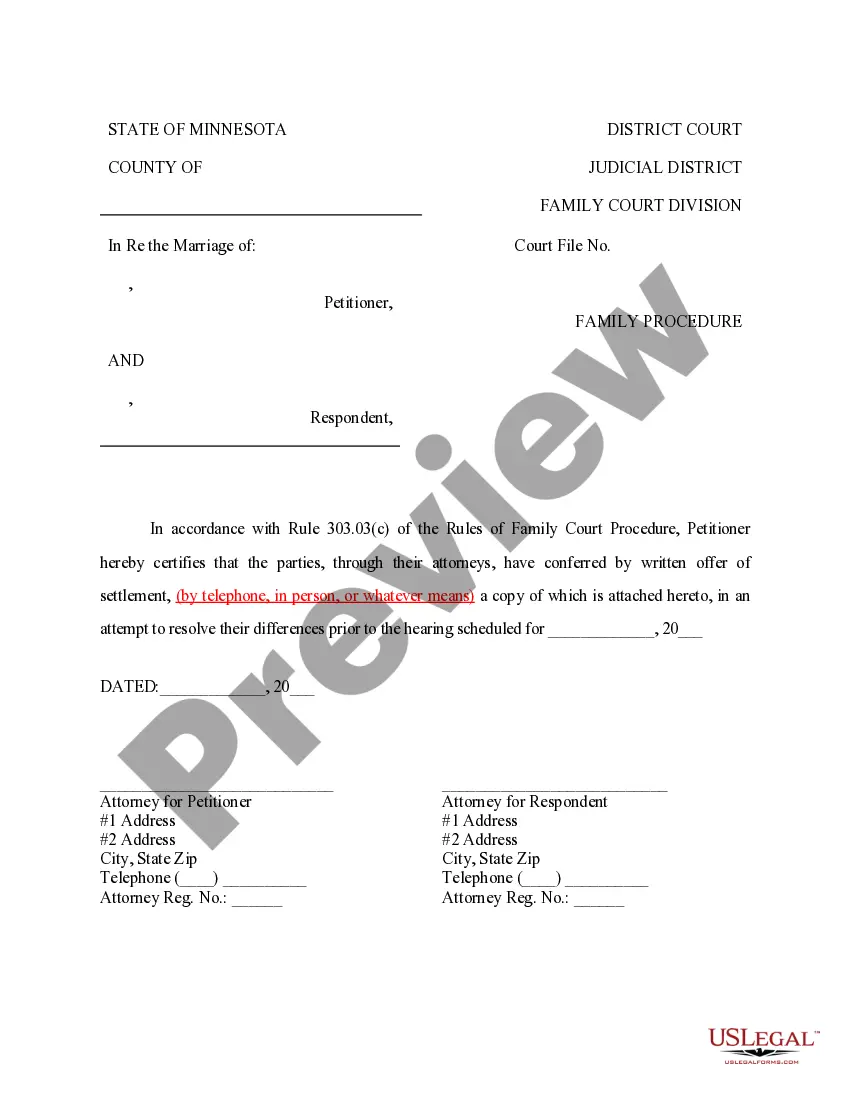
Minnesota Certification that Settlement Discussed Prior to Hearing
About this form
The Certification that Settlement Discussed Prior to Hearing is a legal document that certifies that the parties involved have engaged in settlement discussions before the scheduled hearing. This form ensures compliance with Rule 303.03(c) of the Rules of Family Court Procedure. It provides proof that efforts were made to resolve disputes amicably, distinguishing it from other legal documents related to family law matters, such as divorce or custody filings.
Form components explained
- Petitioner's certification of settlement discussion efforts.
- Details of the settlement communication method used (e.g., written offer, phone call, in-person meeting).
- Scheduled date for the hearing.
- Signatures of both attorneys or parties involved.
- Contact information for both attorneys, including address and telephone numbers.
When this form is needed
This form should be used when parties involved in a family court matter are required to demonstrate that they have attempted to settle their differences before their hearing date. It is essential to file this document before the hearing takes place to comply with procedural rules and to show the court that reasonable efforts to settle have been made.
Who can use this document
- Individuals involved in a family law dispute, such as divorce or custody cases.
- Attorneys representing clients in Family Court.
- Parties seeking to fulfill mandatory settlement requirements before a hearing.
Steps to complete this form
- Identify the petitioner and respondent, including their attorneys.
- Specify the method and content of the settlement discussions.
- Enter the scheduled hearing date.
- Sign the form by both attorneys or parties involved.
- Include contact details for both attorneys.
Is notarization required?
This form does not typically require notarization to be legally valid. However, some jurisdictions or document types may still require it. US Legal Forms provides secure online notarization powered by Notarize, available 24/7 for added convenience.
Get your form ready online
Our built-in tools help you complete, sign, share, and store your documents in one place.
Make edits, fill in missing information, and update formatting in US Legal Forms—just like you would in MS Word.
Download a copy, print it, send it by email, or mail it via USPS—whatever works best for your next step.
Sign and collect signatures with our SignNow integration. Send to multiple recipients, set reminders, and more. Go Premium to unlock E-Sign.
If this form requires notarization, complete it online through a secure video call—no need to meet a notary in person or wait for an appointment.
We protect your documents and personal data by following strict security and privacy standards.

Make edits, fill in missing information, and update formatting in US Legal Forms—just like you would in MS Word.

Download a copy, print it, send it by email, or mail it via USPS—whatever works best for your next step.

Sign and collect signatures with our SignNow integration. Send to multiple recipients, set reminders, and more. Go Premium to unlock E-Sign.

If this form requires notarization, complete it online through a secure video call—no need to meet a notary in person or wait for an appointment.

We protect your documents and personal data by following strict security and privacy standards.
Mistakes to watch out for
- Failing to include all necessary signatures before submitting.
- Omitting the scheduled hearing date.
- Not accurately documenting the method of communication used for settlement discussions.
Benefits of completing this form online
- Convenient access to download and complete the form at any time.
- Editability allows for quick updates to information as needed.
- Reliable templates drafted by licensed attorneys ensure legal compliance.
What to keep in mind
- The form certifies that settlement discussions occurred prior to a hearing.
- It is essential for compliance with family court procedures.
- Complete and sign the form accurately to avoid any issues.
Looking for another form?

Form popularity
FAQ
Rule 69 in Minnesota focuses on the execution of judgments and the collection of debts. It establishes the legal framework for creditors to collect what is owed through various means, including property seizure. By understanding Rule 69, individuals can better navigate the process and consider obtaining a Minnesota Certification that Settlement Discussed Prior to Hearing for clarity and compliance.
The rule of civil procedure 69 in Minnesota outlines the procedures for the enforcement of judgments. It details the rights of judgment creditors and the obligations of debtors during the collection process. Familiarizing yourself with this rule is crucial when seeking a Minnesota Certification that Settlement Discussed Prior to Hearing, as it helps ensure compliance with state laws.
Rule 69 execution refers to the legal process of enforcing a judgment through the seizure of a debtor's property. This process allows creditors to reclaim debts owed to them. For those navigating this process, obtaining a Minnesota Certification that Settlement Discussed Prior to Hearing can clarify the steps and requirements necessary for effective execution.
A Rule 11 hearing in Minnesota addresses issues of frivolous claims and defenses in court. It allows the court to impose sanctions if a party files documents that lack legal merit. Understanding this rule is important for anyone involved in litigation, particularly when considering a Minnesota Certification that Settlement Discussed Prior to Hearing, to ensure compliance with legal standards.
Rule 69 law in Minnesota pertains to the enforcement of judgments. It provides guidelines on how a creditor can collect what is owed to them after a judgment is made. This rule is essential for individuals seeking to understand the process of obtaining a Minnesota Certification that Settlement Discussed Prior to Hearing, ensuring all legal procedures are properly followed.
Rule of Practice 145 in Minnesota focuses on the handling of family law matters, particularly regarding the disclosure of information in custody disputes. This rule emphasizes transparency and encourages parties to communicate openly. Integrating the Minnesota Certification that Settlement Discussed Prior to Hearing into this context can facilitate smoother negotiations in family law cases. Understanding this rule can significantly impact your legal approach.
Rule 521 of the Minnesota General Rules of Practice further elaborates on the procedures for certifying settlements discussed before hearings. This rule aims to ensure that all parties have attempted to resolve their issues before entering the courtroom. The Minnesota Certification that Settlement Discussed Prior to Hearing is crucial for demonstrating compliance with this rule. Awareness of this rule can enhance your legal preparation.
Rule 55.01 in Minnesota deals with default judgments in civil cases. This rule allows a party to seek a judgment when the opposing party fails to respond to a legal action. In conjunction with the Minnesota Certification that Settlement Discussed Prior to Hearing, this rule emphasizes the need for clear communication between parties. Knowing this rule can help you prevent unwanted legal outcomes.
In Minnesota, you can refuse jury duty under certain circumstances, such as financial hardship or health issues. However, you must provide a valid reason to the court to be excused. It's essential to understand that participating in jury duty contributes to the legal system. If you have concerns about your eligibility or the process, platforms like uslegalforms can guide you through the requirements.
The conciliation court process in Minnesota provides a way for parties to resolve disputes without entering a full trial. This process is designed for smaller claims and encourages negotiation and settlement. By obtaining a Minnesota Certification that Settlement Discussed Prior to Hearing, parties can show that they have made efforts to resolve their issues amicably. Engaging with this process can save time and resources.