Minnesota Notice of Default Hearing - 10 Day Notice
Overview of this form
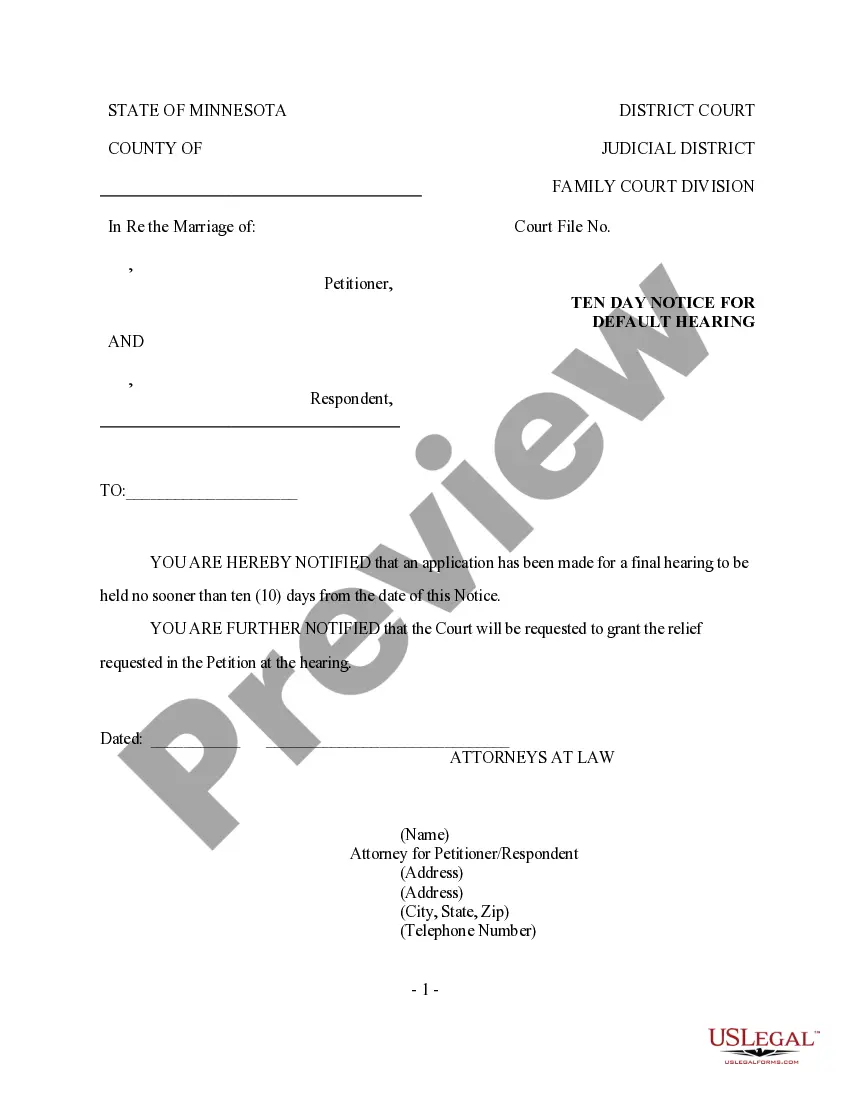
The Notice of Default Hearing - 10 Day Notice is a legal document that notifies involved parties that a hearing for a default judgment will take place no sooner than ten days from the date of the notice. This form serves to inform both the petitioner and respondent about the upcoming court procedures, allowing time for any necessary preparations. Unlike other notices, this form specifically highlights the timeline for the hearing, ensuring all parties are informed in a timely manner.
Key components of this form
- Notice Date: The date the notice is issued.
- Hearing Date: Indicates that the hearing will occur no sooner than ten days after the notice date.
- Relief Request: States that the court will consider the requested relief as specified in the original petition.
- Attorney Information: Includes the name and contact details of the attorney representing the petitioner or respondent.
Common use cases
This form is necessary when a party wishes to formally inform another party about a scheduled hearing for a default judgment. It is commonly used in civil cases where one party has failed to respond to a lawsuit or court order, prompting the other party to seek a default judgment. Utilizing this notice ensures that all parties are aware of the court date and can prepare accordingly.
Who can use this document
- Petitioners seeking a default judgment in a civil case.
- Respondents needing to be informed about the court's scheduled hearing.
- Attorneys representing either the petitioner or the respondent in such legal matters.
How to complete this form
- Identify the notice date by filling in the applicable date at the top of the form.
- Specify the date of the hearing, ensuring it is set for at least ten days after the notice date.
- State the relief requested as outlined in the original petition.
- Enter the attorney's name, address, and contact information in the designated fields.
- Sign and date the notice at the bottom, ensuring it is completed by the appropriate attorney or representative.
Does this form need to be notarized?
In most cases, this form does not require notarization. However, some jurisdictions or signing circumstances might. US Legal Forms offers online notarization powered by Notarize, accessible 24/7 for a quick, remote process.
Get your form ready online
Our built-in tools help you complete, sign, share, and store your documents in one place.
Make edits, fill in missing information, and update formatting in US Legal Forms—just like you would in MS Word.
Download a copy, print it, send it by email, or mail it via USPS—whatever works best for your next step.
Sign and collect signatures with our SignNow integration. Send to multiple recipients, set reminders, and more. Go Premium to unlock E-Sign.
If this form requires notarization, complete it online through a secure video call—no need to meet a notary in person or wait for an appointment.
We protect your documents and personal data by following strict security and privacy standards.

Make edits, fill in missing information, and update formatting in US Legal Forms—just like you would in MS Word.

Download a copy, print it, send it by email, or mail it via USPS—whatever works best for your next step.

Sign and collect signatures with our SignNow integration. Send to multiple recipients, set reminders, and more. Go Premium to unlock E-Sign.

If this form requires notarization, complete it online through a secure video call—no need to meet a notary in person or wait for an appointment.

We protect your documents and personal data by following strict security and privacy standards.
Common mistakes
- Failing to provide the correct notice date.
- Not allowing the full ten days before the hearing date, which could jeopardize the case.
- Incomplete attorney information, which may lead to communication issues.
- Not ensuring that all parties receive a copy of the notice.
Benefits of using this form online
- Convenience of filling out the form anytime, anywhere.
- Editability to customize the form to meet specific case requirements.
- Access to attorney-drafted templates, ensuring legal compliance.
- Immediate downloading for quick filing with the court.
Looking for another form?
Form popularity
FAQ
Rule of Practice 115.10 in Minnesota addresses the requirements for motions and other documents filed in court. This rule ensures that all submissions are clear and complete, which is vital for the success of your case. By understanding this rule, you can enhance your approach to the Minnesota Notice of Default Hearing - 10 Day Notice and streamline your court interactions.
Rule 69 in Minnesota pertains to the enforcement of judgments, including how default judgments can be executed. This rule is vital for understanding your rights and responsibilities after receiving a judgment. Familiarizing yourself with this rule can complement your knowledge of the Minnesota Notice of Default Hearing - 10 Day Notice, ensuring you are fully prepared for the next steps.
To ask the court for a default, submit a formal request that includes the appropriate forms and evidence. You must demonstrate that the other party has failed to respond within the specified time frame. The Minnesota Notice of Default Hearing - 10 Day Notice plays a crucial role here, as it outlines the timeline for the court's consideration of your request.
Rule of Practice 521 in Minnesota outlines the procedures for obtaining a default judgment. This rule specifies the necessary steps and documentation needed to support your request. Understanding this rule is essential if you are navigating the Minnesota Notice of Default Hearing - 10 Day Notice process, as it provides clarity on what the court expects.
To request a default hearing in Minnesota, you must file a motion with the court. This motion should include your reasons for seeking the default and any relevant documentation. Be sure to comply with the Minnesota Notice of Default Hearing - 10 Day Notice requirements, as this will help ensure your request is processed efficiently.
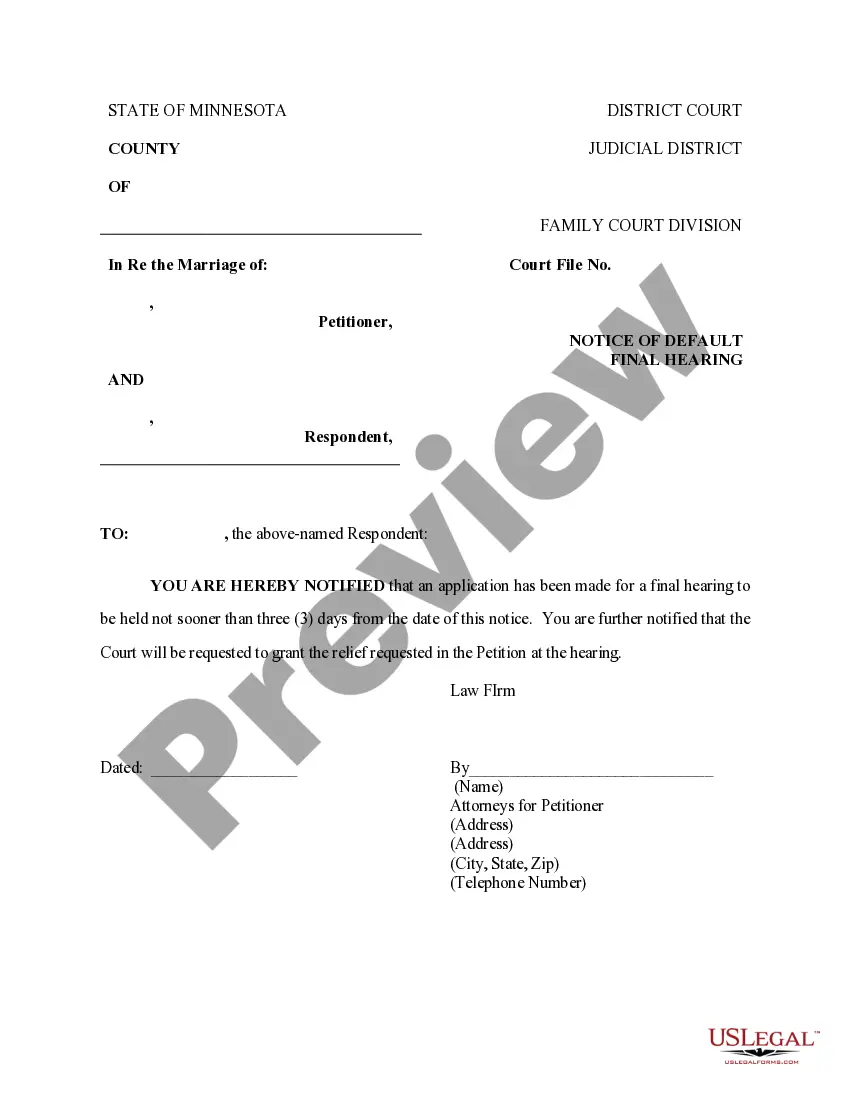
The 48 hour rule in Minnesota refers to the timeframe within which a party must notify the other side of their intent to proceed with a default hearing. Specifically, this rule applies to the Minnesota Notice of Default Hearing - 10 Day Notice, requiring that notice be given at least 48 hours before the hearing. This ensures that all parties have a fair opportunity to respond and prepare. Knowing the rules helps you maintain compliance and avoid unnecessary complications.
To prepare for a Minnesota Notice of Default Hearing - 10 Day Notice, gather all necessary documents, including evidence and correspondence related to the case. Review the timeline of events leading up to the hearing, and ensure you understand your rights. You may also want to consult with a legal expert or use resources from uslegalforms to help you prepare adequately. Preparation can significantly influence the hearing's outcome.
During a Minnesota Notice of Default Hearing - 10 Day Notice, the court reviews the case to determine if a default judgment is warranted. The judge will consider the evidence presented by the plaintiff and may also allow the defendant to explain their absence. It is crucial to have all relevant documents ready, as this can impact the outcome. Understanding this process helps you navigate the legal system more effectively.
Rule 609 in Minnesota pertains to the admissibility of prior convictions in court. It addresses how past criminal behavior may influence the credibility of a witness. Knowing this rule can be crucial during trials, particularly if you find yourself involved in a Minnesota Notice of Default Hearing - 10 Day Notice, as it may affect your case's outcome.
After a default hearing, the court issues a ruling based on the evidence presented. If the judgment is in favor of the plaintiff, you may face financial obligations, such as paying damages or fees. It is important to understand your options moving forward, including the possibility of appealing the decision or negotiating a settlement. Consulting resources like US Legal Forms can provide valuable guidance during this time.