Minnesota Notice of Default - Final Hearing
Overview of this form
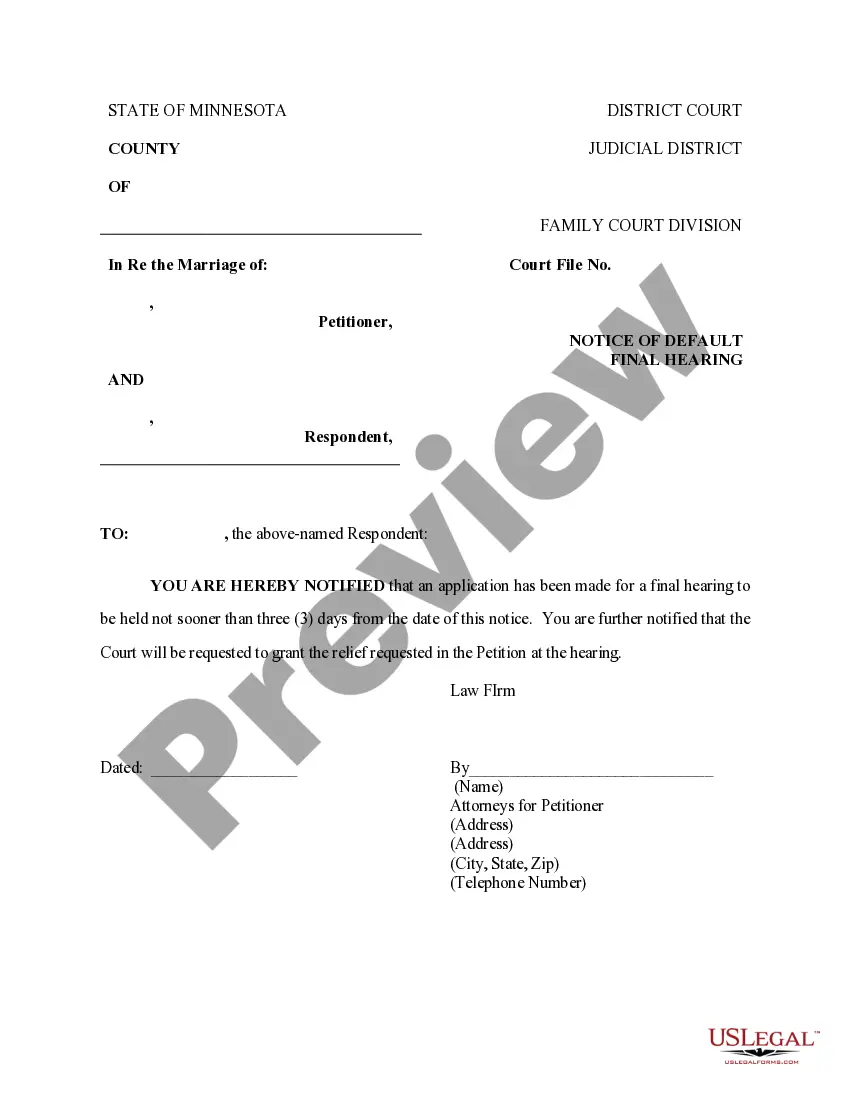
The Notice of Default - Final Hearing is a legal document used to inform a respondent that they are in default of their obligations in a legal proceeding. This notice also indicates that the petitioner has requested a final hearing to resolve the matter, which should occur within three days of notifying the respondent. This form is essential in legal proceedings where timely resolution is critical, distinguishing it from more general notices by emphasizing the request for a final hearing.
Form components explained
- Header indicating the law firm and date of the notice.
- Identification of the parties involved, including the petitioner and respondent.
- Details regarding the request for a final hearing within three days.
- Contact information for the attorney representing the petitioner.
When to use this form
This form should be used in scenarios where a legal proceeding has reached a stage of default by the respondent. It is relevant when the petitioner has taken steps to advance the case to a final hearing and needs to formally notify the respondent of this intention. Common situations might include cases related to contracts, family law disputes, or other civil matters where a respondent has not fulfilled their obligations.
Who this form is for
- Petitioners involved in legal disputes where a default has occurred.
- Attorneys representing clients in civil or family law matters.
- Individuals needing to expedite legal proceedings through formal notification.
How to prepare this document
- Fill in the date at the top of the form.
- Clearly identify the petitioner and respondent, including their full names and addresses.
- Specify the date by which the final hearing is requested, ensuring it is no later than three days from the notice date.
- Include the contact information for the attorney representing the petitioner.
- Sign and date the document as required by law, indicating the authority to act on behalf of the petitioner.
Does this form need to be notarized?
This form usually doesn’t need to be notarized. However, local laws or specific transactions may require it. Our online notarization service, powered by Notarize, lets you complete it remotely through a secure video session, available 24/7.
Get your form ready online
Our built-in tools help you complete, sign, share, and store your documents in one place.
Make edits, fill in missing information, and update formatting in US Legal Forms—just like you would in MS Word.
Download a copy, print it, send it by email, or mail it via USPS—whatever works best for your next step.
Sign and collect signatures with our SignNow integration. Send to multiple recipients, set reminders, and more. Go Premium to unlock E-Sign.
If this form requires notarization, complete it online through a secure video call—no need to meet a notary in person or wait for an appointment.
We protect your documents and personal data by following strict security and privacy standards.

Make edits, fill in missing information, and update formatting in US Legal Forms—just like you would in MS Word.

Download a copy, print it, send it by email, or mail it via USPS—whatever works best for your next step.

Sign and collect signatures with our SignNow integration. Send to multiple recipients, set reminders, and more. Go Premium to unlock E-Sign.

If this form requires notarization, complete it online through a secure video call—no need to meet a notary in person or wait for an appointment.

We protect your documents and personal data by following strict security and privacy standards.
Common mistakes
- Failing to provide complete contact information for all parties involved.
- Not specifying the correct date for the requested hearing.
- Overlooking the signature requirements, which can invalidate the notice.
Advantages of online completion
- Convenience of downloading and completing the form at your own pace.
- Editability allows users to tailor the document to their specific situation.
- Reliable templates that meet legal standards, ensuring compliance and validity.
Legal use & context
- Form provides formal notice to a respondent in case of default, a critical step in legal proceedings.
- Used within a specified timeframe to ensure the prompt resolution of disputes.
- Essential for adherence to procedural rules in civil litigation.
Quick recap
- The Notice of Default - Final Hearing is important for formally notifying the respondent of legal defaults.
- Proper completion and timely submission of this form can expedite legal proceedings.
- Always verify state-specific regulations to ensure compliance and validity of the notice.
Looking for another form?



Form popularity
FAQ
To ask the court for a default, you must first file a motion indicating that the opposing party has not responded within the specified time frame. This motion should clearly outline your reasons for the request, referencing the Minnesota Notice of Default - Final Hearing. It is crucial to provide supporting evidence, and using USLegalForms can help you prepare the motion correctly, making the process smoother and more efficient.
Applying for a default judgment involves submitting a motion to the court after the defendant fails to respond to a complaint. In your application, include evidence that establishes your claim, along with the required forms for the Minnesota Notice of Default - Final Hearing. This process can be complex, but with tools from USLegalForms, you can easily access the necessary documents and guidance to ensure your application is complete and accurate.
To request a default hearing in Minnesota, you need to file a Notice of Default with the court. Make sure to include all necessary documentation that supports your claim for the default. After filing, you should wait for the court to schedule the hearing, which will allow you to present your case regarding the Minnesota Notice of Default - Final Hearing. Utilizing platforms like USLegalForms can streamline this process, ensuring you submit the correct forms.
A default hearing in Minnesota occurs when a party fails to respond to a legal complaint, allowing the other party to request a judgment. During this hearing, the court reviews evidence and decides whether to grant the default judgment. Understanding the implications of a Minnesota Notice of Default - Final Hearing can significantly impact your case, making it essential to be well-prepared.
A motion for default judgment typically requires proof of service, the original complaint, and a proposed order. Additionally, you may need to provide a sworn statement detailing the amount owed. Gathering these documents is vital for a successful outcome in a Minnesota Notice of Default - Final Hearing.
Yes, you can file a motion in court without a lawyer, but it requires careful attention to detail. You must understand the legal procedures and requirements to ensure your motion is valid. Many individuals find guidance through platforms like US Legal Forms, which provide resources to help effectively navigate the process during a Minnesota Notice of Default - Final Hearing.
To file a motion for default judgment in Minnesota, you must first ensure the opposing party has been properly served. Next, prepare your motion, including all necessary documents, and file it with the court. This process is crucial when navigating a Minnesota Notice of Default - Final Hearing, as it sets the stage for obtaining the judgment you seek.
Filling out an entry of default requires careful attention to detail. You will need to include the case number, names of the parties involved, and a statement confirming the defendant's failure to respond. To streamline this process, you can access resources on US Legal Forms, which provide step-by-step instructions for completing the entry of default, ensuring you are prepared for the Minnesota Notice of Default - Final Hearing.
A declaration for entry of default is a legal document that states the defendant has not responded to the lawsuit within the required time. This declaration supports your request for a default judgment by outlining the circumstances surrounding the lack of response. To ensure your declaration is complete and accurate, you may want to refer to US Legal Forms for templates tailored to the Minnesota Notice of Default - Final Hearing.
Filing an entry of default involves submitting the appropriate paperwork to the court after the defendant fails to respond. You will need to fill out the entry of default form and provide proof of service showing the defendant received the complaint. For assistance with this process, consider using US Legal Forms, which offers templates and guidance to help you file correctly for your Minnesota Notice of Default - Final Hearing.