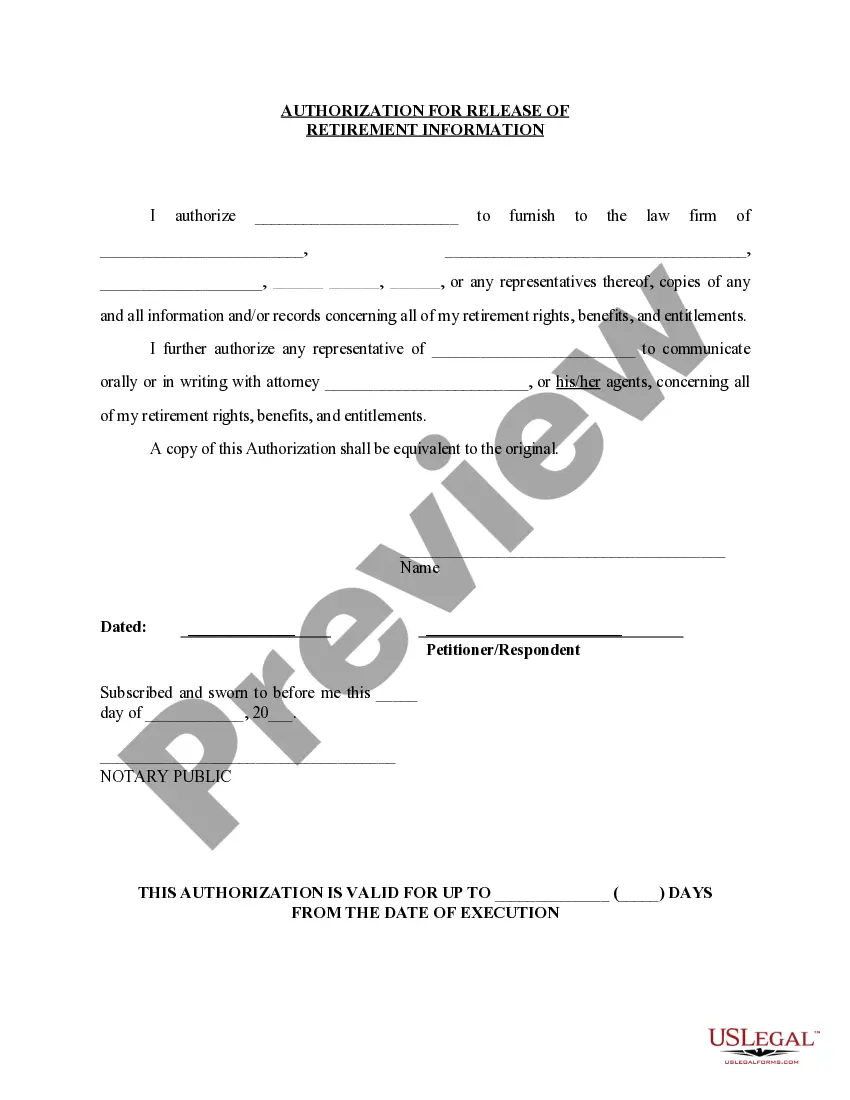
Minnesota Authorization to Release Retirement Information
Overview of this form
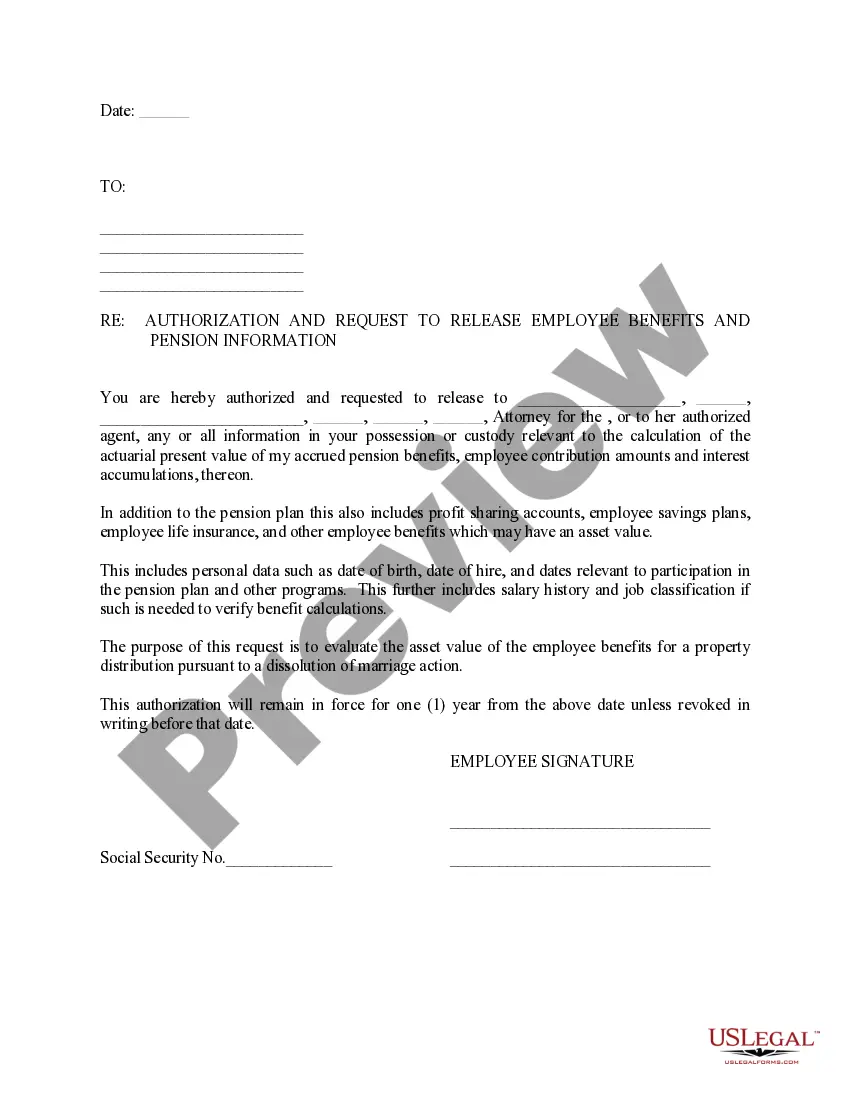
The Authorization to Release Retirement Information is a legal document that allows an individual to authorize a specific company to release their retirement information to a designated law firm. This form is distinct from similar releases as it specifically pertains to retirement rights and entitlements, ensuring that the necessary information is disclosed for legal representation.
What’s included in this form
- Authorizing party: Individual who grants permission for the release of retirement information.
- Company name: The specific retirement company authorized to release information.
- Law firm details: The name and address of the law firm receiving the retirement information.
- Communication authorization: Permission for representatives to communicate directly with the attorney about retirement details.
- Validity period: Duration for which the authorization remains in effect, stated in days.
Situations where this form applies
This form is necessary when an individual needs to allow their law firm access to retirement accounts, benefits, and rights to support legal actions or claims. Scenarios include estate planning, divorce proceedings, or any situation where an attorney requires detailed knowledge of an individual's retirement entitlements to advise effectively or to represent the individual in securing those benefits.
Who needs this form
- Individuals planning to engage legal counsel regarding their retirement rights.
- Persons undergoing a divorce who need to disclose retirement accounts.
- Clients preparing for estate planning that includes retirement benefits.
- Anyone needing to authorize their law firm to access retirement information for legal purposes.
Steps to complete this form
- Identify the party authorizing the release and provide their name.
- Enter the name of the company from which retirement information will be released.
- Fill in the details of the law firm that will receive the information.
- Specify the duration for which the authorization remains valid in days.
- Sign and date the form, and ensure it is notarized if required.
Notarization requirements for this form
This form does not typically require notarization unless specified by local law. Always check local regulations to ensure compliance with any specific legal requirements in your state.
Get your form ready online
Our built-in tools help you complete, sign, share, and store your documents in one place.
Make edits, fill in missing information, and update formatting in US Legal Forms—just like you would in MS Word.
Download a copy, print it, send it by email, or mail it via USPS—whatever works best for your next step.
Sign and collect signatures with our SignNow integration. Send to multiple recipients, set reminders, and more. Go Premium to unlock E-Sign.
If this form requires notarization, complete it online through a secure video call—no need to meet a notary in person or wait for an appointment.
We protect your documents and personal data by following strict security and privacy standards.

Make edits, fill in missing information, and update formatting in US Legal Forms—just like you would in MS Word.

Download a copy, print it, send it by email, or mail it via USPS—whatever works best for your next step.

Sign and collect signatures with our SignNow integration. Send to multiple recipients, set reminders, and more. Go Premium to unlock E-Sign.

If this form requires notarization, complete it online through a secure video call—no need to meet a notary in person or wait for an appointment.

We protect your documents and personal data by following strict security and privacy standards.
Common mistakes to avoid
- Failing to specify the retirement company accurately.
- Not providing the correct law firm information.
- Leaving the validity period blank or unclear.
- Forgetting to sign and date the form.
- Neglecting the notarization requirement if applicable.
Benefits of completing this form online
- Easy access to a professionally drafted template.
- Instant download for immediate use.
- Editable format allows customization for specific needs.
- Secure, straightforward process for handling sensitive information.
Looking for another form?
Form popularity
FAQ
Retiring early can lead to a reduction in your pension benefits, often calculated as a percentage for each year you retire before the designated retirement age. This reduction can significantly impact your monthly income. To assess your options and potential losses, using the Minnesota Authorization to Release Retirement Information will help you make informed decisions.
The monthly pension amount for retired teachers in Minnesota varies based on years of service and salary history. On average, retirees may receive anywhere from a few hundred to several thousand dollars per month. It's important to gather the necessary documentation, and using the Minnesota Authorization to Release Retirement Information will assist in understanding your specific benefits.
The Minnesota Public Employees Retirement Association (MN PERA) has made significant strides toward being fully funded. This status ensures financial stability for current and future retirees. For detailed insights into your retirement benefits, the Minnesota Authorization to Release Retirement Information is a vital tool to access your records.
In Minnesota, you can typically retire as early as age 55, depending on your specific retirement plan. However, your benefits may be reduced if you retire before reaching the age mandated by your plan. It's advisable to review your retirement options and consider the Minnesota Authorization to Release Retirement Information for a smooth process.
As of now, Minnesota does tax Social Security benefits, but changes may occur by 2025. Retirees should stay informed about any legislative updates regarding tax laws. Utilizing the Minnesota Authorization to Release Retirement Information can help clarify any questions about your retirement income and tax obligations.
The rule of 90 in Minnesota allows employees to retire with full pension benefits when their age plus years of service equals 90. This rule provides a flexible option for many workers to plan their retirement. Understanding this rule is essential, and obtaining the Minnesota Authorization to Release Retirement Information can help you navigate your retirement options effectively.
The Minnesota general employee retirement plan provides retirement benefits for public employees. This plan includes various features such as pension benefits, disability coverage, and survivor benefits. To access these benefits, individuals may need to fill out the Minnesota Authorization to Release Retirement Information. This ensures you have the necessary documents to claim your benefits efficiently.
Yes, Minnesota is considered an open record state, meaning that many public records are accessible to residents. However, there are specific exemptions, particularly concerning sensitive personal and financial information. Understanding the nuances of open records can be simplified through the Minnesota Authorization to Release Retirement Information, which facilitates the process of retrieving necessary retirement data.
In Minnesota, certain types of information regarding retirement benefits and personal data are classified as not public. This includes sensitive financial information and personal identification details that require protection under state law. To navigate these complexities, the Minnesota Authorization to Release Retirement Information can provide clarity on what data is accessible and how to request it properly.
The new retirement law in Minnesota focuses on modernizing the state's retirement systems to better serve its residents. It includes provisions for increased employer participation and improved financial literacy programs for employees. Utilizing the Minnesota Authorization to Release Retirement Information can help individuals understand how these developments impact their retirement planning.