Minnesota Emergency Filing Order regarding Hearing Date
Understanding this form
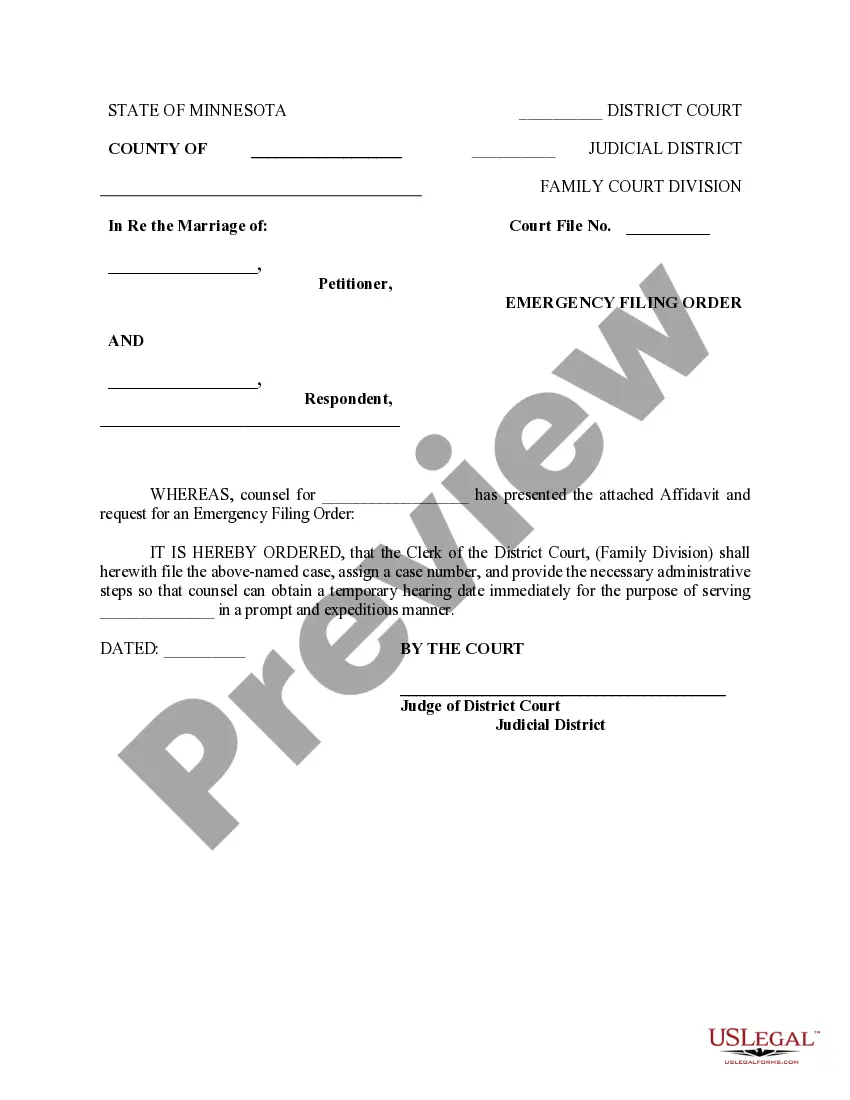
The Emergency Filing Order regarding Hearing Date is a legal document directed to the clerk of the district court (Family Division). This form allows for the immediate filing of a case, assignment of a case number, and ensures that counsel can quickly obtain a temporary hearing date. It is specifically designed for urgent situations requiring expedited legal proceedings, distinguishing it from standard filing forms that may not address immediate needs.
Key components of this form
- Information about the case and parties involved
- Affidavit presenting the request for an emergency filing
- Order for the clerk to assign a case number
- Instructions for obtaining a temporary hearing date
- Date and signature of the presiding judge
Situations where this form applies
This form is typically used in situations where immediate legal action is required, such as in matters involving child custody, domestic violence, or other urgent family law concerns. It allows legal counsel to act swiftly to secure a hearing date, thereby facilitating a prompt judicial response to pressing issues.
Who can use this document
This form is intended for:
- Attorneys representing clients in urgent family law matters
- Individuals requiring immediate court intervention for family-related legal issues
- Parties involved in cases where a temporary hearing is necessary
How to prepare this document
- Identify the parties involved in the case.
- Attach the necessary affidavit detailing the emergency circumstances.
- Clearly state the request for the emergency filing order.
- Sign and date the form where indicated.
- Submit the completed form to the clerk of the district court for processing.
Does this form need to be notarized?
This form does not typically require notarization unless specified by local law. Always check your stateâs requirements to ensure compliance with legal standards.
Get your form ready online
Our built-in tools help you complete, sign, share, and store your documents in one place.
Make edits, fill in missing information, and update formatting in US Legal Forms—just like you would in MS Word.
Download a copy, print it, send it by email, or mail it via USPS—whatever works best for your next step.
Sign and collect signatures with our SignNow integration. Send to multiple recipients, set reminders, and more. Go Premium to unlock E-Sign.
If this form requires notarization, complete it online through a secure video call—no need to meet a notary in person or wait for an appointment.
We protect your documents and personal data by following strict security and privacy standards.

Make edits, fill in missing information, and update formatting in US Legal Forms—just like you would in MS Word.

Download a copy, print it, send it by email, or mail it via USPS—whatever works best for your next step.

Sign and collect signatures with our SignNow integration. Send to multiple recipients, set reminders, and more. Go Premium to unlock E-Sign.

If this form requires notarization, complete it online through a secure video call—no need to meet a notary in person or wait for an appointment.

We protect your documents and personal data by following strict security and privacy standards.
Common mistakes to avoid
- Failing to include all required party information.
- Leaving the affidavit incomplete or unclear.
- Not signing the form or dating it properly.
- Submitting the form to the wrong court division.
Why use this form online
- Convenient access to legal templates at any time.
- Edit and customize the form easily to fit your needs.
- Reliable language and structure drafted by licensed attorneys.
- Quickly obtain and print the form for immediate use.
Legal use & context
- The form initiates legal proceedings in cases requiring immediate intervention.
- It is important for ensuring that urgent family matters are addressed promptly by the court.
- This order provides courts with formal notice of the need for a hearing, enhancing the enforceability of the subsequent actions.
Key takeaways
- The Emergency Filing Order is essential for urgent legal situations.
- Ensure you complete and submit the form accurately for timely processing.
- Understand your state's specific requirements for filing.
Looking for another form?
Form popularity
FAQ
Rule of Practice 521 in Minnesota governs the procedures for emergency filings in child protection cases. This rule outlines the requirements for submitting a Minnesota Emergency Filing Order regarding Hearing Date, ensuring that all necessary information is included for prompt judicial review. By adhering to this rule, legal representatives can facilitate efficient hearings, helping to protect vulnerable children in urgent situations. Understanding Rule 521 is crucial for anyone involved in these legal proceedings.
The emergency protective care hearing in Minnesota is a legal process that occurs when a child faces an immediate risk of harm. During this hearing, a judge reviews the circumstances and determines whether the child should be placed in protective care. This process often involves a Minnesota Emergency Filing Order regarding Hearing Date to expedite the proceedings, ensuring timely intervention to safeguard the child's wellbeing. It is essential for concerned parties to understand their rights and responsibilities during this critical time.
An emergency hearing can occur relatively quickly, often within days of filing your request. The exact timing depends on the court's availability and the specifics of your case. By utilizing a Minnesota Emergency Filing Order regarding Hearing Date, you can improve your chances of a speedy hearing, ensuring that important issues are addressed without prolonged waiting.
You can often secure an emergency hearing within a few days, depending on the court's schedule and the urgency of your situation. Courts prioritize cases involving immediate risk to children, so having a solid reason for your request is essential. A Minnesota Emergency Filing Order regarding Hearing Date can be instrumental in expediting this process, allowing you to address your concerns without unnecessary delays.
Emergency custody in Oregon typically qualifies under situations where a child is at risk of harm or if immediate action is needed to prevent serious injury. Factors include domestic violence, substance abuse, or the potential for abduction. If you find yourself in a similar situation, a Minnesota Emergency Filing Order regarding Hearing Date can assist you in addressing custody concerns swiftly and effectively.
Yes, you can obtain a court order on the same day by filing an emergency motion. However, this process often requires a compelling reason that justifies the urgency. To streamline this, consider using a Minnesota Emergency Filing Order regarding Hearing Date. This can help you present your case effectively and secure the necessary order promptly.
One of the biggest mistakes in a custody battle is failing to prioritize the child's best interests. Parents often focus on personal grievances instead of what is healthiest for the child. It’s crucial to maintain clear communication and a cooperative attitude. Utilizing a Minnesota Emergency Filing Order regarding Hearing Date can help you expedite legal matters and ensure a timely resolution.
The 48-hour rule in criminal procedure ensures that individuals arrested are either charged or released within 48 hours. This rule is vital for protecting your rights and maintaining judicial efficiency. If you experience delays or complications regarding your hearing, consider utilizing a Minnesota Emergency Filing Order regarding Hearing Date through uslegalforms to streamline the process.
Rule 77.04 in Minnesota pertains to the procedures for filing motions and obtaining hearing dates. It is crucial for ensuring that all parties involved in a legal matter are informed and able to respond appropriately. For those needing to navigate these rules effectively, a Minnesota Emergency Filing Order regarding Hearing Date from uslegalforms can provide the necessary support.
The 36 48-hour rule addresses the timeline for arraignment after an arrest. It specifies that an individual must be arraigned within 36 hours if in custody, or within 48 hours if released on bail. Understanding this rule is essential for ensuring your legal rights are upheld. For urgent matters, consider a Minnesota Emergency Filing Order regarding Hearing Date via uslegalforms.