Minnesota Subcontractor's Request for Information - Individual
What this document covers
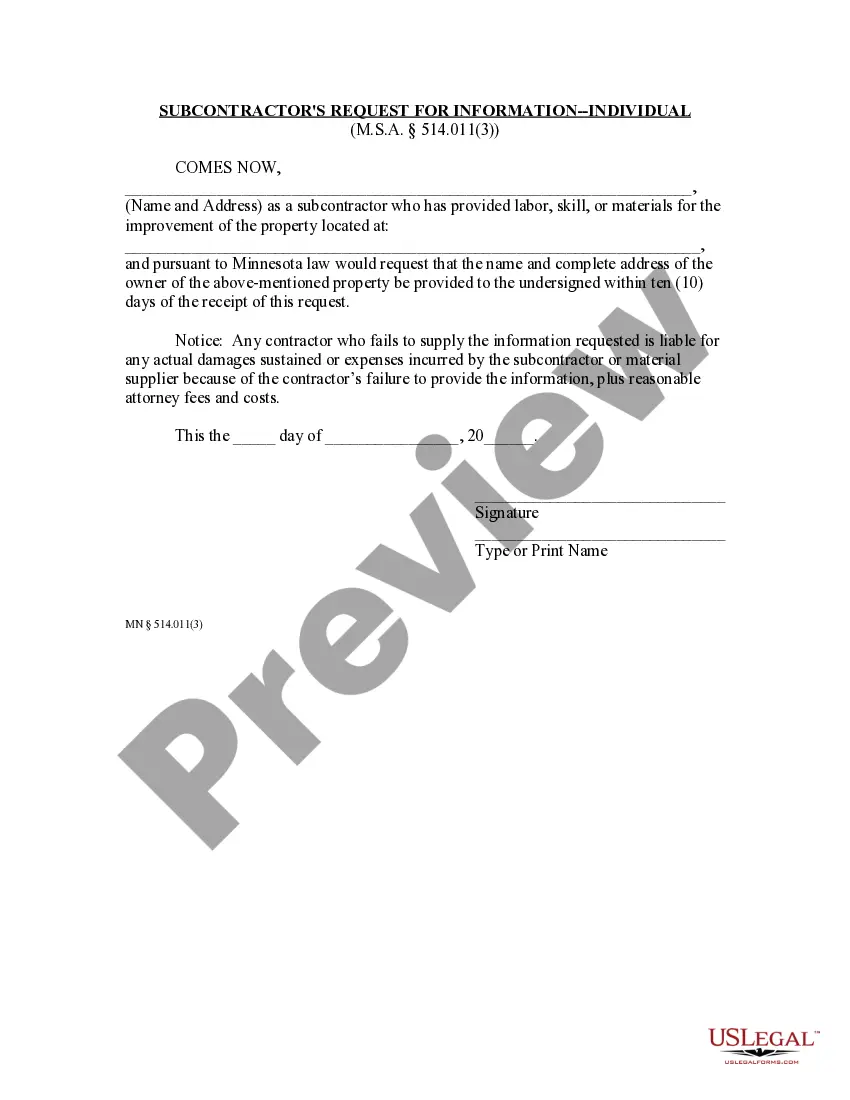
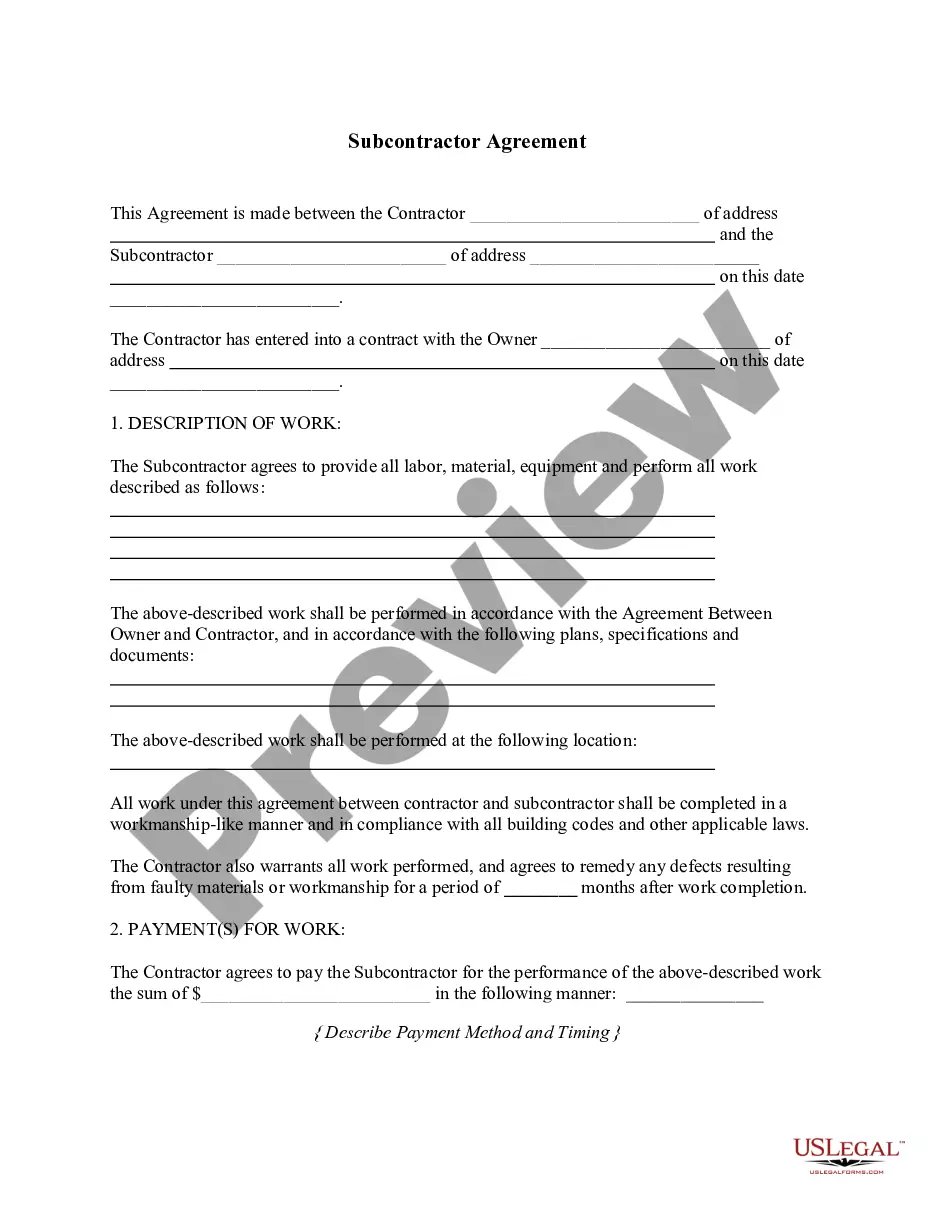
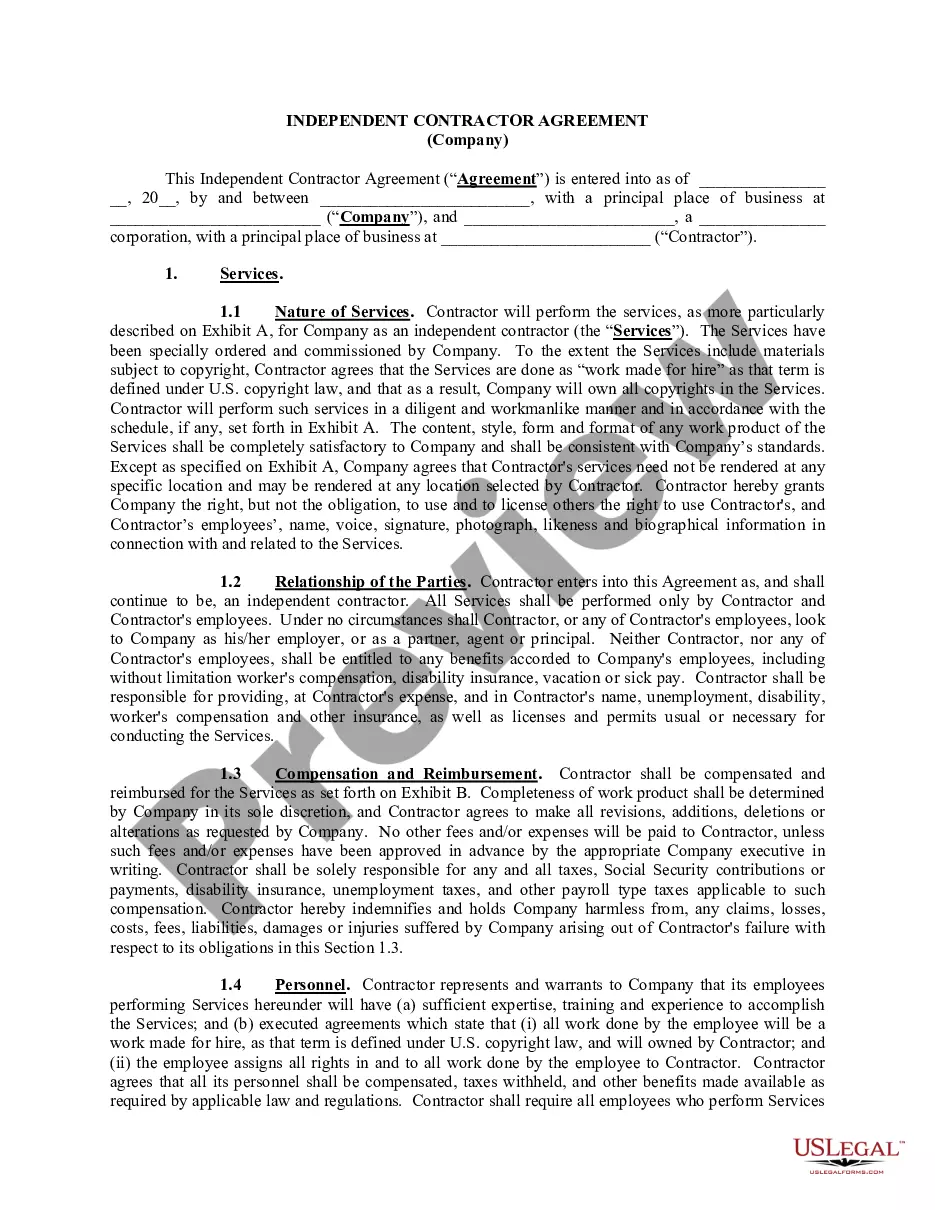
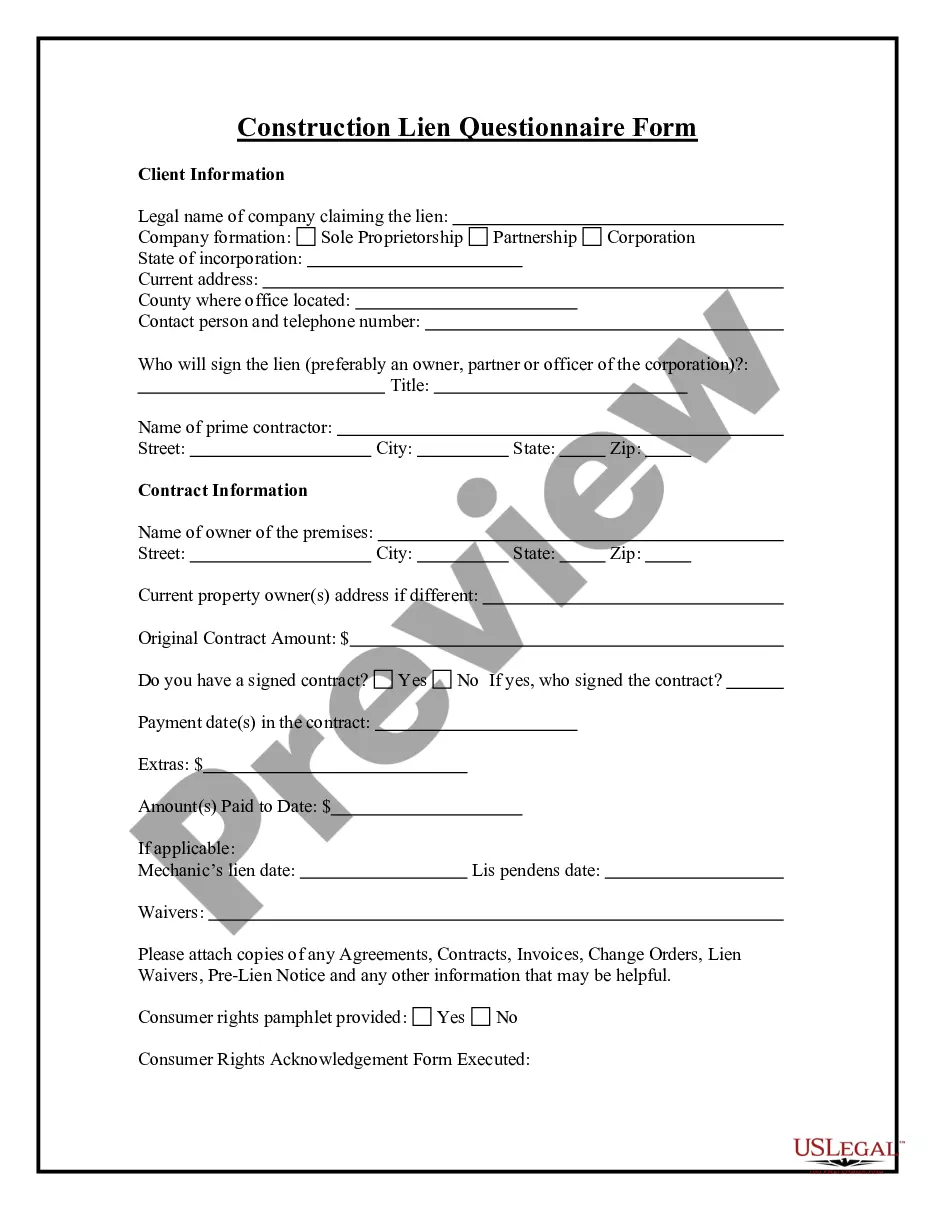
The Subcontractor's Request for Information form is a legal document used by subcontractors in Minnesota to formally request the name and address of the property owner. This form serves to ensure that subcontractors can communicate effectively about the labor and materials they provide, protecting their interests. It differentiates from other forms by specifically addressing the need for transparency between subcontractors and property owners regarding project details and responsibilities.
Key components of this form
- Identification of the subcontractor, including name and address.
- Details of the property where labor or materials were supplied.
- A formal request for the property owner's name and address.
- A notice regarding the contractor's liability if they fail to respond.
- Signature line for the subcontractor, including a date field.
When to use this form
This form should be used when a subcontractor has provided services or materials for a construction project but does not have the contact information for the property owner. It is essential in situations where the subcontractor needs to notify the owner about the work being done and secure their rights in the absence of direct communication from the contractor.
Who this form is for
- Subcontractors providing labor or materials for construction projects.
- Contractors who are required to disclose information to subcontractors.
- Property owners involved in a project where multiple subcontractors are engaged.
How to complete this form
- Identify yourself as the subcontractor by filling in your name and address.
- Specify the property by entering its address where the work is being done.
- Request the property owner's name and complete address.
- Note the ten-day response period for the contractor.
- Sign and date the form to finalize your request.
Is notarization required?
This form does not typically require notarization to be legally valid. However, some jurisdictions or document types may still require it. US Legal Forms provides secure online notarization powered by Notarize, available 24/7 for added convenience.
Get your form ready online
Our built-in tools help you complete, sign, share, and store your documents in one place.
Make edits, fill in missing information, and update formatting in US Legal Forms—just like you would in MS Word.
Download a copy, print it, send it by email, or mail it via USPS—whatever works best for your next step.
Sign and collect signatures with our SignNow integration. Send to multiple recipients, set reminders, and more. Go Premium to unlock E-Sign.
If this form requires notarization, complete it online through a secure video call—no need to meet a notary in person or wait for an appointment.
We protect your documents and personal data by following strict security and privacy standards.

Make edits, fill in missing information, and update formatting in US Legal Forms—just like you would in MS Word.

Download a copy, print it, send it by email, or mail it via USPS—whatever works best for your next step.

Sign and collect signatures with our SignNow integration. Send to multiple recipients, set reminders, and more. Go Premium to unlock E-Sign.

If this form requires notarization, complete it online through a secure video call—no need to meet a notary in person or wait for an appointment.

We protect your documents and personal data by following strict security and privacy standards.
Typical mistakes to avoid
- Failing to provide accurate contact information for the subcontractor.
- Neglecting to specify the property address correctly.
- Not noting the ten-day response requirement for the contractor.
- Overlooking the need for a formal signature and date.
Benefits of completing this form online
- Convenience of immediate access to the form from anywhere.
- Ability to easily edit and customize the form before downloading.
- Reliability of professionally crafted legal language by licensed attorneys.
Legal use & context
- This form is enforceable under Minnesota law, requiring contractors to respond to subcontractor inquiries.
- Failure to respond within the required timeframe may result in legal liability for damages.
- Utilizing this form helps maintain transparency and communication in construction projects.
What to keep in mind
- The Subcontractor's Request for Information is crucial for obtaining property owner details.
- Timely response from contractors is legally mandated to protect subcontractor rights.
- Completing the form accurately can prevent communication issues on construction projects.
Looking for another form?

Form popularity
FAQ
If a lien is filed against your property (in the form of a lien statement), it must be filed with the county recorder and a copy delivered to you, the property owner, either personally or by certified mail, within 120 days after the last material or labor is furnished for the job.
Have a current license, certificate or registration issued by the agency; are an employee of a business performing construction services; have a current residential building contractor or remodeler certificate of exemption; or. are excluded from registration requirements under Minnesota Statutes 326B.
A lien is a claim or legal right against assets that are typically used as collateral to satisfy a debt.A lien serves to guarantee an underlying obligation, such as the repayment of a loan. If the underlying obligation is not satisfied, the creditor may be able to seize the asset that is the subject of the lien.
The notice must inform the homeowner of the contractor's right to lien the property, and the right to pay off any subcontractors that haven't been paid by the general contractor.
If a lien is filed against your property (in the form of a lien statement), it must be filed with the county recorder and a copy delivered to you, the property owner, either personally or by certified mail, within 120 days after the last material or labor is furnished for the job.
When a contractor files a mechanics' (construction) lien on your home, the lien makes your home into what's called security for an outstanding debt, which the contractor claims is due and unpaid for services or materials.
You (and any subcontractors) must submit a Contractor Affidavit (Form IC134) to the Minnesota Department of Revenue to verify you have met state withholding requirements.
Posting a Bond Asselta says to expect to pay 110 percent of the lien amount. Submit the bond to the court. The lien will then transfer to the bond and clear the property's title. Wait for the contractor claimant to foreclose on the lien in the allotted period to dispute the lien in court.