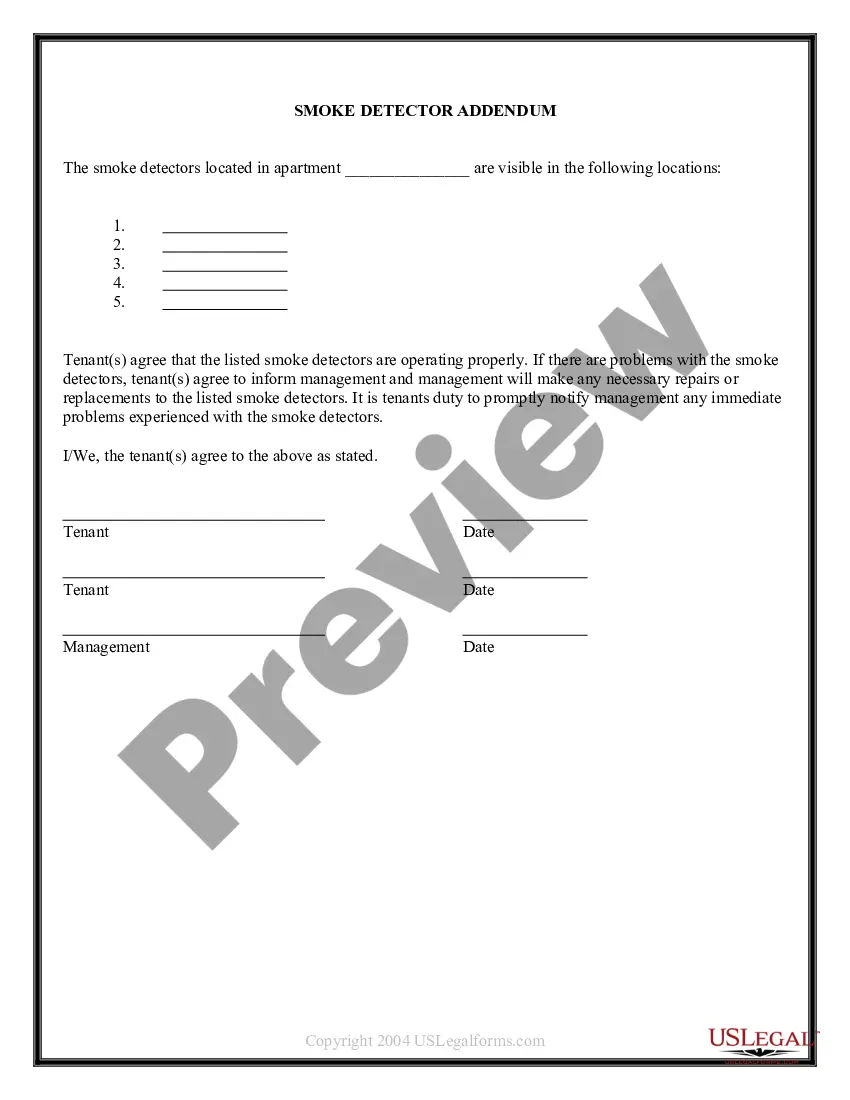
Addendum to apartment lease concerning maintenance of smoke detector.
Michigan Addendum To Apartment Lease regarding Smoke Detector
State:
Multi-State
Control #:
US-893LT
Format:
Word;
Rich Text
Instant download
Description
Get your form ready online
Our built-in tools help you complete, sign, share, and store your documents in one place.
Built-in online Word editor
Make edits, fill in missing information, and update formatting in US Legal Forms—just like you would in MS Word.
Export easily
Download a copy, print it, send it by email, or mail it via USPS—whatever works best for your next step.
E-sign your document
Sign and collect signatures with our SignNow integration. Send to multiple recipients, set reminders, and more. Go Premium to unlock E-Sign.
Notarize online 24/7
If this form requires notarization, complete it online through a secure video call—no need to meet a notary in person or wait for an appointment.
Store your document securely
We protect your documents and personal data by following strict security and privacy standards.

Make edits, fill in missing information, and update formatting in US Legal Forms—just like you would in MS Word.

Download a copy, print it, send it by email, or mail it via USPS—whatever works best for your next step.

Sign and collect signatures with our SignNow integration. Send to multiple recipients, set reminders, and more. Go Premium to unlock E-Sign.

If this form requires notarization, complete it online through a secure video call—no need to meet a notary in person or wait for an appointment.

We protect your documents and personal data by following strict security and privacy standards.
Looking for another form?


How to fill out Addendum To Apartment Lease Regarding Smoke Detector?
If you need to thoroughly, download, or create legal document templates, utilize US Legal Forms, the most extensive collection of legal forms available online.
Employ the site's straightforward and user-friendly search feature to locate the documents you require.
Various templates for commercial and personal use are categorized by type and jurisdiction, or by keywords. Utilize US Legal Forms to locate the Michigan Addendum To Apartment Lease concerning Smoke Detector with just a few clicks.
Every legal document template you obtain is yours eternally. You have access to each form you saved in your account. Visit the My documents section and choose a form to print or download again.
Complete and download, and print the Michigan Addendum To Apartment Lease concerning Smoke Detector with US Legal Forms. There are thousands of professional and state-specific forms available for your business or personal needs.
- If you are already a US Legal Forms user, Log In to your account and click on the Acquire button to obtain the Michigan Addendum To Apartment Lease concerning Smoke Detector.
- You can also access forms you previously saved from the My documents tab in your account.
- If you are using US Legal Forms for the first time, follow the steps below.
- Step 1. Ensure you have selected the form for the correct city/state.
- Step 2. Use the Preview option to review the form's content. Don't forget to read the description.
- Step 3. If you are not satisfied with the form, utilize the Search area at the top of the screen to find alternative versions of the legal form template.
- Step 4. Once you have found the form you need, click the Get now button. Choose your preferred pricing plan and input your credentials to register for an account.
- Step 5. Process the payment. You can use your Visa or MasterCard or PayPal account to complete the transaction.
- Step 6. Select the format of the legal form and download it to your device.
- Step 7. Complete, modify, and print or sign the Michigan Addendum To Apartment Lease concerning Smoke Detector.
Form popularity
FAQ
The current Michigan Residential Code requires hardwired smoke detectors be installed when certain types of work are conducted (condition three on the chart below). Hardwired, battery back-up, interconnected smoke detectors are required in the area where the work is being conducted.
While the National Electrical Code® (NECA®) does not require the installation of smoke alarms or carbon monoxide detectors, the Michigan Residential CodeA® (MRCA®) requires their installation. The MRCA® requires that smoke alarms be installed in accordance with NFPA 72A®, which is known as the Fire Alarm CodeA®.
Smoke alarms are the most common safety alarm in our homes and should ideally be wired to the mains electrical supply with a battery backup in case of a power outage. In fact, new homes and some home improvement projects require hard-wired smoke alarms as part of Building Regulations' compliance.
What action do landlords need to take? From 1 October 2015, every private rented property needs to be fitted with smoke alarms and carbon monoxide alarms (if applicable).
A tenant removing a smoke detector is illegal in most states. As long as you provide tenants with 48-hour notice, you are able to enter the property and check that the smoke detector is functional.
The current Michigan Residential Code requires hardwired smoke detectors be installed when certain types of work are conducted (condition three on the chart below). Hardwired, battery back-up, interconnected smoke detectors are required in the area where the work is being conducted.
Michigan Residential Code requires that Smoke Detectors shall be in the following locations: In each sleeping room. Outside each separate sleeping area near each bedroom. On each additional story of the home, including basements but you do not have to have one in crawl spaces and uninhabitable attics.
Michigan law requires smoke detectors in every home. Smoke alarms must be UL listed. They need to be installed in accordance with the provisions of the Michigan Residential Code, manufacturer's installation instructions, and the household fire warning equipment provisions of the National Fire Protection Act (NFPA) 72.
Where more than 1 smoke detector is required to be installed within an individual dwelling unit in accordance with R314. 3, the alarm devices shall be interconnected in such a manner that the actuation of one alarm will activate all of the alarms in the individual unit.