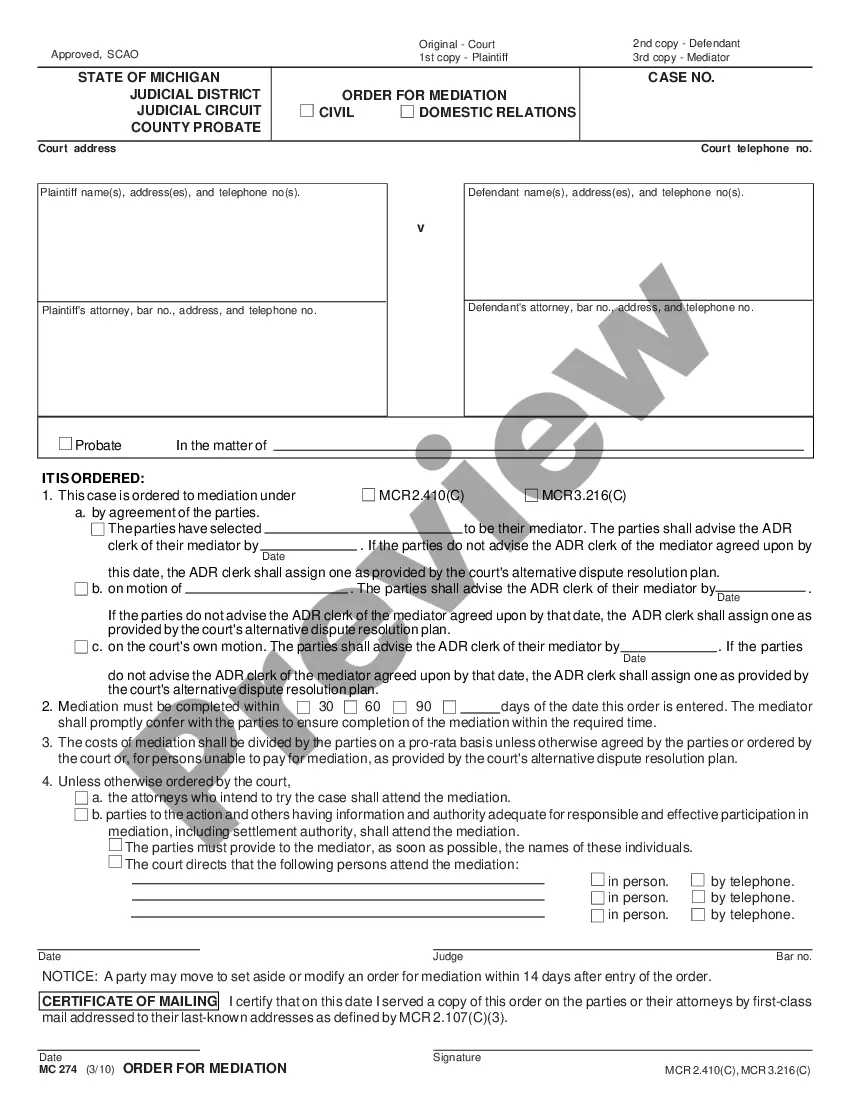
This Order for Mediation is an official document from the Michigan State Court Administration Office, and it complies with all applicable state and Federal codes and statutes. USLF updates all state and Federal forms as is required by state and Federal statutes and law.
Michigan Order For Mediation (Civil Or Domestic Relations)
State:
Michigan
Control #:
MI-MC-274
Format:
PDF
Instant download
This website is not affiliated with any governmental entity
Public form
Description
Get your form ready online
Our built-in tools help you complete, sign, share, and store your documents in one place.
Built-in online Word editor
Make edits, fill in missing information, and update formatting in US Legal Forms—just like you would in MS Word.
Export easily
Download a copy, print it, send it by email, or mail it via USPS—whatever works best for your next step.
E-sign your document
Sign and collect signatures with our SignNow integration. Send to multiple recipients, set reminders, and more. Go Premium to unlock E-Sign.
Notarize online 24/7
If this form requires notarization, complete it online through a secure video call—no need to meet a notary in person or wait for an appointment.
Store your document securely
We protect your documents and personal data by following strict security and privacy standards.

Make edits, fill in missing information, and update formatting in US Legal Forms—just like you would in MS Word.

Download a copy, print it, send it by email, or mail it via USPS—whatever works best for your next step.

Sign and collect signatures with our SignNow integration. Send to multiple recipients, set reminders, and more. Go Premium to unlock E-Sign.

If this form requires notarization, complete it online through a secure video call—no need to meet a notary in person or wait for an appointment.

We protect your documents and personal data by following strict security and privacy standards.
Looking for another form?






Key Concepts & Definitions
Order for Mediation Civil or Domestic Relations: A legal process in which a mediator assists parties in civil or domestic disputes to reach a mutual agreement. In contexts such as family disputes, Cook County Court may refer parties to court ordered mediation to resolve issues without a lengthy trial process. Domestic Violence Protection: Legal mechanisms including restraining orders and safety assessments facilitated through family court services to protect individuals from domestic abuse. Court Annexed Resolution: A court-based process where circuit court judges may direct litigants toward mediation or other alternative dispute resolution methods, typically seen in the Chicago Municipal District.
Step-by-Step Guide to Navigating Court Ordered Mediation
- Understand the Requirement: Determine if your case in areas such as probate, guardianship, or domestic relations, falls under the requirement for court ordered mediation in your jurisdiction, such as the Cook County Court.
- Select a Mediator: Either choose a mediator from a court-approved list or accept a court-appointed one experienced in areas like juvenile justice or criminal law attorneys.
- Pre-Mediation Preparation: Gather all necessary documents and understand the issues at hand. Consult with your attorney to develop a strategy.
- Attend Mediation Sessions: Participate in sessions led by the mediator, aiming to resolve disputes with the other party.
- Finalize Agreement: If mediation is successful, finalize an agreement to be ratified by the court. If mediation fails, prepare for trial.
Risk Analysis of Mediation in Civil and Domestic Relations
Mediation, while beneficial, carries risks like potential bias of mediators, unequal bargaining power between parties, or inadequate resolution of complex issues like those involving domestic violence protection. Proper legal advice and choosing experienced mediators, especially in sensitive cases handled by family court services, can mitigate these risks.
Best Practices in Court Ordered Mediation
- Choose Experienced Mediators: Ensure that the mediator has relevant experience, especially for specific contexts like criminal law or juvenile justice systems.
- Maintain Open Communication: Keep transparent communication with your legal counsel and mediator throughout the process.
- Understand Legal Rights: Always be aware of your legal rights and obligations, particularly in sensitive cases such as those involving domestic violence protection.
FAQ
- What is court ordered mediation? It is a process where the court directs disputing parties to attempt to resolve their differences through mediation before proceeding to trial.
- Can I refuse mediation in a domestic violence case? Specific circumstances, such as the presence of domestic abuse, might affect the suitability of mediation. It's crucial to seek advice from legal professionals or family court services.
- How are mediators selected in Cook County? Mediators are selected from a list approved by the circuit court judges or may be specifically appointed by the court.
How to fill out Michigan Order For Mediation (Civil Or Domestic Relations)?
Obtain any version from 85,000 lawful documents like the Michigan Order for Mediation online through US Legal Forms. Each template is composed and refreshed by state-approved legal experts.
If you have an existing subscription, Log In. After reaching the form’s page, click the Download button and navigate to My documents to access it.
If you haven't subscribed yet, follow the guidelines listed below.
With US Legal Forms, you will consistently have instant access to the suitable downloadable template. The platform offers you access to documents and categorizes them to enhance your search. Utilize US Legal Forms to acquire your Michigan Order for Mediation simply and swiftly.
- Verify the state-specific criteria for the Michigan Order for Mediation you wish to utilize.
- Examine the description and view the sample.
- Once you're certain the template meets your needs, simply click Buy Now.
- Select a subscription plan that fits your financial plan.
- Establish a personal account.
- Make a payment in one of two suitable methods: by card or through PayPal.
- Choose a format to download the document in; two choices are available (PDF or Word).
- Download the file to the My documents section.
- After your reusable form is downloaded, print it out or store it on your device.
Form popularity
FAQ
Mediation should not be used when there is a significant issue of safety, such as domestic abuse, or when one party is not able to make informed decisions. If the conflict involves urgent matters that require immediate legal intervention, mediation might also not be appropriate. Assessing your specific circumstances can guide you, and legal platforms like uslegalforms can assist in determining the right approach based on a Michigan Order For Mediation (Civil Or Domestic Relations).
Mediation may not be suitable for individuals who are unwilling or feel unsafe engaging with the other party. Additionally, those who have a significant power imbalance, such as in cases of domestic violence, may find mediation ineffective. Understanding your personal situation is key, and you might consider a Michigan Order For Mediation (Civil Or Domestic Relations) only if both parties are committed to the process.
If your spouse refuses to participate in mediation, you may need to explore other dispute resolution methods, including court intervention. A Michigan Order For Mediation (Civil Or Domestic Relations) can sometimes compel participation, but assessing each party's willingness is essential. If necessary, consult a legal expert to discuss alternative paths toward resolution.
Mediation is not always a requirement in civil cases, but it is often encouraged as a first step. Many court systems promote mediation to help parties reach amicable agreements before proceeding to trial. A Michigan Order For Mediation (Civil Or Domestic Relations) can facilitate this process and potentially save time and resources. It's advisable to understand your specific jurisdiction's regulations on mediation.
Certain cases are not suitable for mediation, including those involving child abuse, serious criminal offenses, or where one party lacks the capacity to make informed decisions. Additionally, disputes that require urgent court orders may not be resolved effectively through mediation. If you're unsure whether your case qualifies, consulting with a legal professional can help clarify your options under a Michigan Order For Mediation (Civil Or Domestic Relations).
Mediation is generally not suitable for cases involving domestic violence. The dynamics in these situations often create power imbalances that mediation cannot address effectively. If you are considering a Michigan Order For Mediation (Civil Or Domestic Relations) and have concerns about abuse, seek professional guidance. Safety should always be the priority.
In Michigan, mediation involves a structured process where parties come together to discuss their issues with the help of a neutral mediator. The mediator does not decide the outcome; instead, they facilitate communication and help identify solutions. Throughout this process, documents and agreements reached can be formalized under the Michigan Order For Mediation (Civil Or Domestic Relations). Utilizing tools from US Legal Forms can assist you in navigating this process effectively.
The four main types of mediators include evaluative, facilitative, transformative, and directive mediators. Evaluative mediators give opinions on the strengths and weaknesses of each party's case, while facilitative mediators focus on guiding dialogues to find common ground. Transformative mediators prioritize healing relationships, and directive mediators actively help in shaping solutions. Each type can play a significant role under the Michigan Order For Mediation (Civil Or Domestic Relations).
Completing mediation starts with setting a date and getting both parties to agree on attending the sessions. During mediation, a neutral third party helps to facilitate discussions, aiming for a mutually acceptable resolution. Once an agreement is reached, parties should document the settlement under the Michigan Order For Mediation (Civil Or Domestic Relations) to make it binding. Remember to maintain open communication throughout the process.
To draft a mediation settlement agreement, start by clearly outlining the terms both parties have agreed upon during mediation. Include details such as responsibilities, timelines, and any payments involved. It is important to ensure that the document accurately reflects the discussions held under the Michigan Order For Mediation (Civil Or Domestic Relations). Consider using resources from US Legal Forms to access templates that can simplify this process.