Michigan Fiduciary Deed
What is this form?
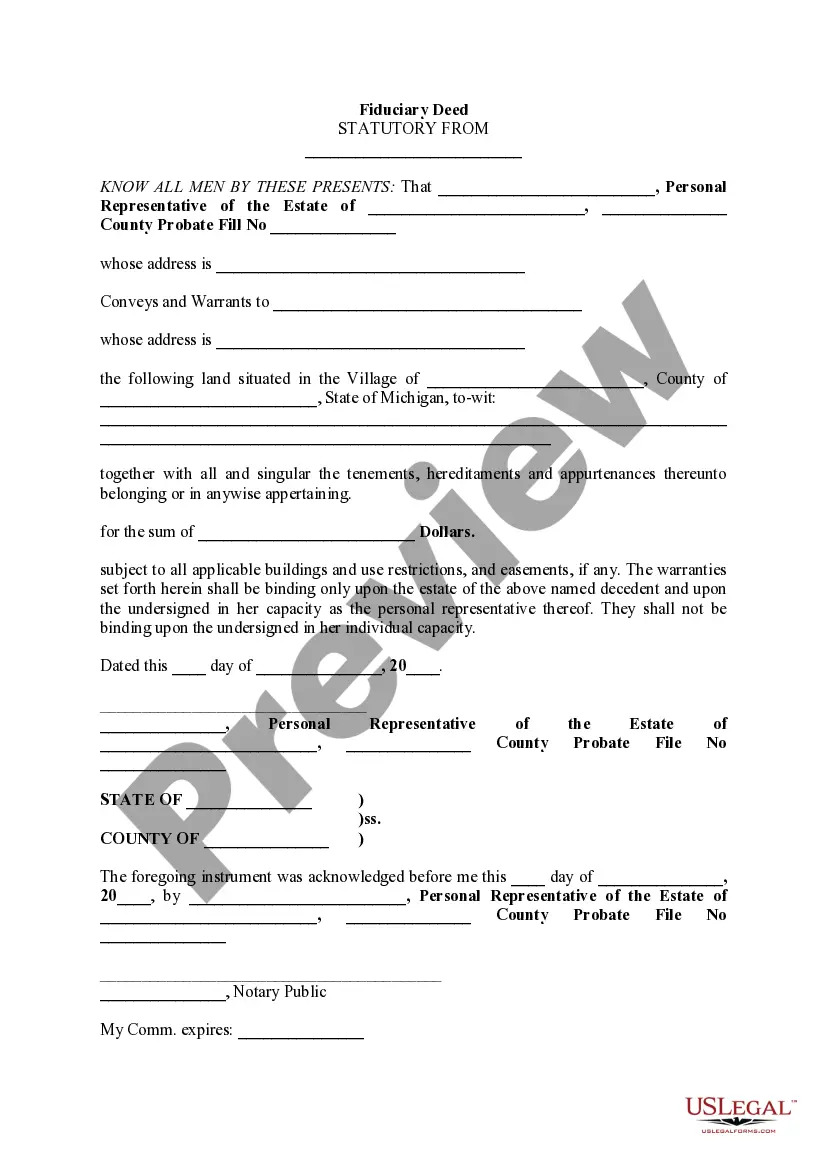
The Fiduciary Deed is a legal document used by a fiduciary, such as a personal representative of an estate, to transfer real property to a grantee. This form ensures that the property is conveyed with all inherent rights, while explicitly stating that the warranties apply only to the estate and not to the personal representative individually. Unlike standard deeds, which may not involve a fiduciary, this form is specific to fiduciaries acting in their official capacity.
Key components of this form
- Grantor information: Name and role of the fiduciary transferring the property.
- Grantee information: Name and address of the individual receiving the property.
- Description of the property: Detailed legal description of the property being conveyed.
- Consideration: Amount paid for the property, typically in dollars.
- Warranties: Statement indicating the extent of the warranties provided by the grantor.
- Notary acknowledgement: Section for notarization to ensure the document's validity.



When to use this document
This form is typically used when a fiduciary, such as an executor or administrator of an estate, needs to transfer property from the estate to an individual or entity. Useful scenarios include selling inherited property, transferring real estate as part of settlement agreements, or when fulfilling the decedent's wishes specified in a will. It is important to use this form to ensure all legal requirements are met during the transfer process.
Who this form is for
- Fiduciaries acting on behalf of decedents, such as executors, administrators, or personal representatives.
- Individuals or entities receiving property from an estate.
- Legal professionals assisting fiduciaries in transferring property.
Completing this form step by step
- Identify the parties: Fill in the names and addresses of both the grantor (fiduciary) and the grantee.
- Specify the property: Provide a detailed legal description of the property being transferred.
- Enter the consideration: Indicate the sum of money involved in the transaction.
- Include the date: Write the date when the deed is being executed.
- Sign and notarize: The fiduciary must sign the deed in the presence of a notary public for legal validation.
Does this form need to be notarized?
Yes, this form must be notarized to be legally valid. Notarization ensures that the identities of the parties involved are verified and that the document is executed correctly, which is vital for the transfer of property. US Legal Forms offers integrated online notarization services, allowing you to complete the process securely via a video call, available 24/7.
Get your form ready online
Our built-in tools help you complete, sign, share, and store your documents in one place.
Make edits, fill in missing information, and update formatting in US Legal Forms—just like you would in MS Word.
Download a copy, print it, send it by email, or mail it via USPS—whatever works best for your next step.
Sign and collect signatures with our SignNow integration. Send to multiple recipients, set reminders, and more. Go Premium to unlock E-Sign.
If this form requires notarization, complete it online through a secure video call—no need to meet a notary in person or wait for an appointment.
We protect your documents and personal data by following strict security and privacy standards.

Make edits, fill in missing information, and update formatting in US Legal Forms—just like you would in MS Word.

Download a copy, print it, send it by email, or mail it via USPS—whatever works best for your next step.

Sign and collect signatures with our SignNow integration. Send to multiple recipients, set reminders, and more. Go Premium to unlock E-Sign.

If this form requires notarization, complete it online through a secure video call—no need to meet a notary in person or wait for an appointment.

We protect your documents and personal data by following strict security and privacy standards.
Common mistakes to avoid
- Failing to include a clear legal description of the property.
- Not properly signing the document in the presence of a notary.
- Leaving out important dates when executing the deed.
- Omitting the consideration amount, which can create confusion.
Why complete this form online
- Convenience: Access and fill out the form from anywhere, at any time.
- Editability: Easily update information until you are ready to finalize the document.
- Reliability: Use forms drafted by licensed attorneys, ensuring legal compliance.
Looking for another form?
Form popularity
FAQ
Filling out a personal representative deed requires attention to detail. First, ensure you have the necessary information about the estate and the Michigan Fiduciary Deed form. Next, accurately enter the names of the parties involved, the legal description of the property, and date the document. After completing the form, it’s important to sign it in front of a notary, as this step assures legal validity and adherence to Michigan requirements.
No, you do not need an attorney to execute a quit claim deed in Michigan. Many individuals choose to follow a DIY approach, thanks to accessible resources like US Legal Forms that guide you through the process. However, consulting with a legal professional can be advantageous if you have questions about your specific situation.
Yes, you can create your own quit claim deed in Michigan without an attorney. By utilizing templates from US Legal Forms, you can easily prepare your documents correctly. This allows for a simple and effective transfer of property interests between parties, ensuring you meet all legal standards.
Transferring a deed in Michigan does not necessarily require you to hire a lawyer. Many people successfully complete the process on their own, especially when using resources like US Legal Forms. However, just remember that legal terms and requirements can be complex, so having a professional review your documents can provide additional peace of mind.
Fiduciary law in Michigan governs the duties and responsibilities of individuals acting in fiduciary roles, such as executors or trustees. These laws ensure that fiduciaries manage and distribute assets in accordance with the wishes of the deceased or the stipulations of a trust. Understanding fiduciary law is crucial for anyone involved in property management in Michigan.
A fiduciary deed is utilized by anyone acting on behalf of another, such as a trustee or a guardian, to convey property. An executor deed, specifically, is used by an executor of an estate to convey property as part of the estate’s settlement. In Michigan, both deeds serve unique roles, but the fiduciary deed encompasses a broader range of fiduciary roles.
A fiduciary deed is a legal instrument used by a fiduciary to transfer ownership of property. This type of deed is essential in situations involving estates or trusts, facilitating the management of assets for the benefit of beneficiaries. In Michigan, fiduciaries can use these deeds to fulfill their responsibilities efficiently and legally.
A fiduciary deed in Michigan is a specialized legal document that allows someone in a fiduciary role to convey property on behalf of another person. This deed is commonly used in the context of administering estates or trusts. It allows the fiduciary to effectively manage and transfer assets while ensuring compliance with Michigan's laws.
The purpose of a Michigan Fiduciary Deed is to facilitate the legal transfer of property by someone acting in a fiduciary role, such as an executor of a will or a trustee. This deed ensures that the estate's assets are administered effectively and that the property ownership is clear. By using a fiduciary deed, you help protect the interests of heirs while adhering to legal obligations.
You should use a Michigan Fiduciary Deed when you need to convey property held by a fiduciary, such as an executor or trustee, during estate settlement or trust administration. This deed type is essential when handling the property of someone who has passed away or is otherwise unable to manage their estate. It ensures the legal transfer of property while complying with fiduciary responsibilities.