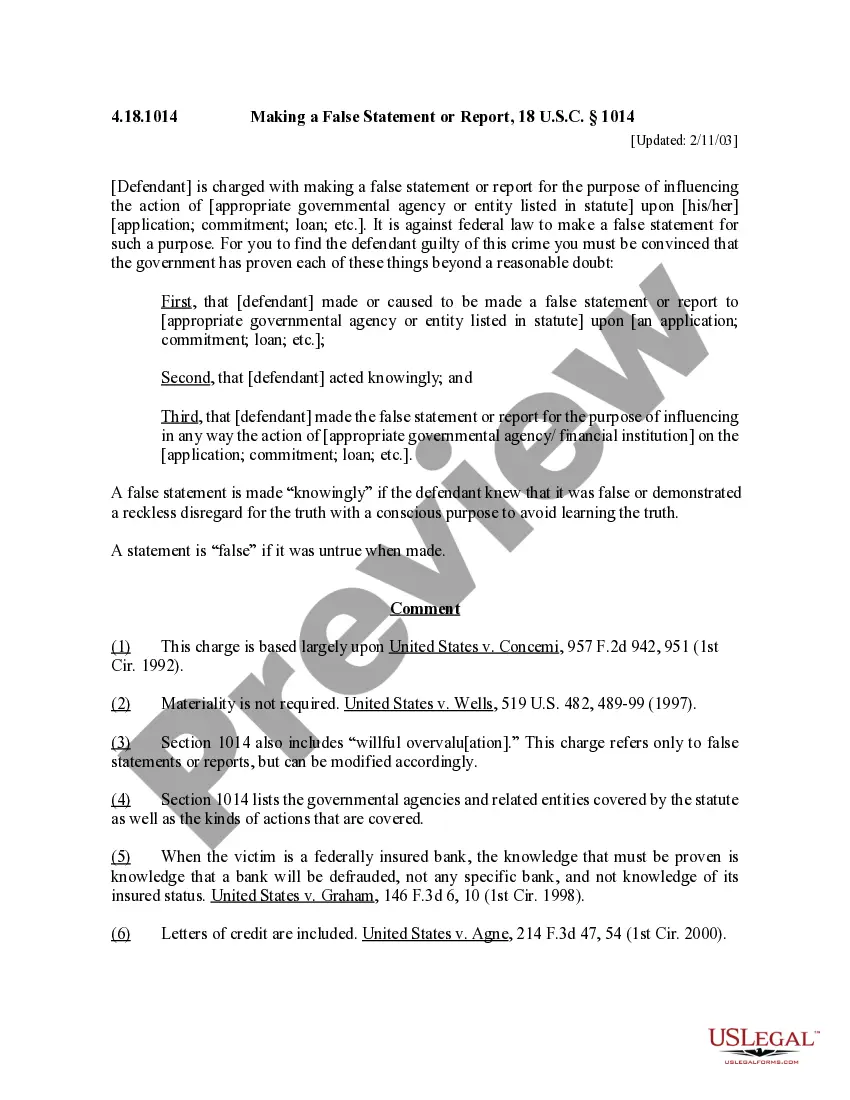
Maine 4.18.1014 Making a False Statement or Report, 18 U.S.C. Sec. 1014
Overview of this form
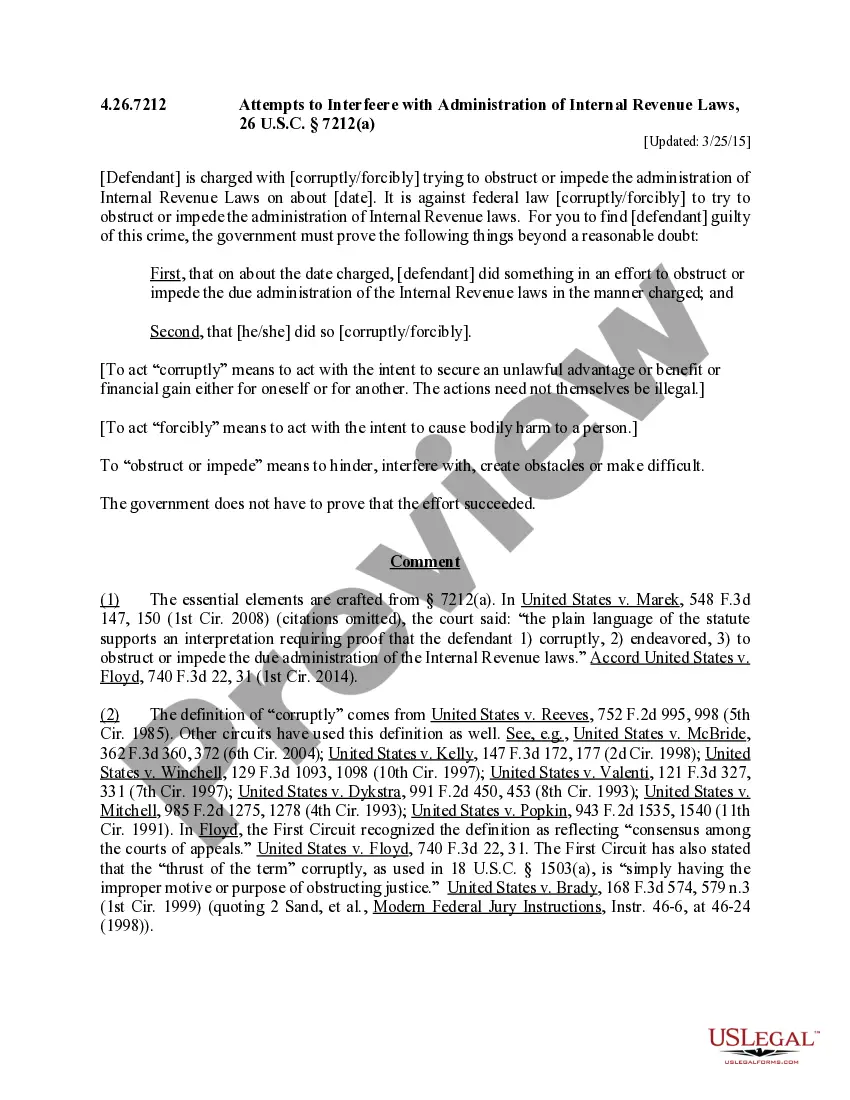
The 4.18.1014 Making a False Statement or Report form, referenced under 18 U.S.C. Sec. 1014, is an official document used in federal court cases in Maine. It addresses the criminal act of making false statements or reports to influence government actions. Unlike other legal forms, this document is specifically tailored for jury instructions in criminal cases, ensuring that jurors understand the requirements for determining guilt in such cases.
Key parts of this document
- The charge outlines that the defendant is accused of making a false statement or report.
- It defines the legal standards needed for a guilty verdict, including knowledge of the falsity of the statement.
- The form clarifies what constitutes a "false statement" and its implications for legal accountability.
- It includes references to relevant case law for further legal context.
When to use this form
This form should be used when you are involved in federal criminal charges regarding the making of a false statement or report intended to influence a governmental entity. If you are facing prosecution under 18 U.S.C. Sec. 1014, this form provides the necessary jury instructions critical for the trial process.
Intended users of this form
- Defendants charged with making false statements in federal cases.
- Legal professionals preparing jury instructions for criminal trials.
- Jurors needing clarification on the requirements for a guilty verdict in such cases.
How to prepare this document
- Identify the defendant and the specific charge of making a false statement or report.
- Include the appropriate governmental agency or entity involved in the case.
- Ensure the description of the false statement or report is accurately documented.
- Verify that the instructions provided align with federal law regarding knowledge and intent.
- Consider referencing relevant case law to provide context for the jury.
Does this document require notarization?
This form does not typically require notarization unless specified by local law. Ensure that you consult legal guidance for your specific situation.
Get your form ready online
Our built-in tools help you complete, sign, share, and store your documents in one place.
Make edits, fill in missing information, and update formatting in US Legal Forms—just like you would in MS Word.
Download a copy, print it, send it by email, or mail it via USPS—whatever works best for your next step.
Sign and collect signatures with our SignNow integration. Send to multiple recipients, set reminders, and more. Go Premium to unlock E-Sign.
If this form requires notarization, complete it online through a secure video call—no need to meet a notary in person or wait for an appointment.
We protect your documents and personal data by following strict security and privacy standards.

Make edits, fill in missing information, and update formatting in US Legal Forms—just like you would in MS Word.

Download a copy, print it, send it by email, or mail it via USPS—whatever works best for your next step.

Sign and collect signatures with our SignNow integration. Send to multiple recipients, set reminders, and more. Go Premium to unlock E-Sign.

If this form requires notarization, complete it online through a secure video call—no need to meet a notary in person or wait for an appointment.

We protect your documents and personal data by following strict security and privacy standards.
Common mistakes to avoid
- Failing to clearly state the specific false statement made.
- Not highlighting the defendant's knowledge of the statement's falsity.
- Overlooking the inclusion of relevant case law or statutes.
Benefits of using this form online
- Convenience of downloading and using the form at any time.
- Editability allows for customization to fit specific case details.
- Access to forms created by licensed attorneys, ensuring legal reliability.
Looking for another form?

Form popularity
FAQ
The elements of a violation under the first prong of the reverse?FCA provisions are that (1) a record or statement was false, (2) the defendant had knowledge of the falsity, (3) the defendant made or used (or caused to be made or used) the false record or statement, (4) the defendant's purpose was to conceal, avoid, or
The False Claims Act defines knowledge broadly to include the following: Actual knowledge. Deliberate ignorance of the truth or falsity of the information. Reckless disregard of the truth or falsity of the information.
§ 1014) Section 1014 of Title 18, United States Code, covers the knowing making of false statements or willfully overvaluing any property or security for the purpose of influencing in any way the action of the enumerated agencies and organizations.
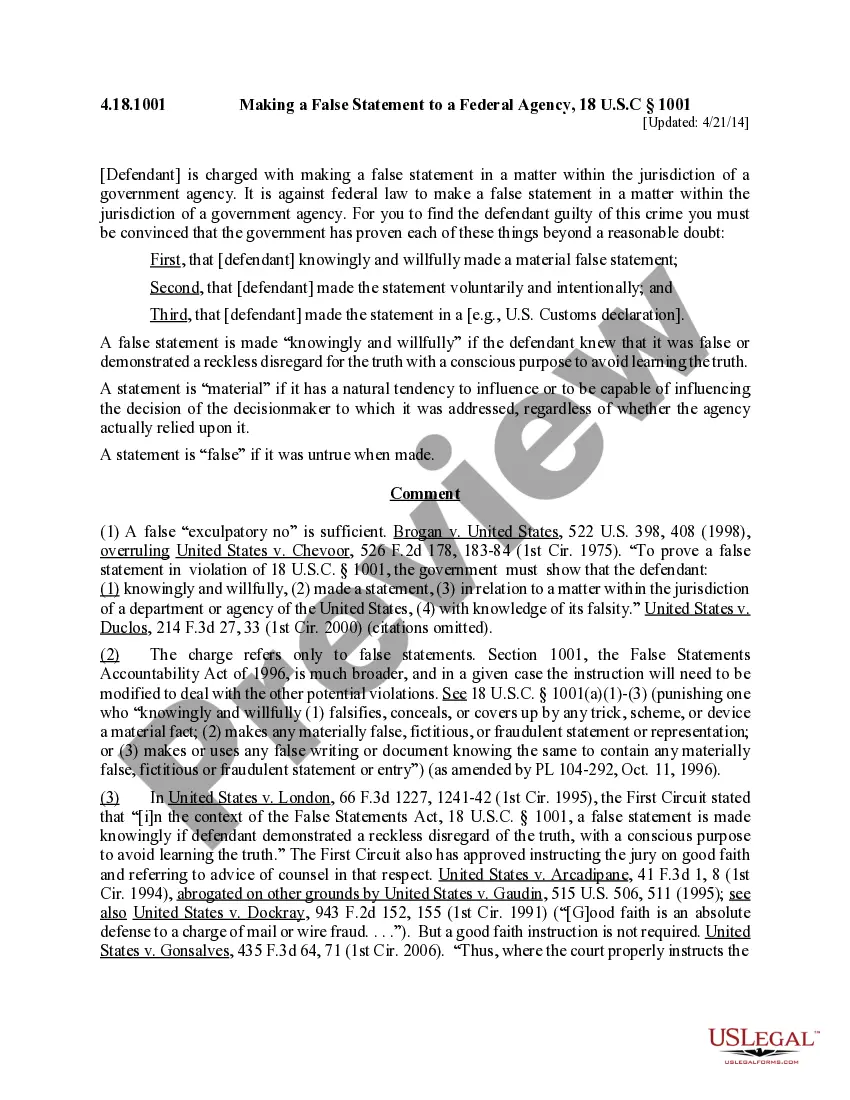
"To prove a false statement in violation of 18 U.S.C. § 1001, the government must show that the defendant: (1) knowingly and willfully, (2) made a statement, (3) in relation to a matter within the jurisdiction of a department or agency of the United States, (4) with knowledge of its falsity." United States v.
False declaration means the act of declaring assets, income and liabilities with an intention to conceal their disproportionate assets by providing incomplete or incorrect information.
Section 1001's statutory terms are violated if someone: "falsifies, conceals or covers up by any trick, scheme or device a material fact," "makes any false, fictitious or fraudulent statements or representations,"
The elements of the offense of making a false statement are: (1) making a false statement or willfully overvaluing property or security knowing the same to be false, (2) for the purpose of influencing in any way the action, (3) of the enumerated agencies and organizations.