Maine Use of Tapes and Transcripts
Understanding this form
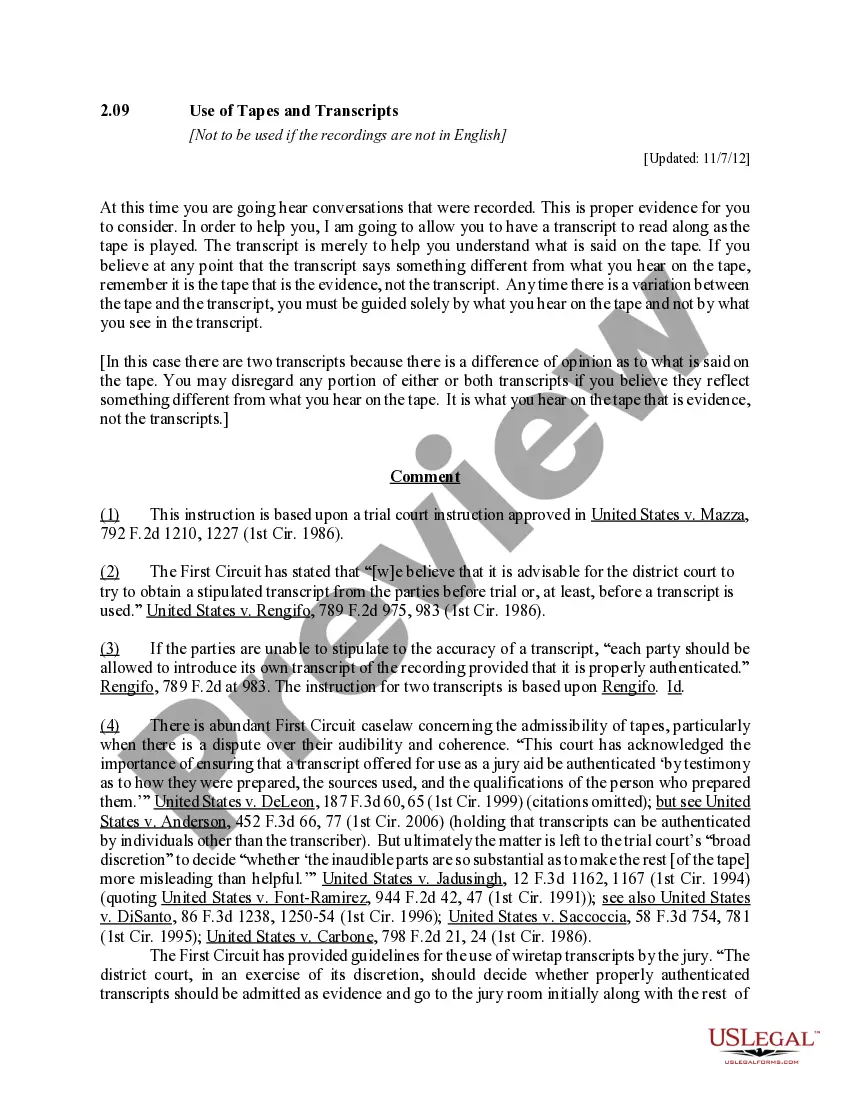
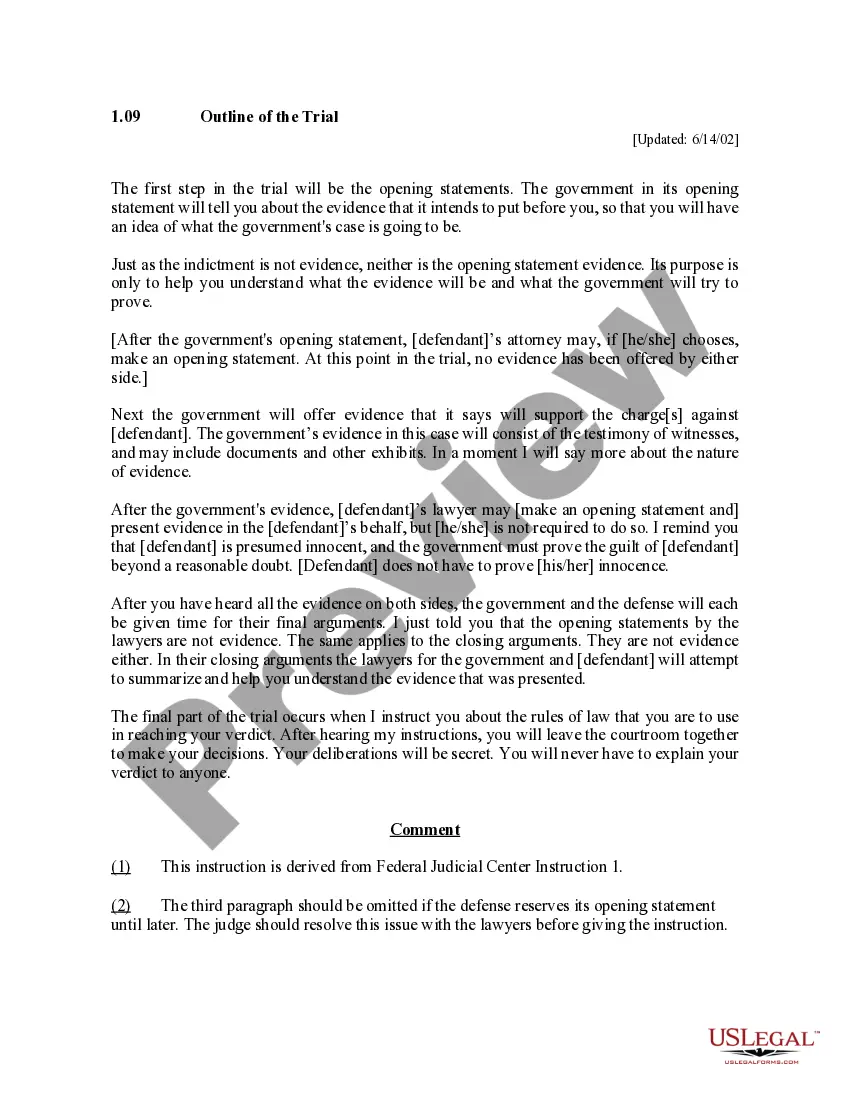
The Use of Tapes and Transcripts form provides official jury instructions for considering recorded conversations as evidence in criminal cases in the Federal District Court of Maine. This form outlines how juries should properly use tapes and accompanying transcripts, emphasizing that the audio recording is the primary evidence, rather than any written transcript prepared for assistance. Unlike other forms, this one includes specific instructions regarding the handling of discrepancies between audio recordings and their transcripts.
Main sections of this form
- Instructions for juries on how to interpret recorded conversations as evidence.
- Clarification that transcripts are for aid and do not replace the audio evidence.
- Guidance on handling multiple transcripts if discrepancies arise.
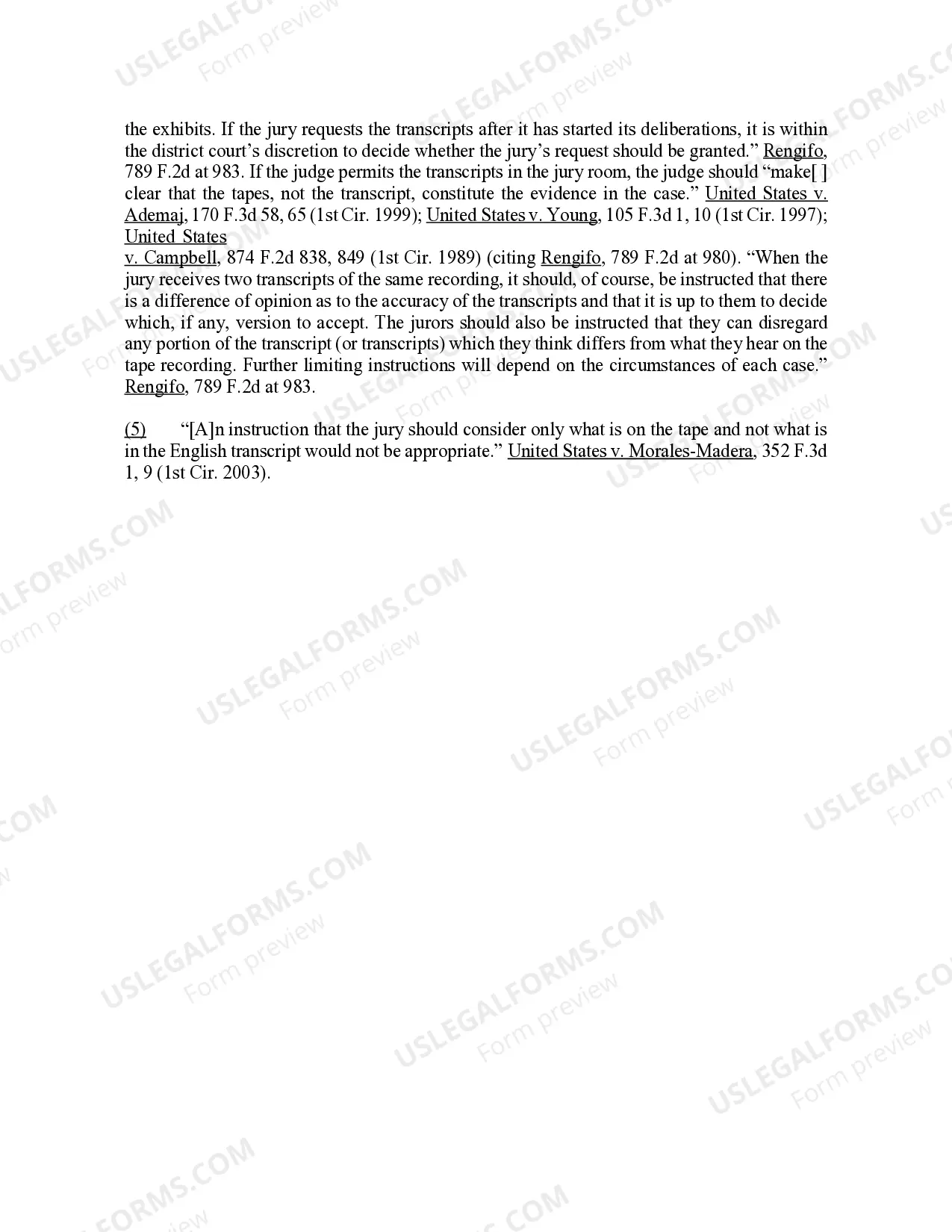
- Procedures for introducing and authenticating transcripts in court.
- Jury instructions on focusing only on the recording when there are conflicting materials.
When to use this document
This form is utilized in criminal trials when recorded conversations are presented as evidence. It is relevant when there is potential for discrepancies between what is heard in the recordings and what has been transcribed, particularly in cases involving wiretapping or recorded evidence. The form provides the necessary legal guidance to juries on how to approach these audio materials objectively.
Who this form is for
- Judges presiding over criminal cases in the Federal District Court of Maine.
- Jurors tasked with evaluating evidence in trials involving recorded conversations.
- Legal practitioners seeking to properly instruct juries on the admissibility and weight of tape recordings and transcripts.
Instructions for completing this form
- Identify the specific recording being admitted as evidence.
- Prepare or obtain a transcript that accurately reflects the recorded content, ensuring it is properly authenticated.
- Clearly instruct the jury that the tape is the primary evidence and the transcript is supplementary.
- If there are conflicting transcripts, prepare both for the jury, indicating the importance of the recordings over the written material.
- Provide the jury with clear guidance on how to resolve discrepancies between what they hear and what is in the transcript.
Does this document require notarization?
This form does not typically require notarization to be legally valid. However, some jurisdictions or document types may still require it. US Legal Forms provides secure online notarization powered by Notarize, available 24/7 for added convenience.
Get your form ready online
Our built-in tools help you complete, sign, share, and store your documents in one place.
Make edits, fill in missing information, and update formatting in US Legal Forms—just like you would in MS Word.
Download a copy, print it, send it by email, or mail it via USPS—whatever works best for your next step.
Sign and collect signatures with our SignNow integration. Send to multiple recipients, set reminders, and more. Go Premium to unlock E-Sign.
If this form requires notarization, complete it online through a secure video call—no need to meet a notary in person or wait for an appointment.
We protect your documents and personal data by following strict security and privacy standards.

Make edits, fill in missing information, and update formatting in US Legal Forms—just like you would in MS Word.

Download a copy, print it, send it by email, or mail it via USPS—whatever works best for your next step.

Sign and collect signatures with our SignNow integration. Send to multiple recipients, set reminders, and more. Go Premium to unlock E-Sign.

If this form requires notarization, complete it online through a secure video call—no need to meet a notary in person or wait for an appointment.

We protect your documents and personal data by following strict security and privacy standards.
Typical mistakes to avoid
- Assuming the transcript is authoritative over the recording.
- Failing to properly authenticate transcripts before presenting them to the jury.
- Not informing jurors that they may disregard parts of the transcript if they perceive discrepancies with the audio.
- Using transcripts not agreed upon by both parties involved in the case.
Advantages of online completion
- Convenience of accessing the form anytime, with the ability to download it immediately.
- Editability allows for customizing the form as per the specifics of the case.
- Reliability of using a form drafted by licensed attorneys ensures legal soundness.
Legal use & context
- This form is legally binding when used according to court procedures in criminal trials.
- Jurors must adhere strictly to the instructions provided in the form during deliberations.
- Transcripts must be managed carefully to avoid misleading interpretations of the audio evidence.
Looking for another form?
Form popularity
FAQ
Maine law prohibits the recording of oral or phone conversations without the consent of one party. Before assuming your neighbor is in violation of this law, you should know that most commercial security cameras are not equipped with audio recording.
Legal transcripts are an important part of the legal process, as they are a written record of everything said during a legal proceeding. This can be important for law firms, courts, and lawyers, as it can help them to reference back to specific points during the proceeding.
If you realize someone is recording you without your permission in a public setting, there isn't much you can do but ask them to stop or leave. If this is a recurring occurrence with a certain individual, you can call the police or choose to sue if you have legal grounds for it.
Maine bars the recording, interception, use or disclosure of any in-person or telephonic conversation without the consent of at least one party to the conversation. However, the state requires the consent of all parties to record conversations occurring in places like dressing rooms and bathrooms.
Eleven (11) states require the consent of everybody involved in a conversation or phone call before the conversation can be recorded. Those states are: California, Delaware, Florida, Illinois, Maryland, Massachusetts, Montana, Nevada, New Hampshire, Pennsylvania and Washington.
In Maine, it is a criminal offense to use any device to record, obtain, use or share communications, whether they are wire, oral or electronic, without the consent of at least one person taking part in the communication, unless the conversation is audible by normal, unaided hearing.
Maine law prohibits the recording or interception of oral or phone conversations without the consent of one party. Violations are criminally punishable by jail time and/or fines, and can also be the basis for civil liability.
The states that are one party consent include: Alabama. Alaska. Arizona. Arkansas. District of Columbia. Georgia. Hawaii. Idaho.