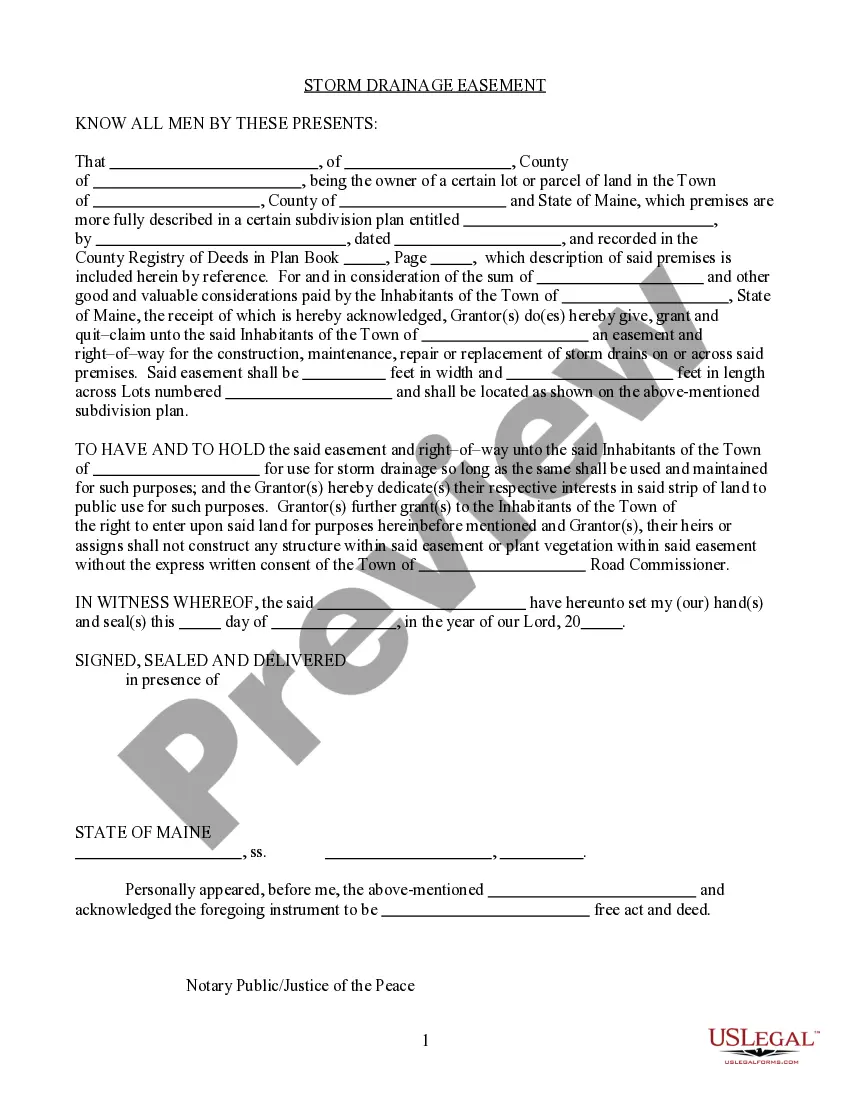
Maine Storm Drainage Easement
What this document covers
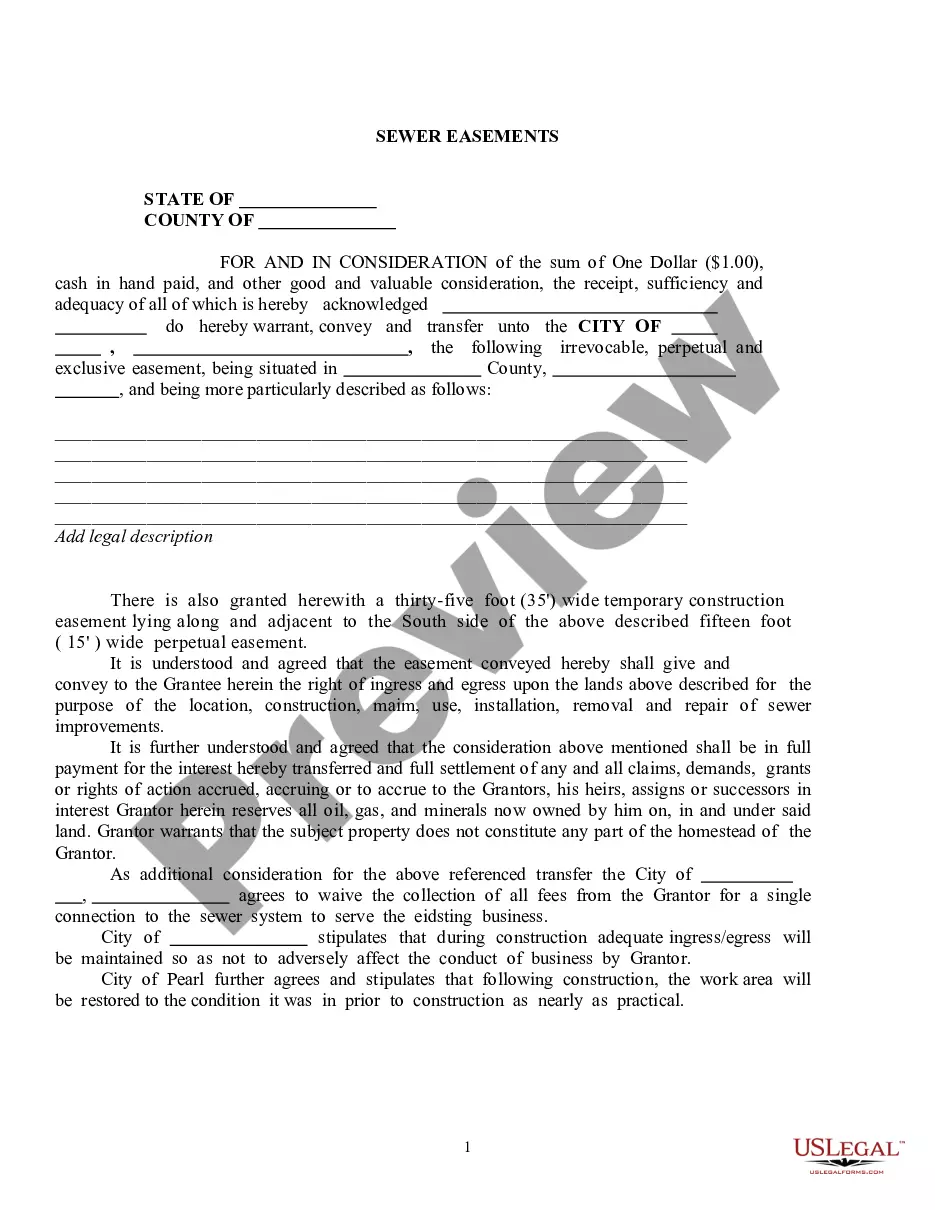
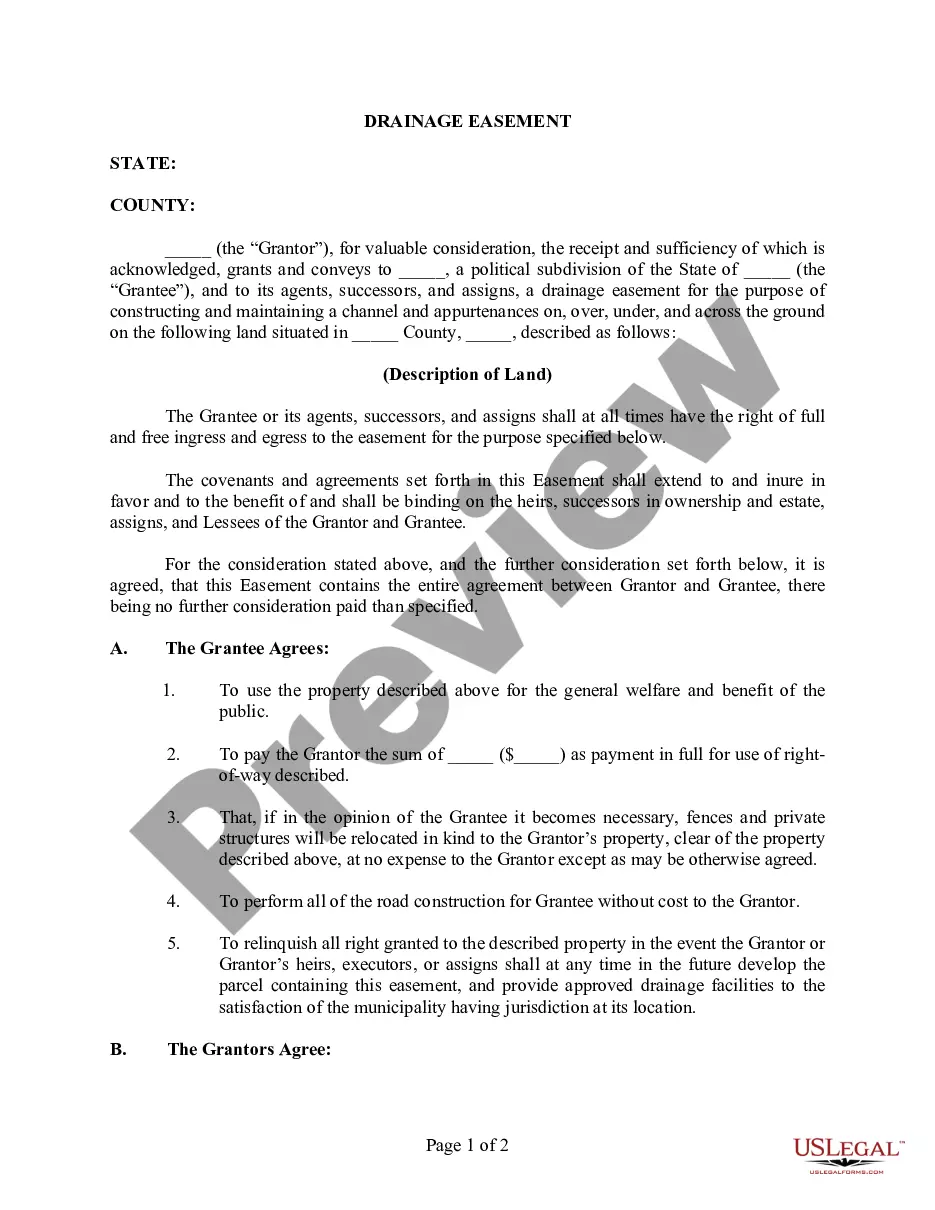
The Storm Drainage Easement is a legal document that grants one party the right to construct, maintain, repair, or replace storm drains on or across another party's property. This easement allows for necessary utility access and ensures proper drainage, distinguishing it from other property-related easements which may serve different purposes, such as access and egress or agricultural use.
Main sections of this form
- Identification of the granting party and the grantee.
- Description of the specific area for the storm drainage easement.
- Rights granted for construction and maintenance activities.
- Duration of the easement agreement.
- Provisions for repair and potential indemnification.

Situations where this form applies
This form is necessary when a property owner needs to allow a utility company or another party access to their property for the installation or upkeep of storm drainage systems. It is commonly used during developments, renovations, or when existing drainage systems require updates or repairs.
Who needs this form
- Property owners who need to grant easement rights to utility companies.
- Developers requiring access to install drainage systems during construction.
- Landscapers or contractors needing to maintain existing drainage systems on private property.
How to prepare this document
- Identify the parties involved, including the property owner and the recipient of the easement.
- Specify the property by providing a legal description and the boundaries of the easement area.
- Detail the rights granted, including access for construction, maintenance, and repair.
- Indicate the duration of the easement, making clear if it is temporary or permanent.
- Review the document carefully and have both parties sign it to finalize the agreement.
Does this form need to be notarized?
This form does not typically require notarization unless specified by local law. Always consult with a legal professional to ensure all requirements are met.
Get your form ready online
Our built-in tools help you complete, sign, share, and store your documents in one place.
Make edits, fill in missing information, and update formatting in US Legal Forms—just like you would in MS Word.
Download a copy, print it, send it by email, or mail it via USPS—whatever works best for your next step.
Sign and collect signatures with our SignNow integration. Send to multiple recipients, set reminders, and more. Go Premium to unlock E-Sign.
If this form requires notarization, complete it online through a secure video call—no need to meet a notary in person or wait for an appointment.
We protect your documents and personal data by following strict security and privacy standards.

Make edits, fill in missing information, and update formatting in US Legal Forms—just like you would in MS Word.

Download a copy, print it, send it by email, or mail it via USPS—whatever works best for your next step.

Sign and collect signatures with our SignNow integration. Send to multiple recipients, set reminders, and more. Go Premium to unlock E-Sign.

If this form requires notarization, complete it online through a secure video call—no need to meet a notary in person or wait for an appointment.

We protect your documents and personal data by following strict security and privacy standards.
Avoid these common issues
- Failing to provide a clear legal description of the property and easement area.
- Not specifying the rights and limitations of the easement.
- Neglecting to obtain signatures from all relevant parties.
- Overlooking local regulations that may affect the easement terms.
Why use this form online
- Convenient access to professionally drafted legal templates.
- Edit and customize the form to fit your specific needs.
- Ensure compliance with current legal standards and requirements.
Legal use & context
The Storm Drainage Easement is enforceable under property law, defining the responsibilities of both parties concerning access and maintenance. Failure to adhere to the terms can result in disputes or legal action.
Main things to remember
- The Storm Drainage Easement is essential for property owners allowing drainage work on their land.
- Clear documentation reduces potential disputes with utility companies or contractors.
- Understanding local laws is crucial for ensuring the legal validity of the easement.
Looking for another form?
Form popularity
FAQ
Deeds will show if the right of way applies to those on foot or in vehicles. On foot permits one to pass and repass without lingering and the pathway should be no less than 90cm wide. Vehicular right of way allows vehicles of up to a permitted size along the carriageway or driveway, to load and unload but not to park.
If an authority has an easement registered over your land, they have the right to access the easement to maintain or repair the easement land or their equipment on the land.
An Easement, a privilege to pass over the land of another, whereby the holder of the easement acquires only a reasonable and usual enjoyment of the property, and the owner of the land retains the benefits and privileges of ownership consistent with the easement.
Easement holders have the right to use the land to their enjoyment as long as it does not place an unreasonable burden on the servient estate. Landowners have the right to make whatever use of the land as long as it doesn't unduly affect the easement.
Types of Easements An easement may be classified as either an easement appurtenant or an easement in gross. Easement Appurtenant. An easement appurtenant is an easement that benefits one parcel of land, known as the dominant tenement, to the detriment of another parcel of land, known as the servient tenement.
Easements are legal designations that allow individuals or entities to use portions of your property (to build on or for physical access), even though you still own the land and technically have a right to build on it.There are utility easements that allow sewer and gas lines.
This 33-feet law is regardless of the specific right-of-way width. However, there is a waiver process if the posted speed limit is 35 mph or less and MaineDOT determines that the obstacle will not pose a safety risk to the traveling public.
An easement which passes (or runs) with land so as to benefit successors can only exist where a number of requirements are satisfied: The land must benefit one piece of land which is in different ownership from another piece of land over which the rights are exercised; and.
"National roads shall have a right of way of not less than twenty (20) meters, provided, that such minimum width may be reduced at the discretion of the Minister of Public Highways to fifteen (15) meters in highly urbanized areas and that a right of way of at least sixty (60) meters shall be reserved for roads