Maryland Certification of Notary's Fair Register of Official Act
What is this form?
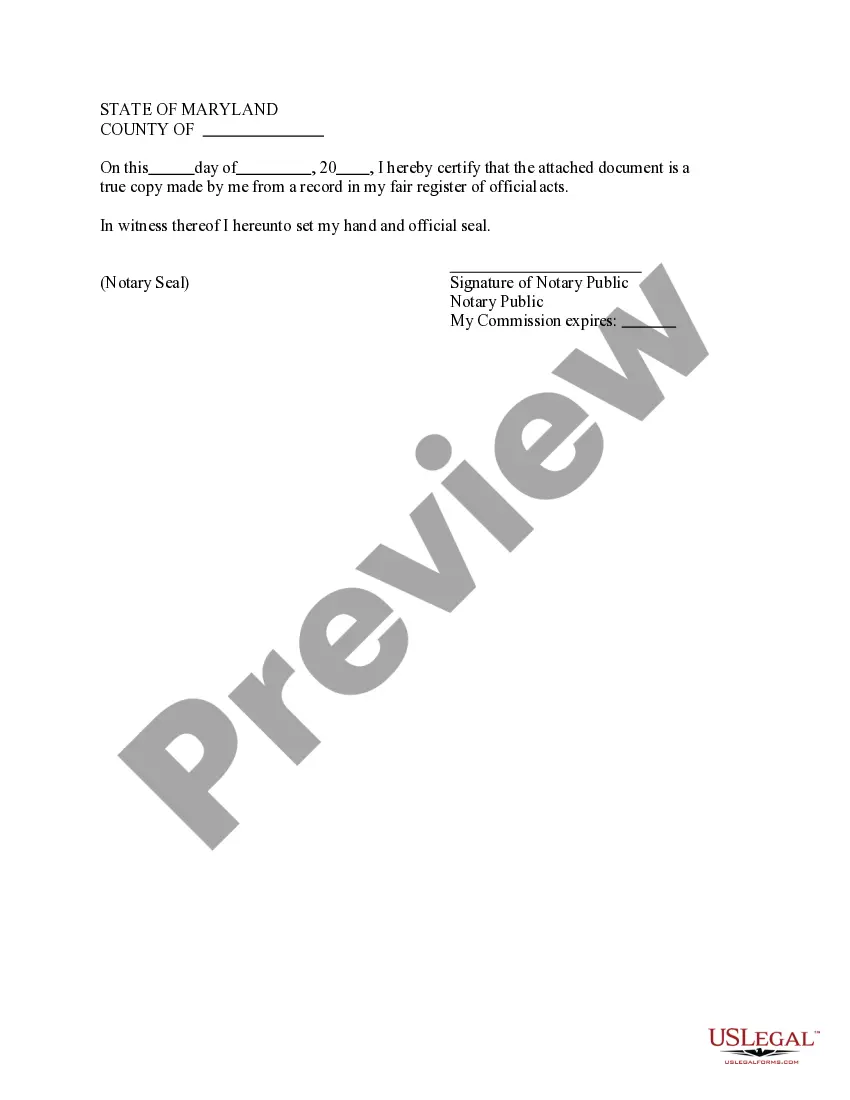
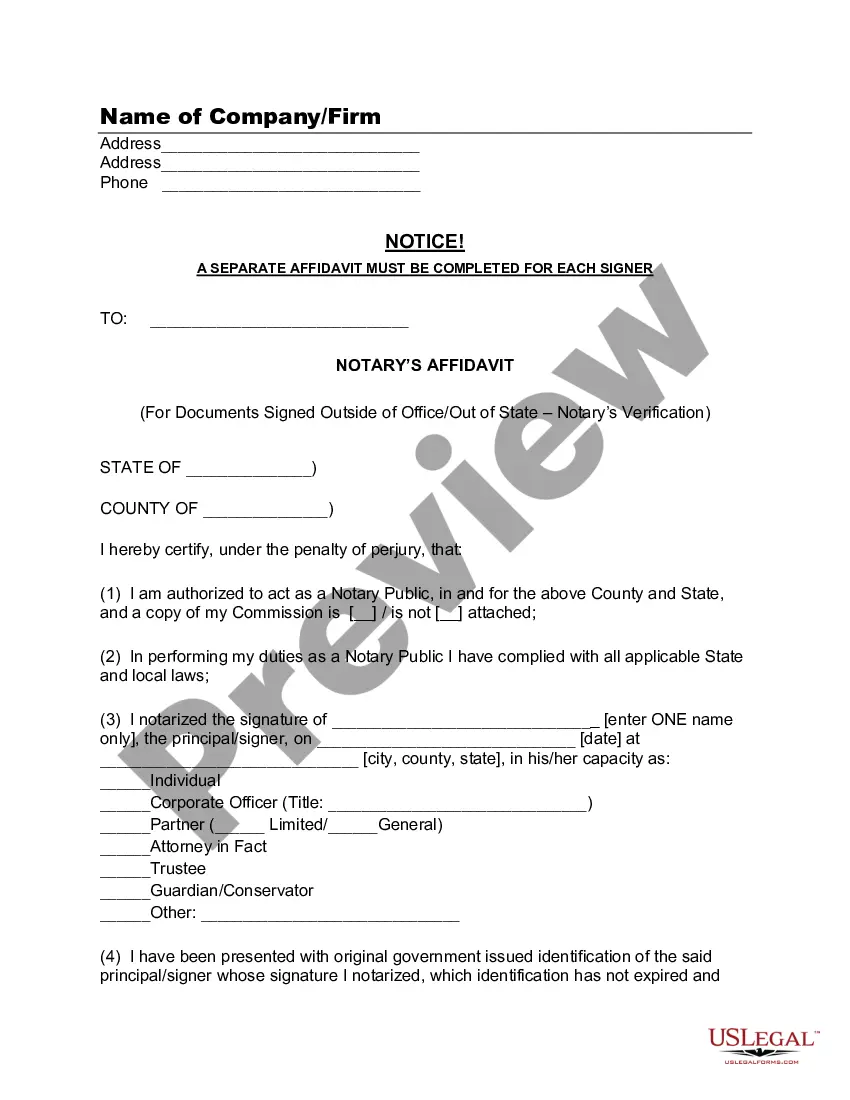
The Certification of Notary's Fair Register of Official Act is a legal document used by notaries public to certify that a document is a true copy from their official records. This form serves to provide evidence of the authenticity of official acts, distinguishing it from other notarial documents by specifically acknowledging the contents of the notary's register.
Key components of this form
- Document certification statement: Confirms that the attached document is a true copy from the notary's fair register.
- Date of certification: Specifies the date when the certification is executed.
- Notary's signature: This section requires the signature of the notary public to validate the certification.
- Notary's seal: An official seal is included to authenticate the certification.
- Commission expiration date: This indicates the period during which the notary's authority is valid.

Common use cases
This form should be used when a notary needs to certify that they have made a true copy of a document from their records. It is applicable in scenarios such as legal proceedings, official applications, or whenever an authenticated document is required by a third party.
Who can use this document
- Notaries public who need to authenticate documents.
- Individuals and organizations requiring certified copies of official documents.
- Lawyers and legal professionals needing to present certified documents in court or other legal settings.
Steps to complete this form
- Begin by entering the date of certification at the top of the document.
- Attach the document that is being certified.
- Fill in the section declaring the attached document is a true copy.
- Sign the form where indicated to authenticate the certification.
- Apply your official notary seal in the designated area.
- Document the expiration date of your notary commission at the bottom of the form.
Does this document require notarization?
This document requires notarization to meet legal standards. US Legal Forms provides secure online notarization powered by Notarize, allowing you to complete the process through a verified video call, available 24/7.
Get your form ready online
Our built-in tools help you complete, sign, share, and store your documents in one place.
Make edits, fill in missing information, and update formatting in US Legal Forms—just like you would in MS Word.
Download a copy, print it, send it by email, or mail it via USPS—whatever works best for your next step.
Sign and collect signatures with our SignNow integration. Send to multiple recipients, set reminders, and more. Go Premium to unlock E-Sign.
If this form requires notarization, complete it online through a secure video call—no need to meet a notary in person or wait for an appointment.
We protect your documents and personal data by following strict security and privacy standards.

Make edits, fill in missing information, and update formatting in US Legal Forms—just like you would in MS Word.

Download a copy, print it, send it by email, or mail it via USPS—whatever works best for your next step.

Sign and collect signatures with our SignNow integration. Send to multiple recipients, set reminders, and more. Go Premium to unlock E-Sign.

If this form requires notarization, complete it online through a secure video call—no need to meet a notary in person or wait for an appointment.

We protect your documents and personal data by following strict security and privacy standards.
Typical mistakes to avoid
- Failing to include the notary seal, which is crucial for the certification.
- Not providing the expiration date of the notary's commission, leading to potential invalidation.
- Not properly stating that the attached document is a true copy.
- Neglecting to sign the form before presenting it to others.
Advantages of online completion
- Convenient access: Download and complete the form from anywhere at any time.
- Editability: Modify the document as needed before printing, ensuring accuracy.
- Reliability: Created by licensed attorneys to ensure compliance with legal standards.
Looking for another form?

Form popularity
FAQ
In such cases, you should refuse to notarize, citing the blank space as a reason. Remember that you may only complete information in the notarial certificate wording. Any blanks in the main text must be completed by the signer or another individual authorized to do so before the notarization may proceed.
Obtain satisfactory proof of the identity of the parent signing the letter; Record the notarization in the Notary's register of official acts; Observe the signing of the letter;
The notarial certificate is a written statement, signed and sealed by the notary public, certifying the facts of a notarial act. The two most common notarial acts a notary will be asked to perform are administering oaths and taking acknowledgments.
A notary public shall provide and keep an official seal, which shall clearly show, when embossed, stamped, impressed or affixed to a document, the name of the notary, the State Seal, the words "Notary Public," and the name of the county wherein the bond and oath of office are filed, and the date the notary public's
Use an appropriate heading. You can write the letter in any format you choose but make certain to mention an appropriate heading. Insert a case caption. Add the address. Give details about the affiant. Include your name. Leave a space for the signature of the notary public.
When you see (here insert the name and character of the officer) next to a blank as shown below, it means you should insert Your name, Notary Public in the blank.
With a few exceptions, notarized documents contain five notary-specific elements: venue, the notary certificate, commission expiration date, notary signature, and notary seal. This article covers the venue.
Staple the certificate to the document: Once the certificate is completed, the Notary should be the one to attach it to the document. Generally, the certificate should be stapled to the document's left margin, behind the signature page.
The body includes the main information about the notarial act, including the name of the signer, the date of notarization, and important details about the notarial act itself. These details describe the facts the Notary is certifying in the particular notarization.