Maryland Joint Request for Uncontested Divorce Hearing with Adult Children
About this form
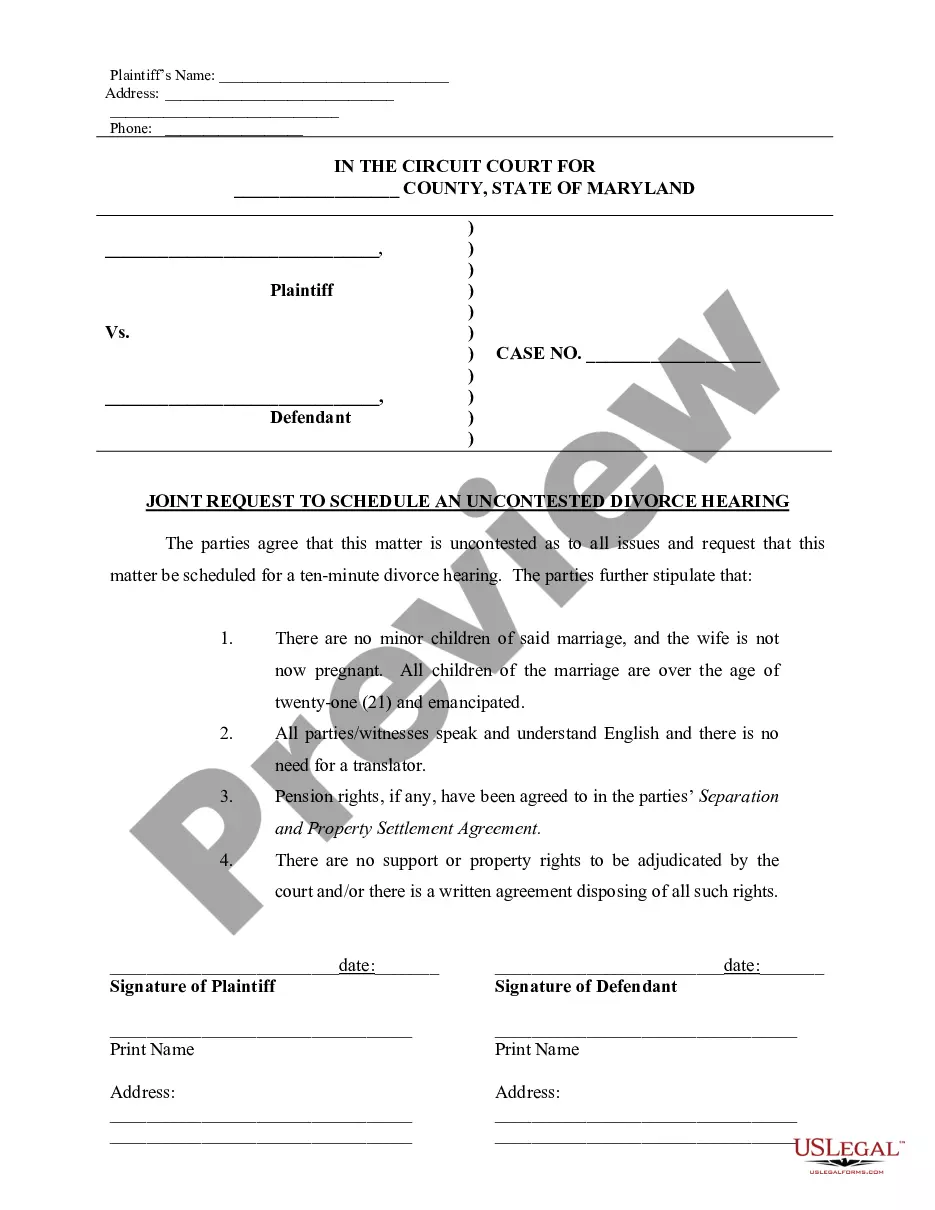
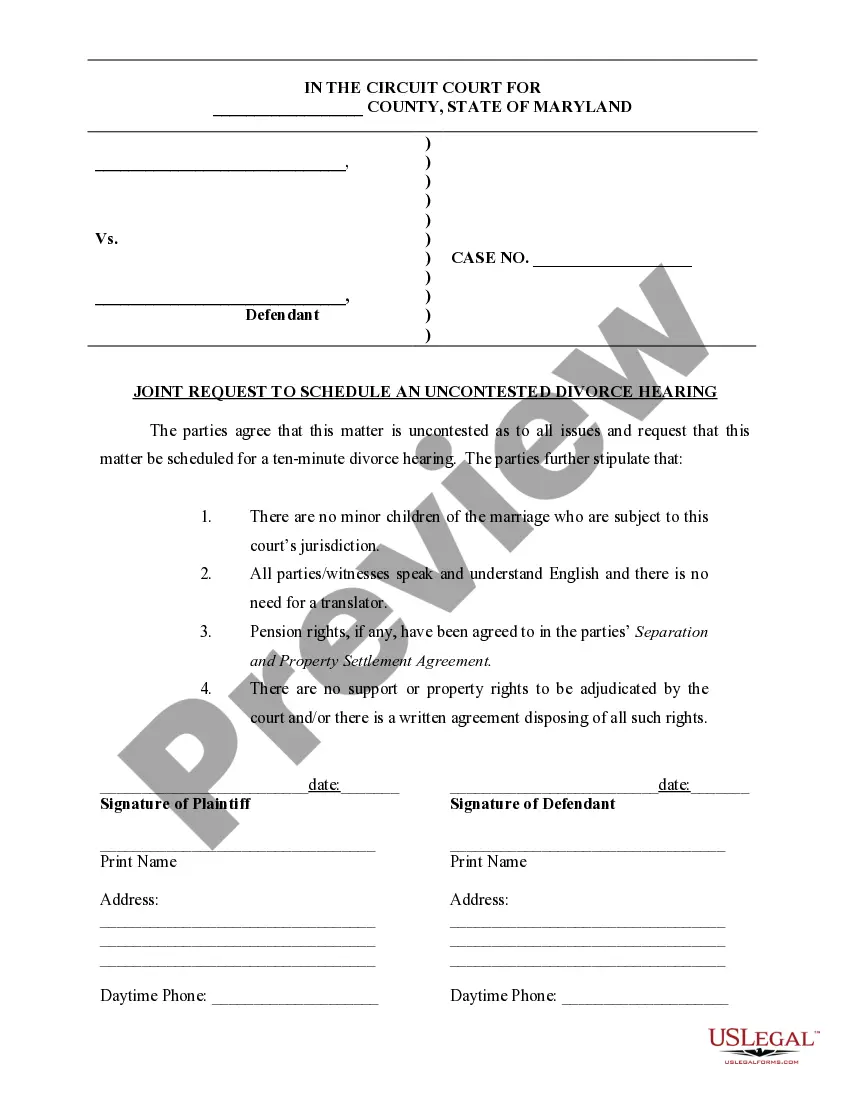
The Joint Request for Uncontested Divorce Hearing with Adult Children is a legal document that allows both spouses to submit a joint request for a final uncontested divorce hearing. This form is specifically designed for instances where all issues have been agreed upon, and there are no minor children involved, as all children are over the age of twenty-one. Unlike other divorce filings, this form streamlines the process by eliminating the need for lengthy hearings and negotiations, making it an efficient option for couples looking to finalize their divorce amicably.
Key parts of this document
- Address and contact information fields for both parties.
- A statement confirming that the matter is uncontested.
- A section certifying that there are no minor children or pregnancy involved.
- Agreement on pension rights and property issues, if applicable.
- Signature lines for both the plaintiff and the defendant.

Common use cases
This form should be used in situations where both parties to a marriage have agreed on all terms related to their divorce, including asset distribution and lack of minor children. It's ideal for couples who have reached a mutual agreement and want to expedite the divorce process without a contested court appearance. Utilization of this form is pertinent when both spouses desire a straightforward and amicable resolution.
Intended users of this form
- Married couples who agree on divorce terms without disputes.
- Couples with adult children who are over the age of twenty-one.
- Individuals looking to avoid the complexities of a contested divorce.
- Spouses who wish to complete their divorce efficiently and with little court intervention.
Steps to complete this form
- Identify the parties involved: Enter the names and contact details of both the plaintiff and defendant.
- Verify the uncontested status: Confirm that both parties agree there are no disputes regarding the divorce terms.
- Declare the status of children: Clearly state that all children are over twenty-one and emancipated.
- Agree on property rights: Acknowledge any agreements made regarding assets in the separation agreement.
- Sign and date the form: Both parties must provide their signatures and dates next to their printed names to validate the request.
Does this document require notarization?
Notarization is generally not required for this form. However, certain states or situations might demand it. You can complete notarization online through US Legal Forms, powered by Notarize, using a verified video call available anytime.
Get your form ready online
Our built-in tools help you complete, sign, share, and store your documents in one place.
Make edits, fill in missing information, and update formatting in US Legal Forms—just like you would in MS Word.
Download a copy, print it, send it by email, or mail it via USPS—whatever works best for your next step.
Sign and collect signatures with our SignNow integration. Send to multiple recipients, set reminders, and more. Go Premium to unlock E-Sign.
If this form requires notarization, complete it online through a secure video call—no need to meet a notary in person or wait for an appointment.
We protect your documents and personal data by following strict security and privacy standards.

Make edits, fill in missing information, and update formatting in US Legal Forms—just like you would in MS Word.

Download a copy, print it, send it by email, or mail it via USPS—whatever works best for your next step.

Sign and collect signatures with our SignNow integration. Send to multiple recipients, set reminders, and more. Go Premium to unlock E-Sign.

If this form requires notarization, complete it online through a secure video call—no need to meet a notary in person or wait for an appointment.

We protect your documents and personal data by following strict security and privacy standards.
Common mistakes
- Failing to sign the form by both parties.
- Not correctly identifying the county and court where the form is filed.
- Overlooking the requirement for adult children to be confirmed as emancipated.
- Incomplete contact information, which may delay processing.
Why complete this form online
- Instant access to professionally drafted legal templates.
- The ability to download and print forms in Word or fillable PDF formats for easy completion.
- Convenient online access allows you to complete forms at your own pace from anywhere.
- Reduces the risk of errors with clear instructions and fields.
Looking for another form?
Form popularity
FAQ
With a hearing, the judge will consider evidence and testimony on one or more aspects of your divorce, perhaps child custody or visitation or temporary alimony, for example. The judge will render a decision on those issues only, removing some of the roadblocks and answering some questions about your divorce.
Uncontested divorces usually take two to three months, after filing in our experience, and contested divorces can take up to eighteen months. D If you have gone through a contested divorce, and if there is no appeal, your divorce will be final thirty days after the judge signs the final decree.
In an uncontested divorce, couples can reach an agreement on the financial terms and division of assets before the case goes to court.Judges and lawyers prefer to settle out of court wherever possible, and so should you if you can help it.
According to the Hindu Marriage Act, 1955; a petition for a 'mutual divorce' can be filed if you and your spouse are facing difficulties and have decided to part your ways legally. you can even file for divorce if the other party is not willing to get a divorce- this is called, 'Contested Divorce'.
Custody and access orders The remaining 38% were made on an uncontested basis, which means that one parent made the application, and the other parent neither contested nor consented.
During the hearing, your attorney, or the Family Law Magistrate, will be asking you questions related to the content of your Complaint for Absolute Divorce (e.g. when and where you were married, names and dates of birth of any children, date of separation, terms of any signed agreements between you and your spouse, etc
If you and your spouse have agreed on all the issues and at least 60 days have passed from the date of service, you can let the Judge know you have an agreement and finalize your divorce that day. This is called an uncontested hearing.