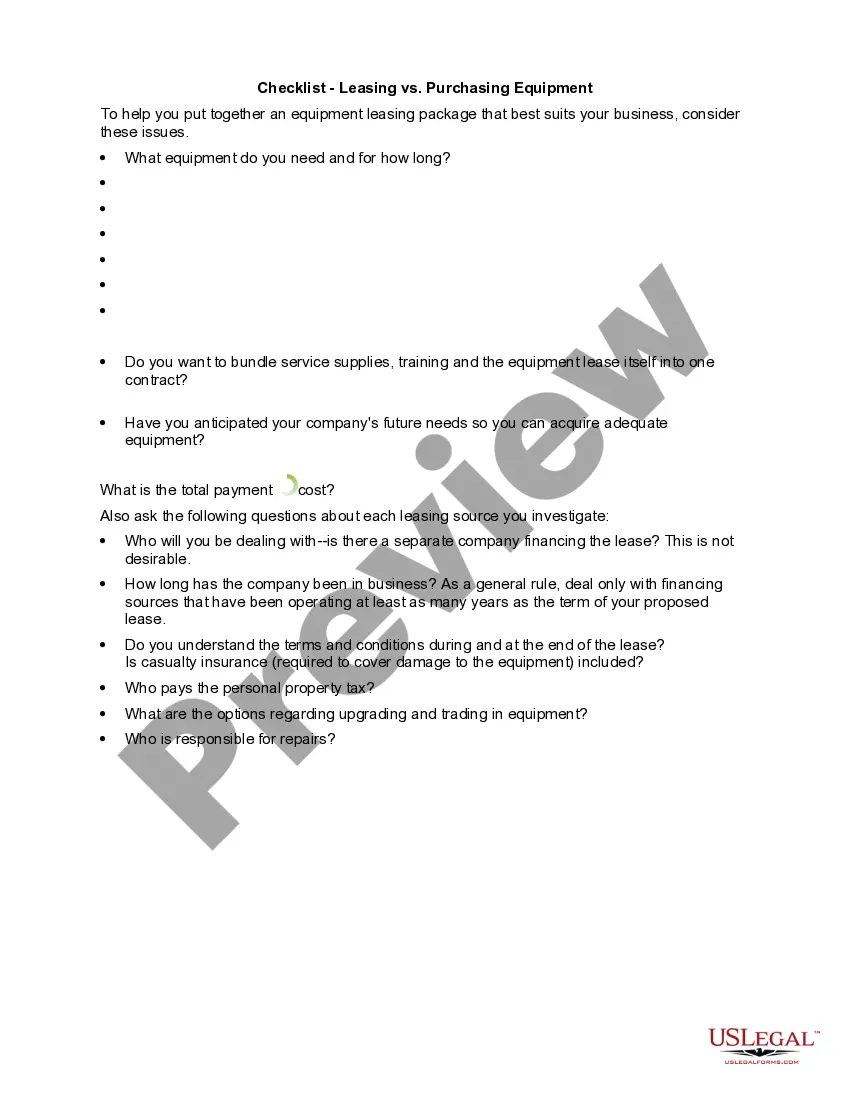
Leasing equipment can help your business stay up-to-date with the latest technology. Other benefits of leasing include making lower monthly payments than you would have with a loan, getting a fixed financing rate instead of a floating rate, benefiting from tax advantages, and conserving working capital by avoiding cash-devouring down payments. Leasing also has its downside, however: You may pay a higher price over the long term. You are also committed to retaining a piece of equipment for a certain time period, which can be problematic if your business is in flux.
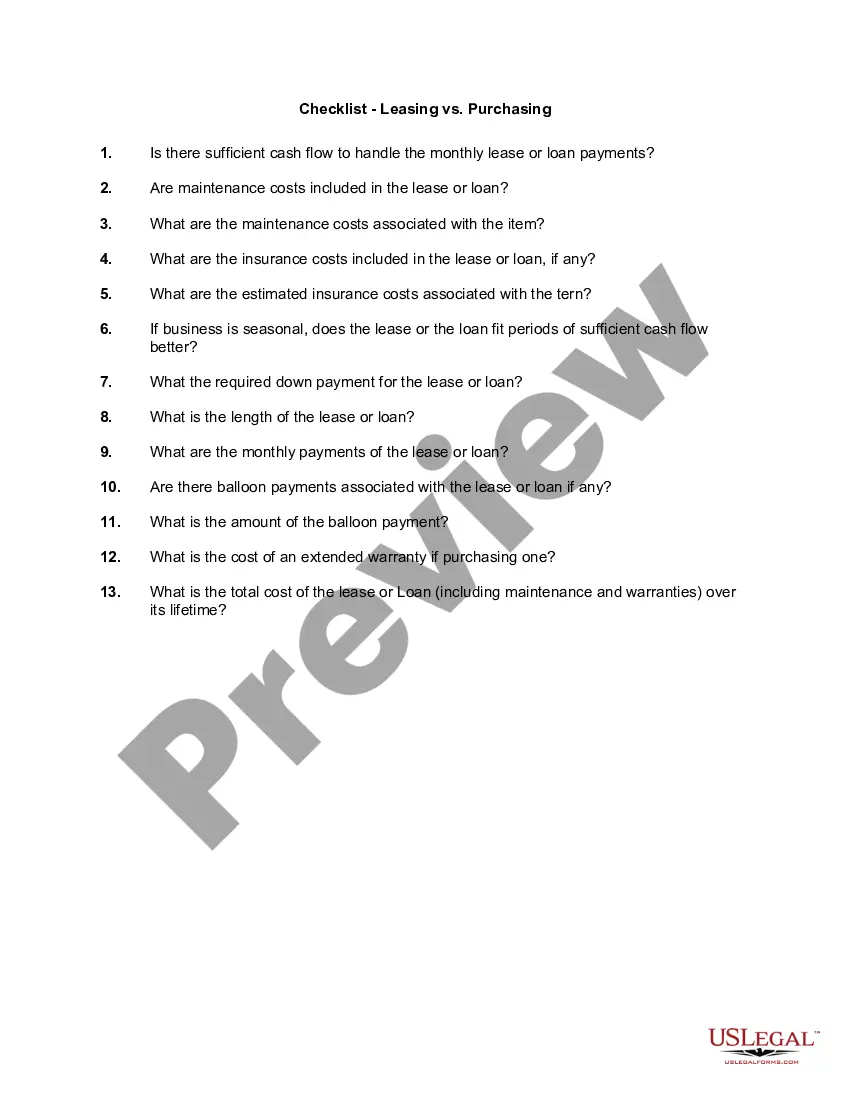
Every lease decision is unique so it's important to study the lease agreement carefully. When deciding to obtain equipment, you need to determine whether it is better to lease or purchase the equipment. You might use this checklist to compare the costs for each option.
Massachusetts Checklist - Leasing vs. Purchasing Equipment
Category:
State:
Multi-State
Control #:
US-03082BG
Format:
Word;
Rich Text
Instant download
Description
Get your form ready online
Our built-in tools help you complete, sign, share, and store your documents in one place.
Built-in online Word editor
Make edits, fill in missing information, and update formatting in US Legal Forms—just like you would in MS Word.
Export easily
Download a copy, print it, send it by email, or mail it via USPS—whatever works best for your next step.
E-sign your document
Sign and collect signatures with our SignNow integration. Send to multiple recipients, set reminders, and more. Go Premium to unlock E-Sign.
Notarize online 24/7
If this form requires notarization, complete it online through a secure video call—no need to meet a notary in person or wait for an appointment.
Store your document securely
We protect your documents and personal data by following strict security and privacy standards.

Make edits, fill in missing information, and update formatting in US Legal Forms—just like you would in MS Word.

Download a copy, print it, send it by email, or mail it via USPS—whatever works best for your next step.

Sign and collect signatures with our SignNow integration. Send to multiple recipients, set reminders, and more. Go Premium to unlock E-Sign.

If this form requires notarization, complete it online through a secure video call—no need to meet a notary in person or wait for an appointment.

We protect your documents and personal data by following strict security and privacy standards.
Looking for another form?






How to fill out Checklist - Leasing Vs. Purchasing Equipment?
If you intend to compile, download, or print legal document templates, utilize US Legal Forms, the largest collection of legal documents that are accessible online.
Take advantage of the site’s user-friendly and convenient search feature to acquire the documents you need.
Various templates for business and personal purposes are categorized by groups and regions, or keywords.
Every legal document template you purchase is yours permanently. You have access to all the documents you saved in your account. Click the My documents section and choose a document to print or download again.
Stay competitive and download, and print the Massachusetts Checklist - Leasing vs. Purchasing Equipment using US Legal Forms. There are thousands of professional and state-specific forms available for your business or personal needs.
- Leverage US Legal Forms to obtain the Massachusetts Checklist - Leasing vs. Purchasing Equipment in just a few clicks.
- If you are already a client of US Legal Forms, Log In to your account and click on the Download button to access the Massachusetts Checklist - Leasing vs. Purchasing Equipment.
- You can also find documents that you previously saved in the My documents tab of your account.
- If you are using US Legal Forms for the first time, follow these steps.
- Step 1. Ensure you have chosen the form for the correct state/region.
- Step 2. Use the Preview option to review the content of the form. Don’t forget to read the summary.
- Step 3. If you are not satisfied with the document, utilize the Search field at the top of the screen to find other variations of the legal document template.
- Step 4. Once you have found the form you need, click the Get now button. Choose your preferred pricing plan and enter your credentials to register for an account.
- Step 5. Complete the transaction. You can use your credit card or PayPal account to make the payment.
- Step 6. Select the format of the legal document and download it to your device.
- Step 7. Fill out, modify, and print or sign the Massachusetts Checklist - Leasing vs. Purchasing Equipment.
Form popularity
FAQ
Leased equipment is owned by the lessor, not the lessee. The lessee gets to use the equipment while making periodic payments, but ownership stays with the lessor until the lease ends. When considering your options, refer to the Massachusetts Checklist - Leasing vs. Purchasing Equipment for clarity on ownership and financing implications. This knowledge helps in making informed leasing decisions.
The ownership of the equipment in a finance lease remains with the lessor. While the lessee effectively controls the equipment during the lease, the lessor retains legal ownership. This distinction significantly affects financial decisions, as highlighted in the Massachusetts Checklist - Leasing vs. Purchasing Equipment. Understanding who owns the equipment can guide your leasing choices.
Leasing equipment can offer various tax advantages, such as immediate deductions on lease payments as business expenses. Also, by avoiding upfront capital investments, businesses can allocate funds towards other operational needs. Consult the Massachusetts Checklist - Leasing vs. Purchasing Equipment to better understand these potential benefits.
Leasing equipment allows businesses to access the latest technology without a significant initial investment. It also offers flexibility to upgrade or replace equipment easily. This agility can be crucial for adapting to market changes, so consider this benefit as you review the Massachusetts Checklist - Leasing vs. Purchasing Equipment.
Leasing can provide immediate tax deductions for businesses, making it a strong candidate depending on your financial situation. Unlike the gradual depreciation of purchased assets, lease payments can be fully deductible as expenses. For the Massachusetts Checklist - Leasing vs. Purchasing Equipment, consult with financial advisors to see what works best for you.
The decision to buy or lease ultimately hinges on your financial strategy and operational needs. Buying tends to be better for long-term use and investment, while leasing favors flexibility and lower upfront costs. Analyzing your specific situation against the Massachusetts Checklist - Leasing vs. Purchasing Equipment can clarify the best choice for you.
The key difference lies in ownership. Buying means you maintain long-term control and can benefit from asset appreciation and depreciation. Leasing, on the other hand, provides short-term usage without ownership hassles but does not build equity. Consider these distinctions critically while following the Massachusetts Checklist - Leasing vs. Purchasing Equipment.
Deciding whether to buy or lease a machine depends on your specific operational needs and financial goals. If you require the latest technology and flexibility, leasing may be advantageous. However, if you prefer ownership and long-term value, purchasing could be the better choice. Your analyses should align with the Massachusetts Checklist - Leasing vs. Purchasing Equipment.
An equipment lease is primarily considered an expense on your balance sheet. Unlike asset purchases, which provide long-term value, leased equipment may not reflect ownership. For the Massachusetts Checklist - Leasing vs. Purchasing Equipment, be mindful of how this classification impacts your financial statements.
While leasing offers flexibility, it does come with some downsides. You do not own the equipment, and once the lease ends, you must return it or negotiate a new deal. Additionally, total costs could exceed those of purchasing over the long term. When evaluating your options for the Massachusetts Checklist - Leasing vs. Purchasing Equipment, weigh these factors carefully.