Massachusetts Fiduciary Deed for use by Executors, Trustees, Trustors, Administrators and other Fiduciaries
About this form
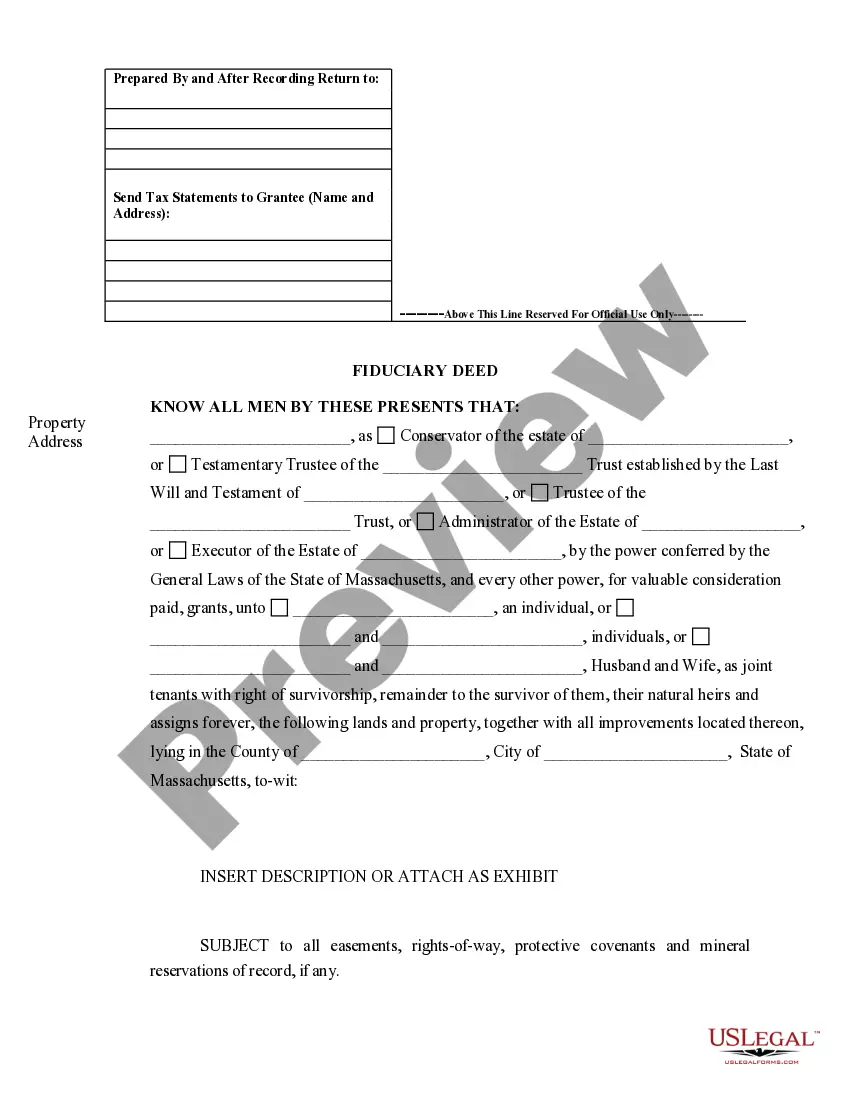
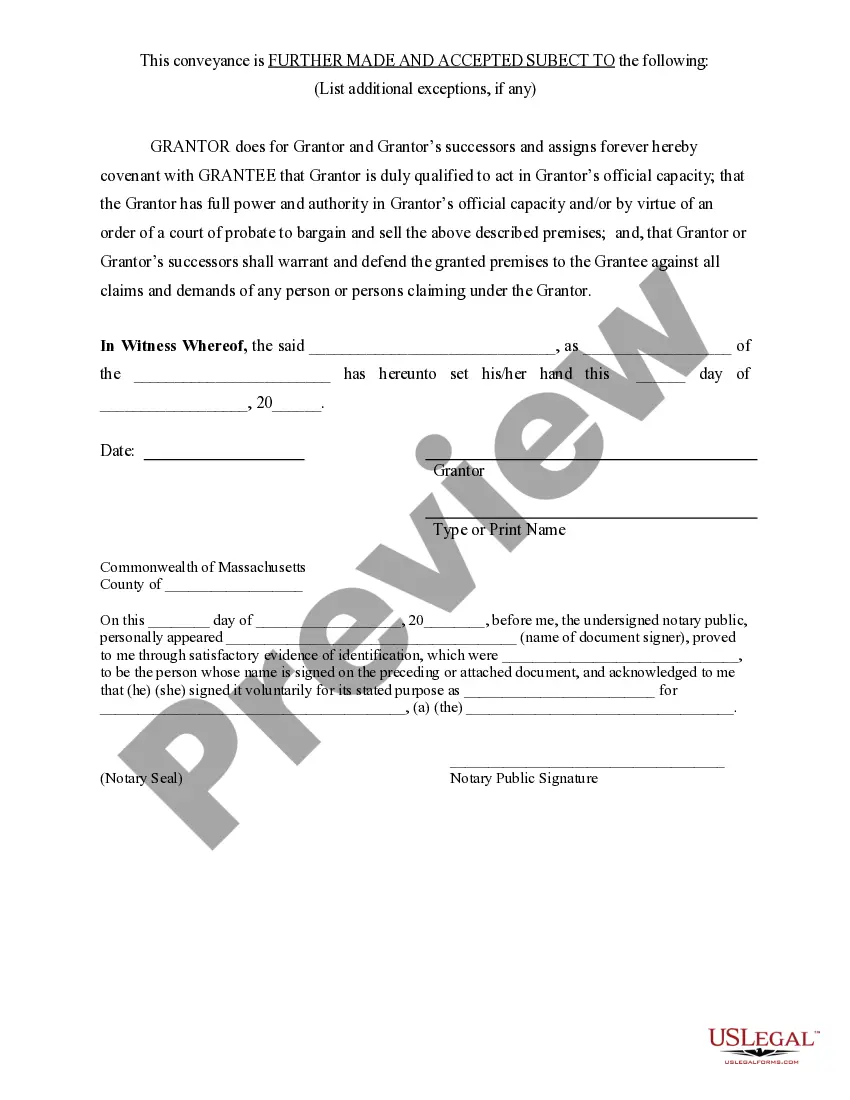
The Fiduciary Deed serves as a legal document allowing fiduciariesâsuch as executors, trustees, and administratorsâto transfer property on behalf of another individual or estate. Unlike a standard deed, this form is specifically designed for those in fiduciary roles, ensuring that property transactions are managed in compliance with the duties outlined in a will or trust. This deed enables fiduciaries to legally convey ownership while fulfilling their responsibilities.
Main sections of this form
- Names of the grantor and grantee, including their roles (e.g., executor, trustee).
- Description of the property being conveyed.
- Statement of the grantor's authority to execute the deed.
- Signatures of the grantor and notary public for validation.
- Conditions and exceptions to the property transfer, if applicable.



Situations where this form applies
This form should be used when a fiduciary needs to transfer property as part of their duties, such as executing a will, managing a trust, or handling an estate. Situations may include selling property from an estate, transferring property to beneficiaries, or conducting other real estate transactions while acting under fiduciary authority.
Who can use this document
- Executors responsible for settling a deceased individualâs estate.
- Trustees managing assets within a trust.
- Administrators appointed by a court to oversee an estate.
- Guardians or conservators acting on behalf of an individual unable to manage their own affairs.
How to complete this form
- Identify the roles of the parties involved (grantor and grantee).
- Specify a detailed description of the property being conveyed.
- Enter the names of the fiduciary and the individual or party receiving the property.
- Sign the document in the presence of a notary public.
- Ensure all required fields are filled out completely before submission.
Does this form need to be notarized?
Yes, this form must be notarized to be legally valid. It includes a section for a notary public's signature, which verifies that the signing parties are who they claim to be, ensuring authenticity. US Legal Forms offers integrated online notarization services, allowing you to complete this process efficiently and securely through a video call, without the need for in-person visits.
Get your form ready online
Our built-in tools help you complete, sign, share, and store your documents in one place.
Make edits, fill in missing information, and update formatting in US Legal Forms—just like you would in MS Word.
Download a copy, print it, send it by email, or mail it via USPS—whatever works best for your next step.
Sign and collect signatures with our SignNow integration. Send to multiple recipients, set reminders, and more. Go Premium to unlock E-Sign.
If this form requires notarization, complete it online through a secure video call—no need to meet a notary in person or wait for an appointment.
We protect your documents and personal data by following strict security and privacy standards.

Make edits, fill in missing information, and update formatting in US Legal Forms—just like you would in MS Word.

Download a copy, print it, send it by email, or mail it via USPS—whatever works best for your next step.

Sign and collect signatures with our SignNow integration. Send to multiple recipients, set reminders, and more. Go Premium to unlock E-Sign.

If this form requires notarization, complete it online through a secure video call—no need to meet a notary in person or wait for an appointment.

We protect your documents and personal data by following strict security and privacy standards.
Common mistakes
- Failing to include the complete legal description of the property.
- Not providing the correct titles for the roles of the grantor and grantee.
- Omitting the required signature of the notary public.
- Leaving any fields blank, which may lead to processing delays.
Why complete this form online
- Easy accessibility for quick downloads from any location.
- Editable fields allow for accurate completion using your computer.
- Time-saving compared to traditional methods that involve printing and manual writing.
- Ensures you are using the most up-to-date legal language and format.
Key takeaways
- The Fiduciary Deed is essential for fiduciaries to convey property effectively.
- This form is intended for use in Massachusetts, adhering to state-specific legal procedures.
- Proper completion and notarization are crucial for the form's legal enforceability.
Looking for another form?
Form popularity
FAQ
When you're ready to transfer trust real estate to the beneficiary who is named in the trust document to receive it, you'll need to prepare, sign, and record a deed. That's the document that transfers title to the property from you, the trustee, to the new owner.
The Trustees can be the author, domestic members or associates, professionals such as accountants, attorneys, etc. a panel of banks or a Trust company, or any mixture of these people.
Two documents are needed to transfer California real property from a trust to beneficiaries of the trust; a deed and an 'affidavit of death of trustee. ' An 'affidavit death of trustee' is a declaration, under oath, by the successor trustee.
A quitclaim deed can be used to transfer property from a trust, but a Special Warranty Deed seems to be a more common way to do this.
Distribute trust assets outright The grantor can opt to have the beneficiaries receive trust property directly without any restrictions. The trustee can write the beneficiary a check, give them cash, and transfer real estate by drawing up a new deed or selling the house and giving them the proceeds.
California Property TaxesTransferring real property to yourself as trustee of your own revocable living trust -- or back to yourself -- does not trigger a reassessment for property tax purposes. (Cal. Rev. & Tax Code § 62(d).)
The personal representative and the trustee named in such wills are sometimes the same person. In the case of a revocable trust containing a testamentary trust, the trustee continues on as the trustee of the trust after your affairs are settled and the trusts are funded.
How to sign as a Trustee. When signing anything on behalf of the trust, always sign as John Smith, Trustee. By signing as Trustee, you will not be personally liable for that action as long as that action is within the scope of your authority under the trust.