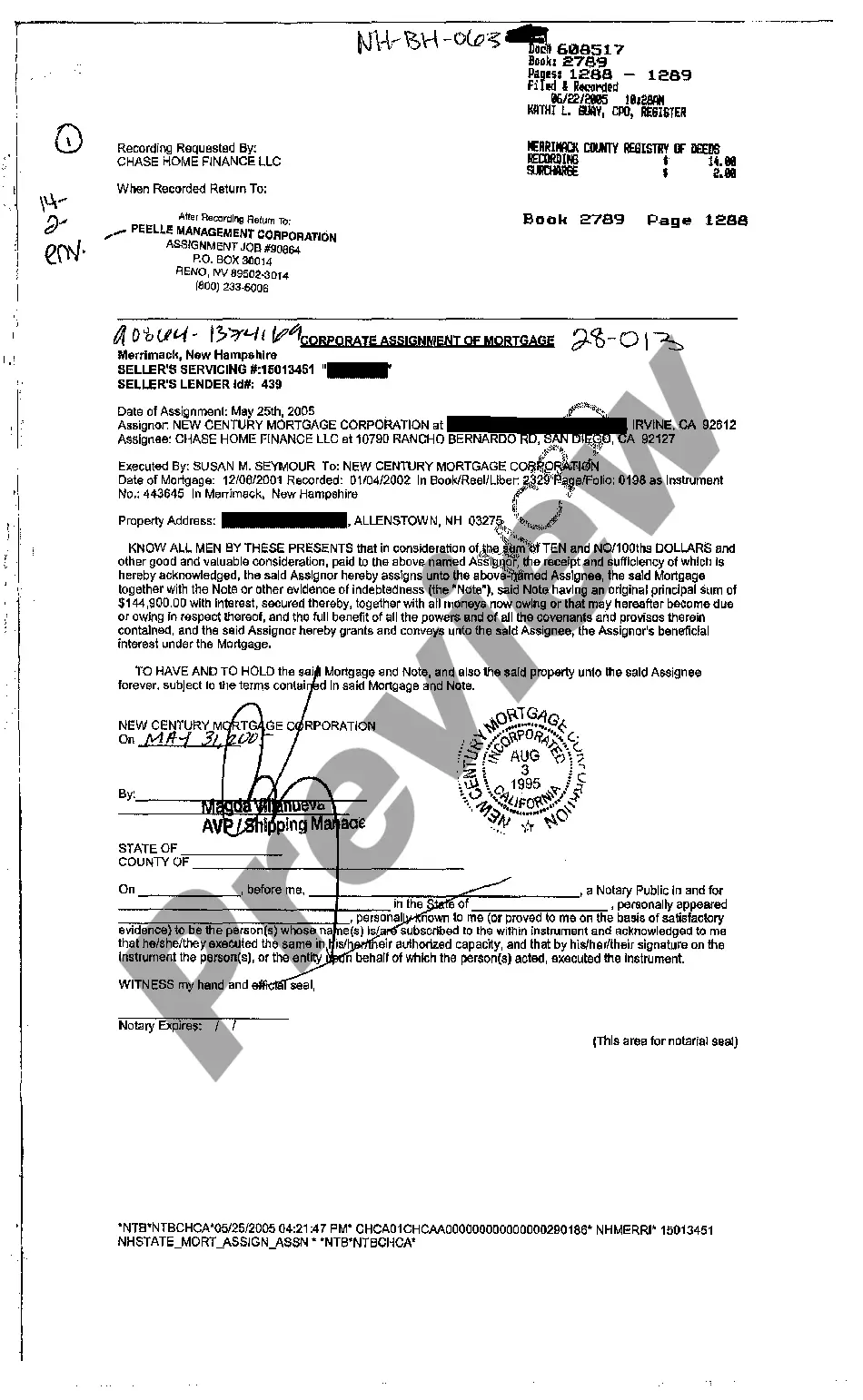
Massachusetts Fiduciary Deed - Trustee to Individual
What is this form?
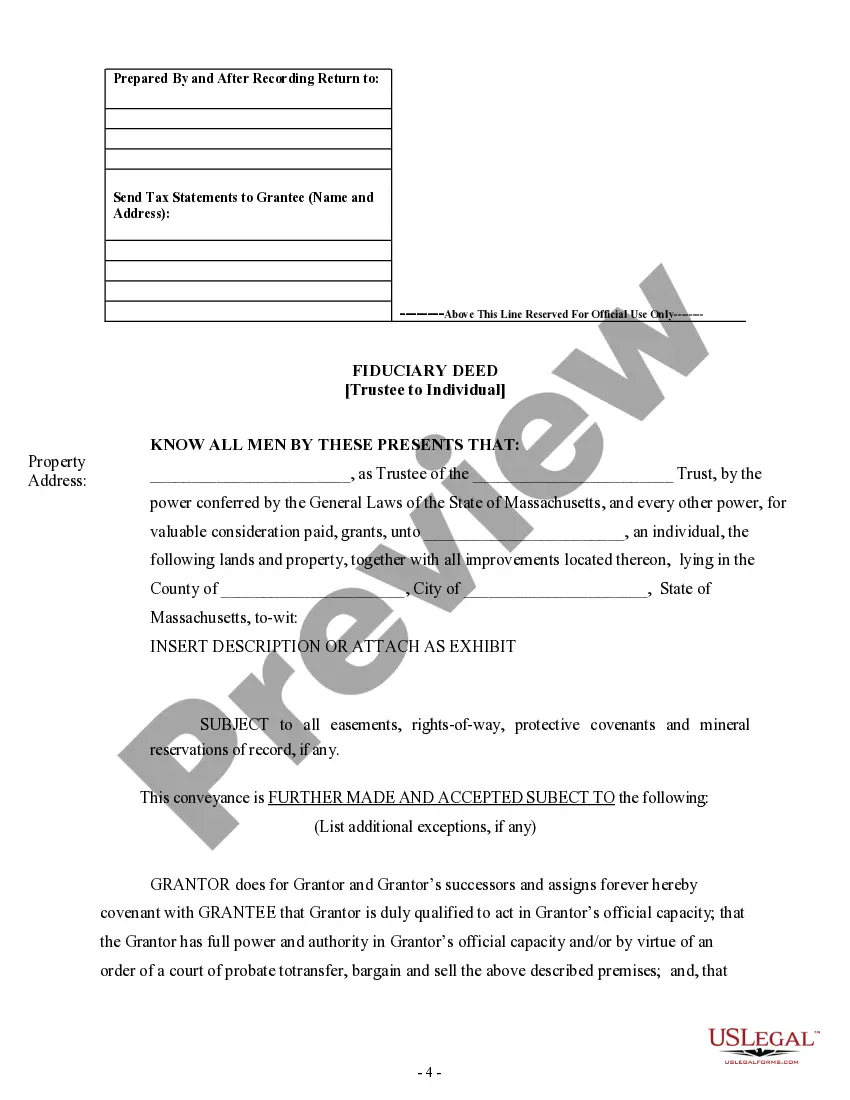
The Fiduciary Deed - Trustee to Individual is a legal document used to transfer property from a trustee to an individual. This form is particularly important for those acting in a fiduciary capacity, such as executors, guardians, or conservators, allowing them to convey property rights according to the established trust or estate plan. Unlike standard property deeds, this fiduciary deed specifically indicates the authority of the trustee, ensuring that the transaction aligns with legal obligations and trust provisions.
What’s included in this form
- Grantor information: Name and capacity of the trustee.
- Grantee information: Name and details of the individual receiving the property.
- Property description: Clear identification of the real estate being transferred.
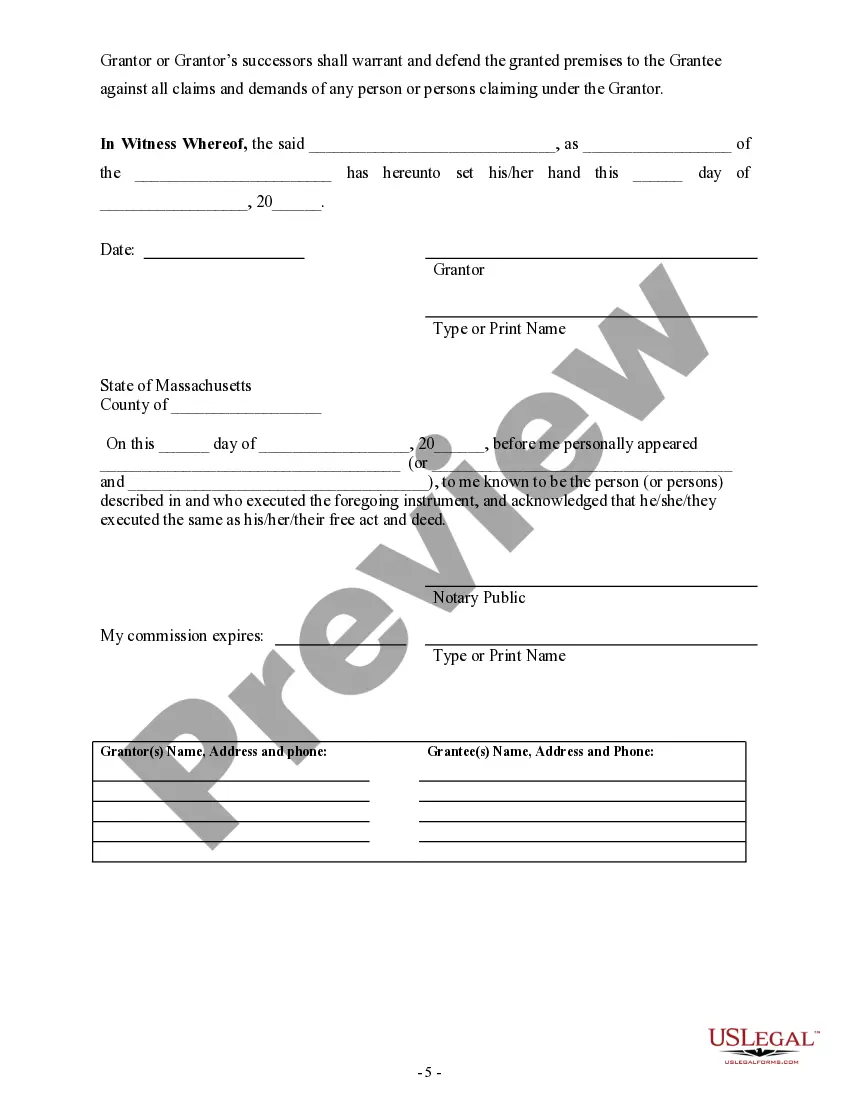
- Signatures: Required signatures of the trustee and notary public.
- Date fields: Dates for the signing and acknowledgment of the deed.


When to use this document
This Fiduciary Deed should be used when a trustee needs to officially transfer property to an individual, whether due to the terms of a trust, the execution of a will, or specific legal requirements. Common scenarios include the distribution of property to beneficiaries after a trustor's death or during the management of an estate where real property must be conveyed to a rightful heir.
Who can use this document
- Trustees acting on behalf of a trust.
- Executors settling an estate.
- Guardians or conservators managing property on behalf of others.
- Individuals involved in the transfer of rights to property held in a trust.
Steps to complete this form
- Identify the parties: Fill in the names of the trustee (grantor) and the individual (grantee).
- Specify the property: Clearly describe the property being transferred, including its location and legal description.
- Enter significant dates: Include the date of execution and any relevant acknowledgment dates.
- Provide signatures: Ensure that the trustee signs the document and that it is acknowledged by a notary public.
- Review completed form: Verify that all fields are filled out accurately to avoid any issues with the transfer.
Does this document require notarization?
This document requires notarization to meet legal standards. US Legal Forms provides secure online notarization powered by Notarize, allowing you to complete the process through a verified video call, available 24/7.
Get your form ready online
Our built-in tools help you complete, sign, share, and store your documents in one place.
Make edits, fill in missing information, and update formatting in US Legal Forms—just like you would in MS Word.
Download a copy, print it, send it by email, or mail it via USPS—whatever works best for your next step.
Sign and collect signatures with our SignNow integration. Send to multiple recipients, set reminders, and more. Go Premium to unlock E-Sign.
If this form requires notarization, complete it online through a secure video call—no need to meet a notary in person or wait for an appointment.
We protect your documents and personal data by following strict security and privacy standards.

Make edits, fill in missing information, and update formatting in US Legal Forms—just like you would in MS Word.

Download a copy, print it, send it by email, or mail it via USPS—whatever works best for your next step.

Sign and collect signatures with our SignNow integration. Send to multiple recipients, set reminders, and more. Go Premium to unlock E-Sign.

If this form requires notarization, complete it online through a secure video call—no need to meet a notary in person or wait for an appointment.

We protect your documents and personal data by following strict security and privacy standards.
Common mistakes to avoid
- Failing to include a complete and accurate property description.
- Not obtaining a notary signature, which is necessary for legality.
- Leaving blank fields that should contain critical information.
- Neglecting to check state-specific legal requirements that may impact the deed.
Benefits of completing this form online
- Convenience: Access and download the form anytime from anywhere.
- Editability: Fill out the form using Microsoft Word or print it for manual completion.
- Time-saving: Quickly complete the necessary legal paperwork without lengthy attorney consultations.
- Accuracy: Forms are drafted by licensed attorneys, reducing the risk of errors in legal language.
Looking for another form?

Form popularity
FAQ
Trustees aren't allowed to sell trust property to themselves unless the trust agreement has explicitly allowed them to do so. They also shouldn't sell the trust property to another trust that they manage, or borrow trust funds for personal use.
The trustee cannot grant legitimate and reasonable requests from one beneficiary in a timely manner and deny or delay granting legitimate and reasonable requests from another beneficiary simply because the trustee does not particularly care for that beneficiary. Invest trust assets in a conservative manner.
California Property TaxesTransferring real property to yourself as trustee of your own revocable living trust -- or back to yourself -- does not trigger a reassessment for property tax purposes. (Cal. Rev. & Tax Code § 62(d).)
Prior to enacting G.L.c. 184, §35, Massachusetts was among the few states requiring the full trust document for trusts containing real property to be recorded.The trustee's certificate is recorded either immediately upon the trust's acquisition of real property, or when the trustee acts upon the title 1.
Since the Schedule of Beneficiaries to a trust is not recorded with the Declaration of Trust at the Registry of Deeds, the identity of the Beneficiaries is not a matter of public record.There are two types of Trusts in Massachusetts.
Locate the deed that's in trust. Use the proper deed. Check with your title insurance company and lender. Prepare a new deed. Sign in the presence of a notary. Record the deed in the county clerk's office.
The court will force the executor to return the property to the estate or pay restitution to the beneficiaries of the estate.The executor cannot transfer estate property to himself because the property belongs to someone else unless he pays the full price for it.
How to sign as a Trustee. When signing anything on behalf of the trust, always sign as John Smith, Trustee. By signing as Trustee, you will not be personally liable for that action as long as that action is within the scope of your authority under the trust.
When you're ready to transfer trust real estate to the beneficiary who is named in the trust document to receive it, you'll need to prepare, sign, and record a deed. That's the document that transfers title to the property from you, the trustee, to the new owner.