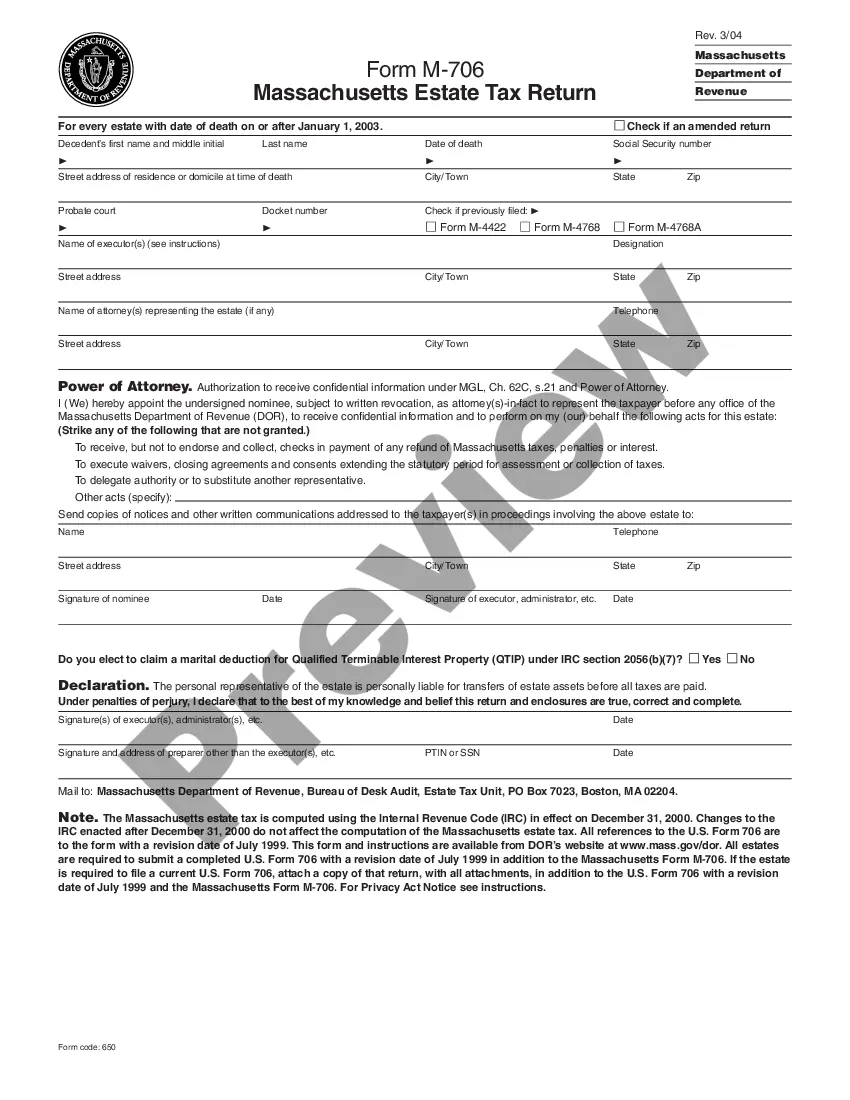
Massachusetts Resident Estate Tax Return
Description

Get your form ready online
Our built-in tools help you complete, sign, share, and store your documents in one place.
Make edits, fill in missing information, and update formatting in US Legal Forms—just like you would in MS Word.
Download a copy, print it, send it by email, or mail it via USPS—whatever works best for your next step.
Sign and collect signatures with our SignNow integration. Send to multiple recipients, set reminders, and more. Go Premium to unlock E-Sign.
If this form requires notarization, complete it online through a secure video call—no need to meet a notary in person or wait for an appointment.
We protect your documents and personal data by following strict security and privacy standards.

Make edits, fill in missing information, and update formatting in US Legal Forms—just like you would in MS Word.

Download a copy, print it, send it by email, or mail it via USPS—whatever works best for your next step.

Sign and collect signatures with our SignNow integration. Send to multiple recipients, set reminders, and more. Go Premium to unlock E-Sign.

If this form requires notarization, complete it online through a secure video call—no need to meet a notary in person or wait for an appointment.

We protect your documents and personal data by following strict security and privacy standards.
Looking for another form?

How to fill out Massachusetts Resident Estate Tax Return?
You are invited to the most extensive legal document library, US Legal Forms.
Here, you can discover numerous samples such as Massachusetts Resident Estate Tax Return templates and save them (as many as you need). Prepare official documents within hours, rather than days or weeks, without needing to spend a fortune on a lawyer.
Obtain your state-specific template with just a few clicks and rest assured that it was prepared by our qualified attorneys.
If the sample meets your needs, click Buy Now. To create an account, select a pricing plan. Use a credit card or PayPal to subscribe. Download the template in your preferred format (Word or PDF). Print the document and complete it with your or your business's information. After completing the Massachusetts Resident Estate Tax Return, send it to your attorney for confirmation. This additional step ensures you are fully protected. Register for US Legal Forms now and access a vast collection of reusable templates.
- If you’re an existing subscriber, simply Log In to your account and click Download next to the Massachusetts Resident Estate Tax Return you require.
- Since US Legal Forms is web-based, you will always have access to your downloaded documents, regardless of the device you’re using.
- You can find them under the My documents tab.
- If you don’t have an account yet, what are you waiting for.
- Follow our instructions below to get started.
- If this is a state-specific form, verify its validity in your resident state.
- Review the description (if available) to determine if it’s the right template.
- Check more details using the Preview feature.
Form popularity
FAQ
The estate tax exemption for 2020 is $11.58 million per decedent, up from $11.4 million in 2019.
The due date of the estate tax return is nine months after the decedent's date of death, however, the estate's representative may request an extension of time to file the return for up to six months.
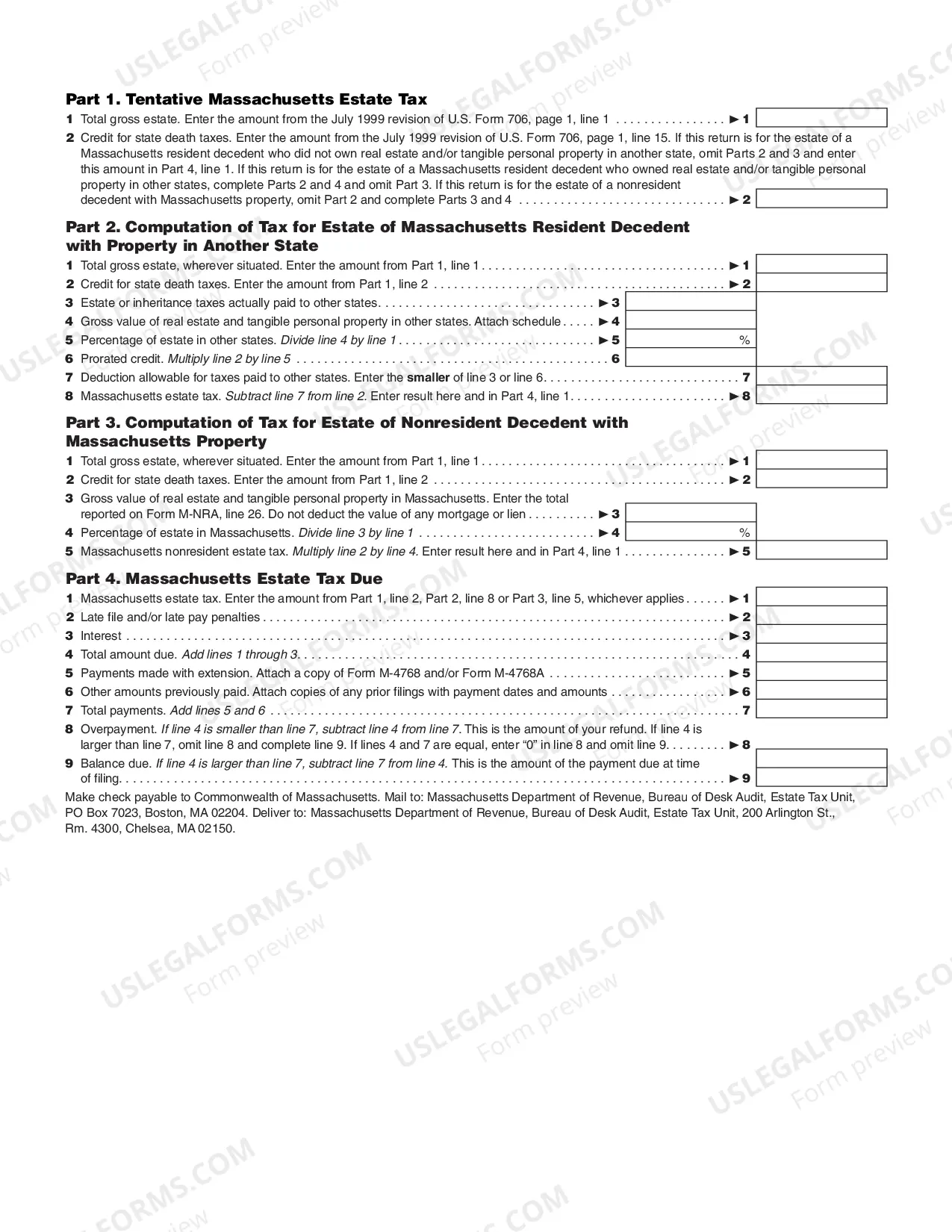
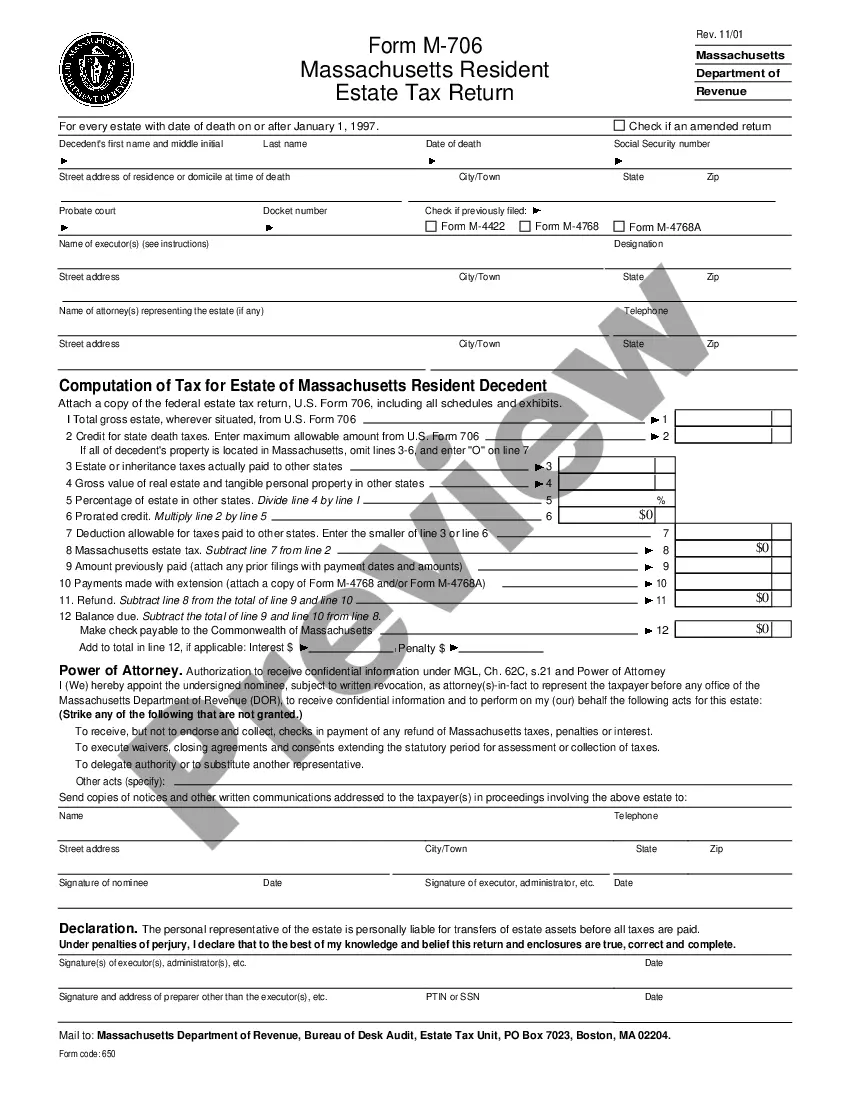
If you're responsible for the estate of someone who died, you may need to file an estate tax return.Massachusetts estate tax returns are required if the gross estate, plus adjusted taxable gifts, computed using the Internal Revenue Code in effect on December 31, 2000, exceeds $1,000,000.
The Massachusetts estate tax is equal to the amount of the maximum credit for state death taxes. It is computed using the Internal Revenue Code Section 2011 in effect on December 31, 2000.
Massachusetts Filing Requirements The executor of a decedent domiciled in Massachusetts on the date of his or her death must file a Massachusetts Resident Estate Tax Return (Form M-706) if a federal estate tax return (U.S. Form 706) is required to be filed.
Massachusetts levies an estate tax on estates worth more than $1 million. The progressive estate tax rates top out at 16%. Estate planning can take a lot of work and a lot of knowledge.
Filing the estate's estate tax return Assuming the decedent didn't make any sizable gifts before dying, no estate tax is due, and no Form 706 is required, unless the estate is worth over $11.18 million for a person who died in 2018 or $11.4 million for someone who dies in 2019.
There are two principal ways to reduce or avoid Massachusetts estate tax (other than simply spending down your children's inheritance): gifts and spousal credit shelter trusts. You can reduce the size of your estate and thus the amount that is taxed by transferring funds to your heirs during life.
Estates are now able to take a deduction for state estate taxes paid. That is, they can subtract the amount of state estate taxes paid from the value of the estate that is subject to federal taxes. The value of this deduction to the estate is the amount of the tax paid times the estate's marginal tax rate.