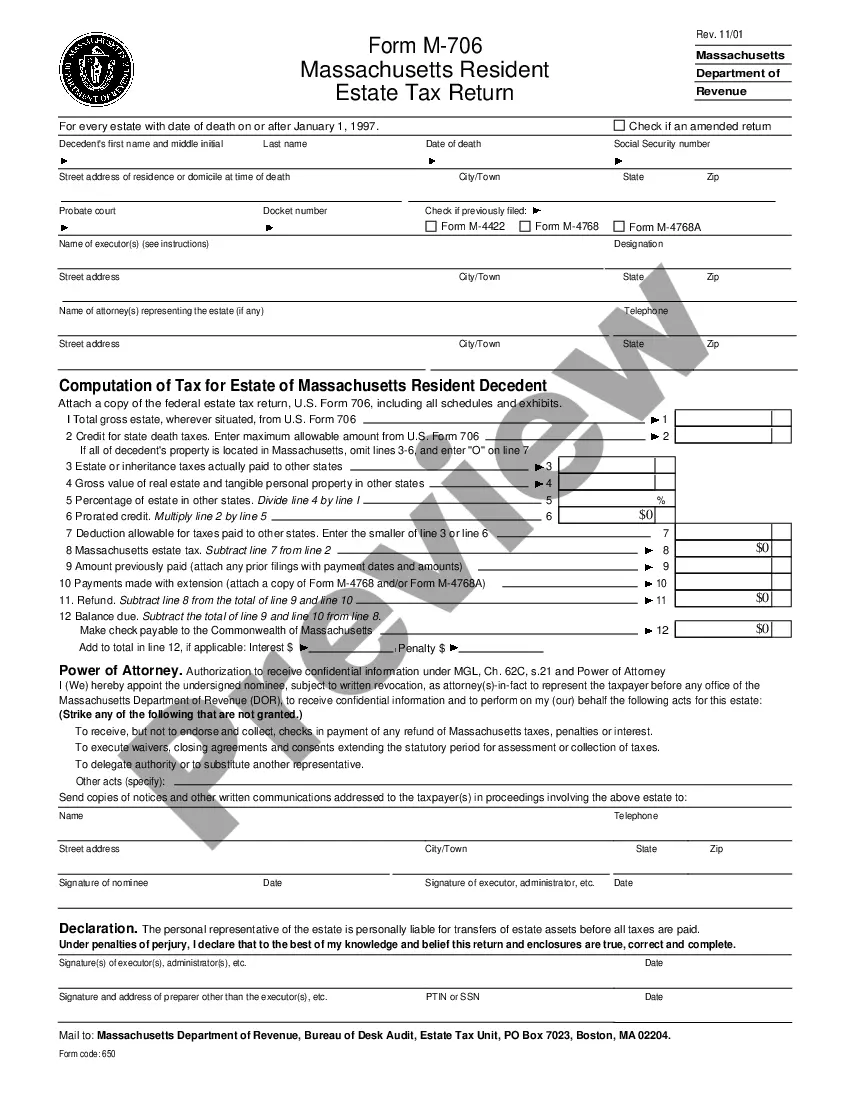
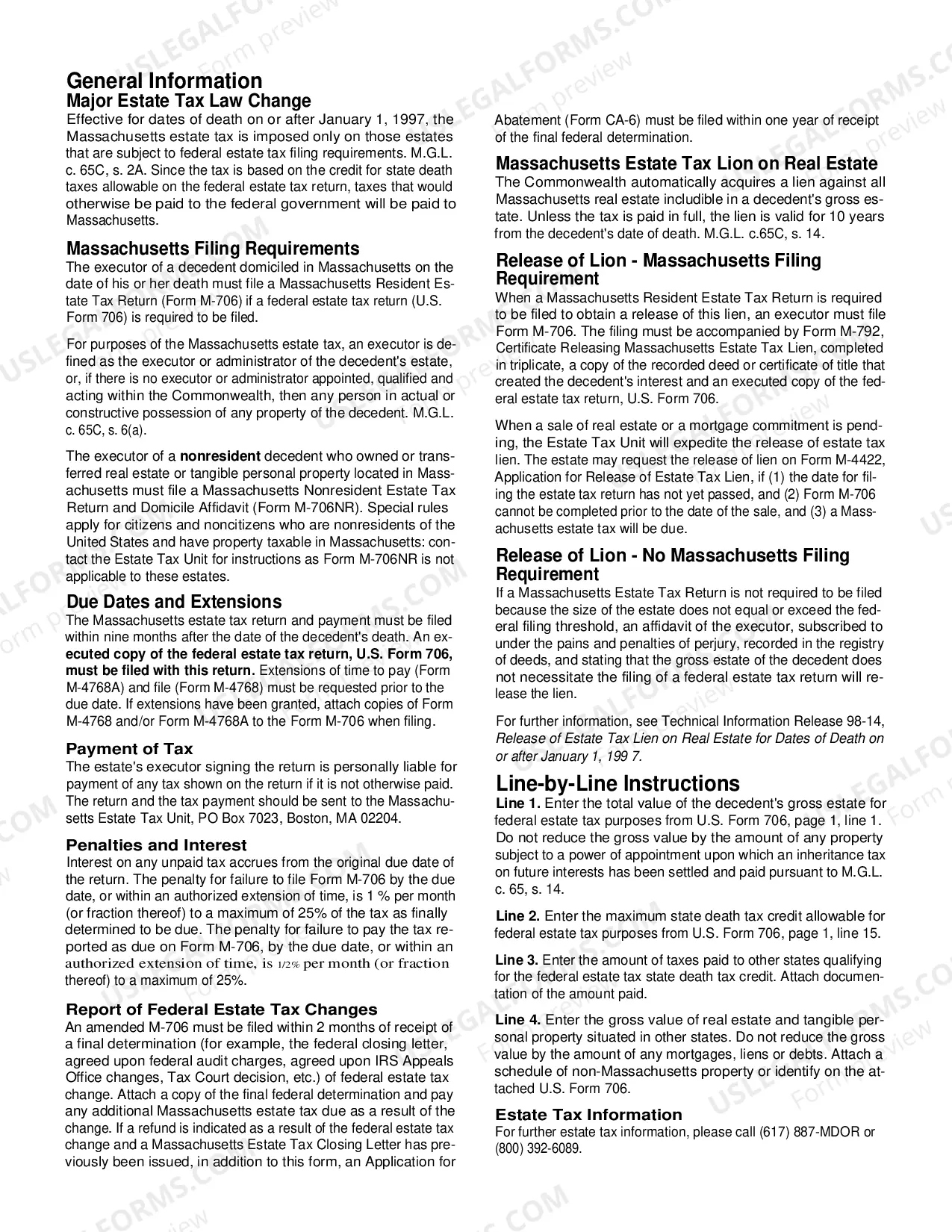
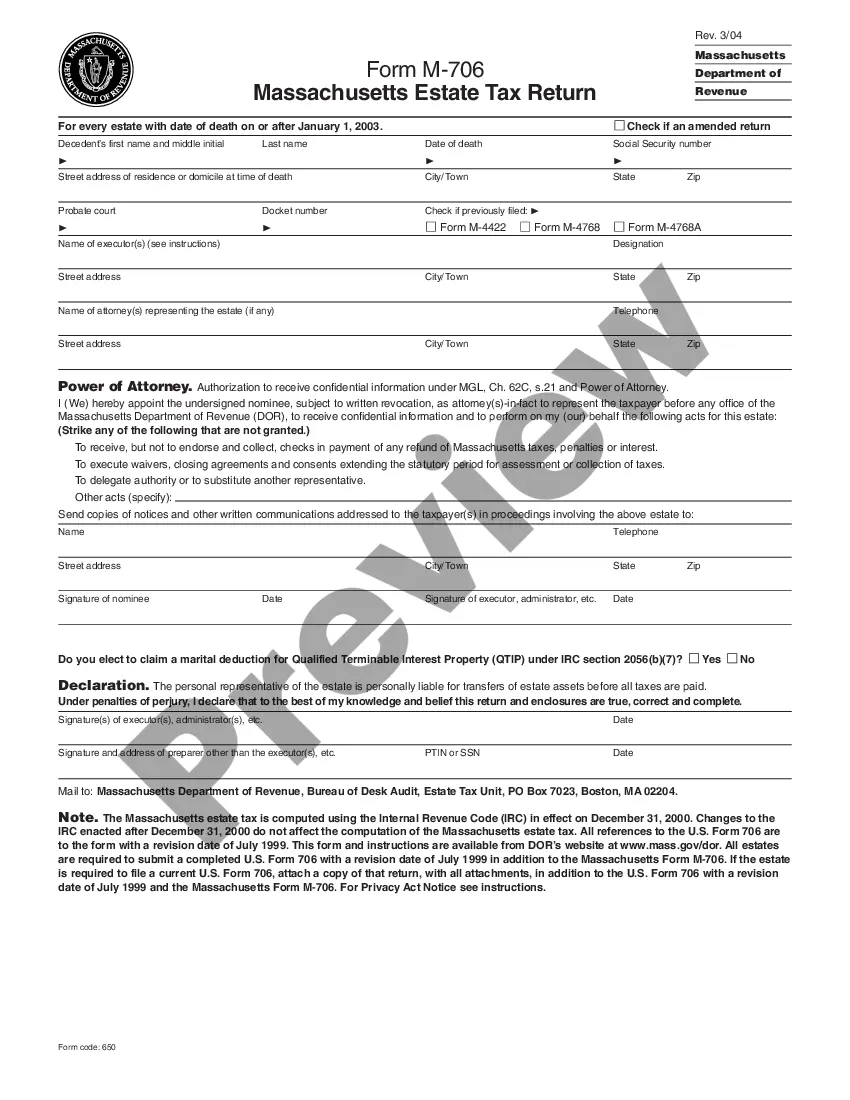
Massachusetts Resident Estate Tax Return - Form M-706
Description
Get your form ready online
Our built-in tools help you complete, sign, share, and store your documents in one place.
Make edits, fill in missing information, and update formatting in US Legal Forms—just like you would in MS Word.
Download a copy, print it, send it by email, or mail it via USPS—whatever works best for your next step.
Sign and collect signatures with our SignNow integration. Send to multiple recipients, set reminders, and more. Go Premium to unlock E-Sign.
If this form requires notarization, complete it online through a secure video call—no need to meet a notary in person or wait for an appointment.
We protect your documents and personal data by following strict security and privacy standards.

Make edits, fill in missing information, and update formatting in US Legal Forms—just like you would in MS Word.

Download a copy, print it, send it by email, or mail it via USPS—whatever works best for your next step.

Sign and collect signatures with our SignNow integration. Send to multiple recipients, set reminders, and more. Go Premium to unlock E-Sign.

If this form requires notarization, complete it online through a secure video call—no need to meet a notary in person or wait for an appointment.

We protect your documents and personal data by following strict security and privacy standards.
Looking for another form?


How to fill out Massachusetts Resident Estate Tax Return - Form M-706?
You are invited to the most extensive legal document repository, US Legal Forms.
Here you can discover any template including Massachusetts Resident Estate Tax Return - Form M-706 models and download them (as many as you wish/require).
Create official documents in a few hours, instead of days or even weeks, without needing to spend a fortune with a lawyer.
Once the sample meets all your criteria, simply click Buy Now. To create an account, select a pricing plan. Utilize a credit card or PayPal account to sign up. Download the template in your desired format (Word or PDF). Print the document and complete it with your/your business’s details. After you’ve filled out the Massachusetts Resident Estate Tax Return - Form M-706, present it to your attorney for validation. It’s an additional step but a crucial one to ensure you’re completely protected. Join US Legal Forms today and gain access to numerous reusable templates.
- Obtain your state-specific form in just a few clicks and feel confident knowing that it was crafted by our skilled legal experts.
- If you’re already a registered user, just Log In to your profile and click Download next to the Massachusetts Resident Estate Tax Return - Form M-706 you require.
- Since US Legal Forms is an online service, you’ll have constant access to your downloaded templates, no matter the device you’re using.
- Find them in the My documents section.
- If you haven't created an account yet, what are you waiting for.
- Follow our instructions below to get started.
- If this is a state-specific form, verify its relevance in the state you reside.
- Review the description (if available) to determine if it’s the suitable template.
Form popularity
FAQ
The responsibility for filing Form 706 usually falls on the executor of the estate. This individual is tasked with managing the estate and ensuring any taxes owed are properly filed. If the estate is located in Massachusetts, the Massachusetts Resident Estate Tax Return - Form M-706 must also be completed. It's essential to carefully follow the guidelines to ensure all obligations are met.
Massachusetts does not have an inheritance tax.
The executor of a decedent's estate uses Form 706 to figure the estate tax imposed by Chapter 11 of the Internal Revenue Code. Form 706 is also used to compute the generation-skipping transfer (GST) tax imposed by Chapter 13 on direct skips.
When someone dies, their assets become property of their estate.IRS Form 1041, U.S. Income Tax Return for Estates and Trusts, is required if the estate generates more than $600 in annual gross income. The decedent and their estate are separate taxable entities.
The executor of a decedent's estate uses Form 706 to figure the estate tax imposed by Chapter 11 of the Internal Revenue Code. Form 706 is also used to compute the generation-skipping transfer (GST) tax imposed by Chapter 13 on direct skips.
Form 1041 is used to report income taxes for both trusts and estates. That is different than the estate tax return which is Form 706. For estate purposes, IRS Form 1041 is used to track the income an estate earns after the estate owner passes away and before any of the beneficiaries receive their designated assets.
The due date of the estate tax return is nine months after the decedent's date of death, however, the estate's representative may request an extension of time to file the return for up to six months.
If you're responsible for the estate of someone who died, you may need to file an estate tax return.Massachusetts estate tax returns are required if the gross estate, plus adjusted taxable gifts, computed using the Internal Revenue Code in effect on December 31, 2000, exceeds $1,000,000.
Massachusetts Filing Requirements The executor of a decedent domiciled in Massachusetts on the date of his or her death must file a Massachusetts Resident Estate Tax Return (Form M-706) if a federal estate tax return (U.S. Form 706) is required to be filed.
Filing the estate's estate tax return Assuming the decedent didn't make any sizable gifts before dying, no estate tax is due, and no Form 706 is required, unless the estate is worth over $11.18 million for a person who died in 2018 or $11.4 million for someone who dies in 2019.