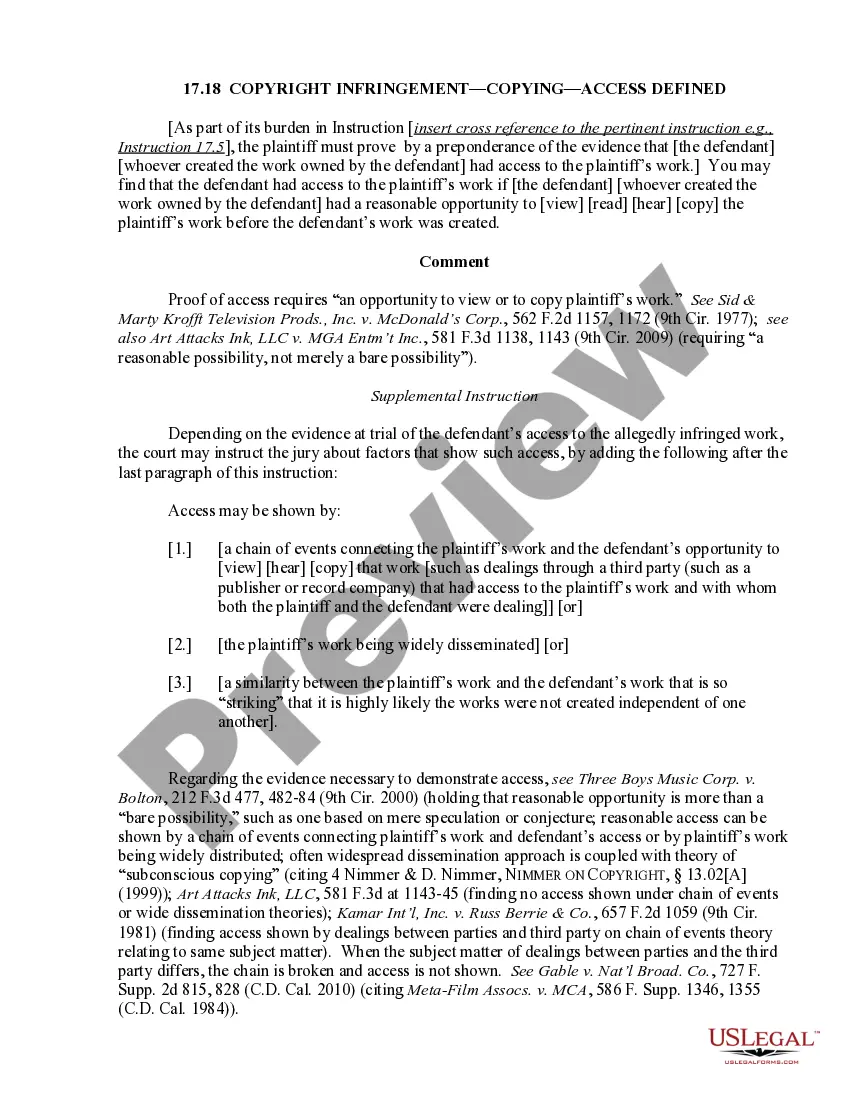
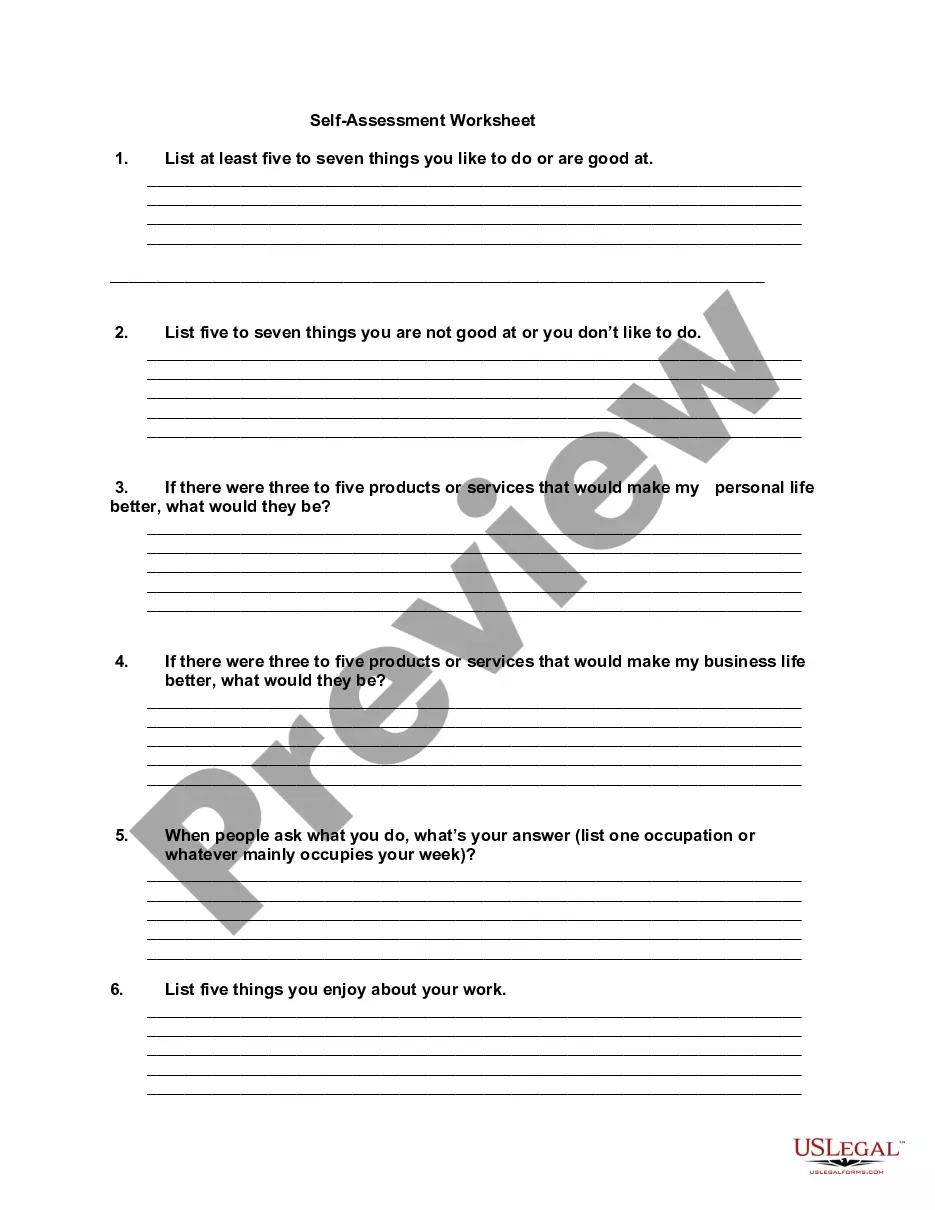
Louisiana Worksheet - Self-Assessment
Description


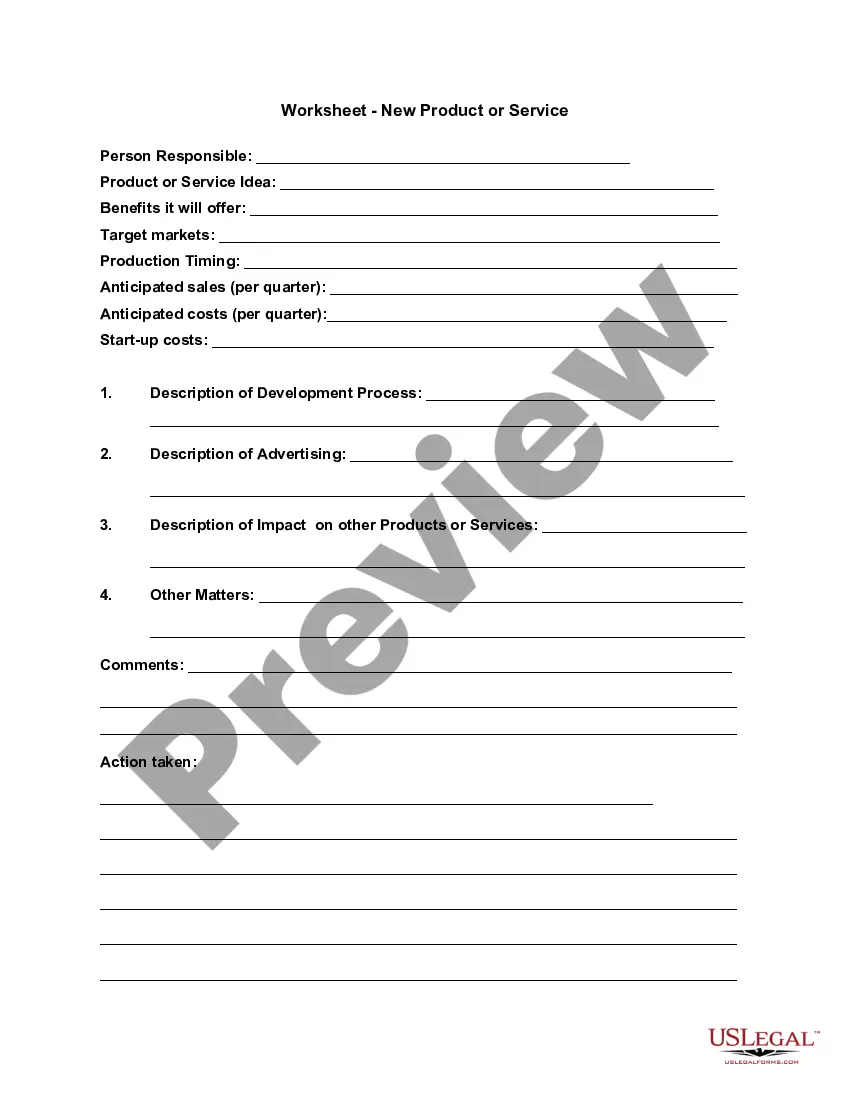
Get your form ready online
Our built-in tools help you complete, sign, share, and store your documents in one place.
Make edits, fill in missing information, and update formatting in US Legal Forms—just like you would in MS Word.
Download a copy, print it, send it by email, or mail it via USPS—whatever works best for your next step.
Sign and collect signatures with our SignNow integration. Send to multiple recipients, set reminders, and more. Go Premium to unlock E-Sign.
If this form requires notarization, complete it online through a secure video call—no need to meet a notary in person or wait for an appointment.
We protect your documents and personal data by following strict security and privacy standards.

Make edits, fill in missing information, and update formatting in US Legal Forms—just like you would in MS Word.

Download a copy, print it, send it by email, or mail it via USPS—whatever works best for your next step.

Sign and collect signatures with our SignNow integration. Send to multiple recipients, set reminders, and more. Go Premium to unlock E-Sign.

If this form requires notarization, complete it online through a secure video call—no need to meet a notary in person or wait for an appointment.

We protect your documents and personal data by following strict security and privacy standards.
Looking for another form?




How to fill out Worksheet - Self-Assessment?
US Legal Forms - one of the largest compilations of sanctioned documents in the United States - offers an extensive selection of authorized form templates that you can download or print.
On the platform, you can discover numerous forms for business and personal purposes, organized by classifications, states, or keywords. You can obtain the latest versions of documents like the Louisiana Worksheet - Self-Assessment within minutes.
If you already possess a monthly subscription, Log In and obtain the Louisiana Worksheet - Self-Assessment from the US Legal Forms library. The Download button will appear on each document you view. You can access all previously downloaded forms in the My documents section of your account.
Process the payment. Use your Visa or Mastercard or PayPal account to complete the transaction.
Select the format and download the form to your device. Make modifications. Complete, edit, print, and sign the downloaded Louisiana Worksheet - Self-Assessment. Each template you add to your account does not have an expiration date and is yours indefinitely. Therefore, if you wish to acquire or print another copy, simply go to the My documents section and click on the document you need. Access the Louisiana Worksheet - Self-Assessment with US Legal Forms, the most extensive collection of sanctioned document templates. Utilize an array of professional and state-specific templates that meet your business or personal requirements and standards.
- Ensure you have selected the correct document for your area/state.
- Click the Preview button to review the form`s details.
- Check the description of the form to confirm that you have chosen the right document.
- If the form does not meet your needs, use the Search field at the top of the screen to find the one that does.
- When you are content with the form, confirm your choice by clicking on the Purchase Now button.
- Then, choose the pricing plan you prefer and provide your details to sign up for an account.
Form popularity
FAQ
A good self-appraisal clearly outlines your contributions and how they align with organizational goals. It should detail specific examples of accomplishments and identify areas for improvement. Leveraging the Louisiana Worksheet - Self-Assessment can provide a comprehensive format that encourages clarity and depth in your appraisal, ensuring you present a balanced review.
The Nonresident and Part-year Resident Worksheet has been designed to more clearly identify that portion of Federal Adjusted Gross Income (AGI) that is Louisiana-sourced income. The worksheet has two columns, Federal and Louisiana.
Standard Deduction$12,550 for single filers. $12,550 for married couples filing separately. $18,800 for heads of households. $25,100 for married couples filing jointly.
The standard deduction amount for single or separate taxpayers will increase from $4,537 to $4,601 for tax year 2020. For married filing/Registered Domestic Partner (RDP) jointly, qualifying widower, or head of household taxpayers, the standard deduction increases from $9,074 to $9,202 for tax year 2020.
The term standard deduction refers to the portion of income not subject to tax that can be used to reduce your tax bill. The Internal Revenue Service (IRS) allows you to take the standard deduction if you do not itemize your deductions using Schedule A of Form 1040 to calculate taxable income.
Louisiana state income tax rate table for the 2020 - 2021 filing season has three income tax brackets with LA tax rates of 2%, 4% and 6% for Single, Married Filing Jointly, Married Filing Separately, and Head of Household statuses. The Louisiana tax rate and tax brackets are unchanged from last year.
To compute Louisiana tax, you need the Louisiana taxable income, the filing status, and total exemptions. The basic idea is to find the 250-dollar span in which the taxable income lies, take the midpoint of that span, and then separate the midpoint income into parts subject to 2%, 4%, and 6% tax.
State residents are also able to take deductions on their state income taxes. The standard deduction for Louisiana is $4,500 for single or married filing single taxpayers, and $9,000 for Married filing jointly, or head of household.
Louisiana has an individual income tax that both residents and non-residents with income earned in the state must pay each year. The tax rate varies from 2-6% based on the amount of income you make, minus all tax credits. Choosing to not pay your taxes can result in a tax evasion or tax fraud charge.
You can calculate the tax bracket you fall into by dividing your income that will be taxed into each applicable bracket. Each bracket has its own tax rate. The bracket you are in also depends on your filing status: if you're a single filer, married filing jointly, married filing separately or head of household.