Louisiana Motion and Order for Psychological Evaluation
What is this form?
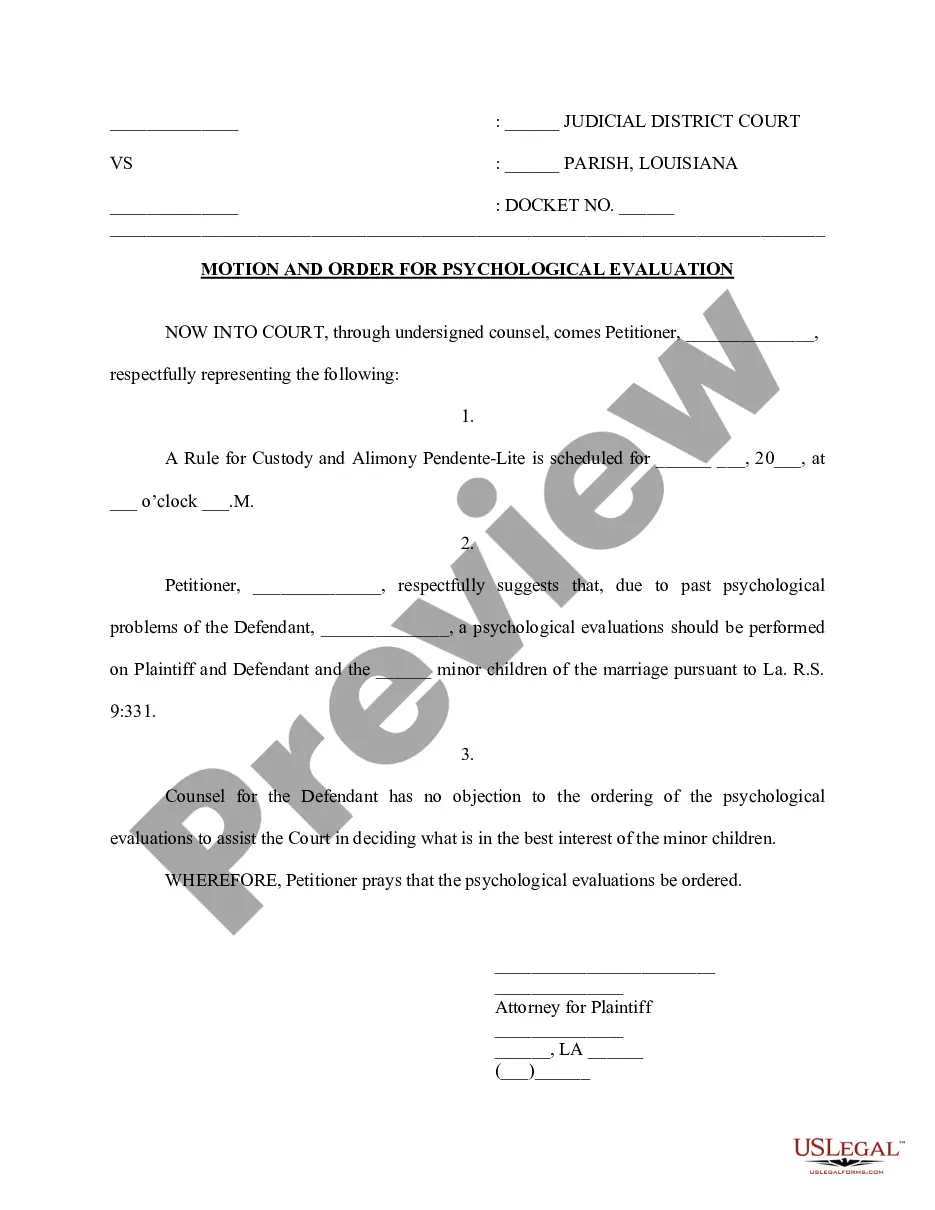
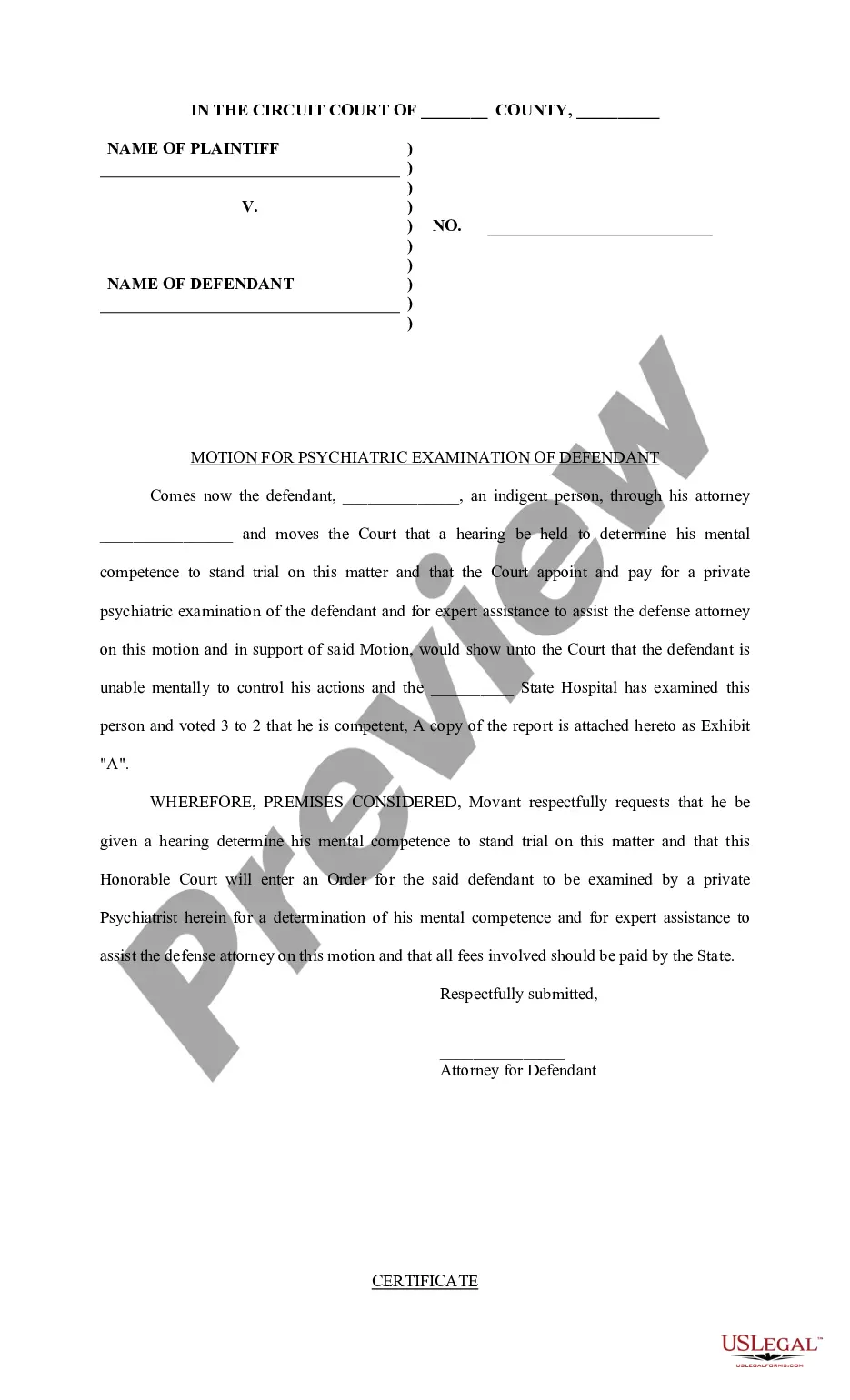
The Motion and Order for Psychological Evaluation is a legal document used in divorce proceedings. It allows a plaintiff to request psychological evaluations for themselves, their spouse, and any minor children involved. This particular motion references concerns regarding past psychological issues of the defendant and aims to assist the court in determining the best interests of the children. It is crucial to understand that this form serves a specific purpose within custody and alimony discussions, offering a structured approach compared to other legal documents related to family law.
Key components of this form
- Petitioner identification: Details of the person filing the motion.
- Scheduled court date: The date and time for the custody and alimony hearing.
- Request for evaluations: A statement requesting psychological evaluations for involved parties and children.
- Defense acknowledgment: Confirmation that the defendant does not object to the evaluations.
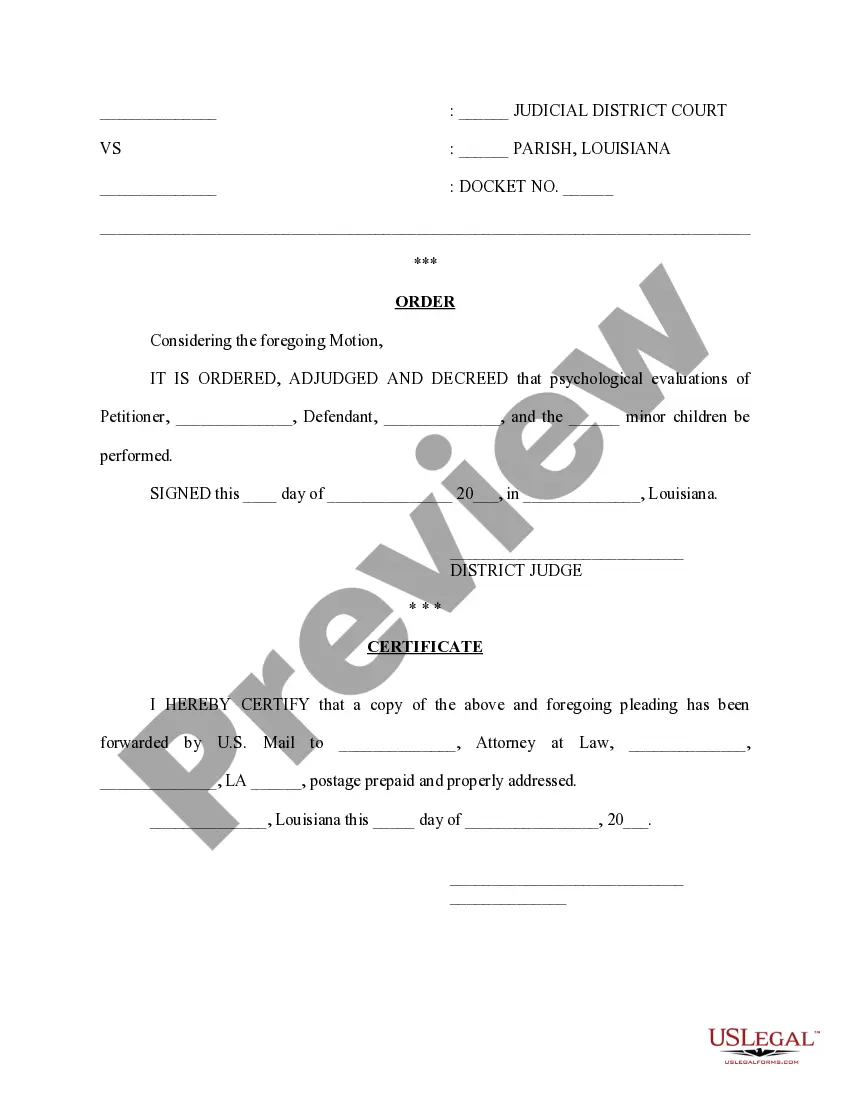
- Order section: A formal order by the court granting the requested evaluations.
When to use this form
This form should be used during divorce proceedings when there are concerns about a party's psychological state that may impact the welfare of minor children. It is particularly relevant when psychological evaluations are necessary to inform custody and alimony decisions. If there is a history of psychological issues that need to be addressed in court, this motion can help in obtaining a comprehensive understanding of how these issues may affect family dynamics.
Who this form is for
- Plaintiffs in divorce cases who have concerns about the psychological well-being of their spouse or children.
- Attorneys representing clients in custody disputes where psychological evaluations are warranted.
- Individuals looking to document psychological concerns related to child custody and support matters in legal proceedings.
Steps to complete this form
- Identify the petitioner: Enter the name of the individual filing the motion.
- Fill in the court details: Provide the parish and docket number associated with the case.
- Specify the court date and time: Indicate when the custody and alimony hearing is scheduled.
- Outline psychological concerns: Clearly state the reasons for requesting evaluations, including past psychological issues.
- Include defense acknowledgment: Note that the defendant agrees to the evaluations.
- Complete the order section: Sign and date the form as required by the court to finalize the motion.
Notarization guidance
Notarization is generally not required for this form. However, certain states or situations might demand it. You can complete notarization online through US Legal Forms, powered by Notarize, using a verified video call available anytime.
Get your form ready online
Our built-in tools help you complete, sign, share, and store your documents in one place.
Make edits, fill in missing information, and update formatting in US Legal Forms—just like you would in MS Word.
Download a copy, print it, send it by email, or mail it via USPS—whatever works best for your next step.
Sign and collect signatures with our SignNow integration. Send to multiple recipients, set reminders, and more. Go Premium to unlock E-Sign.
If this form requires notarization, complete it online through a secure video call—no need to meet a notary in person or wait for an appointment.
We protect your documents and personal data by following strict security and privacy standards.

Make edits, fill in missing information, and update formatting in US Legal Forms—just like you would in MS Word.

Download a copy, print it, send it by email, or mail it via USPS—whatever works best for your next step.

Sign and collect signatures with our SignNow integration. Send to multiple recipients, set reminders, and more. Go Premium to unlock E-Sign.

If this form requires notarization, complete it online through a secure video call—no need to meet a notary in person or wait for an appointment.

We protect your documents and personal data by following strict security and privacy standards.
Common mistakes
- Failing to provide accurate court details, which can lead to delays.
- Not obtaining the necessary signatures from all parties involved.
- Omitting specific details about the psychological issues, making the request unclear.
- Missing the court deadline for filing the motion.
Benefits of completing this form online
- Convenience: Access and complete the form from anywhere at any time.
- Editability: Easily fill in or update your information as necessary.
- Reliability: Ensure that the form is up to date and compliant with legal standards.
Legal use & context
- This form is enforceable in divorce proceedings related to custody and support.
- It allows the court to make informed decisions based on psychological assessments.
- Failure to file this motion when necessary may impact custody outcomes.
Key takeaways
- The Motion and Order for Psychological Evaluation is crucial in custody disputes.
- Understanding how to fill it out accurately can significantly affect court decisions.
- The form addresses psychological concerns that could impact child welfare.
Looking for another form?



Form popularity
FAQ
During the evaluation, you may be asked to complete blood work, a urine test, or a brain scan to rule out any physical conditions. You may also be asked to answer questions about drug and alcohol use to confirm your experience is not a side effect.
The judge must have proof of the parent's mental health issues, before it will even consider ordering a psychological evaluation. Before requesting the court to order a mental heath evaluation of your ex, you should consider that these evaluations are very expensive, and that they are rarely ordered.
Unless you challenge the evaluator - assuming that there is a legitimate, substantive basis to do so - the court will never know the problems with or deficiencies in the report and may rightfully assume that there are no problems or deficiencies. Thus, the burden is on the litigant to prove, argue and persuade.
Understanding Psychiatric Evaluations The initial evaluation will explore many aspects including developmental history, medical history, family history, social and environmental influences, academic/work concerns, and emotional and cognitive (thinking) strengths and weaknesses.
For example, in court-ordered evaluations, the court may be the identified client. In other circumstances, a referring state child protection agency or an attorney may be the identified client.