Louisiana Exhibit, Act of Collateral Mortgage
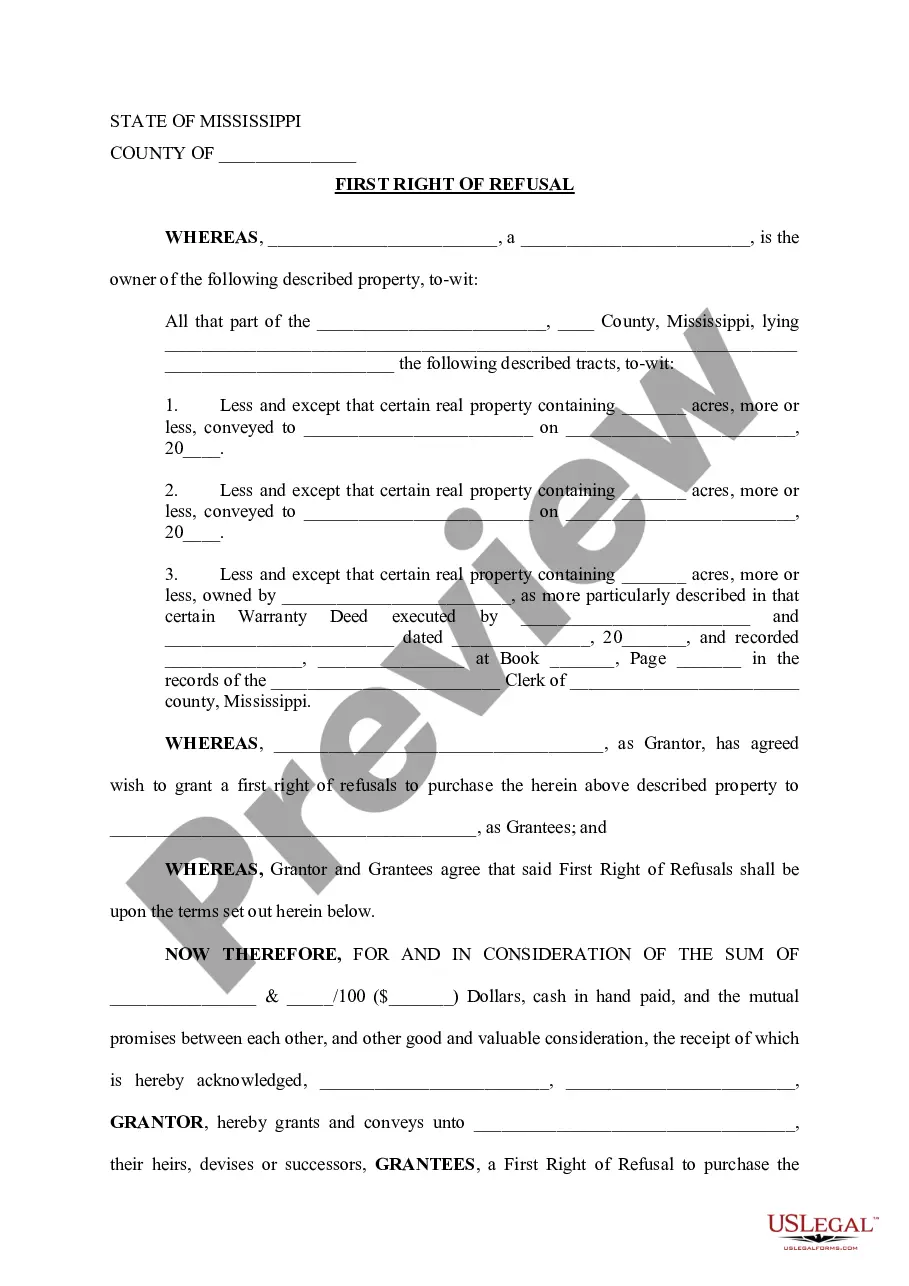
Understanding this form
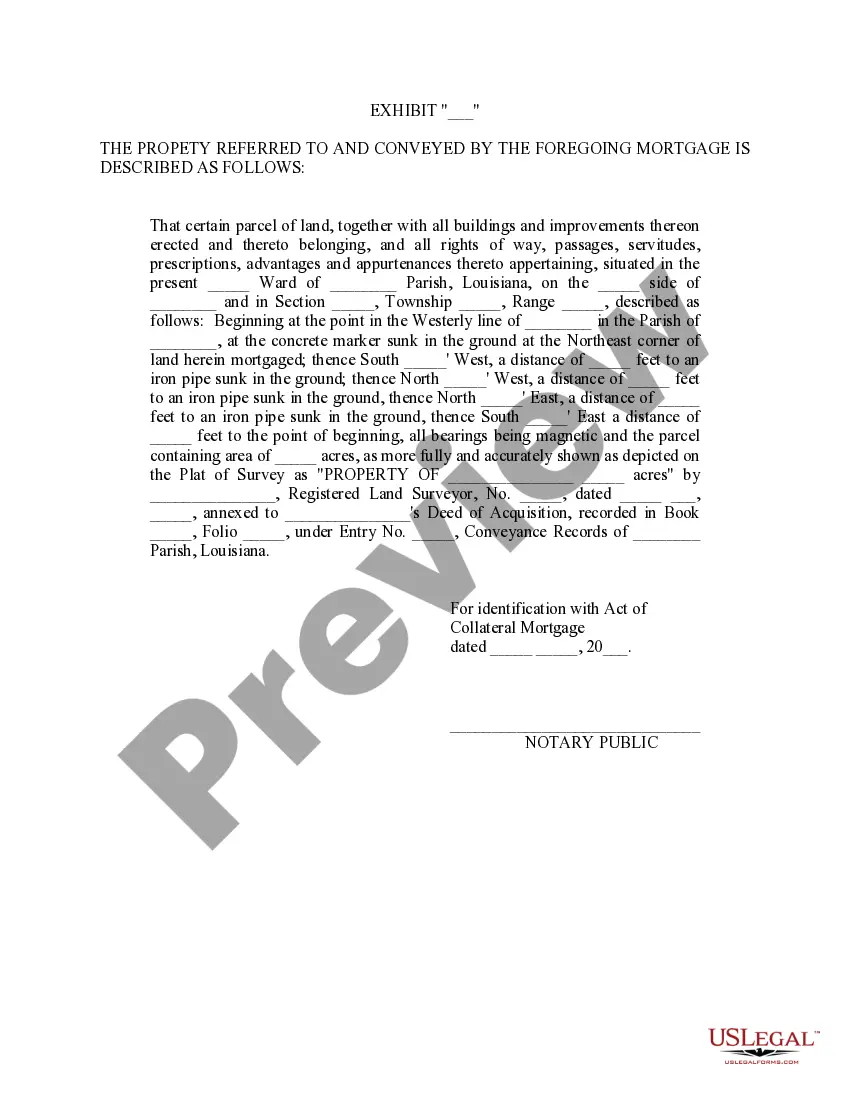
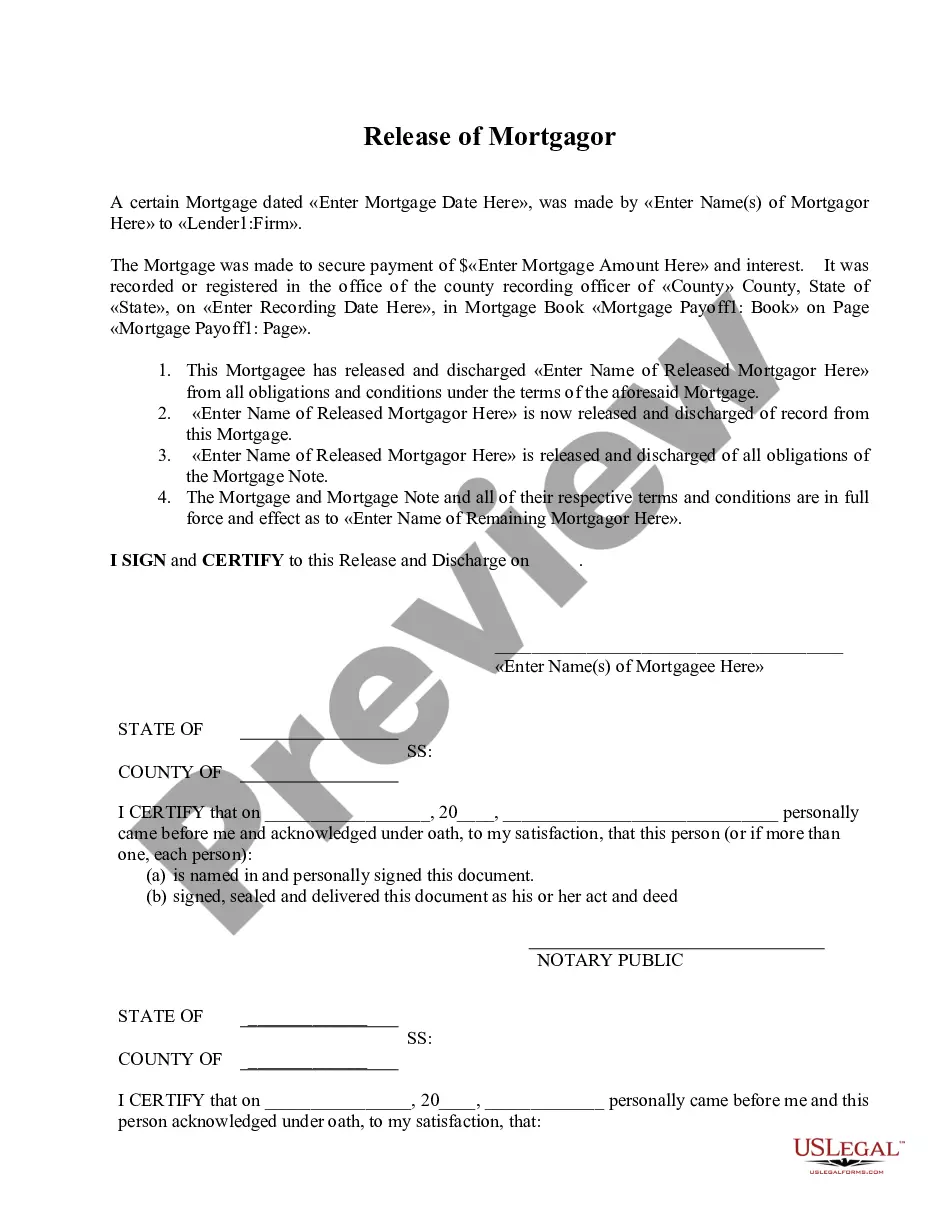
The Exhibit, Act of Collateral Mortgage is a legal document that details a specific piece of real estate meant to serve as an exhibit in a collateral mortgage agreement. This form is important as it provides a clear description of the property in question, which is essential for identification purposes. Unlike other real estate forms, this document includes a paraph by a notary public that authenticates the relationship between the property and the mortgage, ensuring legal clarity and security for both parties involved.
What’s included in this form
- Property description: Detailed description of the real estate parcel, including boundaries and landmarks.
- Identification with the mortgage act: Paraphing by a notary public to bind the note with the collateral mortgage.
- Survey information: References to the plat of survey by a registered land surveyor, including key dates and book entries.
- Signatures: Required signatures from the involved parties, including the notary to validate the document.
- Legal references: Citation of the Act of Collateral Mortgage for context and enforceability.

When this form is needed
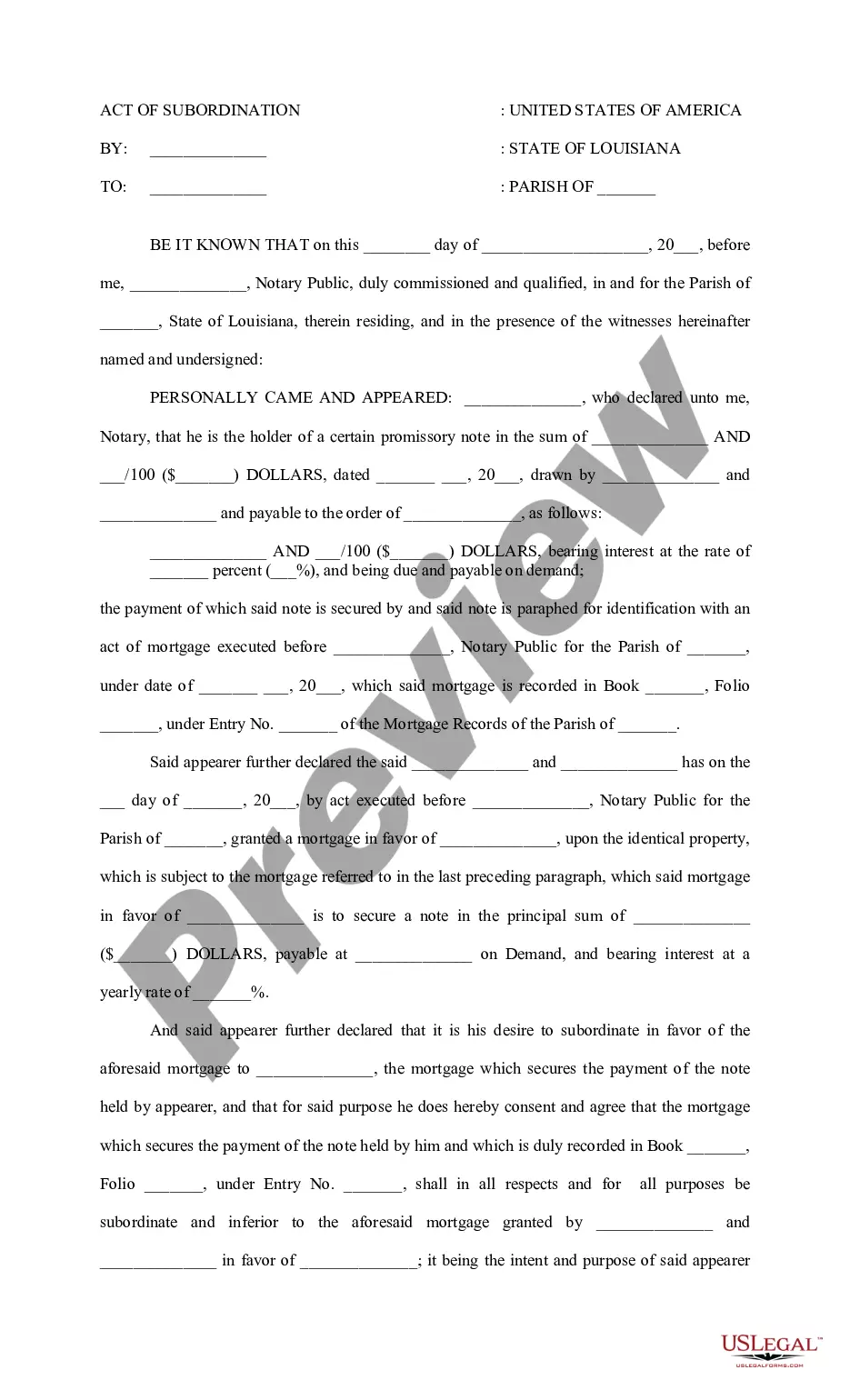
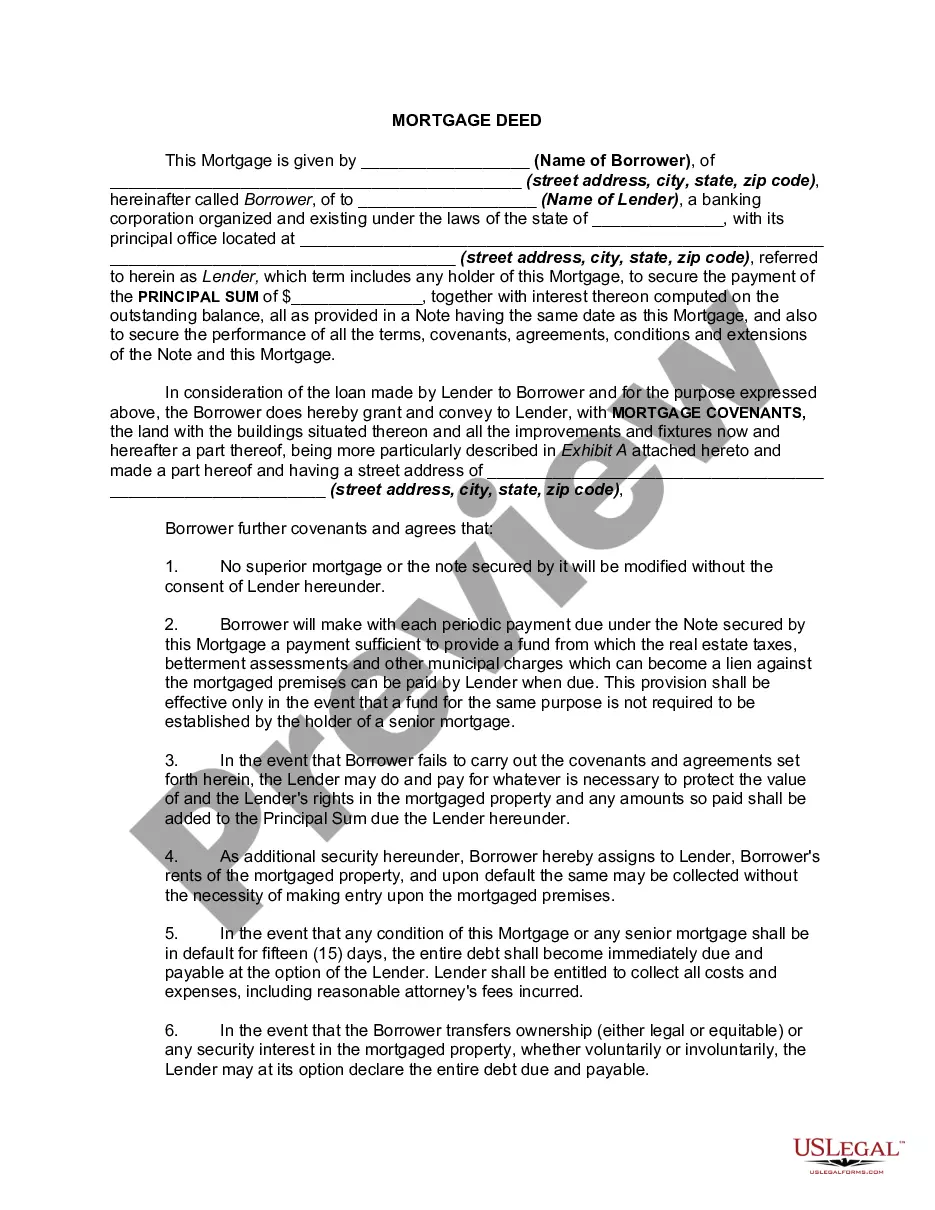
This form is needed when you are entering into a collateral mortgage agreement and need to provide a legal description of the property being used as collateral. It's particularly useful in securing loans where the property is required to guarantee repayment. If you are a lender or borrower in Louisiana, this form formalizes the connection between the mortgage note and the property, offering protection and clarity in financial transactions.
Who this form is for
- Individuals entering a collateral mortgage agreement.
- Real estate lenders seeking to secure a mortgage with a specific property.
- Notaries public involved in the verification of collateral mortgage documents.
- Legal professionals assisting clients in real estate financing matters.
Steps to complete this form
- Identify the property: Fill out the specific details about the real estate being mortgaged, including the location and survey information.
- Enter the mortgage act details: Provide the date of the Act of Collateral Mortgage to connect the exhibit properly.
- Include legal references: Make sure to note the book and folio numbers related to the property's acquisition for clarity.
- Acquire notary signature: Have a notary public sign the document to authenticate the connection between the property and the mortgage note.
- Review for completeness: Ensure all sections are filled out accurately and legibly before submitting.
Notarization guidance
This form must be notarized to be legally valid. US Legal Forms provides secure online notarization powered by Notarize, allowing you to complete the process through a verified video call.
Get your form ready online
Our built-in tools help you complete, sign, share, and store your documents in one place.
Make edits, fill in missing information, and update formatting in US Legal Forms—just like you would in MS Word.
Download a copy, print it, send it by email, or mail it via USPS—whatever works best for your next step.
Sign and collect signatures with our SignNow integration. Send to multiple recipients, set reminders, and more. Go Premium to unlock E-Sign.
If this form requires notarization, complete it online through a secure video call—no need to meet a notary in person or wait for an appointment.
We protect your documents and personal data by following strict security and privacy standards.

Make edits, fill in missing information, and update formatting in US Legal Forms—just like you would in MS Word.

Download a copy, print it, send it by email, or mail it via USPS—whatever works best for your next step.

Sign and collect signatures with our SignNow integration. Send to multiple recipients, set reminders, and more. Go Premium to unlock E-Sign.

If this form requires notarization, complete it online through a secure video call—no need to meet a notary in person or wait for an appointment.

We protect your documents and personal data by following strict security and privacy standards.
Avoid these common issues
- Failing to include all property details, which can lead to disputes or misidentification.
- Omitting the notary's signature, which is crucial for the document's validity.
- Not referencing the correct mortgage act, leading to confusion and potential legal issues.
- Using outdated survey information that does not reflect the current status of the property.
Why use this form online
- Convenience: Easily download the form and fill it out from the comfort of your home.
- Editability: Customize the template to fit specific needs and details of your property transaction.
- Reliability: Obtain a legally vetted form that adheres to state requirements, ensuring compliance.
What to keep in mind
- The Exhibit, Act of Collateral Mortgage is essential for securing real estate as collateral.
- Accurate information about the property and parties is critical for legal validity.
- Notarization is a necessary step in finalizing this form.
Looking for another form?
Form popularity
FAQ
Collateral documents include any documents granting a security interest in collateral by the borrower, parent or subsidiary in favor of the lender and all other documents required to be executed or delivered pursuant to those documents. Collateral documents do not include guaranties.
Collateral is a property or other asset that a borrower offers as a way for a lender to secure the loan. For a mortgage, the collateral is often the house purchased with the funds from the mortgage.For a loan to be considered secure, the value of the collateral must meet or exceed the amount remaining on loan.
Collateral mortgages are pushed heavily by the banks because they benefit the banks. Collateral mortgages tie you to your bank and block taking out other equity in your property; they also give the bank extra power to demand the full balance or begin foreclosure much more quickly.
When you take out a mortgage, your home becomes the collateral. If you take out a car loan, then the car is the collateral for the loan. The types of collateral that lenders commonly accept include carsonly if they are paid off in fullbank savings deposits, and investment accounts.
With a conventional charge, only the amount of the home loan is registered against the property.With a collateral charge, on the other hand, an amount higher than the home loan can be registered against the property.
A collateral mortgage is a readvanceable mortgage product, meaning that your lender can lend you more money as your property value increases without having to refinance your mortgage.
A collateral mortgage is a type of mortgage product that is re-advanceable, which means the lender can loan you more funds as the value of your home increases without the need to refinance your home loan.
According to Experian, in the most basic terms, collateral is an asset.In the event the borrower becomes incapable of making payments, the lender can seize the collateral to make up for their financial loss. A mortgage, on the other hand, is a loan specific to housing where the real estate is the collateral.