Louisiana Affidavit of Service of Process
About this form
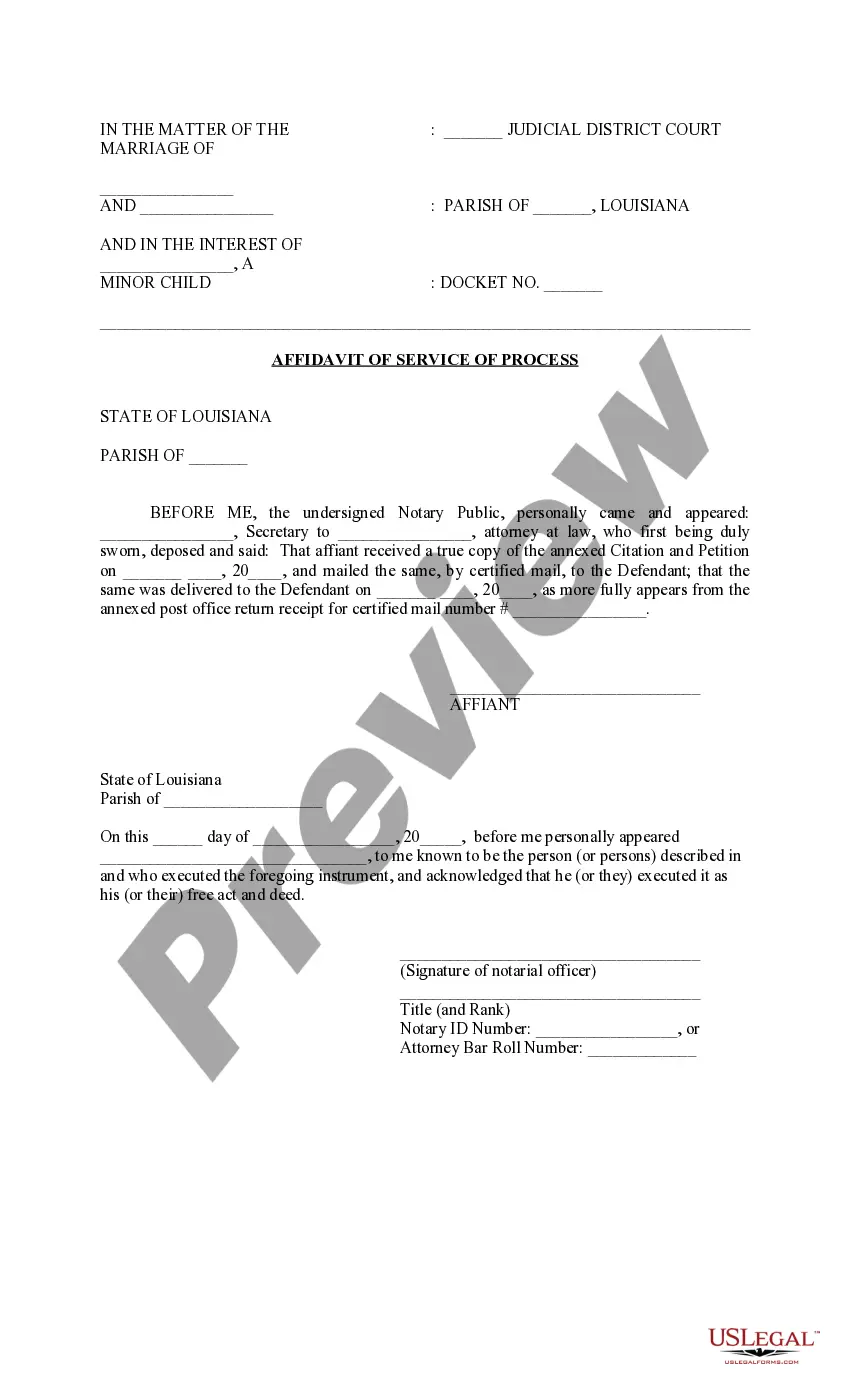
The Affidavit of Service of Process is a legal document used in divorce proceedings to confirm that essential documents have been served to the involved parties. This affidavit provides proof that the affiant has delivered the documents by certified mail and that a return receipt verifying delivery is attached. It is essential for establishing that the other party has received the legal notifications required, distinguishing it from similar forms that may not provide proof of service.
Main sections of this form
- Case title and docket number: Identifies the judicial case.
- Affiant's statement: Acknowledges the receipt and mailing of the documents.
- Delivery date: Indicates when the documents were provided to the defendant.
- Return receipt reference: Provides evidence of delivery via certified mail.
- Notary public signature: Validates the affidavit for legal purposes.

Situations where this form applies
This form should be used during divorce proceedings when one party needs to provide legal proof that the other party has been notified of court actions. It is crucial in situations where the delivery of important documents, such as divorce petitions and citations, needs to be verified to ensure proper legal due process.
Intended users of this form
- Individuals going through a divorce who need to serve court documents.
- Attorneys representing clients in divorce cases.
- Individuals or legal representatives requiring proof of service for court filings.
How to complete this form
- Fill in the case title and docket number at the top of the document.
- Provide the names of the parties involved in the divorce.
- Enter the delivery date when the documents were sent via certified mail.
- Attach the post office return receipt and reference its number on the affidavit.
- Have the affidavit signed in front of a notary public for validation.
Does this form need to be notarized?
Notarization is required for this form to take effect. Our online notarization service, powered by Notarize, lets you verify and sign documents remotely through an encrypted video session, available 24/7.
Get your form ready online
Our built-in tools help you complete, sign, share, and store your documents in one place.
Make edits, fill in missing information, and update formatting in US Legal Forms—just like you would in MS Word.
Download a copy, print it, send it by email, or mail it via USPS—whatever works best for your next step.
Sign and collect signatures with our SignNow integration. Send to multiple recipients, set reminders, and more. Go Premium to unlock E-Sign.
If this form requires notarization, complete it online through a secure video call—no need to meet a notary in person or wait for an appointment.
We protect your documents and personal data by following strict security and privacy standards.

Make edits, fill in missing information, and update formatting in US Legal Forms—just like you would in MS Word.

Download a copy, print it, send it by email, or mail it via USPS—whatever works best for your next step.

Sign and collect signatures with our SignNow integration. Send to multiple recipients, set reminders, and more. Go Premium to unlock E-Sign.

If this form requires notarization, complete it online through a secure video call—no need to meet a notary in person or wait for an appointment.

We protect your documents and personal data by following strict security and privacy standards.
Common mistakes to avoid
- Failing to attach the post office return receipt as proof of delivery.
- Not providing complete names or accurate case details on the form.
- Neglecting to have the affidavit notarized, which may invalidate the document.
Why use this form online
- Easy access to download and complete the form at your convenience.
- Editable templates allowing you to fill in necessary information accurately.
- Reliability of documents drafted by licensed attorneys ensures legal compliance.
Key takeaways
- The Affidavit of Service of Process is essential for verifying the delivery of divorce-related documents.
- Proper completion and notarization of the form are crucial for legal validity.
- Using this form ensures compliance with Louisiana's specific legal requirements for service of process in divorce cases.
Looking for another form?
Form popularity
FAQ
To serve a petition in Louisiana, you must deliver a copy of the petition to the person being sued, adhering to state law guidelines. Typically, this can be done through a sheriff, a private process server, or sometimes by certified mail. It's important to complete a Louisiana Affidavit of Service of Process after delivery, as it serves as proof of proper service in legal proceedings.
A Simple Answer to "What Happens if a Process Server Can't Serve You?" The simple answer to your question is that the court continues without you. Evidence is brought forth without a rebuttal or defense from you and a judgment is issued.
Generally, a process server can come to your house as many times as they want. They will usually make three attempts, in the morning, afternoon and evening respectively, typically on different days of the week to maximize their chances of reaching you.
Service of process is the procedure by which a party to a lawsuit gives an appropriate notice of initial legal action to another party (such as a defendant), court, or administrative body in an effort to exercise jurisdiction over that person so as to enable that person to respond to the proceeding before the court,
A legal process server delivers (serves) court documents to the defendant or individual listed on the legal document being served.Once a process server delivers the documents, an Affidavit of Service, also called a Proof of Service, is notarized and given to the party who requested the service.
No Limit on Service Attempts In theory, there is no restriction to the number of times a process server can attempt to serve a defendant or a witness. When a court issues a summons or a subpoena, a document commonly is known as a "Return of Service" is typically attached.
For standard serves, the typical time to serve papers is 5-7 days. Turn-around-time (or TAT) can vary from process server to process server. However, this is something that can be determined in most cases by you, which usually leads to a higher cost.
Definition. Agreement by the defendant (or the defendant's attorney) to accept papers or a complaint without having the papers served by a process server or a sheriff. Acceptance of service is accomplished by signing a "receipt and acknowledgment of acceptance of service" (or similarly titled instrument).
There are a number of methods of service of process, the most common of which are personal service and mail service.
Generally, process servers make at least three attempts to serve somebody. These attempts are normally made at different times of day and on different days to maximize our chance of serving the papers.