Kentucky Insulation Contractor Package
Understanding this form package
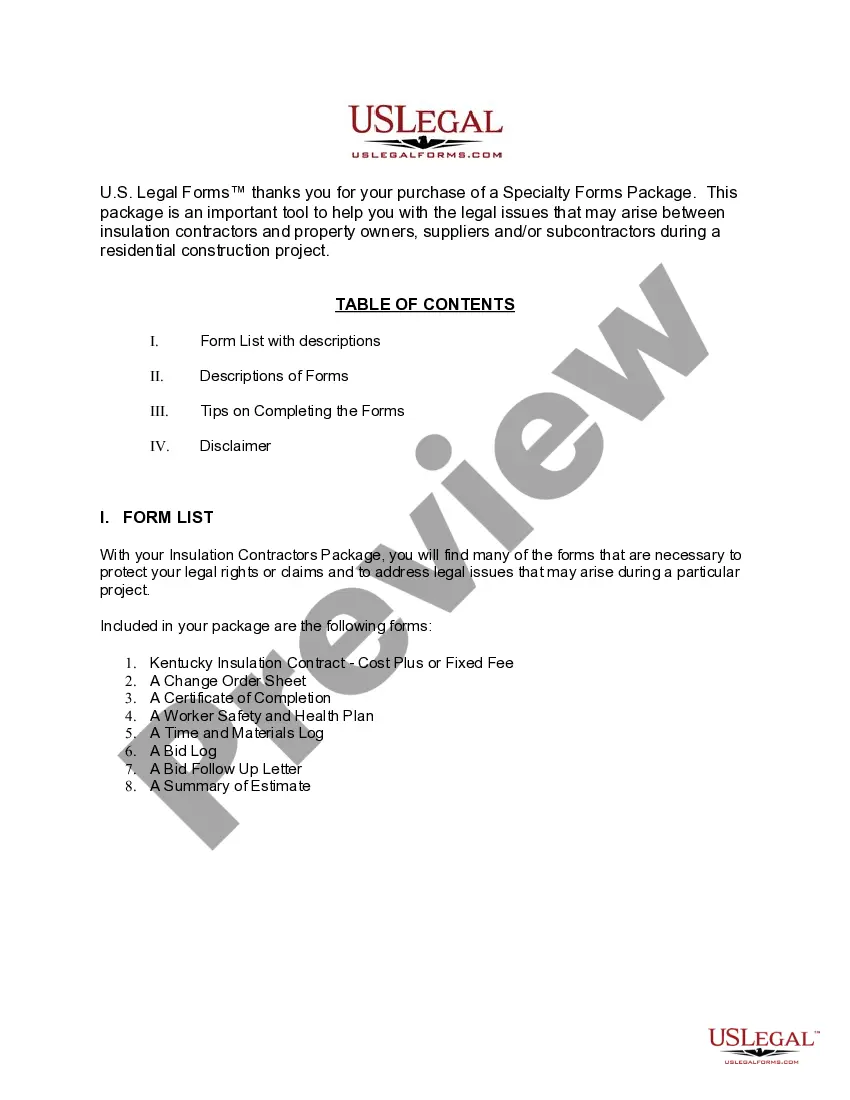
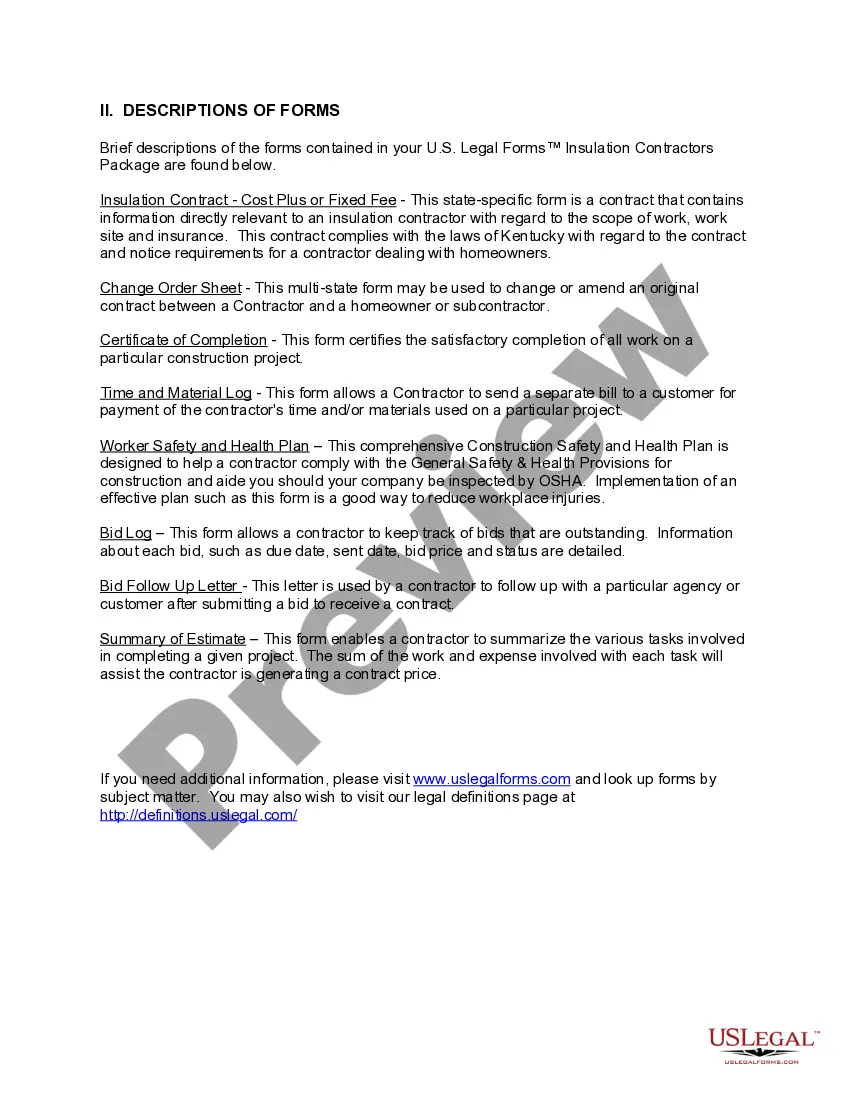
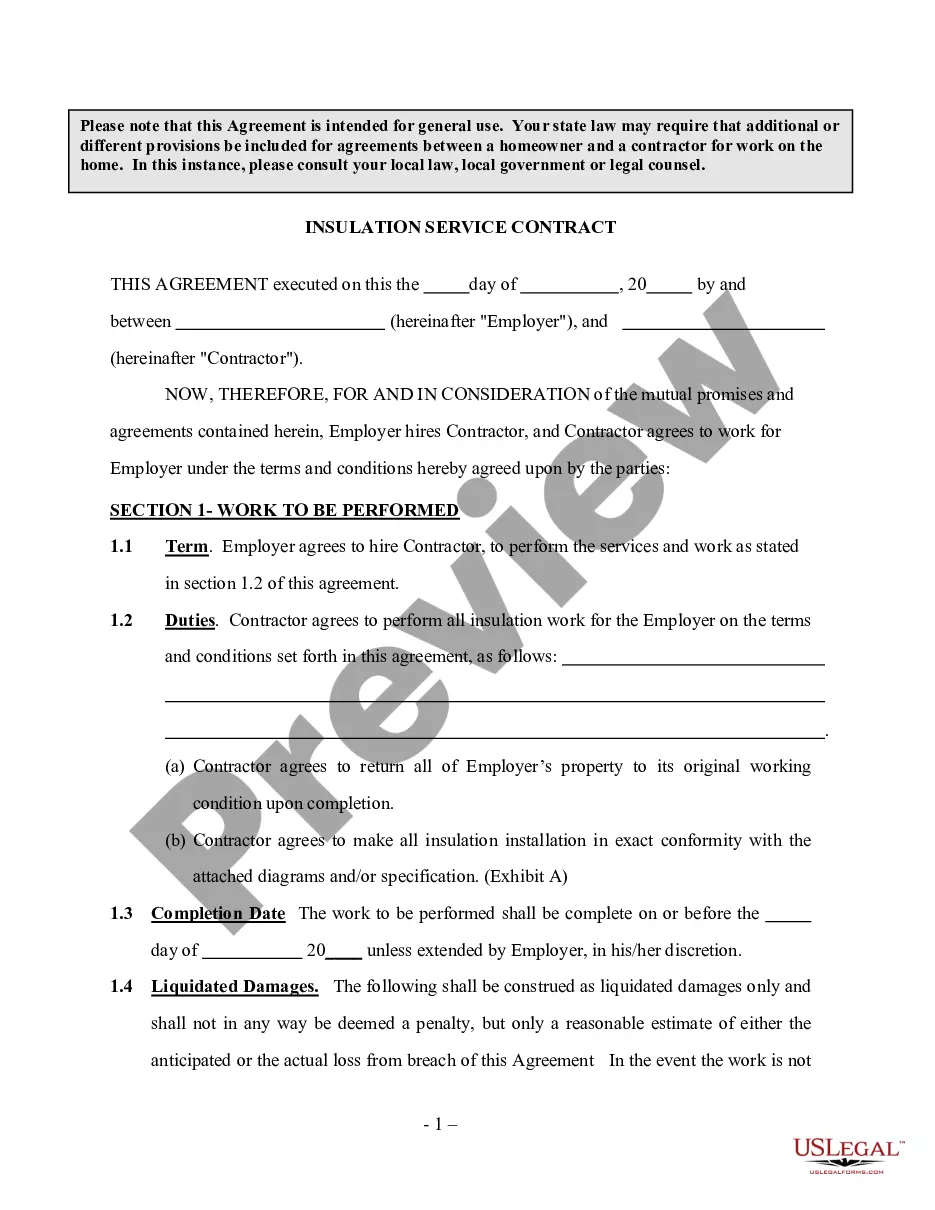
The Kentucky Insulation Contractor Package is a comprehensive collection of legal documents designed specifically for insulation contractors, owners, suppliers, and subcontractors. This package includes essential forms to protect legal rights and manage important aspects of projects related to installing insulation materials in residential properties. The primary document in this package, the insulation contract, is meticulously crafted to comply with Kentucky state law, ensuring it meets all necessary legal standards while streamlining the contracting process.
Documents contained in this package

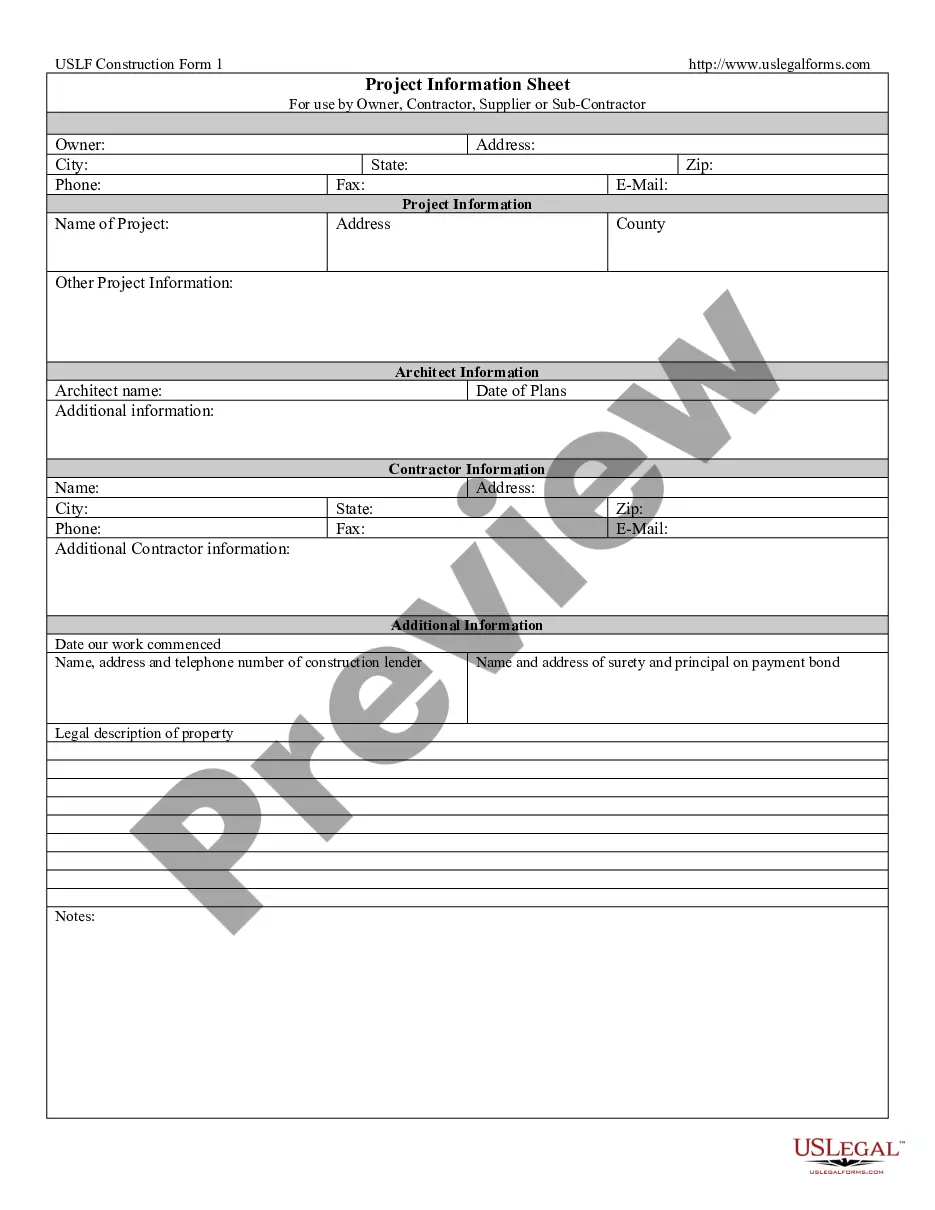
Situations where these forms applies
This form package is useful in several scenarios, including:
- When a contractor is beginning a new insulation project and needs a formal contract.
- If there are changes to be made during a project that require a change order.
- To document the completion of work for billing and certification purposes.
- When tracking bids and estimates for insulation work is necessary.
- To ensure compliance with health and safety regulations on job sites.
Who this form package is for
- Insulation contractors working on residential properties.
- Homeowners employing contractors for insulation installation.
- Suppliers of insulation materials involved in contractual agreements.
- Subcontractors specializing in insulation or related services.
How to prepare this document
- Review included forms to understand their purposes and requirements.
- Identify the parties involved in the contract and enter their details accurately.
- Fill in the specific terms and conditions related to the insulation work being performed.
- Enter dates and obtain necessary signatures from all parties before proceeding.
- Keep copies of each completed form for your records and for future reference.
Do forms in this package need to be notarized?
Forms in this package usually don’t need notarization, but certain jurisdictions or signing circumstances may require it. US Legal Forms provides a secure online notarization option powered by Notarize, accessible 24/7 from anywhere.
Get your form ready online
Our built-in tools help you complete, sign, share, and store your documents in one place.
Make edits, fill in missing information, and update formatting in US Legal Forms—just like you would in MS Word.
Download a copy, print it, send it by email, or mail it via USPS—whatever works best for your next step.
Sign and collect signatures with our SignNow integration. Send to multiple recipients, set reminders, and more. Go Premium to unlock E-Sign.
If this form requires notarization, complete it online through a secure video call—no need to meet a notary in person or wait for an appointment.
We protect your documents and personal data by following strict security and privacy standards.

Make edits, fill in missing information, and update formatting in US Legal Forms—just like you would in MS Word.

Download a copy, print it, send it by email, or mail it via USPS—whatever works best for your next step.

Sign and collect signatures with our SignNow integration. Send to multiple recipients, set reminders, and more. Go Premium to unlock E-Sign.

If this form requires notarization, complete it online through a secure video call—no need to meet a notary in person or wait for an appointment.

We protect your documents and personal data by following strict security and privacy standards.
Mistakes to watch out for
- Forgetting to read and understand the entire contract before signing.
- Failing to update or properly document changes on the Change Order Sheet.
- Not including all relevant party information or dates on the forms.
- Neglecting to keep thorough records of communications regarding bids and contracts.
Advantages of online completion
- Convenient access to all necessary forms in one package.
- Editability allows for customization to fit your specific project needs.
- Instant download means you can start working on your project immediately.
- Reliability and compliance with state law ensure legal protection.
Legal use & context
- All forms included are designed to be legally binding when properly completed and signed.
- They provide a structured way to manage transactions between contractors and clients.
- Usage of these forms can help mitigate disputes by clearly outlining terms and responsibilities.
Quick recap
- The Kentucky Insulation Contractor Package includes essential forms tailored for insulation-related projects.
- Properly completing these forms protects legal rights and facilitates clear communication.
- Ensure compliance with Kentucky law by using this well-drafted and comprehensive form package.
Looking for another form?



Form popularity
FAQ
EPS and mineral wool have similar K-values, whereas PIR is significantly better. Insulation can be added to the wall cavity in two ways. One option is to partially fill the gap, leaving at least 50mm clear. Kingspan has developed a product (K108) that reduces the retained gap to 10mm.
Best Attic Insulation for New Homes: Cellulose, Fiberglass, or Spray Foam. Attic insulation is important if you want to keep your hard-earned money from pouring out of your roof, attic insulation is a must. The best roof insulation options for an attic are open cell spray foam, fiberglass, and cellulose.
The parts of the home to insulate take these basic facts into consideration. Heat rises to the ceiling. Because a large volume of indoor heat is lost through the ceiling, the attic floor above is considered the most important area in the house to insulate for winter comfort and efficiency.
The effectiveness of insulation is rated by R-values. The higher the R-value, the greater the material's ability to insulate. Each inch of fiberglass blanket insulation, for example, provides an R-value of about 3.27. Loose-fill insulation can vary from about 2.2 to 4.0, depending on how effectively it is installed.
Aerogel is more expensive, but definitely the best type of insulation. Fiberglass is cheap, but requires careful handling. Mineral wool is effective, but not fire resistant. Cellulose is fire resistant, eco-friendly, and effective, but hard to apply.
Are you a licensed installer? Can I speak with your references? What warranty or guarantee do you provide for your insulation? What personal protective equipment do you require for your workers? Do you carry liability insurance and workers comp insurance? What type of insulation products do you offer?
For new construction, a homeowner has many choices in the type of insulation. For sheathing, rigid foam insulation is a good choice. For the interior side of those exterior walls, batt insulation is good. With walls, a better choice than fiberglass batts is wet sprayed cellulose or blown-in fiberglass.
Cellulose is the oldest insulation material used for not only the attic but other areas of the home as well. Fiberglass is another traditional insulation material that consists of extremely fine glass fibers.
Cost: The average cost per square foot is between $0.64 - $1.19. So, for a 500 square foot area, your estimate will vary between $145 to $200, if you do it yourself. For a professional job, add between $150 to $300 for labor, and you're looking at around $300 to $500 for 6 hours of work.