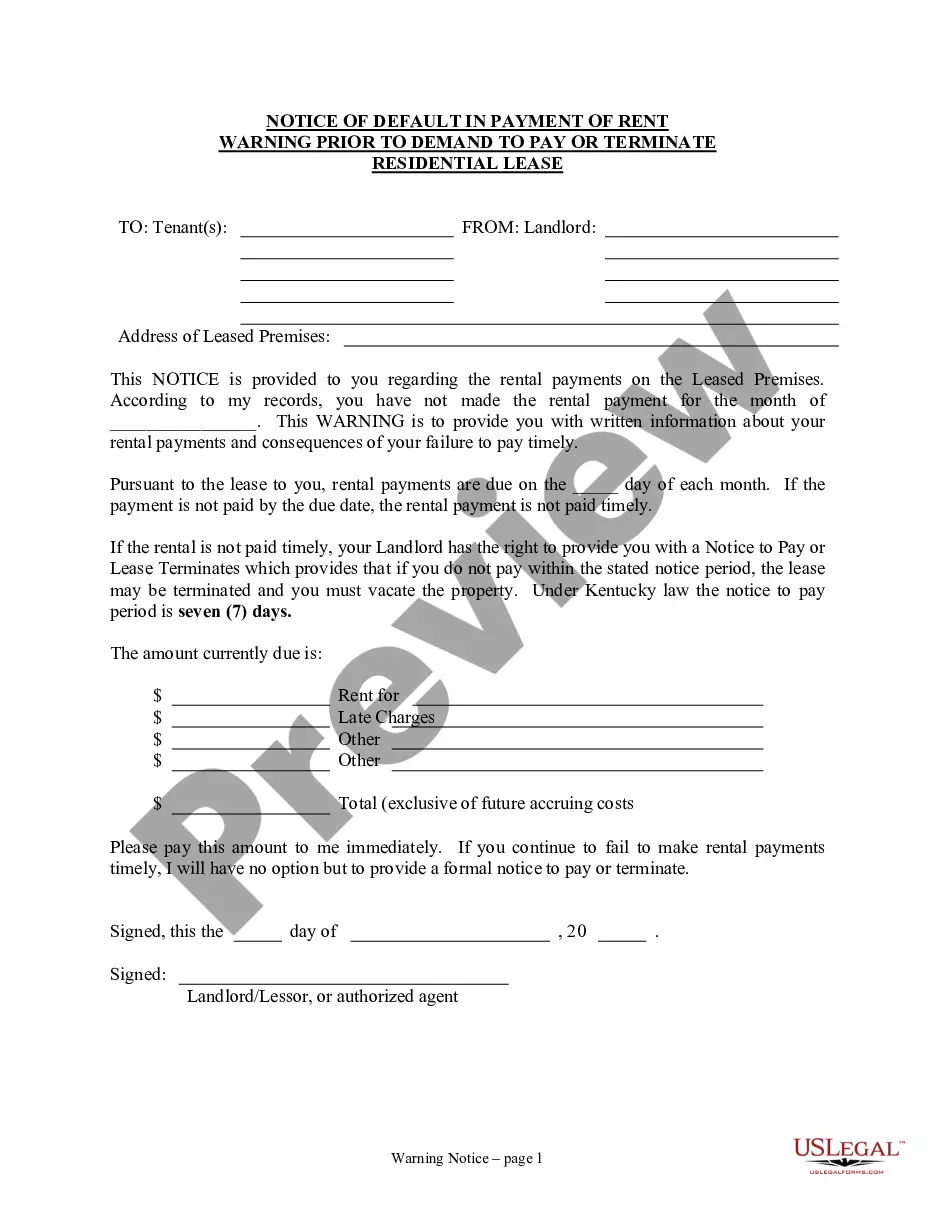
This Notice of Default in Payment of Rent as Warning Prior to Demand to Pay or Terminate for Non-Residential or Commercial Property form is for use by a Landlord to inform Tenant of Tenant's default in the payment of rent as a warning prior to a pay or terminate notice. The form advises the Tenant of the due date of rent and the consequences of late payment. This form may be used where you desire to remind the Tenant of payment terms, the default, demand payment and inform the Tenant that under the laws of this state or lease the Landlord may terminate in rent is not paid timely.
Kentucky Notice of Default in Payment of Rent as Warning Prior to Demand to Pay or Terminate for Residential Property
State:
Kentucky
Control #:
KY-1300LT
Format:
Word;
Rich Text
Instant download
Description
Free preview




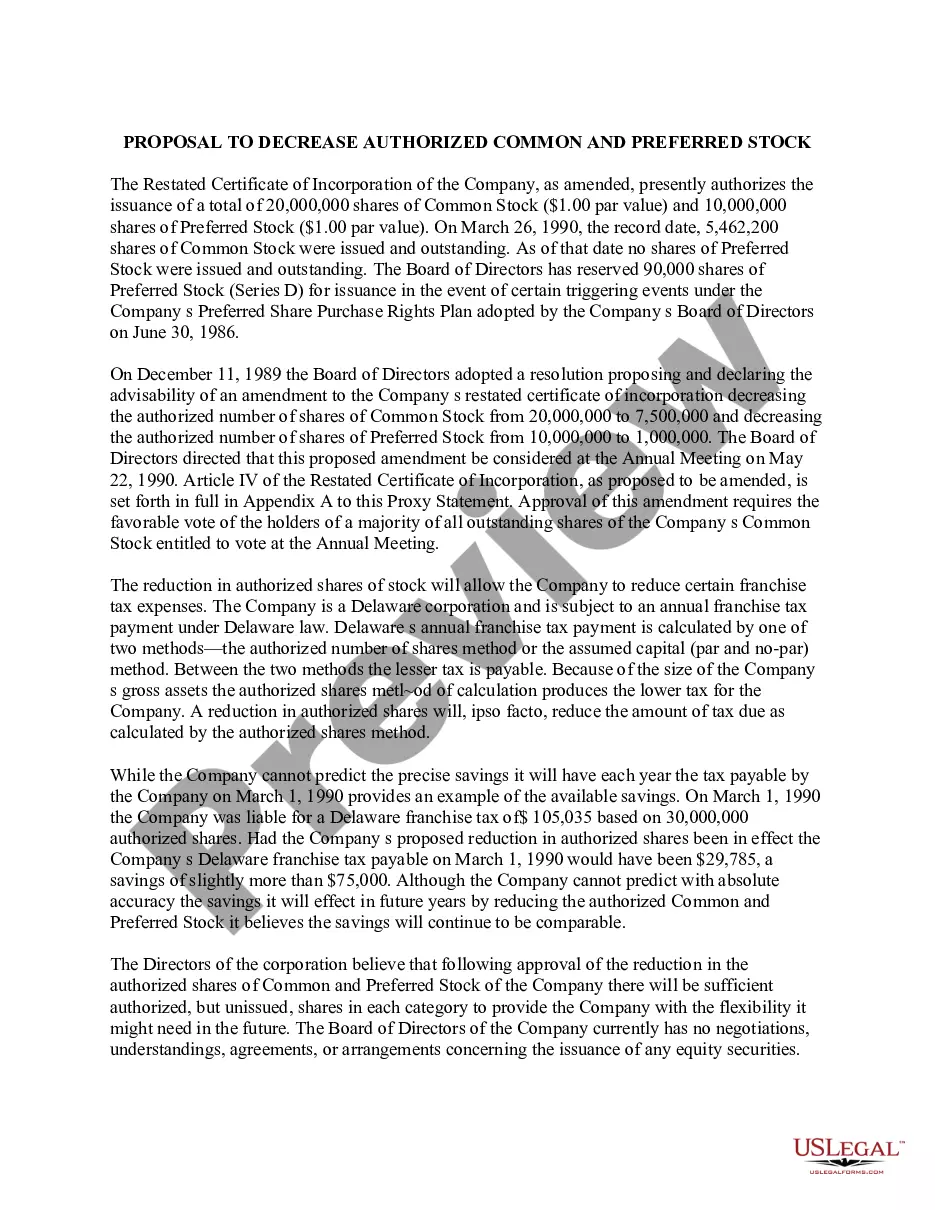

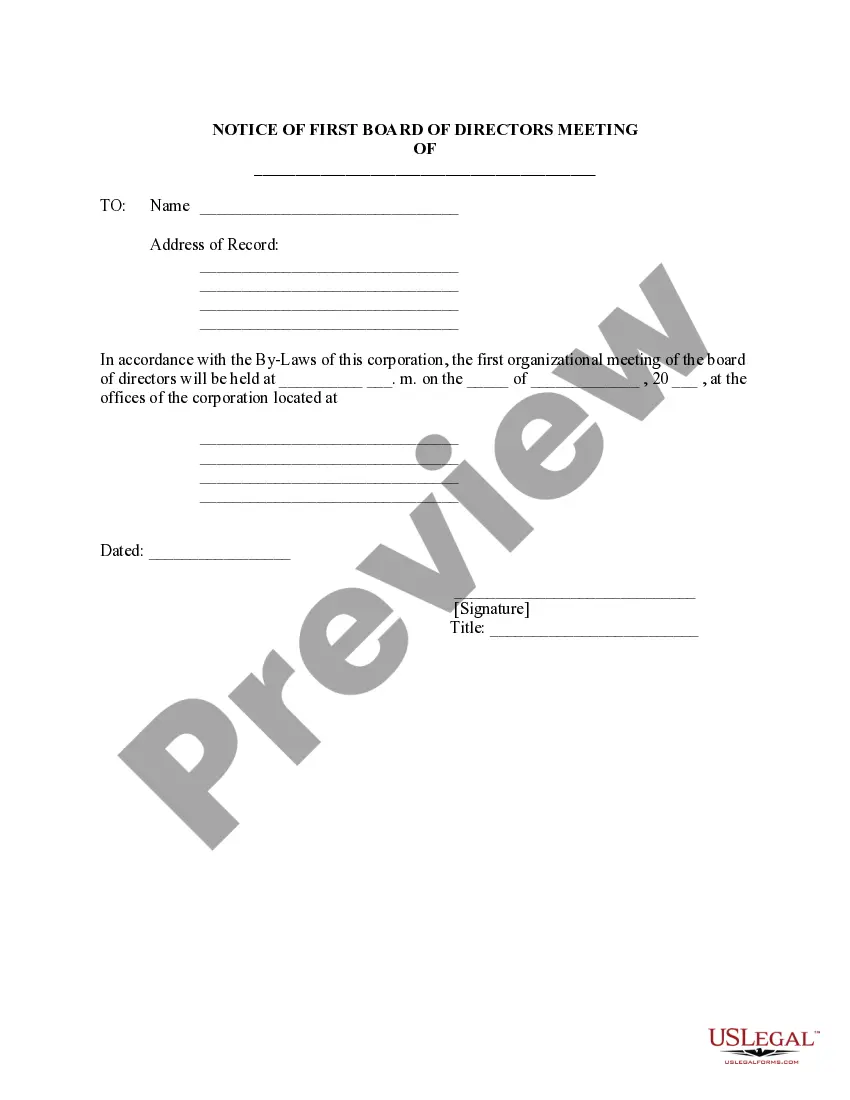
How to fill out Kentucky Notice Of Default In Payment Of Rent As Warning Prior To Demand To Pay Or Terminate For Residential Property?
Locating Kentucky Notice of Default in Rent Payment as a Notice Before Request to Pay or Cancel for Residential Property documents and completing them can be challenging.
To conserve time, expenses, and effort, utilize US Legal Forms to quickly find the correct template specifically for your state in just a few clicks.
Our legal experts prepare each document, allowing you to simply fill them in. It's truly that straightforward.
Select your payment option on the pricing page and create your account. Choose whether you want to pay by credit card or PayPal. Download the document in your preferred format. You can now print the Kentucky Notice of Default in Rent Payment as a Notice Before Request to Pay or Cancel for Residential Property template or complete it with any online editor. Don't worry about making errors since your template can be used and sent, and printed as many times as needed. Explore US Legal Forms and gain access to over 85,000 state-specific legal and tax documents.
- Log in to your account and revisit the form's page to download the template.
- All your saved templates are stored in My documents and are accessible anytime for future use.
- If you haven't yet registered, you need to create an account.
- Review our comprehensive instructions on how to obtain your Kentucky Notice of Default in Rent Payment as a Notice Before Request to Pay or Cancel for Residential Property sample in a matter of minutes.
- Check the example for its suitability to your state.
- View the sample using the Preview feature (if it’s offered).
- If a description is available, read it to grasp the key details.
- Click Buy Now if you found what you're looking for.
Form popularity
FAQ
The 383.595 statute in Kentucky outlines the requirements and processes related to the Kentucky Notice of Default in Payment of Rent as Warning Prior to Demand to Pay or Terminate for Residential Property. This statute specifies how landlords must provide notice to tenants who have failed to pay rent. It ensures fairness by giving tenants a clear warning before further legal action is taken. Understanding this statute is crucial for landlords to execute the eviction process properly and legally.
To file an eviction notice in Kentucky, you must begin by preparing a Kentucky Notice of Default in Payment of Rent as Warning Prior to Demand to Pay or Terminate for Residential Property. This notice serves as a formal indication to the tenant that they have not met their rent obligations. You should deliver this notice to your tenant, ensuring they receive it either personally or via certified mail. If the tenant remains non-compliant, you can proceed to file an eviction lawsuit in your local court.
In Kentucky, a tenant typically must be at least five days behind in rent before the landlord can issue a Kentucky Notice of Default in Payment of Rent as Warning Prior to Demand to Pay or Terminate for Residential Property. This notice serves as an official warning before any legal action for eviction can begin. It is crucial for landlords to follow this process correctly, as failing to provide proper notice might affect their ability to proceed with eviction. If you need help navigating these complexities, consider using uslegalforms, which offers resources to ensure compliance with Kentucky laws.
In Kentucky, landlords cannot engage in self-help evictions, such as changing locks or shutting off utilities. They must go through legal procedures, which start with the Kentucky Notice of Default in Payment of Rent as Warning Prior to Demand to Pay or Terminate for Residential Property. Additionally, landlords cannot retaliate against tenants who exercise their legal rights, so it’s vital to know your protections under the law. If you encounter such issues, consider reaching out for legal assistance.
As mentioned, Kentucky landlords usually must give at least 7 days' notice for nonpayment of rent. If the lease terms outline issues such as lease violations, the notice can extend to 14 or 30 days, depending on the situation. Being aware of these regulations will help you navigate the rental process with clarity. Always refer to your lease agreement for specific terms as well.
In Kentucky, a landlord must provide at least 7 days’ notice to a tenant for nonpayment of rent, primarily utilizing the Kentucky Notice of Default in Payment of Rent as Warning Prior to Demand to Pay or Terminate for Residential Property. For other lease violations, the notice period may vary, often requiring 14 or 30 days. Understanding these timelines ensures tenants are well-informed of their responsibilities.
The time it takes to evict a tenant in Kentucky typically ranges from several weeks to a few months. After the landlord files an eviction suit, a hearing is scheduled, which may take additional time. If the court rules in favor of the landlord, they receive a judgment that allows them to proceed with the eviction. Being aware of the timeline can help you prepare and respond appropriately.
In Kentucky, a tenant may withhold rent under specific circumstances, such as when the rental property is uninhabitable or has significant safety violations. It’s essential to notify your landlord in writing and document any issues, as this is part of the legal process. Keep in mind that withholding rent should be your last resort. Always consider consulting with legal resources to protect your rights if you think about this course of action.
In Kentucky, a landlord cannot evict you without a court order. They must follow the proper legal process, which includes providing a Kentucky Notice of Default in Payment of Rent as Warning Prior to Demand to Pay or Terminate for Residential Property. This notification serves as a formal warning and is necessary before any eviction proceedings can begin. Be sure to understand your rights as a tenant to ensure you receive fair treatment.
Arrears of a lease refer to the total amount of unpaid rent that a tenant owes to a landlord. Accumulating arrears can lead to formal notices and potential eviction proceedings if not addressed in a timely manner. It is advisable to act quickly if you receive a Kentucky Notice of Default in Payment of Rent as Warning Prior to Demand to Pay or Terminate for Residential Property, as it outlines the necessity of resolving any outstanding payments.