Kansas Self-Proving Affidavit
What is this form?
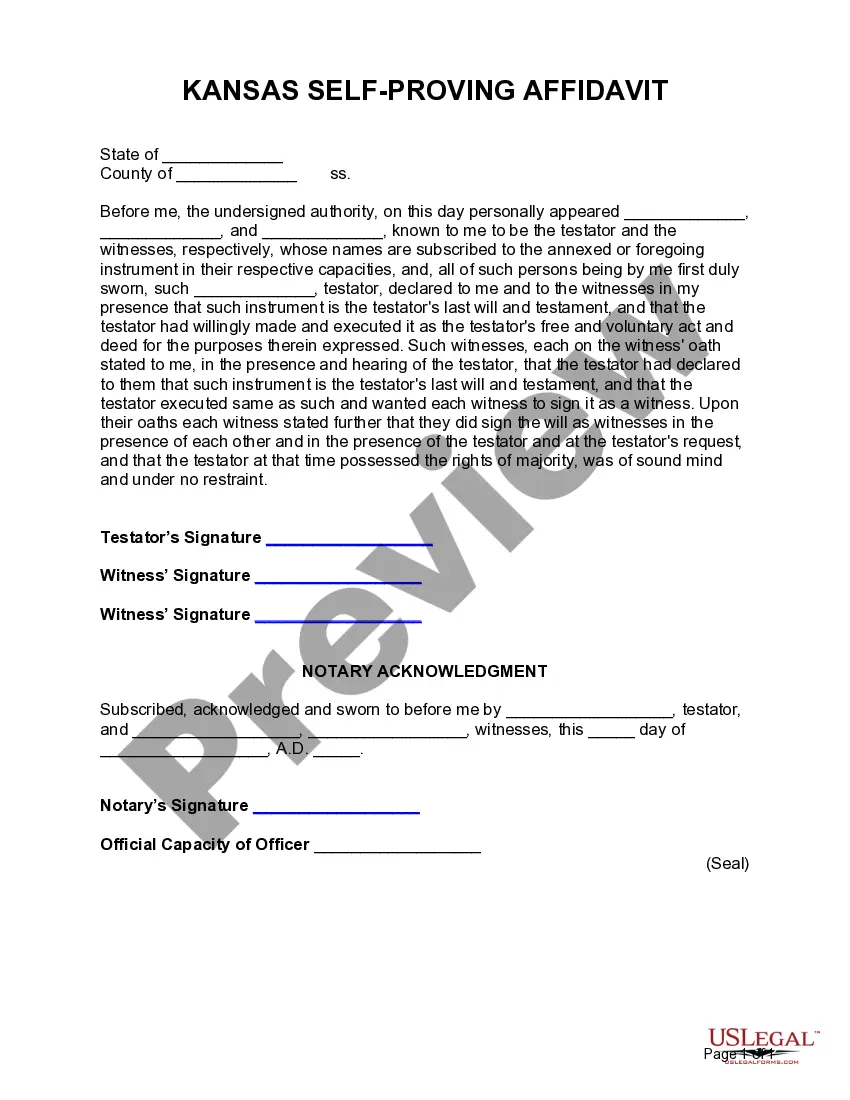
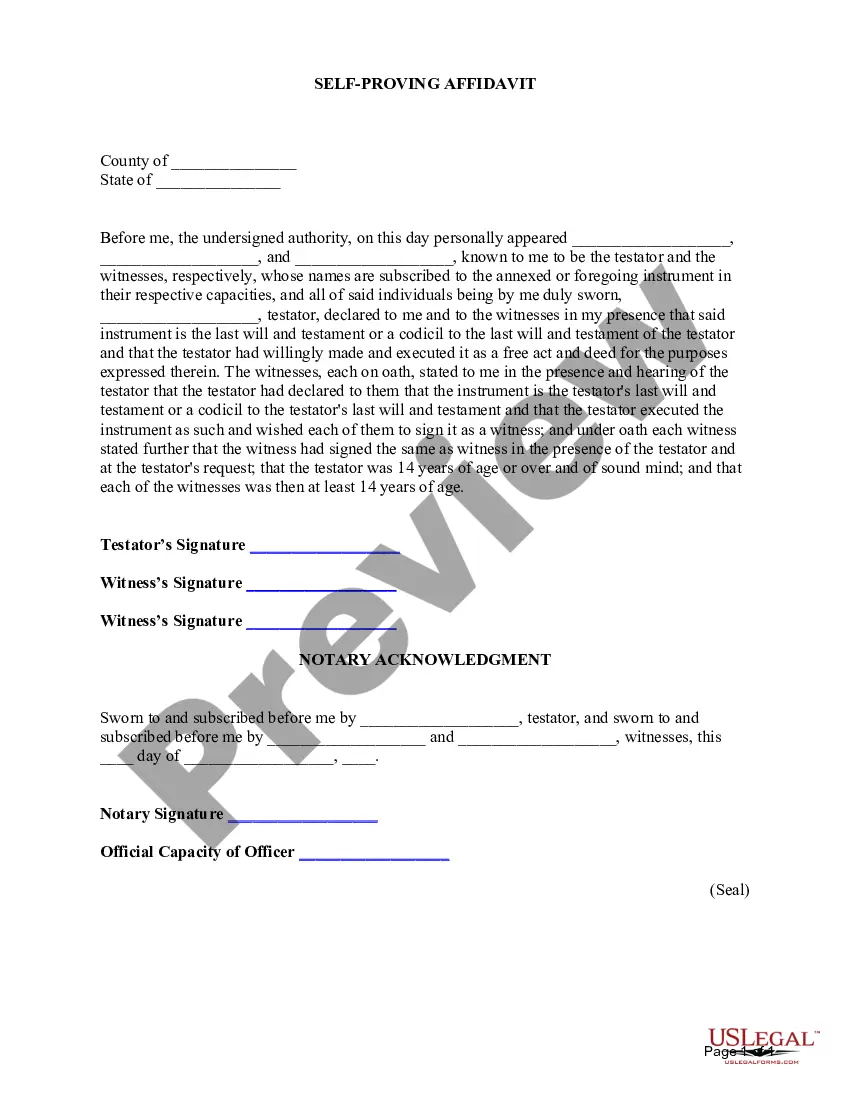
The Kansas Self-Proving Affidavit is a legal document that serves as a sworn statement attached to a will. It is signed by the testator (the person making the will) and the witnesses. This affidavit attests to the validity of the will, confirming that the testator executed the document voluntarily and was of sound mind at the time. By using this form, you streamline the probate process, ensuring that your will is accepted without the need for additional witness testimony in court.
Key components of this form
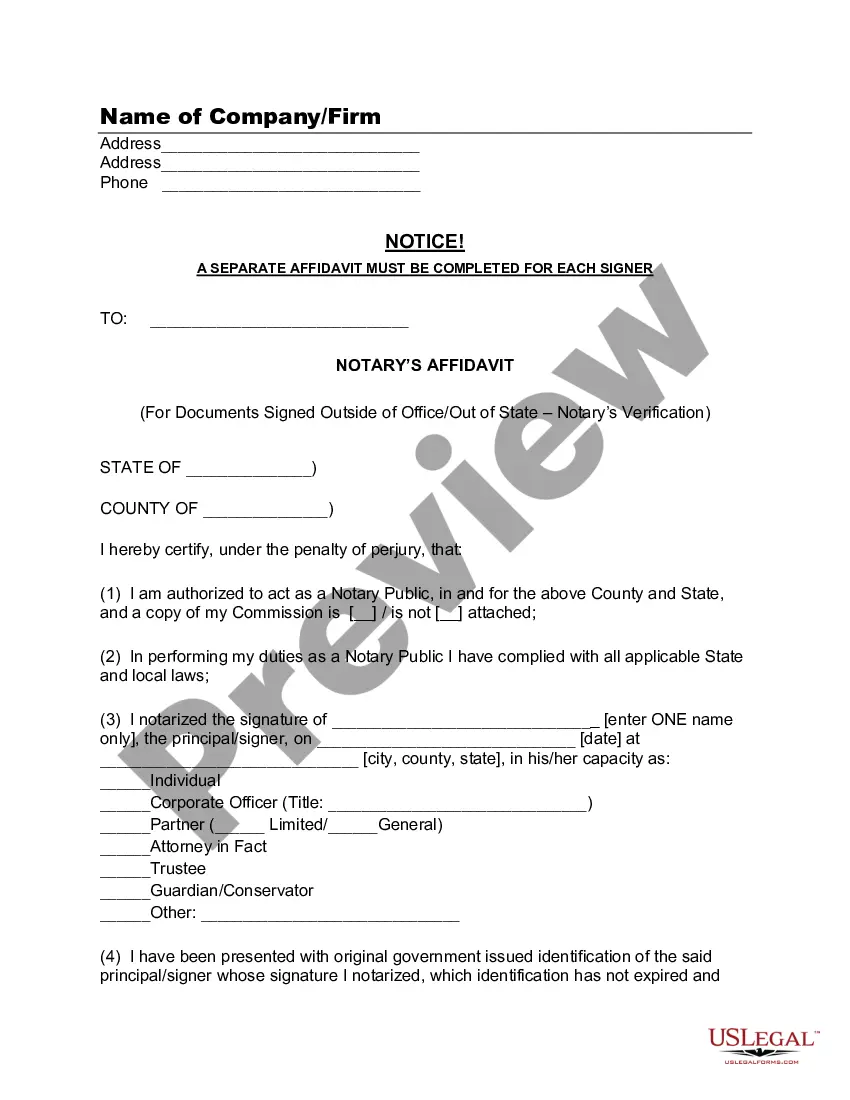
- Testator's declaration: The will-maker declares the document as their last will and testament.
- Witness statements: The witnesses affirm the testator's declaration and their signing of the document without coercion.
- Notary acknowledgment: A notary public certifies the identities of the testator and witnesses and acknowledges their signatures.
- Signatures section: Designated spaces for the testator and witnesses to provide their signatures.

When to use this form
You should use the Kansas Self-Proving Affidavit when you are preparing a will and want to simplify its probate process. It's particularly useful if you believe there may be disputes about the validity of your will after your passing. Including this affidavit protects your intentions and helps your heirs avoid complications in validating the will.
Intended users of this form
- Individuals preparing a will in Kansas.
- Testators who wish to affirm the validity of their will ahead of time.
- Those who have witnesses available to sign the affidavit with them.
- People looking to avoid potential disputes concerning the validity of their estate plans.
Instructions for completing this form
- Fill in your name as the testator in the designated area.
- Have two witnesses sign the document, as they will need to affirm your declaration.
- Ensure all parties are present when the affidavit is signed.
- Identify the notary public who will witness the signing and obtain their signature and seal.
- Keep a copy of the completed affidavit with your will for legal purposes.
Notarization requirements for this form
Yes, this form must be notarized to be legally valid. Notarization confirms the identities of the testator and witnesses, adding an additional level of authenticity to the will. US Legal Forms offers integrated online notarization, providing 24/7 availability, secure video calls, and legally equivalent services without requiring travel.
Get your form ready online
Our built-in tools help you complete, sign, share, and store your documents in one place.
Make edits, fill in missing information, and update formatting in US Legal Forms—just like you would in MS Word.
Download a copy, print it, send it by email, or mail it via USPS—whatever works best for your next step.
Sign and collect signatures with our SignNow integration. Send to multiple recipients, set reminders, and more. Go Premium to unlock E-Sign.
If this form requires notarization, complete it online through a secure video call—no need to meet a notary in person or wait for an appointment.
We protect your documents and personal data by following strict security and privacy standards.

Make edits, fill in missing information, and update formatting in US Legal Forms—just like you would in MS Word.

Download a copy, print it, send it by email, or mail it via USPS—whatever works best for your next step.

Sign and collect signatures with our SignNow integration. Send to multiple recipients, set reminders, and more. Go Premium to unlock E-Sign.

If this form requires notarization, complete it online through a secure video call—no need to meet a notary in person or wait for an appointment.

We protect your documents and personal data by following strict security and privacy standards.
Common mistakes to avoid
- Not having two witnesses present during the signing.
- Failing to have the affidavit notarized.
- Leaving signatures or dates blank.
- Signing without understanding the content of the will and affidavit.
Why use this form online
- Convenience of immediate download to complete at your own pace.
- Editability allows for customization based on your specific needs.
- Access to reliable, attorney-drafted templates to ensure compliance with legal standards.
Main things to remember
- The Kansas Self-Proving Affidavit simplifies the probate process by confirming the validity of a will.
- It requires signatures from the testator, two witnesses, and a notary public.
- Using this form proactively can help prevent disputes about the will's validity.
Looking for another form?

Form popularity
FAQ
What is a Self-Proving Affidavit? A self-proving affidavit is a sworn statement that witnesses and the person making a Will (the testator) sign in front of a notary public. It constitutes presumptive evidence that the testator signed the Will in ance with state laws.
If there are assets to be distributed under the will, the family must file the will for probate with the Court. This involves hiring an attorney to provide the proper paperwork and instruction in the process. The Executor appointed in the will (usually a family member) must take action to keep the assets safe.
In Kansas, a will must be filed within six months of the decedent's death. An estate may be eligible for a simplified probate process; factors the court considers in such a decision may include the following: Size of the estate. Degree of kinship of the heirs.
No, in Kansas, you do not need to notarize your will to make it legal. However, Kansas allows you to make your will "self-proving" and you'll need to go to a notary if you want to do that. A self-proving will speeds up probate because the court can accept the will without contacting the witnesses who signed it.
A valid will in Kansas must be: In writing. Signed at the end by the person making the will (testator) or by someone else in the presence of and at the express direction of the testator. Signed by two or more competent witnesses who saw the testator sign the will or heard him or her acknowledge the will.
Probate proceedings are usually only required if the deceased person owned any assets in their name only. Other assets, also known as non-probate property, can generally be transferred to the other owner without probate. Kansas has not adopted the Uniform Probate Code.
Anyone at least 18 years of age or emancipated by marriage, the court, or another manner and who is of sound mind can create a will. The person who creates a will is called the ?testator.? A valid will in Kansas must be: In writing.
In Kansas, unless you make a will, the courts may decide what happens to your assets. You lose control of the process and assets may end up going to unintended heirs. To ensure that you maintain control over your assets after death and can make adequate provisions for loved ones, you need to create a Will.