Kansas Lien Statement for Subcontractor by Corporation or LLC
What is this form?
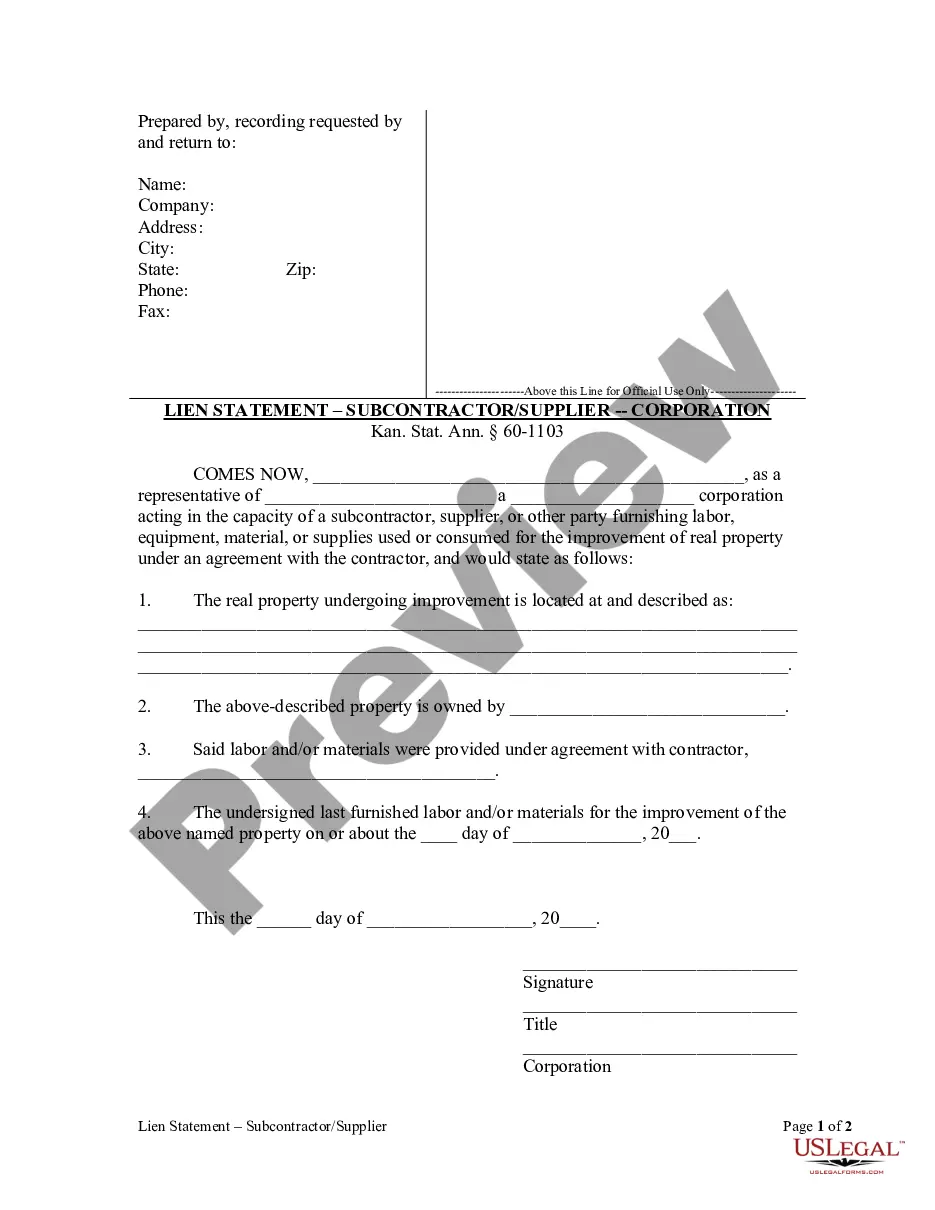
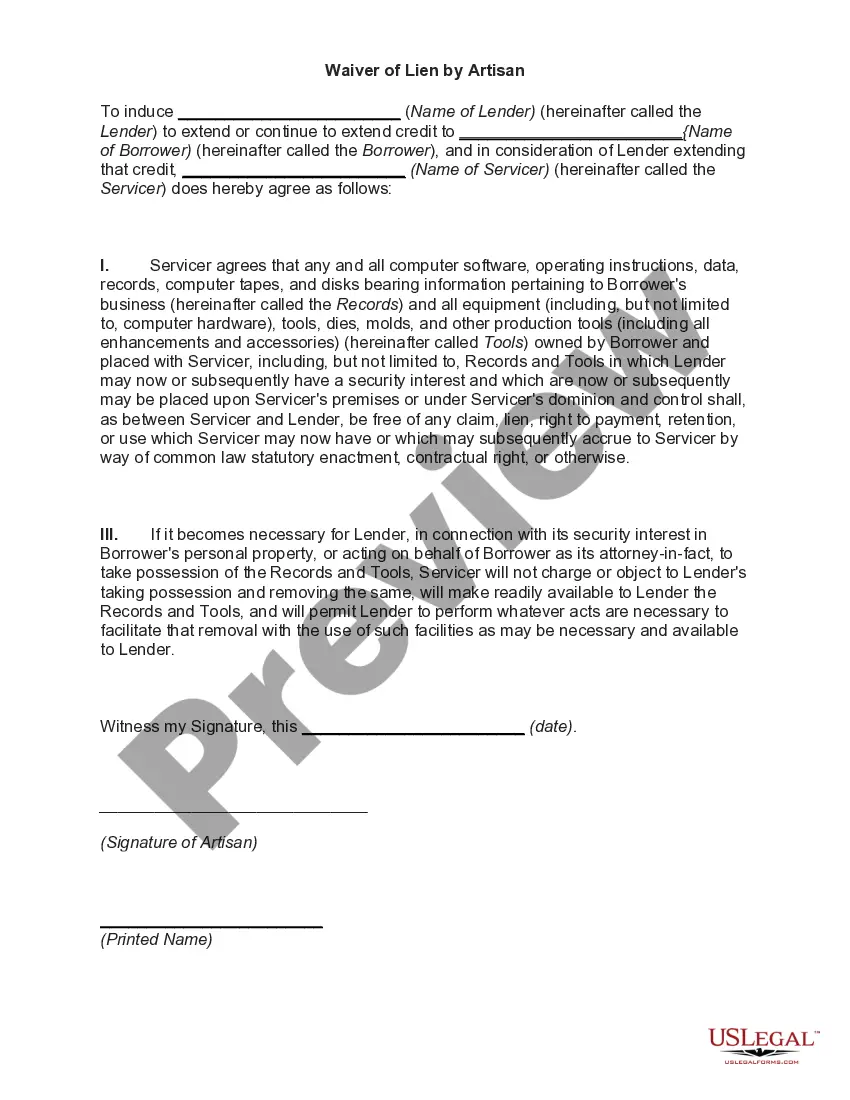
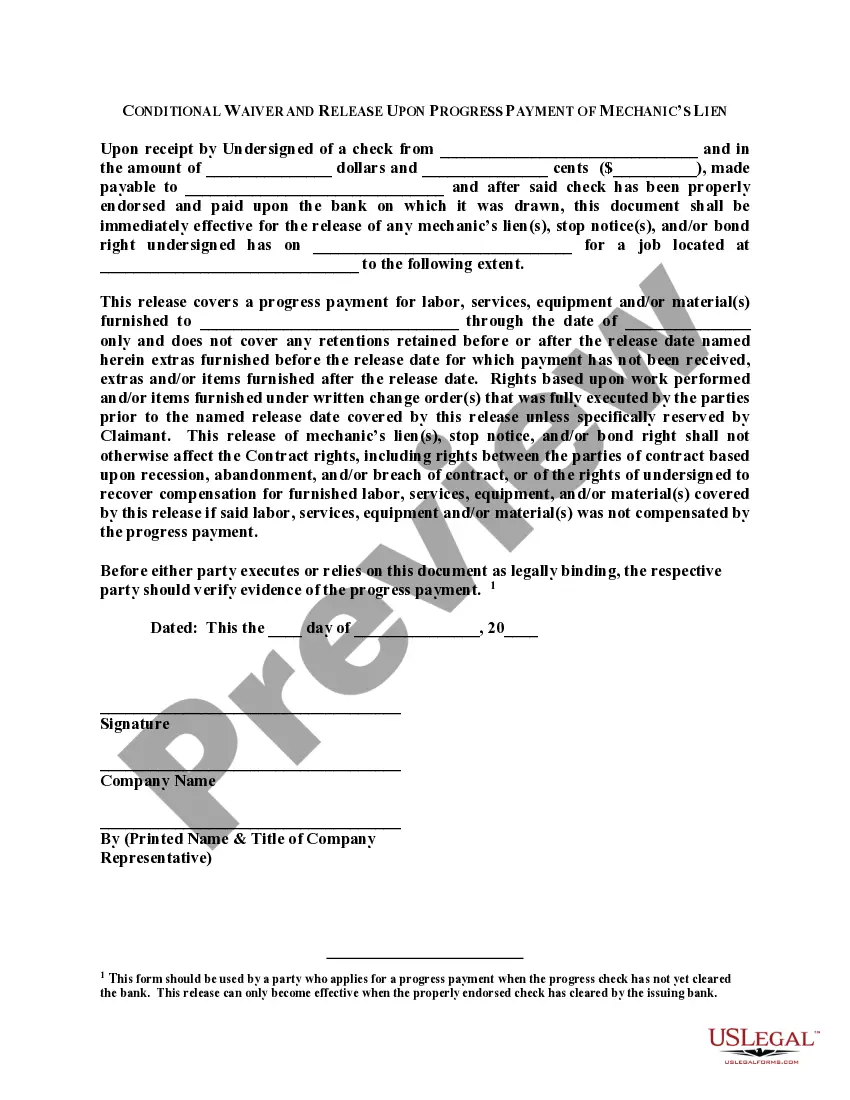
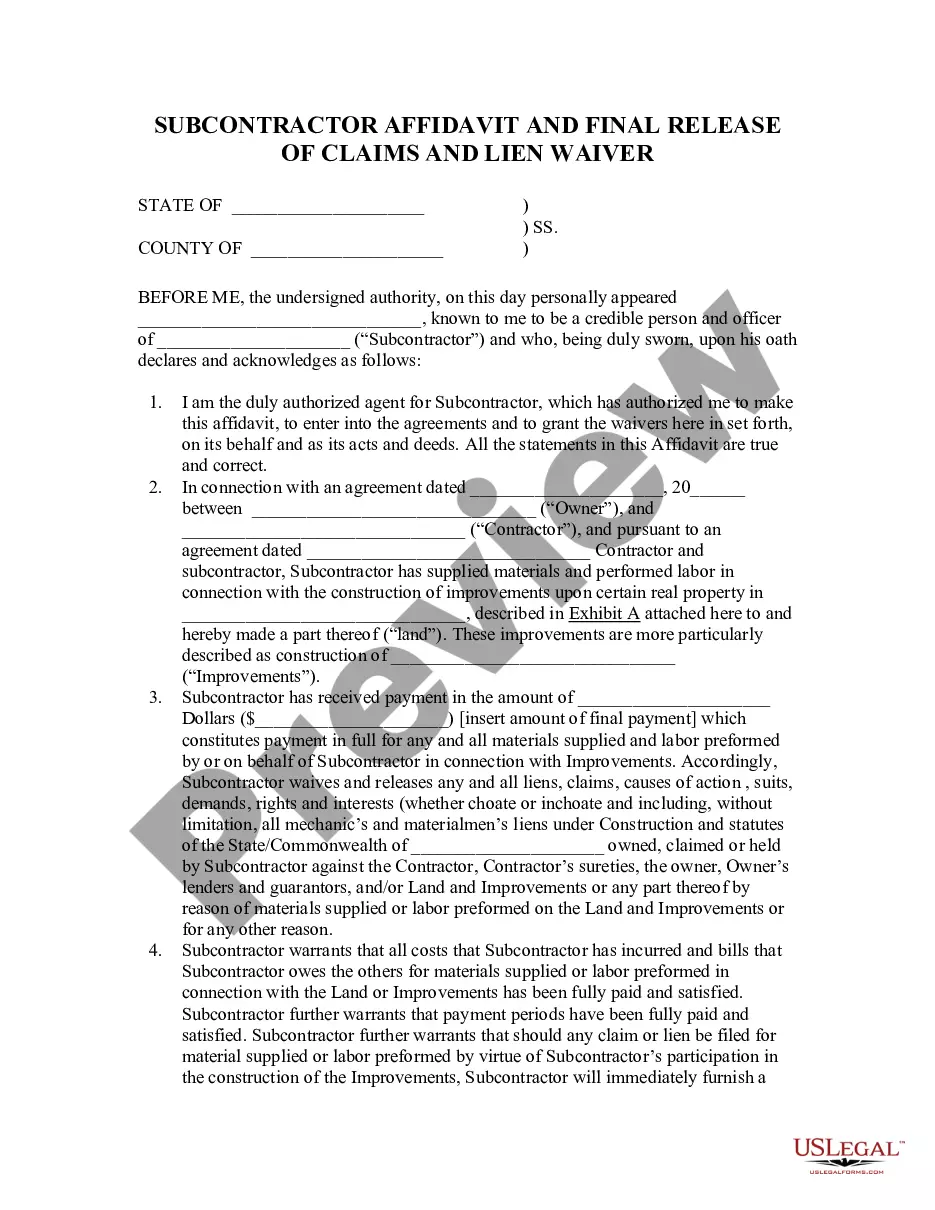
The Lien Statement for Subcontractor by Corporation or LLC is a legal document required in Kansas when subcontractors or suppliers wish to claim a lien against a property for unpaid labor or materials. Unlike the lien statement filed by contractors, this form specifically addresses the role of subcontractors or suppliers in the construction process. It serves to notify property owners of the claim, helping secure the subcontractor's right to payment for services rendered.
Key parts of this document
- Name and address of the subcontractor or supplier corporation.
- Description of the real property where labor or materials were provided.
- Name of the property owner.
- Details about the contractor associated with the provided labor or materials.
- Date of the last labor or materials furnished.
When to use this document
This form should be used when a subcontractor or supplier in Kansas has provided labor or materials for property improvement and has not received payment. It must be filed within three months following the last provision of labor or materials to legally establish a lien against the property. This action ensures that the subcontractor can claim compensation for the work done.
Who should use this form
- Subcontractors engaging in construction projects in Kansas.
- Suppliers providing materials to contractors for property improvements.
- Certain corporations or LLCs acting on behalf of subcontractors or suppliers.
Instructions for completing this form
- Identify the name and address of the corporation or LLC acting as the subcontractor or supplier.
- Specify the exact location and description of the property involved.
- Fill in the name of the property owner and the contractor associated with the work.
- Indicate the date when the last labor or materials were provided.
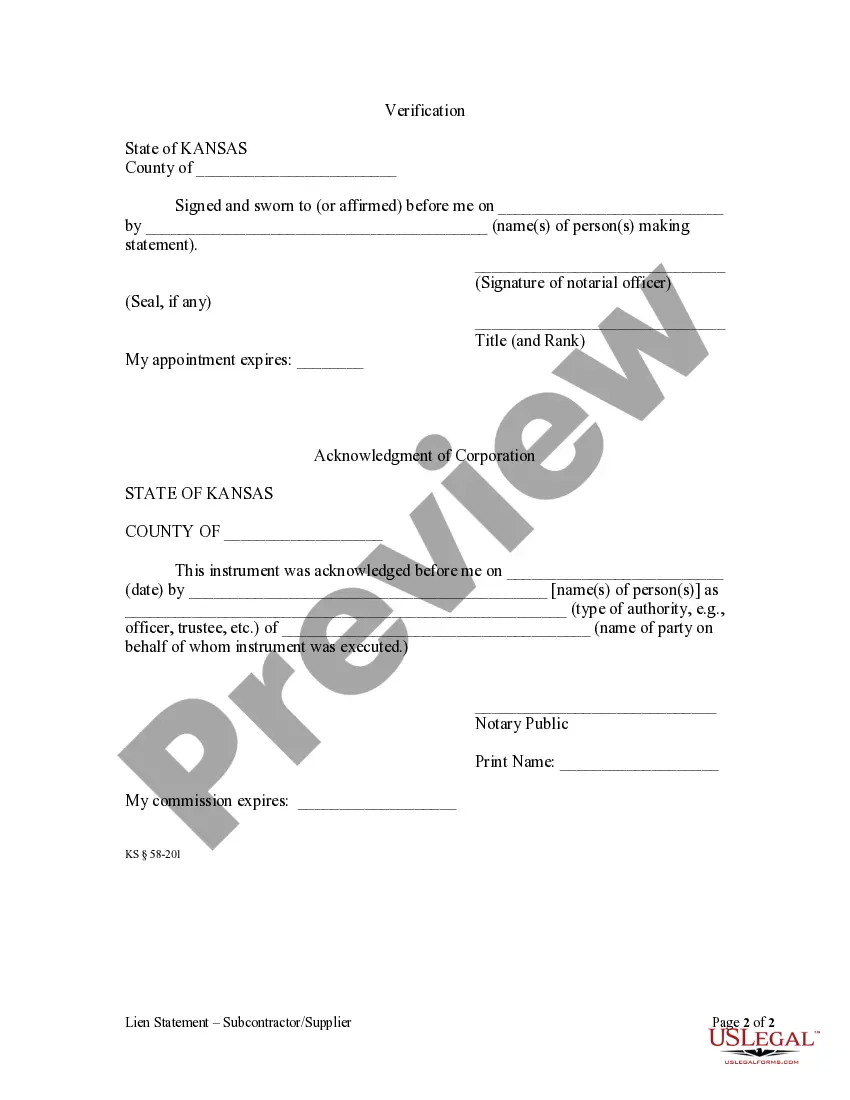
- Sign and date the form, ensuring the appropriate notarial acknowledgment is completed.
Is notarization required?
This document requires notarization to meet legal standards. US Legal Forms provides secure online notarization powered by Notarize, allowing you to complete the process through a verified video call, available 24/7.
Get your form ready online
Our built-in tools help you complete, sign, share, and store your documents in one place.
Make edits, fill in missing information, and update formatting in US Legal Forms—just like you would in MS Word.
Download a copy, print it, send it by email, or mail it via USPS—whatever works best for your next step.
Sign and collect signatures with our SignNow integration. Send to multiple recipients, set reminders, and more. Go Premium to unlock E-Sign.
If this form requires notarization, complete it online through a secure video call—no need to meet a notary in person or wait for an appointment.
We protect your documents and personal data by following strict security and privacy standards.

Make edits, fill in missing information, and update formatting in US Legal Forms—just like you would in MS Word.

Download a copy, print it, send it by email, or mail it via USPS—whatever works best for your next step.

Sign and collect signatures with our SignNow integration. Send to multiple recipients, set reminders, and more. Go Premium to unlock E-Sign.

If this form requires notarization, complete it online through a secure video call—no need to meet a notary in person or wait for an appointment.

We protect your documents and personal data by following strict security and privacy standards.
Avoid these common issues
- Failing to file the lien statement within the three-month deadline.
- Not serving the lien statement to the property owner correctly.
- Incomplete or incorrect property description.
- Missing signatures or proper notary acknowledgment.
Benefits of using this form online
- Convenience of filling out and downloading from any location.
- Editability of the document to ensure accuracy before submission.
- Access to reliable legal templates drafted by licensed attorneys.
- Quick and easy process that saves time compared to traditional methods.
Looking for another form?
Form popularity
FAQ
Legally, an unpaid contractor, subcontractor or supplier can file a lien (sometimes called a mechanic's lien) that could eventually force the sale of your home in place of compensation.Conversely, if the contractor who worked on your project does not pay for materials, a supplier could place a lien on your property.
In fact, the subcontractor doesn't have any contract with the owner neither written nor verbal!However, presuming that the subcontractor on the project has a written contract with someone, they can still file a lien even if they don't have a written agreement with the property owner.
A lien is essentially a claim for repayment of a debt. In the construction context, a lien is of considerable importance because it offers considerable power to a subcontractor to seek payment from an owner through the property itself for a debt owed to the subcontractor by a general contractor or other third party.
If a general contractor refuses to pay his subcontractors, they can make a claim against the payment bond. The surety company will pay out the subcontractors for at least part of their money and take the contractor to court.
The simplest way to prevent liens and ensure that subcontractors and suppliers are paid is to pay with joint checks. This is when both parties endorse the check. Compare the contractor's materials or labor bill to the schedule of payments in your contract and the Preliminary Notices.
Invalid Liens A lien stays in the county records and on your property title until you take action to remove it.If the contractor, subcontractor, laborer, or material supplier fails to follow any of the specific time frames, you can petition the court to remove the lien.
Prepare lien form, taking care to include the necessary information as set forth above, and sign the document with the verification statement. Send the original notarized copy to the office of the clerk of the district court of the county in which property is located.
Legally, an unpaid contractor, subcontractor or supplier can file a lien (sometimes called a mechanic's lien) that could eventually force the sale of your home in place of compensation.Conversely, if the contractor who worked on your project does not pay for materials, a supplier could place a lien on your property.