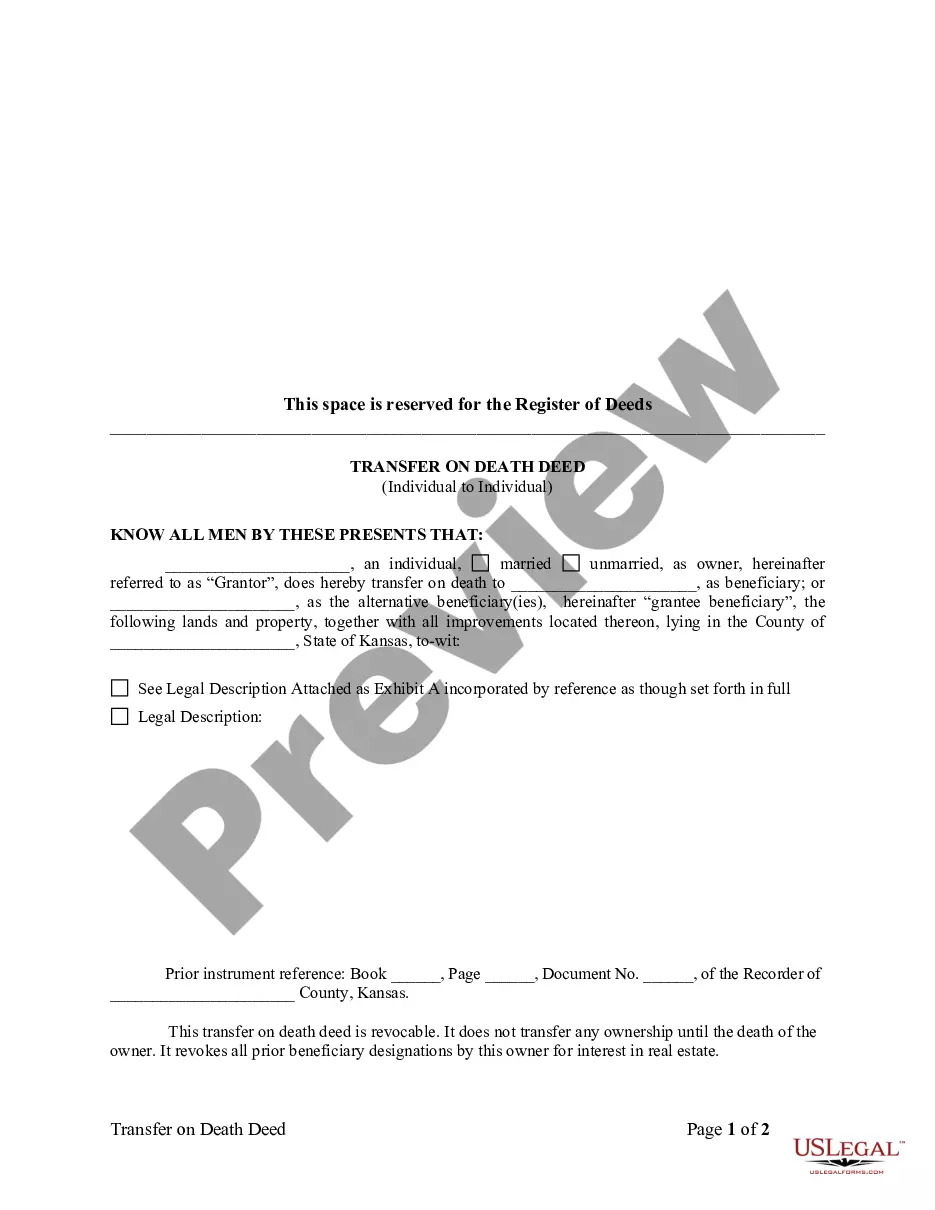
Kansas Transfer on Death Deed or TOD - Beneficiary Deed for Individual to Individual

Understanding this form
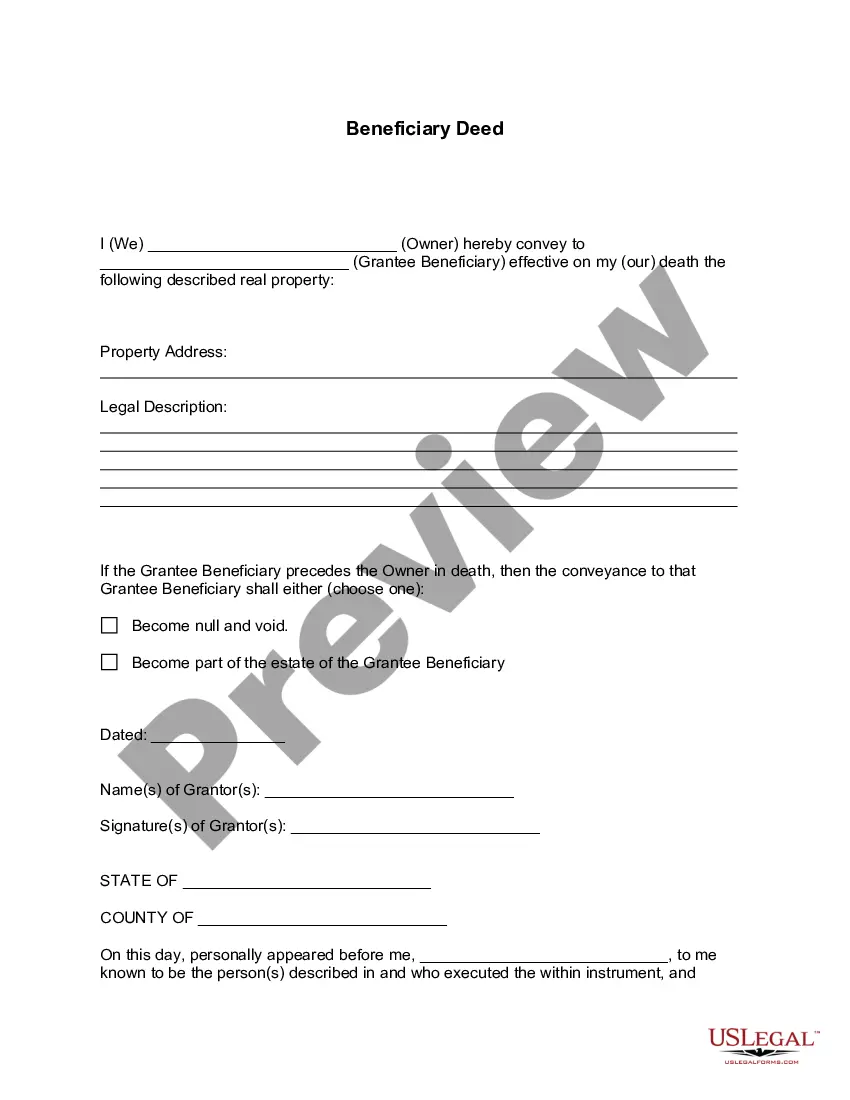
The Transfer on Death Deed (TOD) is a legal document used in Kansas to transfer ownership of real estate to a designated beneficiary upon the death of the property owner, known as the Grantor. This form allows for the seamless transfer of property without the need for probate, distinguishing it from other estate planning documents. By utilizing a TOD, the Grantor can retain control of the property during their lifetime while ensuring that specific individuals receive the property automatically after death.
Form components explained
- Grantor Information: The name and marital status of the individual transferring the property.
- Beneficiary Designation: The name(s) of the individual(s) who will receive the property upon the Grantor's death.
- Property Description: A detailed description of the real estate, including any relevant legal descriptions.
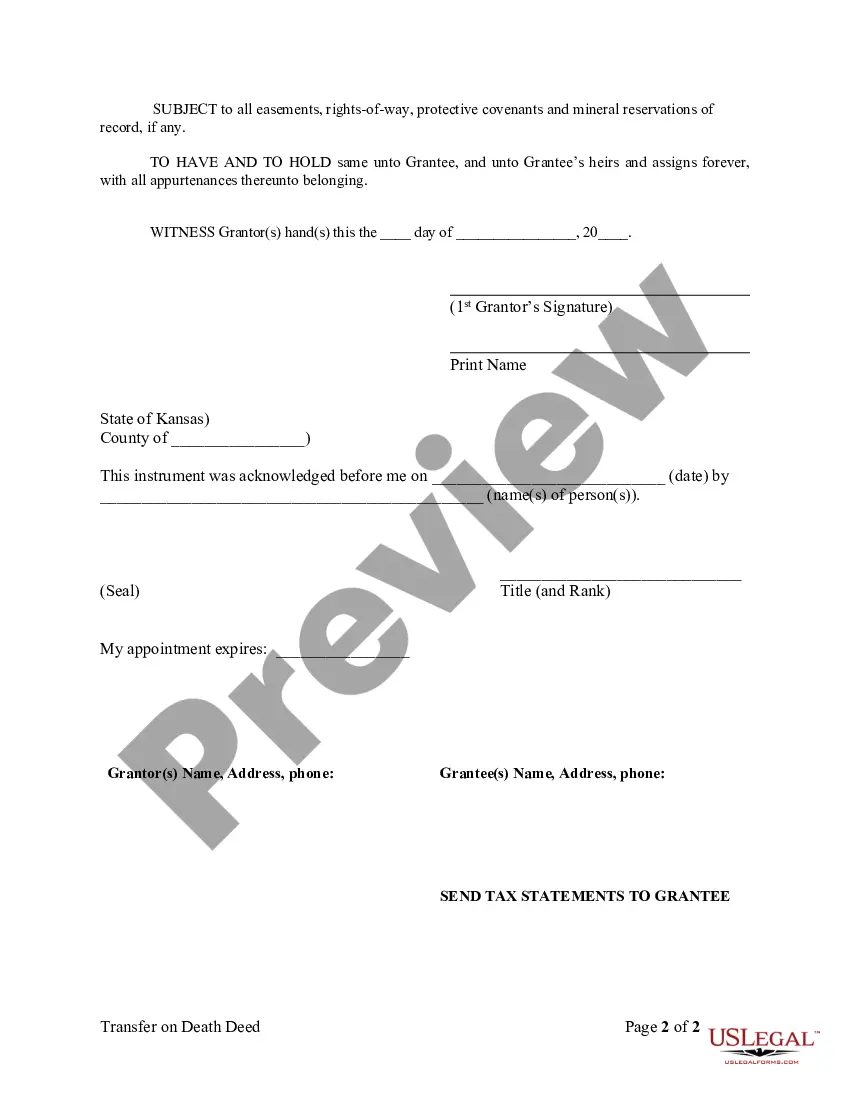
- Notary Requirements: A space for the signature of a Notary Public to validate the deed.
- Date of Execution: The date on which the deed is signed by the Grantor.




Situations where this form applies
This form is used when an individual wishes to transfer real property to a beneficiary upon their death. It is particularly useful for those managing their estate who want to bypass the lengthy probate process. Scenarios include transferring a family home to a child, designating a partner as a beneficiary, or ensuring that property remains within a family lineage without additional legal hurdles.
Intended users of this form
This form is suitable for:
- Property owners in Kansas who wish to designate a beneficiary for their real estate.
- Individuals looking to simplify the transfer of property after their death.
- Anyone who wants to avoid the probate process related to their property.
How to prepare this document
- Identify the Grantor: Fill in the name and marital status of the individual transferring the property.
- Specify the Beneficiary: Provide the name(s) of the beneficiary or alternative beneficiary.
- Describe the Property: Clearly indicate the details of the real estate being transferred.
- Sign Before a Notary: Have the Grantor sign the document in the presence of a Notary Public.
- Record the Deed: Submit the completed deed to the local Register of Deeds for official recording.
Notarization requirements for this form
This document requires notarization to meet legal standards. US Legal Forms provides secure online notarization powered by Notarize, allowing you to complete the process through a verified video call, available 24/7.
Get your form ready online
Our built-in tools help you complete, sign, share, and store your documents in one place.
Make edits, fill in missing information, and update formatting in US Legal Forms—just like you would in MS Word.
Download a copy, print it, send it by email, or mail it via USPS—whatever works best for your next step.
Sign and collect signatures with our SignNow integration. Send to multiple recipients, set reminders, and more. Go Premium to unlock E-Sign.
If this form requires notarization, complete it online through a secure video call—no need to meet a notary in person or wait for an appointment.
We protect your documents and personal data by following strict security and privacy standards.

Make edits, fill in missing information, and update formatting in US Legal Forms—just like you would in MS Word.

Download a copy, print it, send it by email, or mail it via USPS—whatever works best for your next step.

Sign and collect signatures with our SignNow integration. Send to multiple recipients, set reminders, and more. Go Premium to unlock E-Sign.

If this form requires notarization, complete it online through a secure video call—no need to meet a notary in person or wait for an appointment.

We protect your documents and personal data by following strict security and privacy standards.
Mistakes to watch out for
- Failing to have the deed notarized, leading to invalidity.
- Not properly describing the property, which can cause confusion later.
- Neglecting to record the deed with the local Register of Deeds.
- Improperly designating beneficiaries, which can lead to disputes.
Advantages of online completion
- Convenience of instant access: Download and complete the form from anywhere.
- Editability: Easily fill in the required information to ensure accuracy.
- Reliability: Forms drafted by licensed attorneys ensure legal compliance.
Looking for another form?

Form popularity
FAQ
A beneficiary form states who will directly inherit the asset at your death. Under a TOD arrangement, you keep full control of the asset during your lifetime and pay taxes on any income the asset generates as you own it outright. TOD arrangements require minimal paperwork to establish.
Receiving an inheritance can be an unexpected windfall. In fact, transfer on death accounts are exposed to all the same income and capital gains taxes when the account owner is alive, as well as estate and inheritance taxes upon the owner's death.
If you'd like to avoid having your property going through the probate process, it's a good idea to look into a transfer on death deed. A transfer on death deed allows you to select a beneficiary who will receive your property, but only when you've passed away.
A transfer on death deed (TOD) lets a property owner pass land or real estate to a designated beneficiary outside of the probate process. A transfer on death deed can be a helpful estate planning tool but it is not permitted in every state.
A TOD designation supersedes a will. For bank accounts, you can set up a similar account known as payable-on-death, sometimes referred to as a Totten trust. Your beneficiaries can't touch the account while you're alive, and you're free to change beneficiaries or close the accounts at any time.
A TOD designation supersedes a will. For bank accounts, you can set up a similar account known as payable-on-death, sometimes referred to as a Totten trust. Your beneficiaries can't touch the account while you're alive, and you're free to change beneficiaries or close the accounts at any time.
If you'd like to avoid having your property going through the probate process, it's a good idea to look into a transfer on death deed. A transfer on death deed allows you to select a beneficiary who will receive your property, but only when you've passed away.
A transfer on death (TOD) account automatically transfers its assets to a named beneficiary when the holder dies For example, if you have a savings account with $100,000 in it and name your son as its beneficiary, that account would transfer to him upon your death.
Transfer on death applies to certain assets that have a named beneficiary. The beneficiaries (or a spouse) receive the assets without having to go through probate. Beneficiaries of the TOD don't have access to the assets prior to the owner's death.