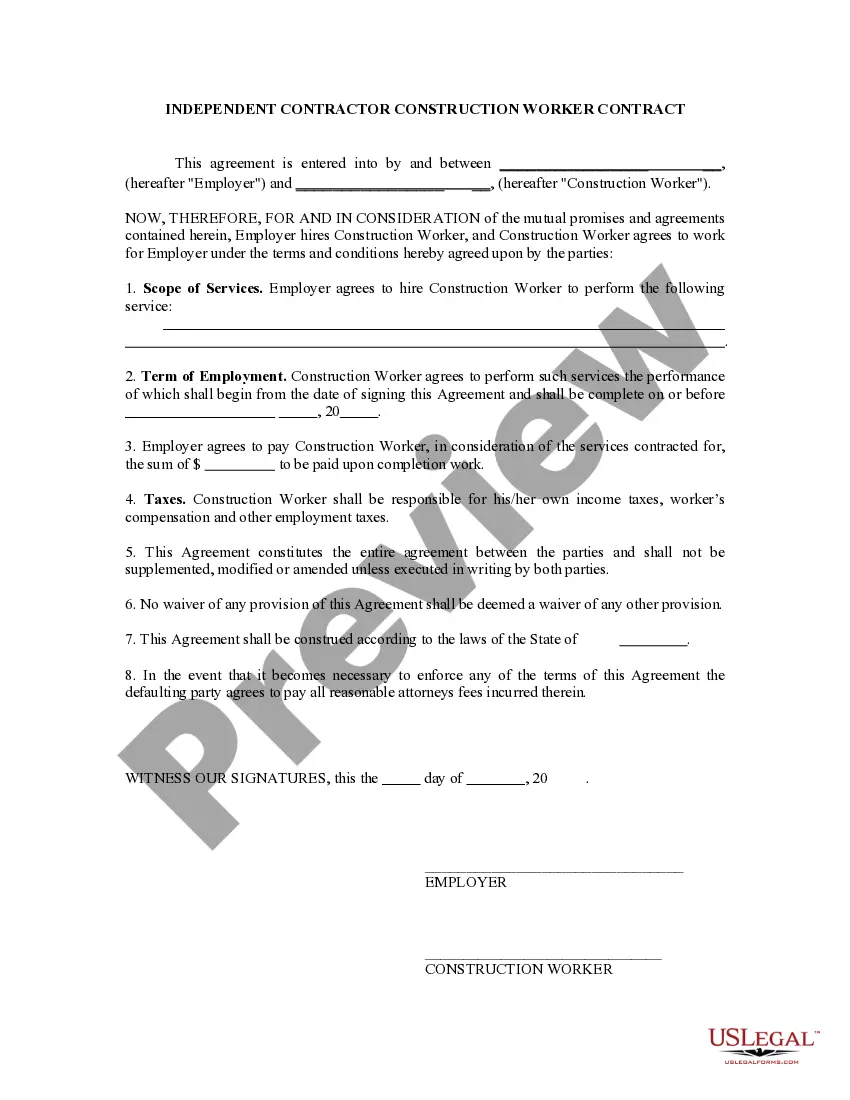
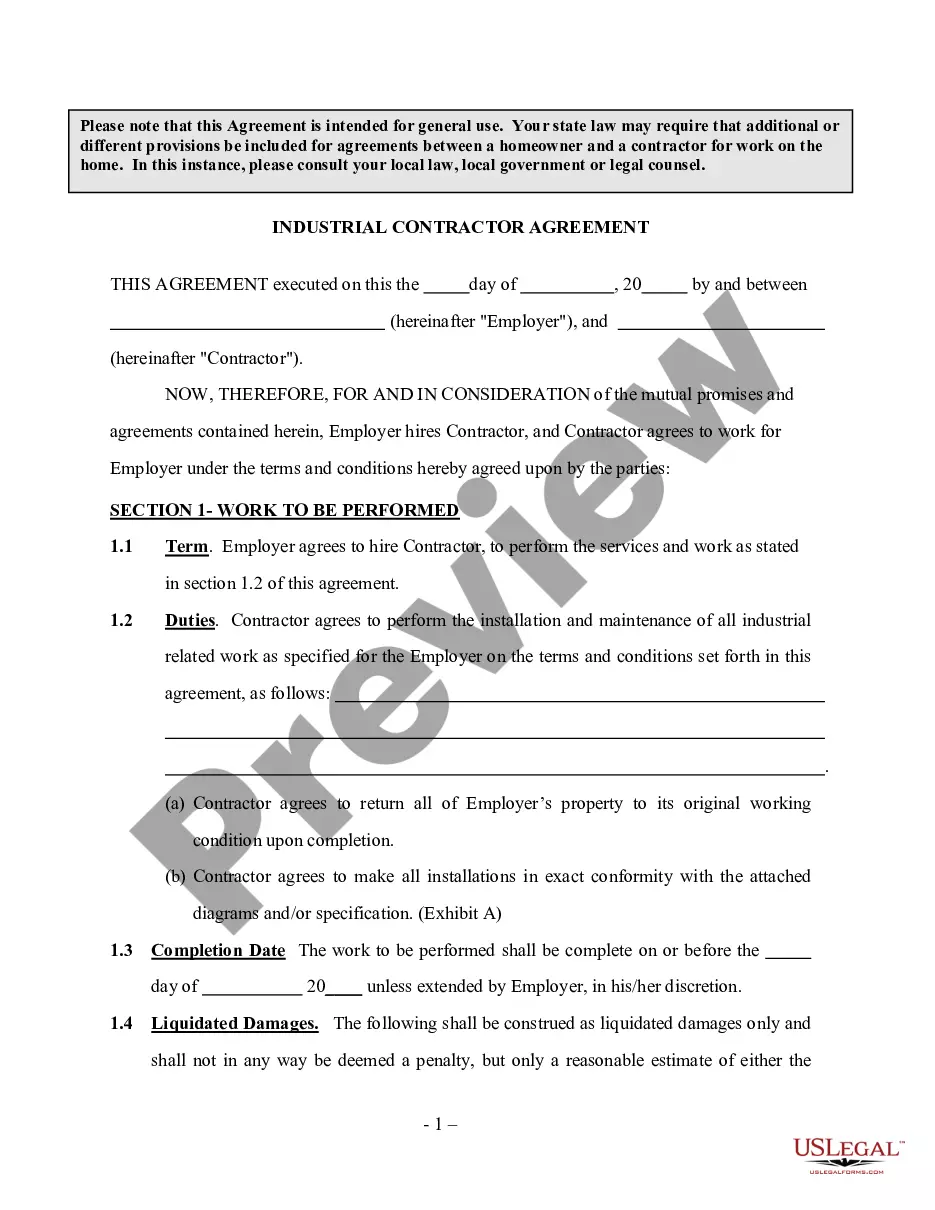
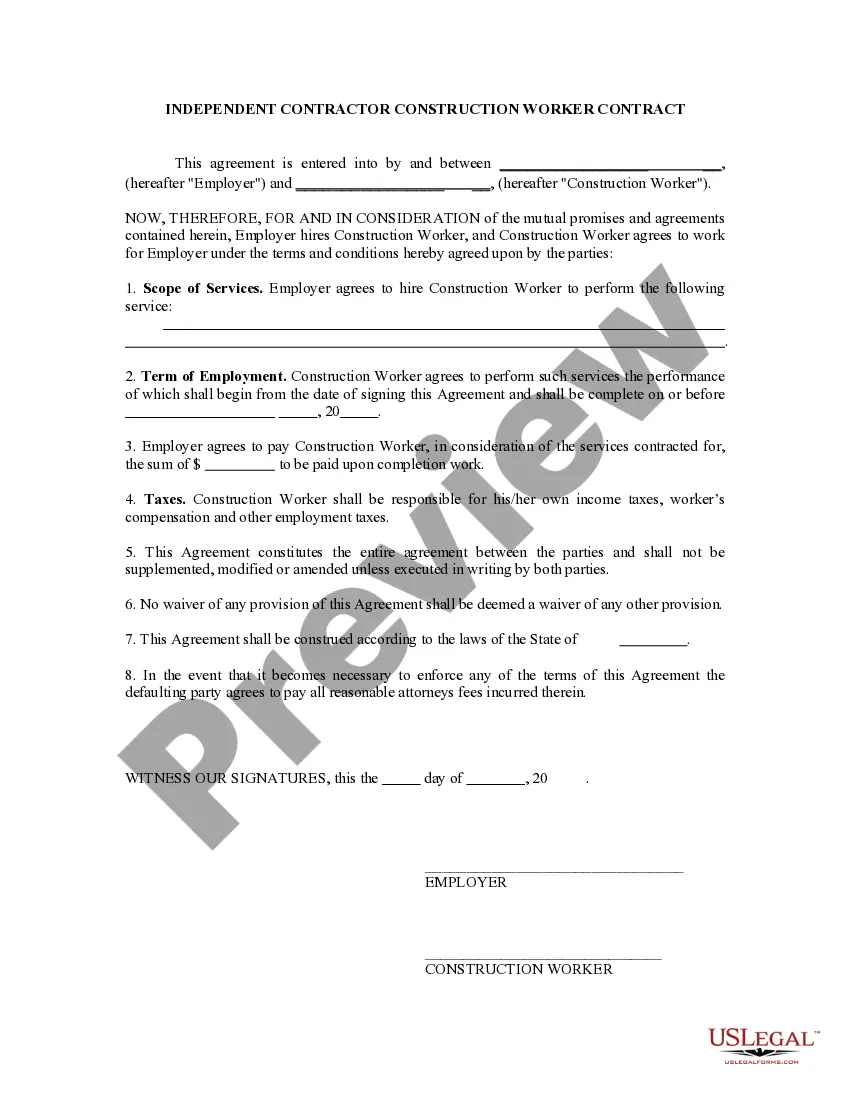
Employer hires a construction worker as an independent contractor to provide various construction help as specified in the Agreement.
Indiana Self-Employed Independent Contractor Construction Worker Contract
State:
Multi-State
Control #:
US-INDC-178
Format:
Word;
Rich Text
Instant download
Description
Get your form ready online
Our built-in tools help you complete, sign, share, and store your documents in one place.
Built-in online Word editor
Make edits, fill in missing information, and update formatting in US Legal Forms—just like you would in MS Word.
Export easily
Download a copy, print it, send it by email, or mail it via USPS—whatever works best for your next step.
E-sign your document
Sign and collect signatures with our SignNow integration. Send to multiple recipients, set reminders, and more. Go Premium to unlock E-Sign.
Notarize online 24/7
If this form requires notarization, complete it online through a secure video call—no need to meet a notary in person or wait for an appointment.
Store your document securely
We protect your documents and personal data by following strict security and privacy standards.

Make edits, fill in missing information, and update formatting in US Legal Forms—just like you would in MS Word.

Download a copy, print it, send it by email, or mail it via USPS—whatever works best for your next step.

Sign and collect signatures with our SignNow integration. Send to multiple recipients, set reminders, and more. Go Premium to unlock E-Sign.

If this form requires notarization, complete it online through a secure video call—no need to meet a notary in person or wait for an appointment.

We protect your documents and personal data by following strict security and privacy standards.
Looking for another form?




How to fill out Self-Employed Independent Contractor Construction Worker Contract?
You might spend numerous hours online searching for the authentic document template that meets the federal and state requirements you need.
US Legal Forms offers a multitude of authentic documents that have been reviewed by specialists.
You can easily download or print the Indiana Self-Employed Independent Contractor Construction Worker Contract from our service.
If available, utilize the Review option to browse through the document template as well.
- If you already possess a US Legal Forms account, you can sign in and click the Download button.
- After that, you can complete, modify, print, or sign the Indiana Self-Employed Independent Contractor Construction Worker Contract.
- Every authentic document template you purchase is yours permanently.
- To acquire another copy of any purchased form, navigate to the My documents section and select the relevant option.
- If you are using the US Legal Forms website for the first time, follow the simple instructions below.
- First, ensure that you have selected the correct document template for the state/city of your choice.
- Review the form description to confirm that you have chosen the right form.
Form popularity
FAQ
Absolutely, you can 1099 a construction worker if they fall under the independent contractor category. Make sure that you keep accurate records of payments, as you will need this information at tax time. Issuing a 1099 form gives both you and the contractor proof of earnings. Using tools and resources from US Legal can help streamline this process.
Yes, having a contract as an Indiana self-employed independent contractor construction worker is essential. A contract helps outline the relationship between you and your client, detailing services, payment, and timelines. It serves as legal protection in case of disputes. Therefore, always prioritize having a written agreement.
To write a contract as an Indiana self-employed independent contractor construction worker, start by clearly defining the scope of work. Include essential elements like payment terms, deadlines, and responsibilities. Consider using a template from US Legal to ensure you cover all necessary legal aspects. A well-drafted contract protects your interests and clarifies expectations.
As an independent contractor in Indiana, you need to complete various documents to formalize your business relationship. This typically includes an independent contractor agreement, a W-9 form to provide your taxpayer information, and possibly a local business license application. Utilizing the resources available at UsLegalForms can help you gather and complete all necessary paperwork efficiently under the Indiana Self-Employed Independent Contractor Construction Worker Contract.
Filling out an independent contractor agreement involves several key steps. Start by clearly defining the scope of work, payment terms, and deadlines. Ensure you include essential details such as both parties' information, the project description, and specific responsibilities. Using the Indiana Self-Employed Independent Contractor Construction Worker Contract template from UsLegalForms can simplify the process and ensure you meet all required standards.
In Indiana, independent contractors generally do not need workers' compensation insurance, as this coverage is typically designed for employers to protect their employees. However, if you're a self-employed independent contractor in construction, it's wise to consider obtaining coverage for yourself. This can offer financial protection against workplace injuries. Always check current regulations and consult with a legal expert to determine your specific needs under the Indiana Self-Employed Independent Contractor Construction Worker Contract.
Many construction workers operate as self-employed individuals, but this can vary based on their employment arrangement. If they work directly for clients and manage their contracts, they are likely classified as self-employed. However, those working under a construction company may be considered employees instead. Understanding this distinction is vital for creating an Indiana Self-Employed Independent Contractor Construction Worker Contract tailored to your situation.
In Indiana, independent contractors generally do not need a business license to operate. However, certain professions, including construction workers, may require specific licenses or permits. It's essential to research the requirements for your trade to confirm compliance. Utilizing resources like US Legal Forms can provide guidance on necessary paperwork and help you stay informed about state regulations.
Creating an Indiana Self-Employed Independent Contractor Construction Worker Contract involves several key steps. Start by defining the scope of work, including project details and timelines. Next, outline payment terms, including rates and due dates. You can use platforms like US Legal Forms to find templates that simplify this process and ensure compliance with Indiana laws.